The Market Is Repricing Risk, Not Necessarily the Future
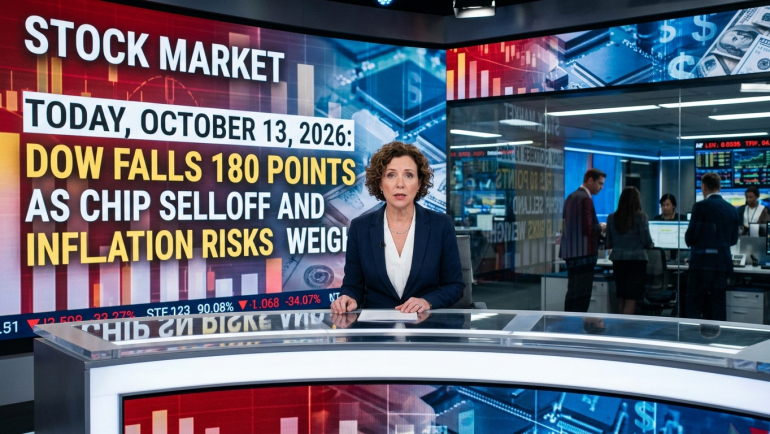
Wall Street’s latest retreat is about more than artificial intelligence. A resurgent dollar, renewed expectations for Federal Reserve tightening and a succession of technology disruptions have forced a broader reassessment of what growth should cost and how reliably the financial system should function. Bloomberg’s market coverage has tracked the technology-led decline, while its currency reporting has linked the dollar’s advance to rising expectations for another rate increase. The constructive interpretation is not that these pressures are imaginary. It is that a market becoming more selective can create a healthier foundation for its next advance. For many, the opportunity is shifting from buying an expansive narrative to identifying businesses that can finance themselves, protect margins and deliver dependable service. That is a less glamorous exercise than chasing the latest technological superlative. It also tends to involve fewer unpleasant surprises in the footnotes. Today’s earnings from NVIDIA (NASDAQ: NVDA), expected after the closing bell on November 17, provide an important test of AI demand. But the larger story is macroeconomic: whether durable corporate earnings can withstand tighter financial conditions while policymakers strengthen the machinery beneath the markets.
The Dollar Has Changed the Conversation
The market’s comfortable assumptions are colliding with a less accommodating currency backdrop. Bloomberg reported that the dollar gained 0.7% during the week ended November 13, its strongest weekly performance since early October, as expectations increased that the Fed would raise rates in December. Its dollar gauge reached its highest level since May 2025 during that session. That matters because a stronger dollar complicates several popular trades simultaneously. For U.S. multinationals, foreign-currency earnings translate into fewer dollars, all else equal. For borrowers with dollar-denominated obligations but revenues in other currencies, servicing those obligations becomes more demanding. And for strategies premised on a steadily weakening U.S. currency, dollar strength challenges the original premise. The bullish response is not to declare that a rising dollar benefits everyone. It plainly does not. It is to recognize that currency pressure can expose the difference between a company with genuine operating strength and one whose appeal depended heavily on accommodating financial conditions. The market may be less generous with valuation multiples. Businesses can still compete through earnings, productivity and execution. In other words, the dollar has become a demanding dinner guest. Companies with strong balance sheets are better positioned to pick up the check.
The Debasement Trade Is Not a Substitute for Business Analysis
The appeal of the “debasement trade” is its simplicity: persistent fiscal concerns and currency weakness should favor scarce assets over paper money. Its vulnerability is the same simplicity. Currency markets also respond to interest-rate expectations and relative monetary conditions. The dollar’s recent advance, which Bloomberg linked to expectations for Fed tightening, demonstrates why a long-term fiscal argument does not dictate a currency’s short-term direction. For many, that distinction strengthens the case for focusing on productive assets rather than relying exclusively on a macro hedge. A profitable business can adjust prices, improve efficiency, win customers and reinvest cash. None of those capabilities guarantees a rising share price, especially when discount rates increase. But they offer more avenues for creating value than waiting for a single currency forecast to prove correct. The positive market story, therefore, is not necessarily the return of indiscriminate risk-taking. It is the prospect of a more discriminating market that rewards financial resilience.
Technology Outages Are a Reliability Problem, Not Automatically a Banking Crisis
Recent disruptions have added another source of unease: the realization that an increasingly digital economy remains vulnerable to decidedly unglamorous software problems. Bloomberg reported that JPMorgan Chase (NYSE: JPM) resolved a technical issue that delayed some customer transactions on November 16. The bank attributed the disruption to a software bug in on-premise hardware systems, said customers retained access to accounts and funds, and stated that the issue was not related to cybersecurity. Separately, Bloomberg reported that the recent sequence of disruptions began with a bug affecting Microsoft’s (NASDAQ: MSFT) productivity software. These distinctions matter. A processing delay is not the same as a capital shortfall. A software failure is not, without supporting evidence, a cyberattack. Treating every interruption as the opening scene of a financial crisis does little to improve the analysis. The constructive implication is that operational resilience deserves greater attention alongside computing capacity. More digital activity increases the importance of redundancy, recovery procedures, software testing and dependable infrastructure. That is a potential business opportunity, not proof of an immediate spending boom. Providers still need to demonstrate that their products prevent failures, shorten recovery times or reduce operating costs. The economy does not merely need more intelligence in its machines. It needs the machines to remain available during business hours.
The Fed Is Discussing Market Plumbing, Not Promising a Rescue Rally
Cleveland Federal Reserve President Beth Hammack’s November 17 remarks address a central macroeconomic issue: how to prepare for Treasury-market dysfunction before a stressful episode arrives.Hammack argued that policymakers should establish principles for potential intervention during calm periods. She emphasized that the Treasury market supports borrowing costs, collateral arrangements and the transmission of monetary policy throughout the economy. Her approach was deliberately restrained. Intervention should face a high bar, address dysfunction that threatens the real economy and remain temporary and targeted. She supported improvements to standing repo operations and said Treasury purchases could be considered if financing operations proved insufficient. For markets, that is constructive because preparation can reduce the risk that a liquidity disruption becomes a larger economic problem. It is not a promise to defend stock prices. Hammack explicitly separated market-functioning operations from monetary-policy accommodation. A central bank can support orderly Treasury trading while maintaining a restrictive stance against inflation. That distinction is essential to the bullish case. A more resilient financial system can help sound businesses obtain financing and price risk without requiring the Fed to make every investment inexpensive. A functioning fire department is reassuring. It is not an argument for removing the smoke detectors.
Higher Rates Are Raising the Standard for Corporate Growth
The policy backdrop remains demanding. In November 5 remarks, Hammack said she expected monetary policy would need to move to a restrictive stance to return inflation to 2% in a timely manner. Her comments also emphasized the importance of effective capital markets, the rule of law and central-bank independence to the dollar’s international role. Meanwhile, Bloomberg reported that the Fed’s November financial-stability assessment flagged elevated asset valuations, enthusiasm surrounding AI and concerns about corporate capital spending and debt issuance. Taken together, those developments suggest a market increasingly focused on how expansion is financed, not simply how ambitious it sounds. That is particularly relevant to AI infrastructure, where substantial commitments can precede the revenue needed to justify them. NVIDIA’s latest quarterly filing, for example, reported $279 billion in supply and capacity commitments as of July 26. Those are obligations supporting future production, not a customer-order backlog. The constructive conclusion is that greater scrutiny can improve capital allocation. Projects with credible customers, financing and economic returns should be easier to distinguish from projects relying primarily on enthusiasm. Not every proposal deserves funding. A market remembering that principle is not necessarily losing its way.
NVIDIA’s Earnings Tonight Are a Checkpoint, Not the Entire Map
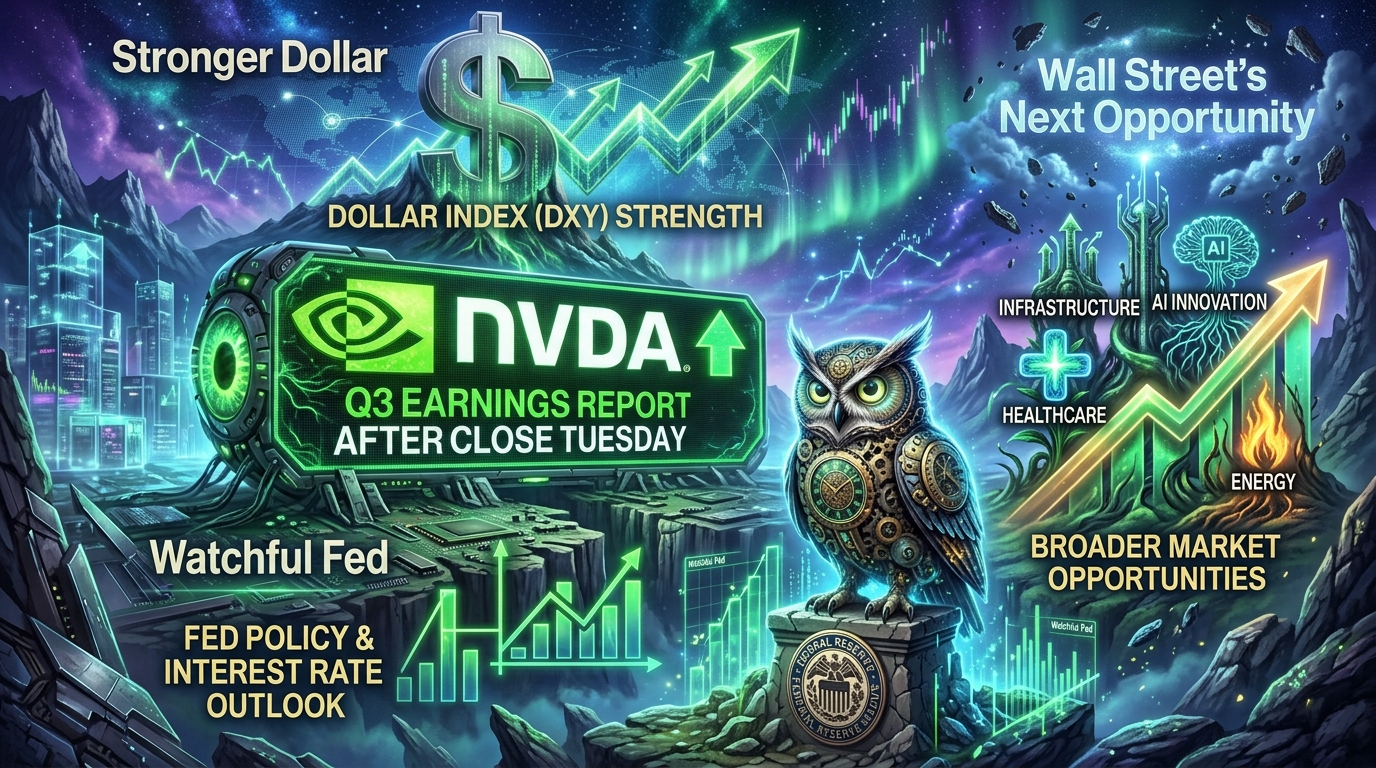
NVIDIA remains a consequential part of this broader story because its results offer a direct reading on AI infrastructure spending. The company is expected to report after today’s market close, making the announcement a forward-looking catalyst rather than an earnings result already available at midday. Its previously issued third-quarter fiscal 2027 guidance called for revenue of $108 billion, plus or minus 2%, with no assumed Data Center compute revenue from China. It projected GAAP and non-GAAP gross margins of 74%, plus or minus half a percentage point. Those figures are management guidance, not reported quarterly results. The macroeconomic questions extend beyond whether revenue clears a headline threshold:
- Does demand remain strong enough to support continued infrastructure expansion?
- Are margins holding up through product transitions?
- Is cash generation keeping pace with sales?
- What does management say about customer financing, deployment timing and supply commitments?
NVIDIA’s preceding quarter provides a substantial starting point: revenue of $96.2 billion, Data Center revenue of $89 billion and operating income of approximately $63.7 billion. Those results demonstrate the scale of the business, although they do not settle questions about future growth or valuation. Tonight’s report can help distinguish a repricing of AI expectations from a more fundamental deterioration in demand. It cannot, by itself, resolve the dollar, inflation or interest-rate outlook.
The Management Situation Adds a Separate Test
NVIDIA’s leadership transition makes the earnings discussion more consequential. According to its SEC filing, the board accepted Jensen Huang’s resignation as president, chief executive and director on November 11. It appointed longtime chief financial officer Colette Kress as interim chief executive while conducting a successor search. Kress continues as CFO, and longtime director Harvey Jones became board chair. That arrangement provides institutional continuity, but it does not eliminate succession risk. For many, the most useful evidence will come from operating execution: product delivery, customer relationships, financial discipline and a clearly communicated governance process. Speculation about a possible return by a former executive should not substitute for those measures.The management situation and the macro backdrop are related through market confidence, but they remain separate analytical questions. A leadership transition can complicate one company’s outlook without invalidating the entire AI economy. Equally, strong company results cannot make restrictive financial conditions disappear.
The Bullish Case Is Becoming More Selective, and More Credible
The encouraging possibility beneath this selloff is that the market is moving toward a sturdier set of priorities. A stronger dollar is testing currency assumptions. Technology disruptions are exposing the value of reliability. The Fed is discussing how to preserve market functioning without abandoning inflation discipline. Corporate earnings are being asked to justify the capital committed to growth. None of that guarantees an immediate rebound. It does, however, create a coherent positive framework: dependable infrastructure, sound financing and durable cash generation can become more valuable when easy assumptions stop doing the work. For many, the next opportunity may emerge not from predicting a perfectly timed Fed pivot, but from recognizing which businesses can keep producing through an imperfect economic environment. Wall Street may be putting enthusiasm on a tighter budget. Businesses that can earn their own way need not consider that bad news.
The Sources
- Bloomberg: Stock Market Today, November 17, 2026
- Bloomberg: Dollar Wraps Best Week in Over a Month on Fed Rate-Hike Bets
- Bloomberg: JPMorgan Resolves Technical Issue Affecting Customers
- Bloomberg: Trump Downplays JPMorgan and Microsoft Outages
- Federal Reserve Bank of Cleveland: Beth Hammack, “Lessons from a Burning River,” November 17, 2026
- Federal Reserve Bank of Cleveland: Hammack on the Dollar, Capital Markets and Monetary Policy, November 5, 2026
- Bloomberg: Fed Sees Risks Tied to Elevated Asset Prices Partly Driven by AI
- SEC.gov: NVIDIA Form 10-Q for the Quarter Ended July 26, 2026
- NVIDIA: Second-Quarter Fiscal 2027 Results, Financial Statements and Third-Quarter Outlook
- SEC.gov: NVIDIA Second-Quarter Fiscal 2027 Financial Results
- SEC.gov: NVIDIA Form 8-K Reporting the November 11, 2026 Leadership Transition
Stay Updated with Vista Partners
Subscribe to receive market insights, investing ideas, and the latest updates directly in your inbox.