The Next AI Opportunity Is Bigger Than the Chat Window
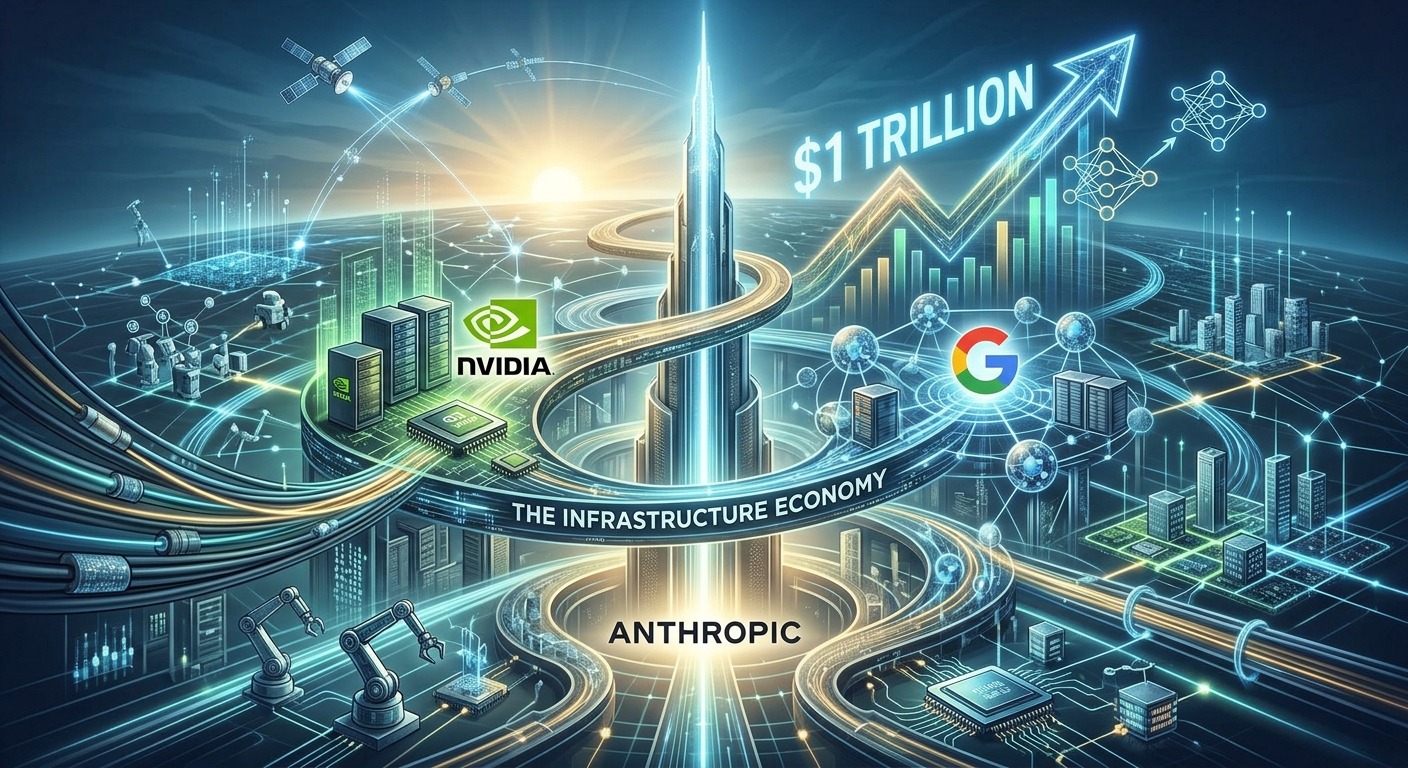
Anthropic’s extraordinary infrastructure commitments are bringing the next phase of artificial intelligence into sharper focus: a multiyear expansion of computing capacity that could reward chipmakers, cloud platforms and businesses turning advanced models into practical services. The maker of Claude filed its IPO registration statement on October 26, 2026. According to Forbes’ examination of the prospectus, its chip and data-center obligations, together with additional agreements and anticipated capacity purchases, could approach $1 trillion through 2045. That is not a trillion-dollar check being written today. It is a long-duration commitment to the machinery behind an increasingly ambitious AI business. For many, the attraction is the breadth of that opportunity. NVIDIA (NASDAQ: NVDA), Google parent Alphabet (NASDAQ: GOOGL, GOOG), Amazon (NASDAQ: AMZN), Microsoft (NASDAQ: MSFT), Broadcom (NASDAQ: AVGO) and Advanced Micro Devices (NASDAQ: AMD) occupy different positions in the supply chain Anthropic is assembling. The company’s expansion offers a particularly large case study in how demand for AI software can translate into demand for physical infrastructure. Silicon Valley once aspired to put the world in the cloud. It now appears determined to give the cloud a rather substantial electricity bill.
What Anthropic’s $1 Trillion Spending Framework Actually Means
The headline figure deserves careful unpacking. Forbes reports that Anthropic had approximately $587 billion in chip and data-center commitments through 2045 as of June, followed by another $266 billion in new and amended agreements over the subsequent four months. The publication also identifies more than $20 billion in expected AMD computing capacity and a further $125 billion to $150 billion for additional Google-designed chips. Together, those categories underpin the roughly $1 trillion estimate. They should not be confused with current expenditure, a single annual budget or revenue already earned by suppliers. The commercial relationships are formidable. Forbes identifies:
- A $161 billion agreement with Broadcom for chips and infrastructure.
- A $114.5 billion cloud-computing and chip agreement with Google.
- A $110 billion cloud-computing agreement with Amazon.
- A $45 billion commitment to Microsoft for computing capacity and access to NVIDIA systems.
These arrangements run across different periods and carry different terms. Their importance lies less in the temptation to add every headline together than in the evidence that Anthropic is securing multiple routes to large-scale computing. The bullish interpretation is straightforward: AI infrastructure is becoming a strategic resource to reserve years in advance, rather than an incidental operating expense.
Revenue Growth Gives the Buildout a Commercial Foundation
A spending plan becomes more compelling when customers are helping to explain it. According to Forbes’ prospectus analysis, Anthropic generated $16.3 billion in revenue during the first half of 2026, up approximately 1,300% year over year. Computing and infrastructure expenses increased by 283% over the same period. From January 2023 through June 2026, cumulative revenue reached approximately $21.3 billion, compared with $19.2 billion spent on computing and infrastructure.Those figures do not establish profitability. Computing costs are not the company’s entire expense base. They do, however, support an encouraging observation : during the reported first-half period, revenue expanded considerably faster than the infrastructure expense category highlighted by Forbes. Approximately 80% of first-half revenue came from consumption-based customers, with the balance coming from subscriptions. That makes usage central to the business model. More activity can produce more revenue, but customers can also moderate spending more readily than a long-term infrastructure contract can be unwound The opportunity, therefore, rests on utilization: converting available computing capacity into services customers repeatedly find worth paying for. Anthropic’s capacity announcements make that connection explicit. Its April expansion with Amazon was intended to support training and deployment of Claude, while its May agreement for additional NVIDIA GPU capacity accompanied higher product usage limits. The infrastructure is being presented as a means to serve demand, not merely as an impressive collection of equipment.
NVIDIA Can Participate Across Several Routes to AI Demand
NVIDIA’s position is especially interesting because Anthropic does not have to choose one exclusive computing architecture for NVIDIA to benefit. Anthropic says it trains and runs Claude across Amazon’s Trainium processors, Google’s tensor processing units, or TPUs, and NVIDIA GPUs. Its stated strategy is to match workloads with the hardware best suited to them. That diversification introduces competition, but it also demonstrates how large the computing requirement has become. Multiple platforms can participate in the same company’s expansion. In November 2025, NVIDIA, Microsoft and Anthropic announced a strategic partnership under which Anthropic committed to purchase $30 billion of Azure computing capacity and contract additional capacity of up to one gigawatt. The announcement also established engineering collaboration intended to improve Anthropic model performance and efficiency on NVIDIA hardware. The subsequently reported $45 billion Microsoft commitment represents a later figure, not an additional $45 billion to be casually stacked on top of the earlier announcementAnthropic added another NVIDIA-related route in May 2026, announcing access to more than 300 megawatts of capacity, comprising more than 220,000 NVIDIA GPUs, through a SpaceX computing agreement. For many following NVIDIA, the appeal is this diversity of delivery channels. Its systems can support AI demand through cloud platforms and other computing operators, rather than relying on a single purchasing path. The chatbot may receive the applause. The processors remain indispensable members of the orchestra.
Google and Broadcom Give Custom Silicon a Larger Stage
Google’s role illustrates why the AI infrastructure story extends beyond GPUs. In October 2025, Anthropic announced plans to expand its use of Google Cloud technologies to include up to one million TPUs. The arrangement was described as worth tens of billions of dollars and expected to bring well over one gigawatt of capacity online in 2026. In April 2026, Anthropic announced a further agreement with Google and Broadcom for multiple gigawatts of next-generation TPU capacity, expected to begin coming online in 2027. Most of that new computing capacity was to be located in the United States. For Alphabet, the relationship demonstrates an external market for Google-designed AI processors alongside the broader Google Cloud platform. For Broadcom, the agreement places it directly within a major customer’s long-term computing expansion. The strategic implication is constructive for the wider sector: frontier AI demand is supporting investment in more than one hardware architecture. That does not make competitive pressure disappear. It means the market is developing around a portfolio of computing approaches, with performance, availability and economics helping determine where workloads land.
Amazon and Microsoft Connect Infrastructure to Enterprise Distribution
The cloud platforms bring something beyond computing capacity: established channels through which businesses can consume AI services. Anthropic’s April 2026 Amazon announcement included a commitment exceeding $100 billion over ten years to AWS technologies and access to as much as five gigawatts of new capacity. Anthropic also said more than 100,000 customers were running Claude on Amazon Bedrock and reaffirmed AWS as its primary cloud provider and training partner. Microsoft’s partnership provides another enterprise distribution route through Azure, supported by NVIDIA infrastructure. Its original announcement included broader access to Claude models for Azure customers as well as the computing commitment. Anthropic says Claude is available across Amazon Bedrock, Google Cloud’s Vertex AI and Microsoft Azure’s Foundry platform. That gives the company several channels for reaching customers while allowing the cloud providers to offer access within their existing service environments. This is an important connection between the software and infrastructure stories. Capacity has greater commercial potential when customers can access it through platforms they already use. A data center without demand is an expensive building. Distribution helps turn it into a business.
The Opportunity Extends to Specialized Computing Providers
Anthropic’s expansion also reaches beyond the largest technology companies. Its announced $50 billion American infrastructure initiative involves building data centers with Fluidstack in Texas and New York, with additional locations contemplated. Anthropic said it selected Fluidstack for its ability to deliver computing infrastructure rapidly. The scale of the opportunity is also visible in Nscale’s SEC registration statement. That filing describes Anthropic service agreements providing for aggregate payments of up to approximately $44.6 billion, subject to delivery and service-availability requirements. It also states that binding commitments for the financing needed to perform those agreements had not been obtained as of the prospectus date. That distinction matters. Contracted demand can create a substantial opportunity without eliminating financing and construction risk. For many evaluating the infrastructure ecosystem, the useful questions are becoming more specific: Who can secure power? Who can finance equipment? Who can deliver capacity on schedule? And who can do all three without making the balance sheet resemble an architectural experiment?
Seven Boson Group Adds the Sovereign AI Dimension
The same infrastructure expansion is creating interest in a different question: not simply how much AI capacity exists, but who controls the systems running on it. Seven Boson Group describes its business as sovereign AI decision intelligence supported by clean-energy infrastructure. Its stated focus is helping governments and enterprises deploy and govern AI within their own jurisdictions and operating environments. In a July 2026 announcement, Seven Boson said it was developing a Sovereign Agent Operating System, or SAOS, designed around locally operated models, auditable actions, human oversight and the ability to operate within a customer-controlled perimeter. The company also stated that it participates in the NVIDIA developer ecosystem and Inception program. Those are company-reported affiliations and development plans, not evidence of a NVIDIA investment or a purchase commitment. Seven Boson separately announced participation in the Google Cloud Partner Advantage program, describing plans to incorporate Google technologies into its sovereign AI stack. That announcement should likewise be understood as program participation, not as a quantified commercial contract. Its relevance to this story is thematic rather than contractual. The reviewed sources do not establish a Seven Boson agreement with Anthropic. Nevertheless, the connection is useful. Anthropic’s buildout highlights the supply of advanced computing. Seven Boson’s stated strategy addresses how governments and enterprises might deploy AI while retaining control over data, operational authority and system governance. Those are distinct parts of the emerging AI economy, and neither needs to be confused with the other to be interesting.
The Bull Case Gets Stronger When It Respects the Fine Print
The most persuasive positive case does not require pretending that trillion-dollar commitments are risk-free. Forbes identifies power shortages, construction delays, competition from less expensive models and contractual obligations that may persist regardless of actual usage. Some arrangements can require payments before the associated infrastructure becomes operational. Financial relationships also deserve attention. Several major suppliers hold financial interests in Anthropic, creating connections between funding, infrastructure purchases and the company’s continued growth. Those relationships can support expansion, but they do not substitute for paying customers and sustainable economics. The central test is whether useful AI services can generate enough recurring demand to justify the capacity being reserved. So far, the reported revenue acceleration, expanding cloud distribution and repeated capacity additions provide a substantive foundation for optimism. The timetable remains long, and execution will matter. But the opportunity is no longer confined to predicting which chatbot will deliver the cleverest answer. It encompasses the companies building, supplying and governing the systems behind those answers. For many, that is the more durable attraction: an AI economy with several potential engines of growth, and a supply chain that has moved decisively beyond the demonstration stage.
The Sources
- Forbes video: Inside Anthropic’s $1 Trillion Spending Plan on Data Centers, AI Chips
- SEC.gov: Anthropic Form S-1, filed October 26, 2026
- SEC.gov: Anthropic S-1 filing detail and document index
- Forbes: Anthropic’s IPO Filing Reveals the Scale of Its AI Infrastructure Spending
- Anthropic: Expanded Partnership With Google and Broadcom for Next-Generation Compute
- Anthropic: Amazon Collaboration for Up to Five Gigawatts of New Compute
- Anthropic: Higher Usage Limits and a SpaceX Compute Deal
- Anthropic: Expanding the Use of Google Cloud TPUs and Services
- NVIDIA: Microsoft, NVIDIA and Anthropic Announce Strategic Partnerships
- Anthropic: $50 Billion Investment in American AI Infrastructure
- SEC.gov: Nscale Form S-1, Including Anthropic Service Agreements
- Anthropic: Series H Funding Announcement
- Seven Boson Group: Sovereign AI Platform and Company Overview
- Seven Boson Group: Company Mission and Operating Focus
- Seven Boson Group: NVIDIA Developer Ecosystem and Sovereign AI Announcement
- Seven Boson Group: Announcements, Including Google Cloud Partner Advantage Participation
Stay Updated with Vista Partners
Subscribe to receive market insights, investing ideas, and the latest updates directly in your inbox.