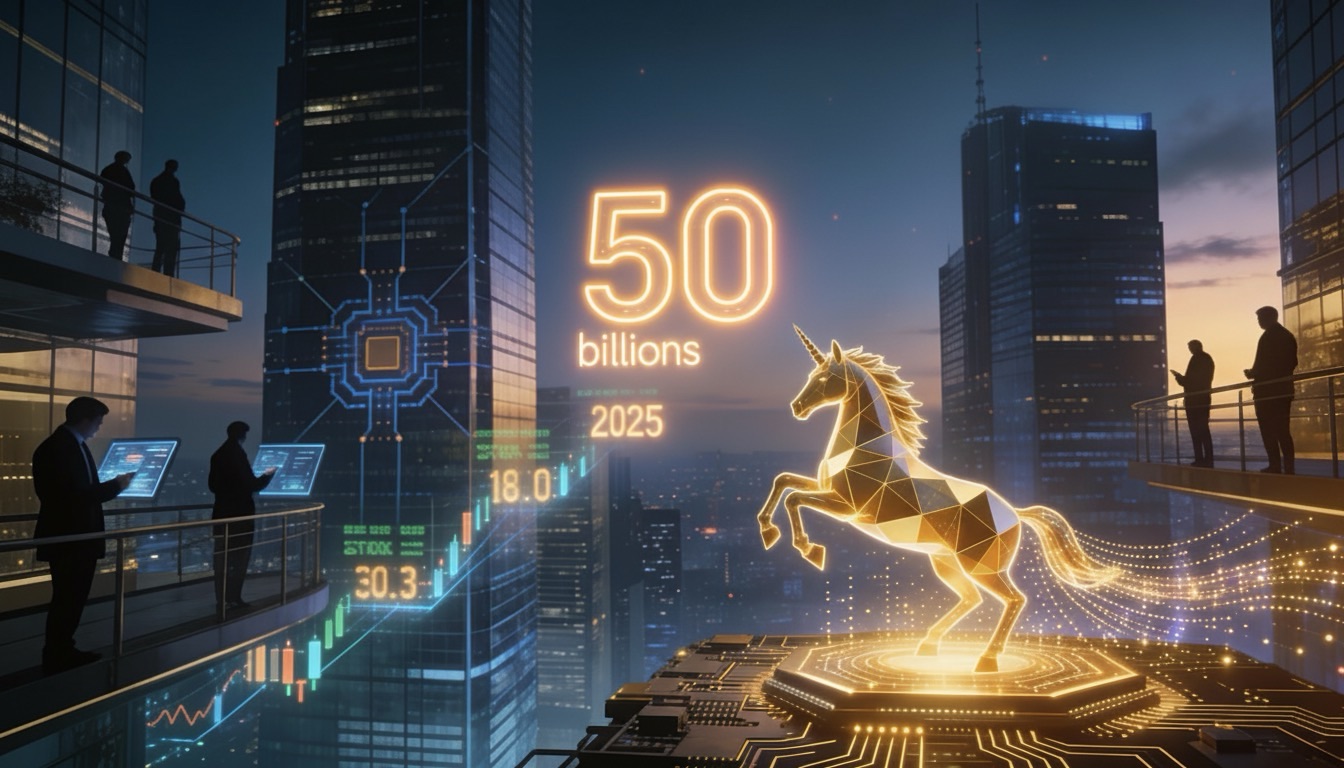
Artificial intelligence turned 2025 into a wealth factory, minting more than 50 new billionaires and reshaping the upper decks of the three‑comma club with the efficiency of a well‑tuned recommendation algorithm. The AI boom didn’t just pad existing fortunes—it drafted a new roster of founders, executives, and infrastructure kingmakers into global billionaire ranks. For a technology once accused of taking jobs, AI seems to have started at the top.
Record activity across AI models, infrastructure, and real-world applications pushed dozens of entrepreneurs and corporate insiders over the billion‑dollar line. These new fortunes came from nearly every layer of the AI value chain—from the labs training frontier models to the chipmakers supplying the compute to the startups teaching machines to flirt convincingly in code.
Forbes’ global tally shows 288 new billionaires this year, with more than 50 of them directly tied to AI’s meteoric rise. Many joined the list not via old-fashioned bootstrapping but through that very modern ritual known as the “late-stage valuation leap.” Call it the IPO effect, without the IPO.
Where the New Fortunes Were Forged
The geography of wealth creation mirrored the geography of silicon.
- U.S. and European founders behind model labs, AI developer tools, and cloud infrastructure saw their wealth explode as mega‑rounds fueled valuations with heatmap intensity.
- Corporate insiders at hyperscalers and chip suppliers collected windfalls from the surge in AI demand—creating what analysts jokingly dubbed a “closed-loop economy,” where AI companies invest in the same suppliers driving their own stock prices higher.
- Application-layer entrepreneurs behind coding copilots, customer‑service chatbots, and creative AI software turned venture‑backed prototypes into billion‑dollar empires seemingly overnight.
“AI‑adjacent” became the new “platform shift,” and markets responded in kind.
The AI Economy in Motion
By year-end 2025, the AI wealth engine had achieved multiple milestones:
- Global AI unicorns crossed nearly 500 companies, collectively valued above $2.7 trillion.
- Enterprise spending on generative AI tripled from the prior year, surpassing $30 billion as cost‑cutting gave way to productivity chasing.
- Venture investors poured over $200 billion into AI startups, amounting to nearly half of global VC funding.
- Hyperscaler capital expenditures surged to record highs—about $400 billion—as data centers grew into the century’s new oilfields.
- Meanwhile, 20 established billionaires added roughly $500 billion in cumulative wealth from AI investments alone.
In short, AI didn’t just eat the world—it rewired its income statement.
The Old Guard Levels Up
While the new blood dominated headlines, the familiar faces quietly fattened their ledgers. Tech titans leveraged AI to expand already vast empires, injecting capital into model developers, data-infrastructure ventures, and AI‑powered consumer apps. Twenty legacy billionaires collectively amassed half a trillion dollars from AI‑driven stock and equity gains.
Public‑market investors joined the ride as chipmakers, software giants, and data‑center landlords made up the bulk of market‑cap growth in 2025. For them, AI wasn’t just disruption—it was dividend yield with better branding.
AI has effectively become a new asset class. It behaves like a venture bet but trades like a blue chip—except when it goes full meme.
The Punchline No One Can Backtest
Behind the champagne bubbles, there’s still a spreadsheet of caveats. Economists point out that AI’s capex boom rests on a foundation of corporate borrowing, with more than $200 billion in new AI‑linked debt issued this year. Policy experts, meanwhile, caution that AI’s impressive productivity numbers remain more promise than proof.
If the technology ultimately delivers, it could lift long‑term global output and even reduce fiscal deficits. But for now, what’s measurable is momentum.
AI has turned 2025 into a live‑fire experiment in accelerated wealth creation—compressing decades of tech‑cycle gains into fiscal quarters. The next great test may not be how many billionaires it mints, but whether prosperity eventually trickles beyond the silicon corridor.
Sources
- AI Minted More Than 50 New Billionaires In 2025 (Forbes)[1]
- Forbes (homepage / AI & wealth coverage hub)[2]
- 20 Billionaires Who Gained Combined $460B Through AI Investments in 2025 (Nasdaq)[3]
- AI is Creating New Billionaires at a Record Pace (CNBC)[4]
- 20 Billionaires Who Gained Combined $460B Through AI Investments in 2025 (Yahoo Finance)[5]
- A Huge Chunk of U.S. GDP Growth Is Being Kept Alive by AI Capex (Fortune)[6]
- The AI Billionaire Boom: How Artificial Intelligence is Reshaping Wealth in 2025 (LinkedIn)[7]
- 2025: The State of Generative AI in the Enterprise (Menlo Ventures)[8]
- Top 30 AI Billionaires in the World 2025: Rankings and Net Worth (Global Biz Outlook)[9]
- The Projected Impact of Generative AI on Future Productivity Growth (Penn Wharton Budget Model)[10]
- AI Boom Billionaires: These Tech Moguls Joined The Forbes List In 2025 (Forbes)[11]
- There Are Now 498 AI Unicorns—and They’re Worth $2.7 Trillion (Fortune)[12]
- The State of AI in 2025: Agents, Innovation, and Transformation (McKinsey)[13]
- Forbes Billionaires List 2025: 288 New Billionaires Were Minted In 2025 (Forbes)[14]
- How to Write Headlines Like The Wall Street Journal (Ragan Consulting)[15]
- Winning Headline Strategies from News SEO Experts – “WTF is SEO?”[16]