From Theme Parks to CEO Tables, Real Engagement Is Becoming a Premium Product
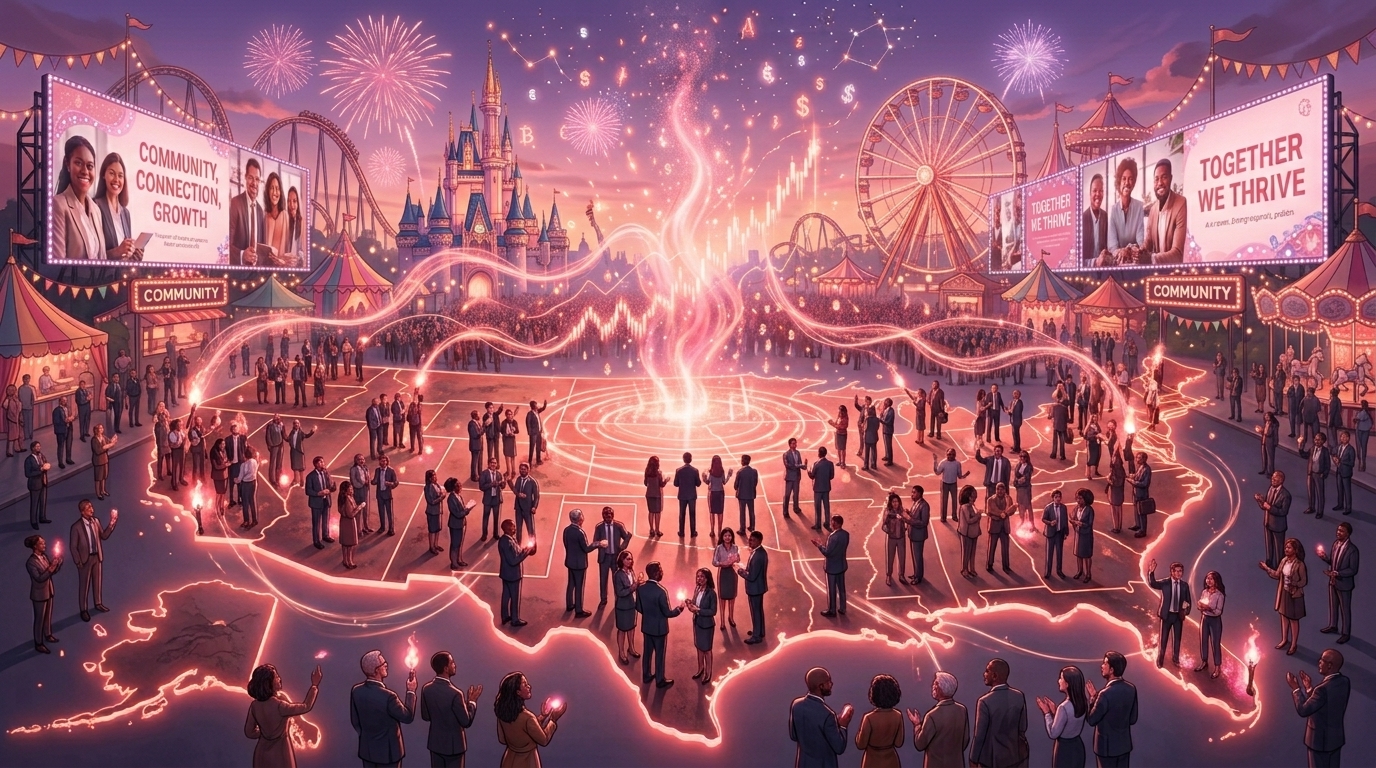
The next attractive growth story may not involve keeping people glued to their screens. It may involve giving them a compelling reason to look up. The Walt Disney Company (NYSE: DIS) offered fresh support for that proposition on November 17, reporting that Disney Experiences achieved an all-time record for global guests in fiscal 2026. Its fourth-quarter guest count also increased, despite macroeconomic pressure affecting its Shanghai and Hong Kong parks. For a business built around turning fictional worlds into actual destinations, the message was refreshingly concrete: people are still showing up. A much smaller business, Vista Partners’ sister organization, Tribe Public, is pursuing a related opportunity in corporate communications. Its live CEO presentations with companies and experts from all sectors and disciplines, question-and-answer sessions, luncheons, dinners and webinar events aim to convert passing interest into direct participation. The platform’s community spans 31 countries, with in-person events program across 41 U.S. event venues. A theme park and a CEO luncheon or dinner are not comparable businesses. Their capital requirements, economics and operating risks belong in different neighborhoods, perhaps different ZIP codes. But the underlying commercial proposition has a recognizable family resemblance: when information and entertainment are abundant, a distinctive experience can make attention more valuable. Disney supplies the large-scale operating evidence. Tribe Public offers an emerging application of the same principle to advisory & corporate access. Together, they frame a bullish thesis for the experience economy: distribution gets a message delivered; participation gives it somewhere to land.
Disney’s Advantage: Stories That Can Sell More Than One Ticket
Disney’s experience business enters this discussion with substantial financial weight. In fiscal 2025, the company’s then-reported Experiences segment generated approximately $36.2 billion in revenue and a record $10.0 billion in segment operating income. Revenue increased 6%, while operating income rose 8%. Those historical figures included consumer products under the segment structure then in effect, an important distinction when comparing them with subsequent reporting. That earnings base helps explain why Disney’s parks and cruises deserve attention beyond the familiar debate over admission prices. A successful franchise can support several forms of spending, from entertainment subscriptions to vacations. Disney’s November 2026 management commentary explicitly emphasized those connections, describing a business in which stories extend across streaming, games, hotels, parks and ships. The appeal is not simply that Disney owns recognizable characters. It owns settings in which people can spend time with those characters, and with one another. A film can be watched again. A vacation can be anticipated, purchased, photographed, discussed and eventually repeated. For Disney, that creates multiple opportunities to deepen a customer relationship without having to introduce an entirely new franchise at every turn. The mouse, in other words, has more than one checkout counter.
Capacity Gives the Bull Case Somewhere to Go
A compelling experience is commercially useful only if a company can deliver enough of it at attractive returns. Disney’s fiscal 2025 earnings materials showed Experiences capital expenditures of approximately $6.4 billion, up from roughly $3.7 billion a year earlier. That spending illustrates both the ambition and the financial demands of expanding physical entertainment. Castles are powerful brand assets, but they are not especially asset-light. Management had already identified cruise expansion as an expected contributor to fiscal 2026 Experiences growth, particularly in the second half as the company moved beyond launch costs and certain dry-dock periods. That earlier commentary provides useful context for the record guest levels subsequently reported for fiscal 2026. The bullish interpretation is straightforward: additional capacity can create more opportunities to monetize established demand. New attractions and ships can also give existing customers a reason to return. The discipline lies in the second half of that equation. More capacity must produce sufficient spending, utilization and earnings to justify its cost. Disney’s SEC filings identify consumer preferences, economic conditions, competition, pricing acceptance and adverse weather among the factors that can affect performance. These are operating variables, not footnotes to the fairy tale. Still, record global guest participation is a useful starting point. It suggests that Disney’s physical experiences retain an appeal that cannot be measured solely by the amount of entertainment available on a living-room screen.
The Connection Economy Is Bigger Than Entertainment
There is a broader human backdrop to the commercial argument. The World Health Organization estimates that approximately one in six people worldwide experiences loneliness. Its work distinguishes loneliness, the distress caused by a gap between desired and actual relationships, from social isolation, the objective absence of sufficient social connections. Those findings do not establish that theme parks or business events solve loneliness. They do, however, underscore why meaningful interaction deserves to be treated as more than a fashionable marketing phrase. The commercial inference is that businesses able to organize worthwhile shared experiences may be addressing something more durable than a temporary preference for going out. Vista Partners’ September article, “The New Premium Asset: Attention That Shows Up,” applies that idea to corporate engagement. Its central argument is that access to information has become easy, while securing an audience willing to listen, participate and return remains difficult. That is an editorial thesis rather than independently established market-size evidence, but it identifies a useful distinction. A page view records a visit. A thoughtful question reveals an interest. For companies trying to explain a complicated business, the latter may be the more useful beginning.
Tribe Public’s Opportunity: Turn Awareness Into a Conversation
Tribe Public’s model combines content creation & digital reach in partnership with Vista Partners with smaller, more focused and curated interactions. According to its website, participants can submit a wishlist of companies and experts they want to hear from. Once an event is confirmed, attendees may submit questions before or during the presentation. The platform also says it regularly invites leaders back so its community can follow subsequent developments. That structure creates a potentially valuable progression: discovery, explanation, questioning and continued attention. The distinction matters because a corporate presentation and a corporate conversation do different jobs. A presentation establishes the intended narrative. Questions test whether the narrative has been understood and where it needs more support. A polished slide can announce a large market opportunity. A well-aimed question can ask how the company intends to reach it without exhausting its cash first. Both have their place, although only one reliably improves the room’s posture. Tribe Public describes an offering that extends beyond the event itself into newsletters, social media and survey campaigns. The opportunity, therefore, is not merely to fill seats. It is to develop a continuing distribution channel around people who have already demonstrated interest. That is a promising business proposition, though the available materials do not establish audited revenue, profitability or customer-retention economics for the platform. Its appeal rests on the model and its execution opportunity, not on financial results that have not been supplied.
Four Days in San Francisco, With One Company Getting the Floor
Tribe Public’s planned January 2027 healthcare series gives that strategy a specific format. Vista Partners’ October announcement describes four corporate-sponsored, RSVP-only CEO presentation and Q&A luncheons scheduled for January 11 through January 14 in San Francisco, during the annual healthcare conference week associated with JPMorgan Chase & Co. (NYSE: JPM). The announcement anticipates 50 to 80 attendees per corporate sponsored luncheon event, with one company featured each day from noon to 2 p.m. The one-company-per-day structure is the commercially interesting feature. It offers a presenting business a concentrated window to explain its strategy rather than compete within a rapid sequence of unrelated pitches with a curated audience of members that include Portfolio Managers from large and small funds, Registered Investment Advisors, Family Offices, Accredited Investors, Business Owners, Retail Traders, Brokers, Sell-side Analysts, Entrepreneurs & Members of Media. For healthcare companies, that time can be useful. Clinical development, regulatory requirements, commercialization and financing are connected subjects. Compressing all four into an elevator pitch generally produces an elevator that nobody wishes to enter. A dedicated session creates space to distinguish what has already been achieved from what remains an objective. That distinction can improve the quality of attention even when it does not immediately change anyone’s opinion.
Healthcare Shows Why Better Questions Matter
Two companies highlighted in Vista Partners’ account illustrate the value of keeping business stages distinct: Alpha Cognition Inc. (NASDAQ: ACOG) and Eupraxia Pharmaceuticals Inc. (NASDAQ: EPRX; TSX: EPRX). Vista reports that both participated in Tribe Public CEO luncheons during the January 2026 healthcare conference week. That participation should not be confused with evidence that the events caused subsequent corporate or share-price performance, but it is interesting that both companies pressed very well over the last year since their Tribe events. Alpha Cognition’s ZUNVEYL, or benzgalantamine, who had received FDA approval for the treatment of mild to moderate dementia of the Alzheimer’s type in adults has continued to progress on the commercialization front. Eupraxia presents a different discussion. It remains a clinical-stage company developing localized, extended-release medicines. In October 2026, it announced that its RESOLVE study had reached the enrollment target of 120 patients in the randomized, placebo-controlled Phase 2b portion evaluating EP-104GI for eosinophilic esophagitis, or EoE. The company said interim data were expected in December 2026. Eupraxia’s subsequent third-quarter results, furnished through an SEC filing, reiterated both the enrollment milestone and the expected December analysis. That provides a specific development checkpoint, rather than a generalized promise of progress. The company has also published 52-week findings from the earlier open-label portion of RESOLVE. Such findings can inform the development thesis, but they are not equivalent to results from the randomized, placebo-controlled study. Keeping those evidence categories separate is precisely the sort of work that a substantive management discussion should help accomplish. For many, direct access is most valuable not when it produces a more enthusiastic adjective, but when it produces a more precise question.
The Bullish Thesis: Earn the Return Visit
Disney and Tribe Public operate at dramatically different scales. Their connection is a business principle, not a shared valuation framework. Disney’s record fiscal 2026 guest participation supports the case that differentiated physical experiences remain attractive even as digital entertainment proliferates. Its expansion program creates additional opportunities, provided those projects generate suitable returns. Tribe Public is applying a parallel idea to company engagement: use technology to assemble an audience, then give that audience a reason to participate. Its planned four-day San Francisco series puts a defined schedule and a focused format behind that approach. The strongest version of this thesis is not that every gathering creates value. Plenty of meetings have conducted rigorous experiments proving otherwise. It is that well-designed experiences can make a relationship more useful, memorable and repeatable. For Disney, that relationship can lead to another vacation. For a public company, it can lead to a better-informed audience that follows the next milestone. In an economy capable of generating almost limitless content, earning someone’s undivided attention looks increasingly like a business worth building.
The Sources
- The Walt Disney Company: Disney Q4 FY26 Earnings, Commentary From CEO Josh D’Amaro
- The Walt Disney Company: Fourth-Quarter and Full-Year Fiscal 2025 Earnings
- SEC.gov: The Walt Disney Company Fiscal 2025 Form 10-K
- The Walt Disney Company: November 13, 2025 Earnings Conference Call Transcript
- World Health Organization: Social Isolation and Loneliness
- World Health Organization: Social Connection Linked to Improved Health and Reduced Risk of Early Death
- Vista Partners: The New Premium Asset, Attention That Shows Up
- Tribe Public: Direct Corporate Access, Community and Event Format
- Vista Partners: Four Days, Four Companies, a Bigger Dedicated Stage for Healthcare Innovation During JPM 2027
- U.S. Food and Drug Administration: ZUNVEYL Approval Letter
- Eupraxia Pharmaceuticals: RESOLVE Phase 2b Enrollment Target Reached
- SEC.gov: Eupraxia Pharmaceuticals Third-Quarter 2026 Results, Exhibit 99.1
- Eupraxia Pharmaceuticals: 52-Week Data From the Highest-Dose RESOLVE Cohorts
Stay Updated with Vista Partners
Subscribe to receive market insights, investing ideas, and the latest updates directly in your inbox.