


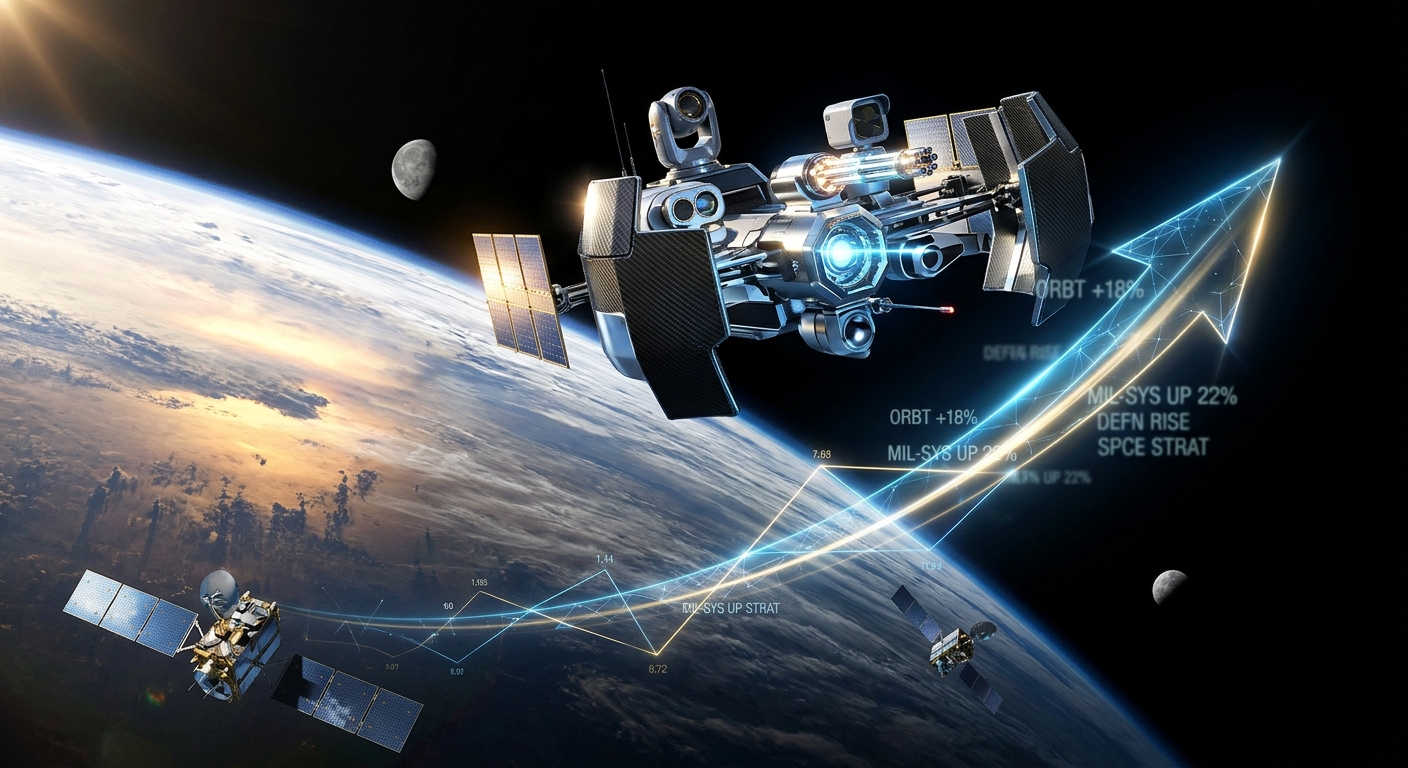
Lockheed Martin, SpaceX and Rocket Lab Stand at the Intersection of National Security and Commercial Opportunity
Space is acquiring something more commercially consequential than glamour: necessity. Military communications, missile warning and battlefield information increasingly depend on systems above the atmosphere. Protecting those systems creates another layer of demand, extending the opportunity from rockets and satellites to sensors, software, cybersecurity and ground infrastructure. For Lockheed Martin (NYSE: LMT), SpaceX (NASDAQ: SPCX), Rocket Lab (NASDAQ: RKLB) and other space-sector companies, the bullish case is becoming less about distant possibilities and more about capabilities governments are already purchasing. Robert Lightfoot, president of Lockheed Martin Space, captured that transition in a Bloomberg interview. Historically, space supported operations on Earth. Increasingly, he explained, nations also need capabilities to operate and protect assets in space itself. Commercial dependence and military dependence are advancing together, making orbital security harder to treat as an optional expense. The stock-market implication is substantial, although not indiscriminate. Companies that can deliver reliable spacecraft, connect them securely and integrate their information into military operations have a credible path into multiyear spending programs. The final frontier, it seems, has developed a procurement department.
Why Space Has Become Essential to Modern Warfare
The strategic logic begins with information. A missile-defense system must detect a threat, follow its trajectory and move useful information to the systems responsible for responding. The U.S. Space Development Agency, or SDA, is building a network designed to do precisely that, combining missile-tracking satellites with a low-latency communications architecture. Its Tracking Layer is intended to detect and track advanced threats, including hypersonic missiles, while its Transport Layer moves mission data through an interconnected network. That architecture matters commercially because it requires more than a handful of exceptionally expensive spacecraft. It calls for constellations, communications terminals, infrared payloads, ground systems and integration across multiple suppliers. SDA’s development model also anticipates successive generations with improved coverage, sensitivity, accuracy and resilience. For many watching space defense stocks, this is the central distinction: a satellite is a product, but a continually upgraded defense network can become a sustained market. Lightfoot’s emphasis on modular open-system architecture fits that direction. Systems must accommodate new technologies rather than become obsolete while procurement officials are still admiring the original presentation. His argument was that adaptability must be built into the architecture, allowing capabilities to be added as requirements evolve.
The Opportunity Is Already Appearing in Contract Awards
The clearest support for the bullish thesis comes from awarded programs rather than broad forecasts. In December 2025, SDA announced approximately $3.5 billion in agreements for 72 Tracking Layer Tranche 3 satellites. Four teams, led by Lockheed Martin (NYSE: LMT), Rocket Lab (NASDAQ: RKLB), Northrop Grumman (NYSE: NOC) and L3Harris Technologies (NYSE: LHX), were each selected to deliver and operate 18 spacecraft, with launches planned for fiscal 2029. SDA listed these potential agreement values:
- Lockheed Martin: approximately $1.1 billion.
- Rocket Lab: approximately $805 million.
- Northrop Grumman (NOC): approximately $764 million.
- L3Harris Technologies (LHX): approximately $843 million.
The purchasing continued. In July 2026, SDA announced two additional agreements totaling approximately $1.75 billion for 36 accelerated missile-defense tracking satellites, with spacecraft expected to be available for launch by the end of 2028. L3Harris received an agreement with a total potential value of approximately $955 million for 18 missile-defense spacecraft. These awards do not make every space stock attractive at every price. They do establish something more useful than enthusiasm: identifiable customers, defined missions and potential revenue tied to actual procurement.
Lockheed Martin: An Established Business With Orbital Growth
Lockheed Martin offers a relatively established route into the space-defense theme, with an operating business large enough to place the opportunity in financial context. For 2025, the company reported total sales of approximately $75.0 billion. Its Space segment generated approximately $13.0 billion in sales, up 4% from 2024, and finished the year with approximately $39.8 billion in backlog. Companywide backlog reached approximately $193.6 billion. Those figures describe different scopes: the larger number covers Lockheed Martin’s full portfolio, not space alone. The company’s annual filing attributed the increase in Space backlog primarily to higher orders for strategic and missile-defense programs, including the Next Generation Interceptor, strategic re-entry programs and hypersonics. That provides an important bridge between the company’s traditional defense role and the expanding requirement for integrated warning, tracking and response capabilities. For many seeking exposure to space infrastructure without relying entirely on an emerging company’s production ramp, Lockheed Martin presents a grounded proposition: a substantial existing space business positioned alongside strategic programs and allied relationships. Lightfoot also highlighted the importance of international supply chains. Rather than portraying additional European industrial capacity solely as a competitive threat, he argued that a broader defense industrial base could help deliver the systems customers require. That is management’s perspective, not a guarantee of future awards, but it illustrates how allied spending can create partnership opportunities as well as competition.
Rocket Lab: The Satellite Business Deserves Equal Billing
Rocket launches attract attention. Satellite manufacturing can attract very large contracts. Rocket Lab’s December 2025 announcement described an approximately $816 million award to build 18 missile-defense tracking satellites, consisting of an approximately $806 million base contract plus up to $10.45 million in options. SDA’s separate announcement listed approximately $805 million for Rocket Lab’s agreement, so the agency and company figures should not be treated as perfectly interchangeable. Rocket Lab also said the award followed an existing $515 million contract to provide 18 satellites for SDA’s Transport Layer-Beta Tranche 2 program. Together, the company described its SDA awards as exceeding $1.3 billion in contract value. The strategic significance is larger than the headline number. Rocket Lab is competing not merely as a way to put hardware into orbit, but as a prime contractor responsible for building national-security spacecraft. Its component business adds another dimension. The company identified potential additional opportunities to supply other Tranche 3 prime contractors with payloads, solar solutions, attitude-control components, software and other systems. Those opportunities are prospective, not equivalent to awarded revenue, but they show how a supplier can participate across a program even when another company wins the main contract. That is a particularly appealing feature of the sector’s industrial structure: competition for the spacecraft can coexist with cooperation inside it.
Northrop Grumman and L3Harris: The Broader Space-Defense Bench
Northrop Grumman and L3Harris demonstrate why the opportunity should not be reduced to a contest between established defense companies and newer space businesses. Both received substantial Tranche 3 Tracking Layer agreements. L3Harris subsequently secured the approximately $955 million accelerated missile-defense satellite agreement announced in July 2026. These are direct positions in the sensing infrastructure intended to identify and track advanced threats. Northrop Grumman’s participation also extends to spacecraft already reaching orbit. In October 2026, SDA reported that a SpaceX Falcon 9 had delivered 21 Northrop Grumman-built Tranche 1 transport satellites, bringing the total number of Tranche 1 spacecraft in orbit to 84. That development is an important reality check in the constructive sense. The architecture is not confined to proposals and conference panels. Hardware is being launched, and suppliers are accumulating operational experience. For many evaluating the sector, the more useful question is therefore not simply which company has the most ambitious vision. It is which companies can repeatedly manufacture, launch, connect and operate the required systems.
SpaceX: Launch and Connectivity at the Center of the Network
SpaceX (NASDAQ: SPCX) occupies a different but complementary position. Its September 2026 quarterly filing identifies separate Space and Connectivity businesses, alongside its AI segment. The Space business includes launch services and government spacecraft-development and mission work using vehicles including Falcon 9, Falcon Heavy, Starship and Dragon. The filing reported companywide backlog of approximately $63.0 billion as of September 30, 2026. That is a consolidated figure, not a measure of defense contracts alone. SpaceX’s role in deploying Northrop Grumman-built SDA satellites illustrates a commercially important relationship: the company can provide launch infrastructure for spacecraft manufactured by another publicly traded defense supplier. The Bloomberg interview also highlighted Ukraine’s reliance on Starlink while raising questions about security. Lightfoot’s broader response emphasized that protection must be incorporated into space systems because the domain is contested. The takeaway is not that a commercial network is automatically secure or insecure. It is that connectivity and protection increasingly belong in the same purchasing discussion. For the broader industry, that creates a compelling feedback loop. More dependence on orbital infrastructure increases the importance of resilient access, protected communications and the ability to maintain service.
Tesla: A Real Connection, but a Different Investment Case
Tesla (NASDAQ: TSLA) belongs in this discussion with a distinction that enthusiasm should not erase. Tesla is not interchangeable with SpaceX, and owning Tesla shares does not by itself constitute direct ownership of SpaceX’s launch or satellite operations. There is, however, a documented commercial relationship. Tesla’s September 2026 quarterly filing reported $626 million in revenue from SpaceX’s purchases of Megapack products during the first nine months of the year, including $221 million in the third quarter. That establishes an energy-storage connection to SpaceX’s infrastructure spending, rather than a direct claim on satellite-defense revenue. SpaceX’s quarterly filing also stated that both companies had formed special committees to evaluate a potential combination. It expressly said no determination had been made by SpaceX’s special committee and that any transaction would require further approvals. A possible combination is therefore a development to monitor, not a completed transaction to build into the base case. The distinction matters. A shared business relationship can be meaningful without turning every associated stock into the same security. Even in space, corporate boundaries have not yet escaped gravity.
Firefly Aerospace Adds Responsive Launch and Defense Software
Firefly Aerospace (NASDAQ: FLY) provides another publicly traded route into the theme through launch services, spacecraft and national-security software. Its 2025 annual filing reported approximately $1.35 billion in year-end backlog and described a multi-launch agreement with Lockheed Martin covering up to 25 missions over five years. The company also highlighted its VICTUS NOX mission, which demonstrated launch roughly 24 hours after notification, a capability relevant to military demand for more responsive access to orbit. Firefly’s acquisition of SciTec added software and data-processing capabilities supporting missile warning, tracking and defense, remote sensing and space-domain awareness. That broadens its position beyond transportation into interpreting the information collected by space systems. The combination illustrates a wider industry opportunity. The valuable deliverable is not simply a successful launch. It is an operational capability available when the customer needs it.
The Bull Case Still Needs Financial Discipline
A bullish industry outlook and an attractive stock valuation are related questions, not identical ones. Lockheed Martin’s filing explains that backlog converts into sales as work is performed or deliveries occur and can be revised as contract estimates change. Firefly similarly cautions that cancellations, amendments and terminations can reduce backlog and prevent expected revenue from being recognized. Execution remains equally important. Firefly’s annual filing identifies launch failures, manufacturing constraints, development requirements, funding changes and the ability to achieve profitability among its material risks. Those are practical reminders that an expanding market does not remove the difficulty of building a durable business inside it. For many examining space defense stocks, the strongest approach is to distinguish among three things: awarded demand, demonstrated delivery and eventual cash generation. The first supports the opportunity. The second builds credibility. The third ultimately pays the bills.
The New Space Economy Is Becoming Security Infrastructure
The most persuasive bullish case for space defense is not that every company with a rocket will prosper. It is that governments are purchasing interconnected capabilities that require multiple kinds of expertise. SDA’s progression from industry solicitations to multibillion-dollar satellite awards and operational launches shows that transition taking shape. Its architecture links sensing, communications and ground integration, while successive development cycles create opportunities for technological improvement rather than a single, final procurement. Lockheed Martin, Rocket Lab, Northrop Grumman, L3Harris, SpaceX and Firefly occupy different positions within that system. Tesla’s documented energy-storage relationship provides a more indirect connection. The distinctions make the story more compelling, not less: this is an industrial network, not a one-company wager. Space once invited capital largely on the promise of what humanity might someday do there. An increasingly important part of the business now rests on what nations believe they cannot afford to lose. That is a sturdier foundation for a growth story than wonder alone.
The Sources
- Bloomberg Television: “Lockheed’s Martin Says Space Is Now Key to Warfighting Plans,” interview with Robert Lightfoot
- SEC.gov: Lockheed Martin 2025 Form 10-K
- SEC.gov: Lockheed Martin Fourth-Quarter and Full-Year 2025 Financial Results
- Space Development Agency: Awards for 72 Tracking Layer Tranche 3 Satellites
- Space Development Agency: Awards for 36 Accelerated Missile Defense Tracking Layer Satellites
- SEC.gov: Rocket Lab Announces $816 Million Missile-Defense Satellite Contract
- SEC.gov: SpaceX Form 10-Q for the Quarter Ended September 30, 2026
- SEC.gov: Tesla Form 10-Q for the Quarter Ended September 30, 2026
- SEC.gov: Firefly Aerospace 2025 Form 10-K
- Space Development Agency: Fourth Orbital Plane of Tranche 1 Satellites Delivered to Orbit
- Space Development Agency: Tranche 3 Tracking Layer Solicitation
- Space Development Agency: Tranche 3 Tracking Layer Draft Architecture and Industry Feedback Request
- Space Development Agency: Third Launch of Tranche 1 Satellites
Stay Updated with Vista Partners
Subscribe to receive market insights, investing ideas, and the latest updates directly in your inbox.

