Stronger Earnings, Expanding AI Demand and a $115 Billion Deal Put Business Fundamentals Back in Focus
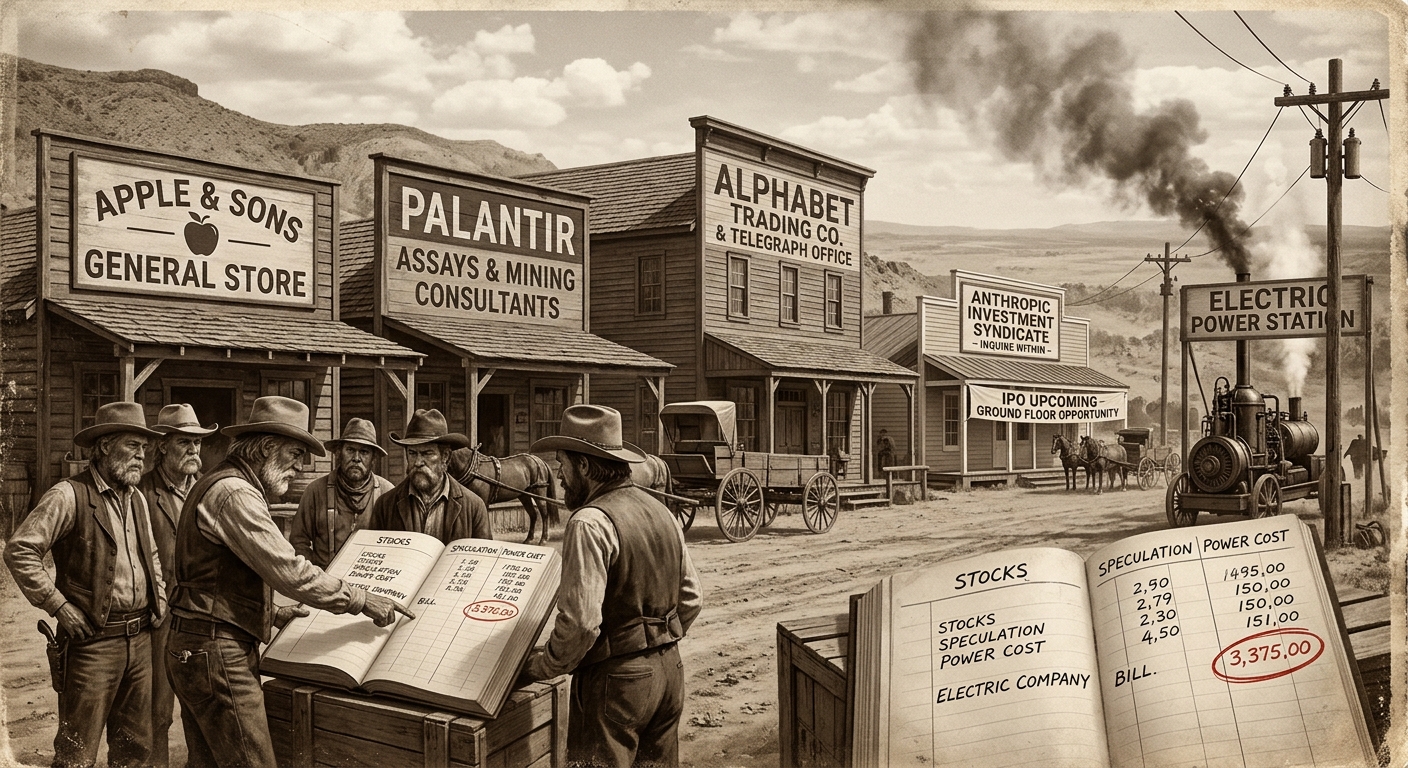
The strongest bullish argument for stocks this November is not that every artificial intelligence project will succeed. It is that several important businesses are already turning demand into revenue, operating profit and, in Apple’s case, substantial cash generation. Apple (NASDAQ: AAPL) just delivered a record September quarter, Alphabet (NASDAQ: GOOGL, GOOG) reported sharply higher revenue and cloud earnings, and Marvell Technology (NASDAQ: MRVL) agreed to acquire Lumentum Holdings (NASDAQ: LITE) in a transaction with an implied enterprise value of $115 billion. Corporate America is not behaving as though the future has been canceled. For many, the opportunity is to distinguish the price of building that future from the earnings power it could create. The central word is monetization: selling useful products, securing repeat business and eventually collecting more cash than the machinery consumes. That distinction matters because the emerging growth story spans more than one fashionable corner of technology. It includes consumer devices, enterprise software, cloud infrastructure, optical networking, satellite connectivity and even luxury fragrance. The economy, apparently, can accommodate both better algorithms and better cologne.
Apple Earnings: The iPhone Franchise Still Has Plenty to Say
Apple’s fiscal fourth-quarter results offer a useful rebuttal to the notion that scale must eventually become an obstacle to growth. Revenue reached $114.5 billion, up 12% from a year earlier, while diluted earnings per share increased 14% to $2.10. The company reported a September-quarter record for iPhone revenue and an all-time high for Services. Full-year fiscal 2026 revenue reached $479 billion. Those are substantial advances for a business that is hardly operating from a standing start. The most persuasive figure may be less glamorous than a new device launch: Apple generated $28 billion in quarterly operating cash flow and returned $28 billion to shareholders. A growth narrative supported by cash has a certain old-fashioned elegance. It also requires fewer imaginative accounting accessories.The September results extend an established pattern rather than introducing an isolated improvement. Apple’s earnings release filed with the Securities and Exchange Commission for its March quarter showed revenue of $111.2 billion, up 17%, and earnings per share of $2.01, up 22%. Services revenue in that quarter reached nearly $31 billion. There are qualifications. September-quarter gross margin of 47.9% included approximately one percentage point of benefit from tariff refunds, and earnings per share received a five-cent benefit. Those contributions should not be mistaken for recurring product economics. Even with that distinction, record iPhone and Services revenue provides a concrete foundation for the bullish case. Apple’s attraction is not simply that it can introduce another product. It is that a large, loyal installed base gives new hardware and services a distribution advantage that emerging competitors must spend years trying to replicate. Management reported another record active-device installed base across major product categories and geographic segments.
Palantir Stock: Enterprise AI Moves Beyond the Demonstration
Palantir Technologies (NASDAQ: PLTR) represents a different part of the same commercial progression: moving AI from a promising demonstration into recurring enterprise workflows. The company’s first-quarter 2026 business update reported revenue growth of 85% to $1.63 billion. U.S. commercial revenue increased 133% to $595 million, while U.S. commercial remaining deal value rose 112% to $4.92 billion. Adjusted operating income reached $984 million, representing a 60% adjusted margin. These are non-GAAP profitability measures, but the combination of growth and operating leverage is central to the company’s appeal. Momentum continued into the second quarter. Palantir reported revenue growth of 93% to approximately $1.94 billion and U.S. commercial growth of 149% to $764 million. Its quarterly report likewise documented the near-doubling of total revenue. That progression gives the latest earnings discussion a meaningful foundation. Palantir’s official reporting archive now includes its November 2 third-quarter release, shareholder letter and presentation. The broader investment question remains straightforward: can enterprise AI become indispensable enough that customers expand spending rather than merely renew an experiment? The earlier 2026 figures suggest that commercial adoption was already advancing rapidly. For many, that is more informative than another argument over whether AI will someday matter. Customers increasing their commitments are providing an answer in a language finance departments tend to understand.
Alphabet Earnings: A Large Construction Bill Meets a Larger Opportunity
Alphabet’s third quarter captures both the promise and the financial demands of the AI buildout. Consolidated revenue increased 25% to $127.6 billion. Google Cloud revenue surged 103% to $30.7 billion, while Cloud operating income more than tripled to $11.1 billion. Its operating margin expanded to 36.2%, compared with 23.7% a year earlier. This was not merely more business flowing through the same economic model. It was substantially greater reported profitability alongside exceptional growth. Cloud backlog reached $561 billion, with management expecting to recognize just over 55% as revenue over the following 24 months. Backlog is not cash in the bank, and its conversion still depends on execution, but it gives the infrastructure expansion a visible commercial foundation. The spending is equally visible. Alphabet generated $42.3 billion in operating cash flow but spent $51.4 billion on capital expenditures, producing negative quarterly free cash flow of $9.1 billion. Management also identified an inventory buildup supporting tensor processing unit system sales and a $5.2 billion European Commission fine payment as cash-flow headwinds. The bullish interpretation is not that negative free cash flow should be ignored. It is that a cash-flow deficit caused partly by capacity expansion should be evaluated differently from one caused by collapsing demand. Alphabet’s Cloud revenue, operating profit and backlog point toward substantial demand. Whether that demand ultimately earns an attractive return on the growing asset base remains the essential test.
Search and YouTube Are Still Financing the Next Chapter
Alphabet’s established businesses continue to provide considerable operating strength. Google Search and other advertising revenue increased 12% to $63.3 billion, while YouTube advertising revenue rose 9% to $11.2 billion. Google Services generated $39.2 billion in operating income, with a 40.7% operating margin. Search nevertheless faces a real transition. Management acknowledged that AI Mode’s lower monetization affected growth, even as AI usage expanded. The company is scaling advertising across AI Overviews and AI Mode, making the next question less about whether people will use AI search and more about how effectively those interactions can generate revenue. Quantum computing and Project Suncatcher, Alphabet’s space-based computing initiative, add longer-term possibilities. They should remain separate from the near-term earnings argument. The investment case does not need an orbital data center to justify every terrestrial expense. Cloud, Search and YouTube already provide enough substantial questions to keep the spreadsheet occupied.
Marvell and Lumentum: The AI Trade Moves at the Speed of Light
Marvell’s proposed acquisition of Lumentum highlights an increasingly important part of AI infrastructure: moving information efficiently, not merely processing it. The companies announced an all-stock agreement with an implied enterprise value of $115 billion. Lumentum shareholders would receive 4.5 Marvell shares for each Lumentum share, with existing Marvell shareholders owning approximately 67% of the combined company and Lumentum shareholders approximately 33% after closing. The transaction is expected to close in the first half of 2028, subject to approvals and other conditions. The strategic fit brings together Marvell’s electrical and optical interconnect products, switching and custom silicon with Lumentum’s lasers, optical transceivers and optical circuit-switching capabilities. Management estimates that the combination would expand the combined company’s total addressable market to $550 billion. That figure is a management estimate of market opportunity, not a revenue forecast. The logic is compelling: greater AI computing capacity creates greater demands on the connections between systems. A powerful processor waiting for data is an expensive employee staring at an empty inbox. Bloomberg described the agreement as one of the largest technology transactions in history. Its size signals corporate conviction, although conviction and successful integration are not interchangeable The fixed exchange ratio also matters. The market value of the stock consideration will fluctuate with Marvell’s share price. For many assessing the deal, the important questions are the future economics of the combined business, ownership dilution and execution, not simply the headline transaction value.
Anthropic’s IPO: Exceptional Growth Meets Exceptional Capital Demands
Anthropic’s planned public offering could become a major test of how the market values frontier AI. Bloomberg reported that the company generated nearly $17 billion in third-quarter revenue, approximately twelve times the year-earlier figure, while disclosing more than $895 billion in spending commitments over future years. Those figures describe two sides of the same expansion: unusually rapid customer demand and an unusually demanding infrastructure bill. Anthropic publicly filed for its IPO on October 26 and subsequently updated its financial disclosures. Bloomberg reported that the maker of Claude was expected to list on Nasdaq in November. A planned listing should not be confused with an already completed public debut or an established public trading symbol. The constructive reading is that enterprise demand for advanced AI has become large enough to support a major new public-market candidate. The necessary restraint is that multiyear commitments are not the same thing as current-period expenses, and fast revenue growth does not by itself establish sustainable free cash flow. For many, the offering’s appeal will depend on how convincingly Anthropic connects usage, pricing, computing costs and financing needs. A blockbuster debut can generate excitement. A durable business must eventually generate something more spendable.
SpaceX and Starlink: Connectivity Becomes a Larger Commercial Ambition
SpaceX (NASDAQ: SPCX) adds another growth avenue through Starlink’s mobile ambitions.Bloomberg reported in October that SpaceX was acquiring nationwide spectrum from Grain Management, a step toward becoming a major mobile carrier. The report described a Starlink network of more than 11,000 satellites supporting broadband and mobile coverage. The possibility of a Boost Mobile transaction involving EchoStar (NASDAQ: SATS), raised in the supplied material, should remain a prospective scenario rather than a completed acquisition. The independently supported development is the spectrum expansion, which gives the broader wireless strategy a tangible foundation. The commercial attraction is the potential to combine satellite reach with the capabilities required for everyday mobile service. The challenge is converting those complementary assets into reliable coverage and attractive economics. The addressable ambition is substantial, but a strategic opportunity should not be booked as revenue before the customer receives a bill.
Estée Lauder: Growth Does Not Require a Server Rack
The Estée Lauder Companies (NYSE: EL) provides an encouraging reminder that the growth story can extend beyond AI infrastructure. For its fiscal first quarter ended September 30, 2026, the company reported net sales of approximately $3.7 billion, up 7%, with organic sales growth of 6%. Fragrance sales increased 20% on the company’s constant-currency presentation, led by double-digit growth across luxury brands including Le Labo, Tom Ford, Jo Malone London and Kilian Paris That distinction matters because reported fragrance revenue rose approximately 19%, from $721 million to $861 million. Separating reported and currency-adjusted growth keeps a strong result from becoming an unnecessarily embellished one. The broader opportunity is a portfolio of brands capable of attracting repeat purchases through product launches, brand loyalty and different usage occasions. The company highlighted new fragrance introductions across several luxury labels as contributors to customer acquisition For many seeking evidence that discretionary spending still has pockets of strength, fragrance offers a useful counterpoint to the technology debate. Not every attractive growth business needs to purchase several billion dollars of computing equipment before breakfast.
November’s Bullish Case: Demand Is Becoming Easier to Measure
The coming market tests are substantial, particularly around Anthropic’s planned offering and the November 3 midterm elections. Bloomberg has identified the election as a potential source of uncertainty for an AI industry benefiting from a broadly supportive policy environment. Yet the strongest positive argument rests on operating evidence rather than a forecast of political outcomes:
- Apple is pairing record product and Services revenue with substantial operating cash generation.
- Palantir’s earlier 2026 results show rapid commercial expansion alongside significant adjusted operating leverage.
- Alphabet is reporting extraordinary Cloud growth and higher segment profitability, even as infrastructure spending pressures free cash flow.
- Marvell and Lumentum are positioning for rising demand for electrical and optical connectivity.
- Estée Lauder is demonstrating that selected consumer categories can contribute meaningful growth outside technology.
These developments do not make every stock inexpensive, every acquisition wise or every capital commitment productive. They do, however, support a more durable bullish thesis: important parts of the growth economy are moving from technological promise toward measurable commercial results. For many, that is where the next compelling stock-market story begins. Not with the assumption that everything will work, but with evidence that several consequential things already are.
The Sources
- Apple: Fiscal 2026 fourth-quarter results
- SEC.gov: Apple fiscal 2026 second-quarter earnings release, Exhibit 99.1
- Palantir: First-quarter 2026 business update
- Palantir: Second-quarter 2026 business update
- Palantir: Second-quarter 2026 Form 10-Q
- Palantir: Official 2026 quarterly reporting archive
- Alphabet: Third-quarter 2026 earnings-call transcript
- Marvell: Announcement of proposed combination with Lumentum
- SEC.gov: Form 425 filing concerning the Marvell-Lumentum transaction
- Bloomberg: Marvell to acquire Lumentum in historic $115 billion technology deal
- Wilson Sonsini: Marvell’s proposed $115 billion acquisition of Lumentum
- Bloomberg: Anthropic revenue and spending commitments ahead of its IPO
- Bloomberg: What to know about the Anthropic IPO
- Bloomberg Businessweek: Anthropic’s spending commitments and revenue growth
- Bloomberg: SpaceX acquires nationwide spectrum for its Starlink mobile offering
- The Estée Lauder Companies: Fiscal 2027 first-quarter results
- Bloomberg: Anthropic’s IPO and potential midterm-election effects
Stay Updated with Vista Partners
Subscribe to receive market insights, investing ideas, and the latest updates directly in your inbox.