An upsized $317.5 million offering gives Lycia Therapeutics (NASDAQ: LYCA) fresh capital to pursue protein-degrading medicines, with early human data and 2027 clinical milestones sharpening the investment story.
October 24, 2026
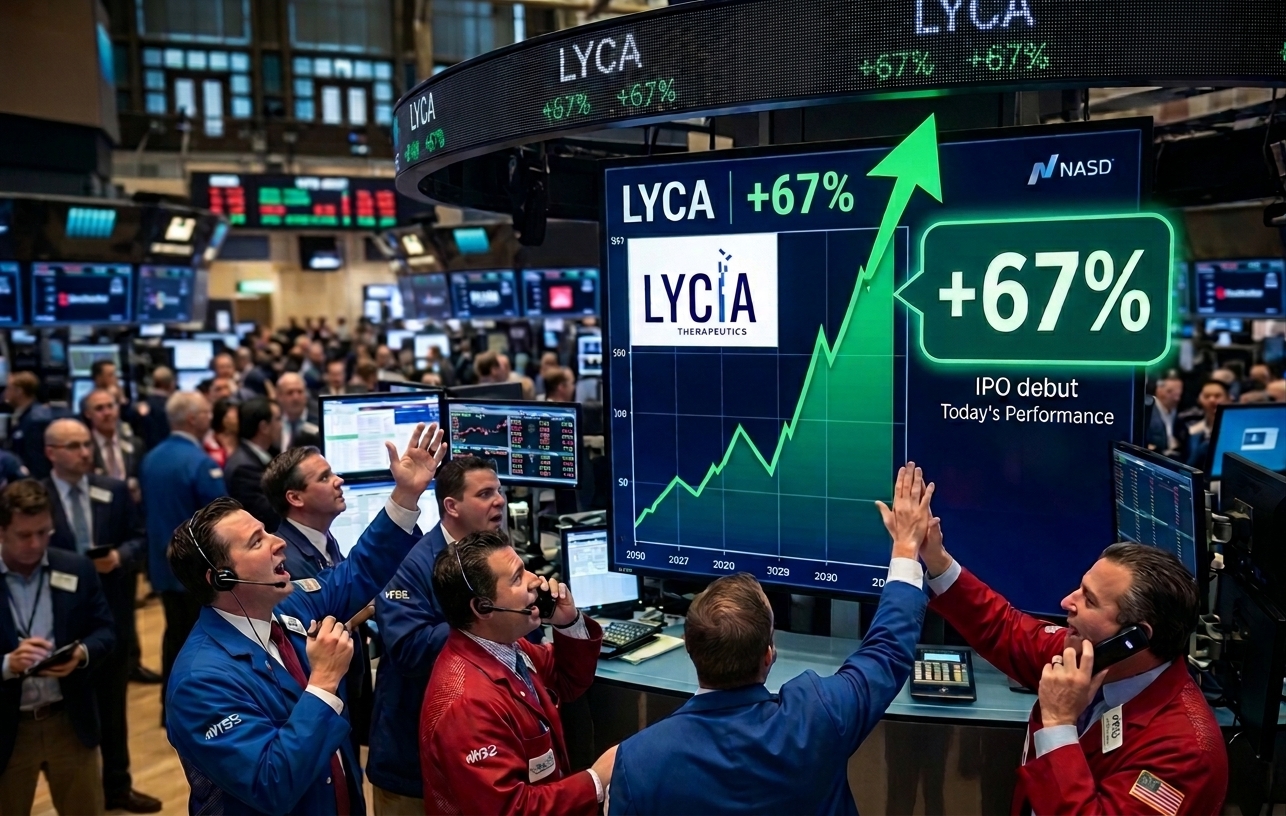
Wall Street has found a biotechnology company with an unusually literal approach to taking out the trash. Lycia Therapeutics (NASDAQ: LYCA), which is developing medicines designed to remove disease-causing proteins rather than merely block them, closed its first trading session at $30 on October 23. That represented a gain of approximately 66.7% from its $18 initial public offering price and gave the company an equity market value of roughly $1.65 billion, according to Bloomberg. For a newly public drug developer, the reception was considerably warmer than the customary handshake. The South San Francisco company priced an upsized offering of 17.64 million shares, generating expected gross proceeds of approximately $317.5 million before underwriting discounts, commissions and other expenses. The offering is expected to close October 26, subject to customary conditions.The bullish argument extends beyond a lively first day. Lycia combines a differentiated drug-development platform, preliminary human evidence that its lead candidate can substantially reduce an allergy-associated protein, and a clinical calendar that could give investors several opportunities to assess whether the science deserves its enthusiastic reception. Those opportunities remain experimental, but they are no longer confined to a laboratory hypothesis.
Lycia’s IPO Grew Before Its Shares Started Trading
The first indication of demand arrived before the opening bell. Lycia initially marketed 14.7 million shares at $16 to $18 apiece, seeking up to $264.6 million, Reuters reported on October 20. It ultimately sold 17.64 million shares at the top of that range, increasing the share count by 20%. Bloomberg separately confirmed the final $317.5 million transaction. That distinction matters. A rising stock price rewards shareholders, but a larger primary offering supplies capital directly to the company. Lycia said all shares in the offering were being sold by the company, rather than by existing holders. The underwriters also received a 30-day option to purchase up to 2.646 million additional shares. Cooley, which advised the underwriters, independently confirmed those final offering terms. MarketWatch reported that the deal priced at the high end of expectations, while Axios noted that the proceeds would help advance two Phase 1 candidates. Taken together, the transaction pairs a strong market reception with a concrete clinical purpose.
What Is Lycia’s LYTAC Technology?
Lycia’s platform is built around lysosomal targeting chimeras, or LYTACs. These molecules are designed to direct proteins outside cells into the cell’s lysosome, where the proteins can be broken down using natural cellular machinery. The distinction from conventional inhibition is straightforward:
- An inhibitor seeks to interfere with a protein’s activity.
- A degrader seeks to eliminate the protein itself.
- Lycia’s approach extends targeted degradation to extracellular proteins, including proteins implicated in allergic and autoimmune diseases.
The company’s technology builds on foundational work by Carolyn Bertozzi, the Stanford scientist awarded the 2022 Nobel Prize in Chemistry for work in bioorthogonal chemistry. The Nobel pedigree supplies scientific credibility, although Lycia’s medicines must establish their own safety and effectiveness through clinical trials. Lycia has developed two related approaches. Its classic LYTAC degraders are broken down alongside their targets. Its cataLYTAC degraders are designed to cycle repeatedly into and out of cells, allowing one degrader molecule to help eliminate multiple target molecules. For many, that recycling mechanism is the intriguing part. If it delivers durable activity at practical doses, it could support differentiated medicines. The cellular housekeeping is elegant; the commercial implications will depend on whether patients actually benefit.
LCA-0061: Early Human Data Give the Allergy Story Substance
Lycia’s lead allergy candidate, LCA-0061, targets immunoglobulin E, or IgE, a protein involved in multiple allergic diseases. The candidate is being evaluated in a Phase 1 trial involving participants with elevated IgE, including participants with food allergy. The most investment-relevant detail appears in Lycia’s SEC registration statement. According to the company, preliminary results from its first cohort of healthy atopic participants receiving a single 70-milligram subcutaneous dose showed:
- A mean maximum IgE reduction of 96% from baseline.
- A majority of treated participants maintaining greater than 95% reduction at 28 days after dosing.
- No observed safety signals or dose-limiting toxicities in that preliminary cohort.
Those findings offer an early indication that the platform can engage its intended biological target in humans. They do not establish that LCA-0061 prevents allergic reactions, improves patients’ daily lives or will remain safe with broader exposure and repeated dosing. Lycia expects additional data in participants with elevated IgE and patients with food allergy in 2027. That is the appropriate balance for the investment thesis: a striking biomarker result creates a reason to investigate further, not permission to skip the investigation.
Why Food Allergy Is an Attractive First Target
Lycia is pursuing a disease area with a large potential patient population and existing evidence that targeting IgE can provide clinical benefit. Its prospectus estimates that food allergy affects more than 33 million Americans. It also points to adoption of the approved IgE blocker Xolair as evidence of demand for treatment, while arguing that existing approaches leave room for improvements in dosing and coverage of patients with high circulating IgE. These are Lycia’s assessments, not established advantages of its experimental drugs. LCA-0061 is designed to reduce both total and free IgE through degradation. The commercial proposition is therefore not simply another version of IgE blockade, but a potentially different way to control the underlying biology. Whether that distinction produces superior clinical outcomes remains unproven. Lycia is also developing LCA-0062, a bispecific antibody cataLYTAC degrader targeting IgE. That program remains in investigational new drug-enabling development and could offer another route to explore dosing flexibility and duration of response. For shareholders, the portfolio approach creates more than one development path within allergy. It does not eliminate risk, particularly because both programs depend on related technology.
LCA-0321 Adds a Second Clinical Opportunity in Graves’ Disease
Lycia’s other Phase 1 candidate, LCA-0321, targets thyroid-stimulating hormone receptor autoantibodies, commonly called TRAbs, which drive Graves’ disease. The company expects initial clinical data in 2027. The candidate is designed to selectively degrade those disease-causing antibodies rather than broadly reduce antibody levels. If that selectivity translates into meaningful clinical benefit, it could support a more targeted approach to the autoimmune process underlying the disease. The investment significance goes beyond a second indication. Positive results in both allergy and Graves’ disease would provide evidence across different targets and disease settings, potentially strengthening the argument that LYTAC is a repeatable platform rather than a single-program opportunity. That remains a conditional thesis, not an outcome already demonstrated.
Fresh Capital Meets a Defined Clinical Calendar
Lycia estimated that it held approximately $138.2 million in cash, cash equivalents and marketable securities at September 30, before the IPO. That figure was preliminary and unaudited, according to its SEC filing. The expected IPO proceeds would materially strengthen that financial position, although gross proceeds should not be confused with net cash available after transaction costs. BioWorld reported that the offering was intended to advance clinical work on the company’s immunology pipeline and confirmed the stock’s $30 first-day close. The principal milestones disclosed in the prospectus include:
- Additional LCA-0061 data in 2027.
- Initial LCA-0321 data in Graves’ disease in 2027.
- A potential Phase 1 start and initial second-half 2027 data for LCA-0062, contingent on regulatory clearance.
- A defined calendar makes the story easier to follow. Many can evaluate progress against clinical evidence rather than rely exclusively on the expanding vocabulary of biotechnology presentations.
The Premium Valuation Raises the Standard of Proof
A strong debut is encouraging, but it also changes the entry price. At $30, Lycia shares were approximately two-thirds more expensive than their IPO allocation price. The roughly $1.65 billion equity valuation reflects meaningful expectations for technology that remains early in clinical development. Lycia’s SEC filing makes the risks explicit: the company has no approved products, has not completed any clinical trials, has generated no product-sales revenue and expects continued significant losses. It also anticipates needing substantial additional capital, even after a successful offering. Platform dependence deserves particular attention. Multiple programs create opportunity, but shared technology can also transmit a setback across the pipeline. Early biomarker success may not translate into clinical efficacy, and an initially reassuring safety profile may change as more patients are treated. In other words, the opening-day applause is useful. It is not a substitute for the next clinical readout.
Why Lycia Therapeutics Merits Attention
Lycia’s appeal rests on a coherent sequence: remove a well-understood disease-driving protein, demonstrate that removal in humans, and determine whether the biological effect produces a differentiated medicine. The IPO supplies substantial expected funding for that effort. The preliminary LCA-0061 results provide an early human signal. The Graves’ disease program offers a second clinical test, while the 2027 calendar gives investors identifiable evidence points to watch. That makes Lycia Therapeutics (NASDAQ: LYCA) a compelling emerging immunology company to follow, albeit at a valuation that now demands execution. The most durable upside would come not from repeating its first trading day, but from showing that its protein-disposal system can deliver benefits patients cannot obtain elsewhere. Wall Street has paid for a front-row seat. The clinical data will determine the quality of the performance.
Four Days. Four Companies. A Bigger, Dedicated Stage for Healthcare Innovation During JPM 2027 In San Francisco.
Vista Partners’ sister company, Tribe Public (www.TribePublic.com), is expanding its CEO Presentation & Q&A Luncheon series during the annual J.P. Morgan Healthcare Conference (JPM2027) in San Francisco, the largest and most informative healthcare investment symposium in the industry. Tribe Public is now hosting four corporate-sponsored, RSVP-only Tribe Public CEO Presentation and Q&A Luncheon Events January 11-14. Tribe Public’s curated events will be taking place daily from noon to 2 p.m. at a location that is a short 5-minute Waymo to Uber ride from the conference. Each luncheon event is expected to welcome 50–80 attendees from the dedicated Tribe Public community that will, most likely, not be attending the chaos of other J.P. Morgan Healthcare Conference activities. However, the events or ‘company dedicated conferences’, will be meaningful and with thoughtful crowd that will help any company seeking to maximize their time and efforts to increase awareness, business development, and understanding amongst a broader globally connected community. One company will take center stage each day, giving its CEO a focused opportunity to share the company’s vision, highlight its latest developments and growth opportunities, and engage directly with a curated audience of Tribe Members through a live Q&A. For participating companies, this expanded series offers a compelling platform to elevate visibility, build relationships, and bring their stories to an engaged audience during a major week for healthcare. If companies are interested in presenting at one of these four events, then they should send an indication of interest to Events@TribePublic.com to schedule an introductory virtual meeting.
A Global Community. A Collective Voice. Direct Access.
Tribe Public aggregates the voices of consumers and investors to attract management teams from some of the world’s most interesting and groundbreaking companies to its corporate-sponsored, RSVP-only CEO presentations, Q&A luncheons, dinners, speaking engagements, and webinars. This growing community now spans 31 countries and is accessed via its ongoing Tribe Public CEO Presentation and Q&A Webinar based event series. Tribe Public also hosts luncheon, dinner, and speaking engagement events across 41 Tribe Event Venues in the United States. Members regularly learn alongside one another and engage directly with company leadership and experts. The Tribe Public audience includes portfolio managers from large and small funds, registered investment advisors, family offices, accredited investors, business owners, retail traders, brokers, sell-side analysts, entrepreneurs, and members of the media. This diverse community brings thoughtful questions and a broad range of perspectives to every conversation.
Capital-Markets Expertise. An Integrated Communications Platform.
Vista Partners LLC is a California-registered investment advisor with capital-markets and strategic-advisory capabilities. Its focus complements the opportunity for companies to communicate their vision, articulate their growth strategies, and build meaningful relationships with the investment community. Vista is led by its Managing Member, John F. Heerdink, Jr, an advisor, investor and entrepreneur, who has advised public and private companies across all sectors with an emphasis on biotechnology, healthcare, technology & natural resource companies. In addition, Mr. Heerdink has worked with companies seeking a listing on public exchanges via IPO, reverse merger and assisted foreign issuers seeking a listing on a U.S. exchange. Mr. Heerdink has assisted companies to raise debt and equity capital for growth, consummated mergers and acquisitions, and performed all other matters dealing with investor relations, business development, & marketing. He maintains an extensive relationship base in the investment community, lending industry, investment banking industry & a worldwide investor network. Learn more about Vista Partners: www.vistapglobal.com/about-vista-partners/.
Tribe Public LLC is an integrated media, communications, and investor-event platform that supports live experiences, digital events, original content development, social distribution, and targeted outreach. These capabilities create opportunities to extend company storytelling beyond a single presentation and support continued audience engagement. Learn more about Tribe Public: www.TribePublic.com.
With an expanded four-day luncheon series and a growing global community, Tribe Public is creating more opportunities for healthcare leaders to tell their stories, and for investors and consumers to hear directly from the people shaping what comes next. if you would care to join these upcoming events, then please join the Tribe by registering at www.TribePublic.com and or send a message to Events@TribePublic.com. If you are a company CEO or Director of Investor Relations that would like to learn more and/or even to be considered to be a presenter during the J.P Morgan Healthcare Week in San Francisco or otherwise across the U.S., then please send a request to Research@TribePublic.com.
The Sources
Stay Updated with Vista Partners
Subscribe to receive market insights, investing ideas, and the latest updates directly in your inbox.