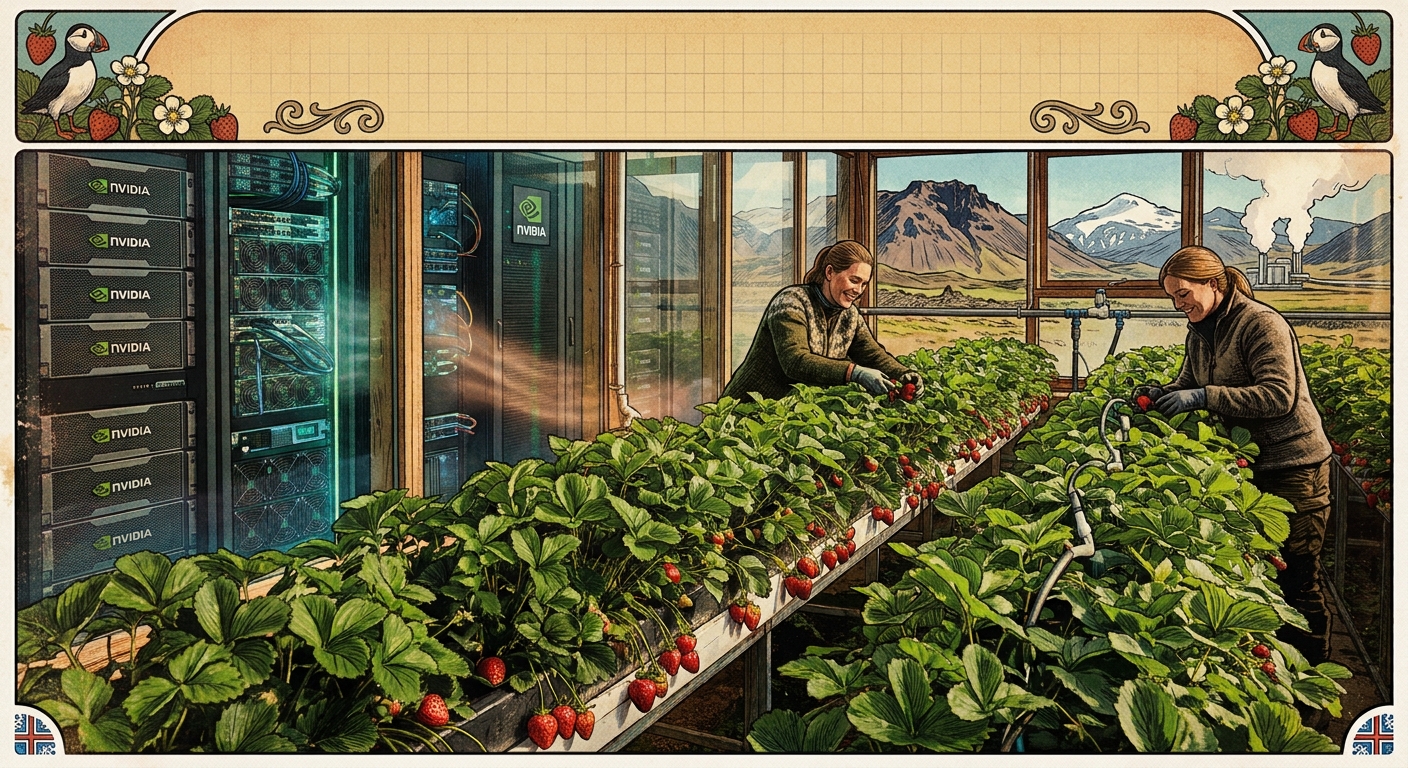
How geothermal energy, indoor farming and data center heat reuse are creating a compelling intersection of food production, industrial efficiency and AI infrastructure.
Iceland is cultivating an unlikely growth story beneath its volcanic landscape: premium Japanese strawberries, food-growing containers warmed by data centers and microalgae destined for nutritional supplements. In a country better known for glaciers than growing seasons, entrepreneurs are discovering that the most valuable agricultural resource may not be the land. It may be the energy underneath it. For many, the attraction extends beyond the produce aisle. Iceland offers a working illustration of convergence: renewable electricity, controlled-environment agriculture, computing infrastructure and industrial biotechnology finding ways to make one another more productive. NVIDIA (NASDAQ: NVDA) belongs in that broader discussion through its agricultural AI applications and digital-twin technology for data centers, although the sources reviewed do not establish its involvement in the Icelandic farms featured here. The investment thesis is straightforward. As food production becomes more technologically intensive and computing becomes more energy intensive, companies that improve the economics of electricity, cooling, automation and heat reuse could become increasingly valuable. The strawberry, in other words, is not the entire story. It is the unusually photogenic opening argument.
Underground Strawberries Turn Iceland’s Climate Into an Advantage
In BBC News’ October 18 report, correspondent Adrienne Murray visits an underground growing room in Keflavík containing more than 5,000 Japanese strawberry plants. Their grower, identified in the report as Ken, left an information technology career to establish the operation. The premium fruit reaches local consumers and restaurants through online sales. Separate industry reporting identifies Japanese entrepreneur Kenichi Noda as the operator of an underground, climate-controlled strawberry business using LED lighting, geothermal heating and Iceland’s clean water. His proposition is not to persuade the Arctic to behave like a Japanese spring. It is to engineer the growing environment independently of the weather. That distinction matters commercially. Indoor farming substitutes infrastructure and operating discipline for dependence on sunlight, seasonal temperatures and outdoor growing conditions. In the BBC report, lighting, irrigation, temperature and humidity all require careful adjustment. The farm’s appeal rests on matching a premium crop with a location that can support its substantial energy requirements. It is a more selective proposition than simply moving agriculture indoors. A specialty strawberry sold for flavor and quality has a different commercial equation from a commodity crop competing primarily on price. The better question is not whether Iceland can grow strawberries. The plants have answered that. It is whether operators can repeatedly turn favorable energy inputs into attractive margins.
Renewable Electricity Is the Foundation, Not a Marketing Accessory
Iceland’s agricultural experiment begins with an unusual electricity system. Government sources describe the country’s electricity production as almost entirely renewable, supplied principally by hydropower and geothermal generation. That is an electricity claim, not a claim that every part of the national economy operates without fossil fuels. For an indoor grower, the distinction is practical. Lighting and environmental controls consume electricity regardless of how appealing the sustainability presentation looks. The BBC report explicitly acknowledges that indoor farms are energy intensive. It also shows why Iceland can offer a useful combination: renewable power, geothermal resources, water and a cold outdoor environment that some facilities can exploit for cooling. The resulting business logic is location-specific. Put a power-hungry production process where its critical inputs are comparatively favorable, then select products capable of supporting the remaining costs. Iceland’s broader indoor-growing sector already extends beyond strawberries. The BBC reports more than 45 hectares of greenhouses and indoor farms producing crops including tomatoes, salads and wasabi. Separately, industry publication VerticalFarmDaily describes Reykjavík-based VAXA supplying leafy greens, herbs and microgreens to major retailers and customers ranging from Michelin-starred restaurants to fast-food operators. That customer range is encouraging. Agricultural innovation ultimately needs more than enthusiastic visitors. It needs repeat orders.
Data Center Waste Heat Finds a Second Career
The most intriguing development may be the effort to make data centers useful neighbors. Icelandic startup Hringvarmi captures low-grade waste heat and directs it into purpose-built growing pods. The company says it has deployed a working prototype in which warm exhaust air that previously escaped into the surrounding environment now supports microgreen cultivation. Its collaboration with data center operator atNorth provides a concrete testing ground. A 2024 announcement described plans to place Hringvarmi’s first-generation prototype at atNorth’s ICE03 facility in Akureyri, working with local producer Rækta Microfarm to test food production using recovered heat. The BBC subsequently shows a demonstration pod adapted from a shipping container. The report describes recovered heat at approximately 25 to 27 degrees Celsius and identifies potential applications including microgreens, strawberries, tomatoes and, prospectively, aquaculture. Those potential applications should not be confused with proof that every crop is already commercially established in the system. This is industrial symbiosis in a particularly accessible form: one operation’s unwanted output becomes another operation’s useful input. Servers have long been good at producing heat. Giving that heat a second job is the innovation.
Why the AI Buildout Strengthens the Heat-Reuse Thesis
The scale of computing’s energy requirements makes these experiments more consequential. In its Energy and AI analysis, the International Energy Agency estimates that global data center electricity consumption reached approximately 415 terawatt-hours in 2024. Its base case projects around 945 terawatt-hours by 2030, with AI the most significant driver of the increase. Those figures describe all data centers, not AI facilities alone, and the 2030 figure is a forecast rather than a guaranteed outcome. That expansion creates a larger economic incentive to improve how computing facilities manage power and thermal output. Heat reuse will not eliminate the electricity required to run servers. Nor does recovered warmth replace the lighting, irrigation, labor and crop-management systems needed to grow food. Its opportunity is narrower and more credible: reduce a compatible nearby user’s heating requirement by recovering energy that would otherwise be discarded. Hringvarmi is still an emerging business rather than a proven, widely deployed agricultural platform. A May 2026 profile described the company as completing a working prototype, with a funding round planned for late 2026. The BBC’s October report likewise characterized the project as early-stage and described commercial pods as an ambition, not a completed rollout. For many, that makes commercial validation the next important chapter: customer contracts, installation costs, operating reliability and measurable savings. A warm container is an engineering achievement. A repeatable return on capital is the business.
Where NVIDIA Fits: Making Physical Infrastructure More Intelligent
NVIDIA (NASDAQ: NVDA) is relevant to this story through two established capabilities: agricultural AI and simulation of energy-intensive infrastructure. In agriculture, NVIDIA has described how Deere & Company (NYSE: DE), operating under the John Deere brand, uses GPU-powered computing, machine learning and computer vision in autonomous and precision-farming applications. That example concerns agricultural machinery rather than Icelandic indoor farms, but it demonstrates how computing can support more precise agricultural decisions. In data centers, NVIDIA’s AI-factory digital twins create virtual representations of computing facilities, including their power, cooling, networking and equipment. These models allow engineering teams to evaluate thermal behavior and electrical loads before and during deployment. That capability has a clear conceptual connection to heat-reuse projects. Before linking a computing facility to a greenhouse or growing pod, developers need to understand how much useful heat is available, when it is available and how the two operations interact. The sources reviewed do not show NVIDIA modeling the Icelandic projects, but its technology addresses the broader infrastructure-design challenge. NVIDIA’s work with AVEVA, part of Schneider Electric (Euronext Paris: SU), adds another relevant layer. NVIDIA describes an application that connects equipment data with cooling, power and process simulation, helping engineers assess facility configurations and identify opportunities to make more power available for AI computing. The connection is not that a strawberry greenhouse will move NVIDIA’s earnings. It is that increasingly complex physical systems create demand for better modeling, controls and optimization. That is a considerably larger market than strawberries, even the exceptionally well-dressed Japanese variety.
Algalif Shows Why the Opportunity Extends Beyond Fresh Produce
Iceland’s controlled-environment production story also reaches into higher-value biological ingredients. The BBC visits Algalif, an Icelandic producer cultivating microalgae in tightly managed indoor systems. Its report shows 10,000-liter reactors, controlled lighting, carbon dioxide inputs and monitoring of temperature and pH. The algae are processed to obtain astaxanthin, an ingredient sold onward for use in dietary supplements. Algalif says its production uses geothermal electricity and Icelandic water. Its product materials describe closed cultivation systems designed to control purity and quality. The commercial significance lies in product selection. These facilities are not simply competing to produce the cheapest kilogram of food. They are manufacturing a specialized ingredient for downstream customers. The BBC also shows Algalif using Iceland’s cold outside air to help cool its operation, while geothermal generation supplies electricity. That combination illustrates the broader location strategy: choose production processes that benefit from several local inputs at once. For many assessing the category, that is an important distinction. Controlled-environment agriculture and biotechnology should not be treated as one uniform business model. Premium fruit, fresh greens and specialty microalgae ingredients have different customers, operating requirements and routes to profitability.
What Would Turn a Promising Concept Into a Durable Business?
A bullish thesis becomes more persuasive when it identifies what must happen next. For Iceland’s indoor-growing and heat-reuse businesses, the key questions are commercial:
- Can growers secure enough recurring demand at prices that cover their full operating and capital costs?
- Can heat-reuse installations deliver reliable savings after equipment, maintenance and integration expenses?
- Can production systems expand without sacrificing crop quality or biological consistency?
- Can operators secure suitable energy arrangements while managing labor, logistics and distribution?
- Can pilot projects graduate into repeatable installations with customers willing to pay?
These questions do not weaken the opportunity. They distinguish an investable operating model from a compelling demonstration. The evidence already supports several important building blocks: premium strawberries are being sold, established indoor growers serve retail and restaurant customers, a data center heat-reuse prototype has been deployed, and Algalif produces specialized ingredients using geothermal-powered cultivation. What remains unproven is whether every emerging model can scale profitably.
The Bigger Story: Getting More Value From the Same Energy
Iceland’s advantage is not that it has somehow abolished the costs of farming. It is that entrepreneurs are assembling businesses around a distinctive combination of renewable electricity, geothermal resources, water and climate. The strongest bullish interpretation is therefore broader than indoor strawberries. It is a thesis about resource productivity: use the right location, match production to its inputs, recover useful outputs and apply technology to control the resulting system. The BBC’s farms and bioreactors make that idea tangible. NVIDIA’s digital twins and agricultural computing applications show how the technology layer can extend far beyond one island. The IEA’s data center forecast explains why power efficiency and thermal management are becoming more economically significant. In Iceland, the next growth crop may be better economics per unit of energy. The strawberries simply make the prospect easier to digest.
The Sources
Sources
- BBC News: “Inside Iceland’s Farming Innovations.” October 18, 2026. The original video covering Japanese strawberries, geothermal-powered agriculture, data center heat reuse and Algalif’s microalgae production.
https://www.youtube.com/watch?v=aK1Cmn8yua8 - VerticalFarmDaily: “Japanese Entrepreneur Harnesses Iceland’s Geothermal Energy for Growing.” October 16, 2026. Background on Kenichi Noda’s premium Japanese strawberry operation.
https://www.verticalfarmdaily.com/article/9864585/japanese-entrepreneur-harnesses-iceland-s-geothermal-energy-for-growing/ - Government of Iceland: “Energy.” Official overview of Iceland’s energy resources and renewable-energy system.
https://www.government.is/topics/business-and-industry/energy/ - Government of Iceland: “Hydro Power Plants.” Information on renewable electricity generation from hydropower and geothermal resources.
https://www.government.is/topics/business-and-industry/energy/hydro-power-plants/ - VerticalFarmDaily: “Iceland: ‘50-Gram Salad Blends Are Booming, Reducing Food Waste Immensely.’” October 18, 2023. Coverage of VAXA’s indoor-grown greens and its retail and restaurant customers.
https://www.verticalfarmdaily.com/article/9569165/iceland-50-gram-salad-blends-are-booming-reducing-food-waste-immensely/ - Hringvarmi: Official company website. Description of the company’s approach to using low-grade data center waste heat for food production.
https://www.hringvarmi.com/ - Data Center Forum / atNorth: “atNorth Announces Iceland Expansion and Heat Reuse Initiative.” November 11, 2024. Details of the Hringvarmi collaboration and proposed prototype deployment at the ICE03 facility.
https://www.datacenter-forum.com/atnorth/atnorth-announces-expansions-and-heat-reuse-initiative-in-iceland - High North Dialogue: “Your Netflix Stream Is Heating a Data Center. Hringvarmi Wants to Grow Food With It.” May 13, 2026. Background on Hringvarmi’s prototype, founders and commercialization plans.
https://www.highnorthdialogue.no/your-netflix-stream-is-heating-a-data-center-hringvarmi-wants-to-grow-food-with-it/ - International Energy Agency: “Energy Demand From AI,” Energy and AI. Analysis of data center electricity consumption and projected demand through 2030.
https://www.iea.org/reports/energy-and-ai/energy-demand-from-ai - NVIDIA: “How AI and Robotics Are Driving Agricultural Productivity and Sustainability.” September 25, 2024. Discussion of Deere & Company’s precision agriculture, autonomous machinery and AI applications.
https://developer.nvidia.com/blog/how-ai-and-robotics-are-driving-agricultural-productivity-and-sustainability/ - NVIDIA: “AI Factory Digital Twins.” Explanation of digital representations of data center computing, networking, power and cooling systems.
https://www.nvidia.com/en-gb/use-cases/ai-factory-digital-twins/ - NVIDIA: “AVEVA Builds AI Factory Digital Twins With NVIDIA Omniverse.” Case study covering engineering simulation, equipment data and infrastructure optimization.
https://www.nvidia.com/en-us/case-studies/aveva/ - Yahoo Finance: “Schneider Electric SE (SU.PA).” Company profile and public-market identifier for Schneider Electric.
https://finance.yahoo.com/quote/SU.PA/ - Algalif: Official company website. Overview of its Icelandic natural astaxanthin production and geothermal-powered operations.
https://algalif.is/ - Algalif: “Frequently Asked Questions.” Details on astaxanthin, controlled cultivation systems and production inputs.
https://algalif.is/faq/
Stay Updated with Vista Partners
Subscribe to receive market insights, investing ideas, and the latest updates directly in your inbox.