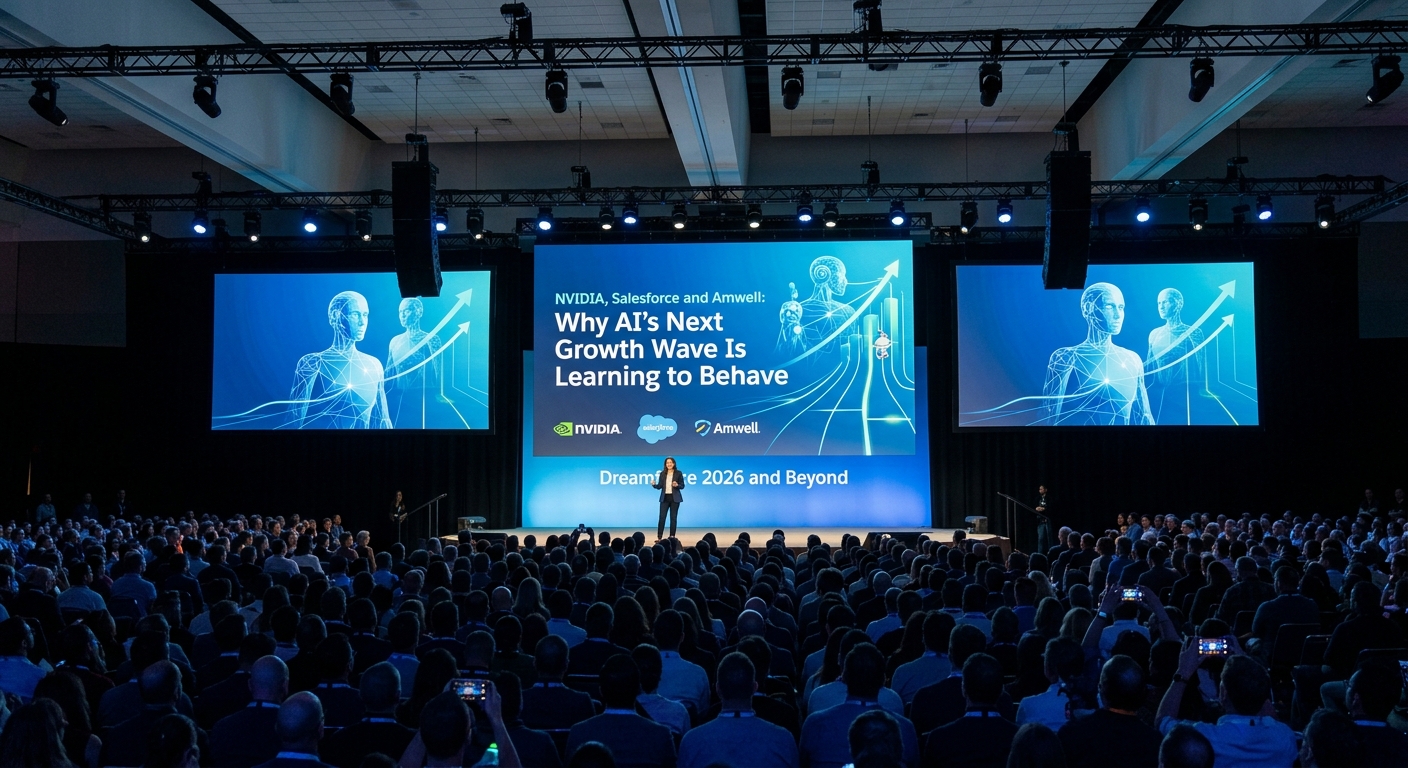
Artificial intelligence’s investment story is broadening from a race to build the largest models into a more commercially durable contest: who can deploy capable AI securely, govern it responsibly and connect it to real-world workflows. That shift puts NVIDIA Corp. (NASDAQ: NVDA), Salesforce Inc. (NYSE: CRM) and Amwell (NYSE: AMWL) in three distinct but increasingly connected lanes of the AI economy, compute, enterprise execution and regulated digital care. At Salesforce’s Dreamforce conference, NVIDIA Chief Executive Jensen Huang made the growth case in characteristically direct fashion: speed and safety need not be opposing forces. Anthropic’s Dario Amodei and OpenAI’s Sam Altman placed greater emphasis on deliberate safeguards and monitoring. For investors, the disagreement is less a sign of fracture than evidence that AI has graduated from laboratory theater to industrial policy, corporate governance and procurement committees, the places where large budgets tend to live.
From AI Debate to AI Deployment
The market’s first AI act rewarded chips, cloud capacity and headline model releases. The next act may reward platforms that make artificial intelligence dependable enough to use with customer records, healthcare information, government workflows and other data that would prefer not to become tomorrow morning’s cautionary tale. NVIDIA’s (NASDAQ: NVDA) message at Dreamforce was clear: rapid innovation can coexist with accountability if developers build and release responsibly. Anthropic and OpenAI, meanwhile, argued that safety and monitoring should precede, or at least tightly accompany, capability gains. That debate matters because it validates a key investment premise: trust is becoming a product feature. In the enterprise, the winning AI system will not merely write a decent paragraph or summarize a meeting. It will need to work inside permissions systems, preserve data boundaries, complete multistep tasks and produce results that a compliance officer can explain without reaching for the herbal tea. That is precisely where the commercial opportunity is moving.
NVIDIA and Salesforce Aim at the Enterprise Wallet
Salesforce (NYSE: CRM) and NVIDIA (NASDAQ: NVDA) used Dreamforce to introduce Koa, Salesforce’s first CRM-focused reasoning model for its Agentforce platform. Built on NVIDIA’s Nemotron 3 Super open-weight model, Koa is designed to help AI agents work through complex, multistep CRM tasks across sales, service and marketing. The distinction is important. General-purpose models generate excitement; domain-specific models can generate recurring enterprise revenue. Salesforce said Koa was post-trained using a proprietary synthetic dataset modeled on 27 years of CRM intelligence, rather than customer data. The model is intended to operate within Salesforce’s infrastructure, with Salesforce controlling the weights and the deployment environment. For customers, that structure addresses a perennial corporate concern: how to use advanced AI without casually sending sensitive business information on an unsupervised field trip. Salesforce also said Koa has matched or exceeded leading-model performance on CRM tasks in its internal CRM Bench while producing three times fewer errors. It is currently available to selected Agentforce pilot customers, with general availability in U.S. regions expected in winter 2026. Those are company-reported metrics and timelines rather than independent guarantees, but they point to a meaningful evolution in the Agentforce strategy, from offering AI access to owning more of the reasoning layer for high-value enterprise workflows.
Why This Is Bullish for NVIDIA
For NVIDIA, the Koa announcement reinforces a more durable investment thesis than simply “AI needs GPUs.”
- NVIDIA’s open-weight Nemotron architecture gives customers and partners a starting point for proprietary AI systems that can be fine-tuned, hosted and governed within controlled environments.
- The Salesforce collaboration demonstrates that NVIDIA’s opportunity extends beyond hardware shipments into enterprise AI software, model tooling and deployment frameworks.
- Salesforce is bringing Nemotron-based models and accelerated computing to Missionforce, its platform for government and regulated organizations—an area where private clouds, confidential networks and air-gapped environments can command premium attention.
- Koa’s focus on routine but economically vital tasks, case routing, opportunity management and follow-up scheduling, offers a concrete example of AI moving closer to measurable productivity rather than remaining a very articulate intern with no login credentials.
The broader takeaway is that NVIDIA (NASDAQ: NVDA) is helping partners create specialized reasoning systems around proprietary workflow expertise. That model could widen demand for NVIDIA’s full-stack AI ecosystem as organizations seek performance, efficiency and sovereignty rather than a one-size-fits-all chatbot.
Why Salesforce’s Position Is Improving
Salesforce (NYSE: CRM) has long owned a valuable real estate portfolio: customer relationships, workflow data, permissions, business logic and daily employee habits. Koa seeks to turn that installed base into a stronger AI moat. The company’s advantage is not simply access to a model. It is the ability to pair a model with the CRM context that makes agentic systems useful. Salesforce described Koa as being built for complicated workflows and trained on synthetic scenarios across more than 14 industries. That points toward a potentially favorable commercial equation: AI value = model capability + trusted enterprise context + workflow integration. A powerful model without context can be impressive. A powerful model that knows which customer case to route, which sales opportunity needs attention and which approval step cannot be skipped is much closer to becoming enterprise infrastructure.
Sovereign AI Is Becoming an Investable Theme
Seven Boson Group, a private company, is positioning itself around what it calls a Sovereign Agent Operating System: a full-stack, open, containment-first AI platform designed to allow nations and enterprises to own and govern advanced AI within their own borders. The language may sound grand “AGI era” is not known for understatement, but the underlying market signal is serious. Data residency, model control, national security, regulatory compliance and operational independence are becoming central requirements in AI deployments. This is the same demand vector that helps explain the appeal of NVIDIA’s (NASDAQ: NVDA) open-weight model ecosystem and Salesforce’s (NYSE: CRM) controlled deployment approach. Enterprises and governments increasingly want AI that can operate within their own technology and legal boundaries, rather than treating sensitive data as a frequent flyer. For public-market investors, Seven Boson Group does not offer a listed equity ticker for now, but could it be the next unicorn? For now, its relevance is thematic: sovereign AI may strengthen the addressable markets for public companies supplying the infrastructure, security, cloud capacity, networking, software orchestration and enterprise applications needed to operate AI in controlled environments. Potential beneficiaries across that broader ecosystem may include NVIDIA (NASDAQ: NVDA), Salesforce (NYSE: CRM), Microsoft Corp. (NASDAQ: MSFT), Amazon.com Inc. (NASDAQ: AMZN), Alphabet Inc. (NASDAQ: GOOGL), Oracle Corp. (NYSE: ORCL), Palo Alto Networks Inc. (NASDAQ: PANW), CrowdStrike Holdings Inc. (NASDAQ: CRWD) and Zscaler Inc. (NASDAQ: ZS). These companies face different competitive dynamics and valuation profiles, but each has exposure to the security, cloud, AI infrastructure or enterprise-governance layers that sovereign deployments require.
Amwell Turns AI Optimism Into a Real-World Care Opportunity
The AI investment narrative becomes more compelling when it reaches a regulated industry with large, persistent operational needs. Amwell (NYSE: AMWL) may offer one such example. The company announced that the U.S. Department of Veterans Affairs issued a letter of intent indicating its plan to deploy Amwell’s virtual-health platform across the VA enterprise to support modernization of digital health infrastructure. The platform is expected to facilitate connected care for more than nine million Veteran beneficiaries, according to the company. That is a potentially significant validation of Amwell’s ability to meet demanding requirements in a market where scale, security, interoperability and reliability carry more weight than a slick product demo. The VA cited Amwell’s capabilities in scalable video consultations, interoperability, cybersecurity compliance and integrated-care delivery as factors in its determination. Those are precisely the kinds of operational qualities that could make AI-enhanced healthcare platforms strategically valuable over time. For Amwell (NYSE: AMWL), the opportunity is not necessarily about declaring that a chatbot will replace medicine, a claim best left to PowerPoint decks with too many gradients. It is about building a digital infrastructure layer that can support virtual clinical services, improve care coordination and expand access.
The Crucial Caveat
The letter of intent is not a binding contract. The VA and Amwell still must negotiate and execute a definitive agreement, and the company identified risks including failure to convert the LOI, procurement challenges, timing, appropriations uncertainty and potential scope changes. That caveat matters. Investors should treat the announcement as a strategic milestone, not booked revenue. Still, the potential scale of the VA deployment could be consequential if it advances to a final contract, particularly for a company seeking to demonstrate that its platform can serve complex institutional healthcare systems.
The Bull Case: AI Becomes Infrastructure
The most constructive read across these developments is that AI’s commercial architecture is maturing.
| Company | Ticker | Strategic AI Role | What Investors May Watch |
|---|---|---|---|
| NVIDIA | NASDAQ: NVDA | Compute, AI software and open-weight model infrastructure | Enterprise adoption of Nemotron-based systems, sovereign AI demand and software ecosystem expansion |
| Salesforce | NYSE: CRM | AI agents embedded in CRM workflows | Koa pilot traction, Agentforce monetization, adoption in sales, service and government-adjacent environments |
| Amwell | NYSE: AMWL | Digital-health and virtual-care infrastructure | Whether the VA letter of intent converts into a definitive contract and deployment milestones |
| Seven Boson Group | Private | Sovereign, containment-first AI operating-system concept | A thematic indicator of rising demand for controlled, locally governed AI systems |
The common thread is not merely intelligence. It is operational AI: systems that can be deployed within a company’s boundaries, tied to real workflows, audited by human managers and used in industries where failure is expensive. That favors the companies building the picks and shovels, the business systems and the secure delivery platforms. NVIDIA (NASDAQ: NVDA) supplies the engine room. Salesforce (NYSE: CRM) is attempting to turn enterprise data into a controlled AI workbench. Amwell (NYSE: AMWL) illustrates how digital infrastructure can become consequential when it intersects with a large healthcare institution.
What Could Change the Story
A bullish thesis should leave room for the small matter of reality.
- AI spending could become more selective if customers struggle to demonstrate a return on investment from agent deployments.
- Regulatory requirements, cybersecurity incidents and data-governance failures could slow adoption, especially in government and healthcare.
- Salesforce’s Koa is still in limited pilot availability, so evidence of broad customer uptake and direct monetization remains ahead.
- Amwell’s VA opportunity remains nonbinding until a definitive contract is executed.
- Competition across models, cloud platforms, cybersecurity and enterprise applications remains intense, and investors should not assume today’s AI partnerships will become permanent moats.
Still, the tone from Dreamforce suggests that the AI boom is acquiring a more investable vocabulary: governance, security, data boundaries, domain expertise, deployment control and measurable workflow outcomes. That may be less cinematic than a model passing another benchmark. But it is also how technology graduates from a fascination into an expense line that a chief financial officer learns to defend, and, in the best cases, increase.
The Sources
- CNBC: Nvidia’s Huang diverges with Anthropic and OpenAI CEOs on AI safety at Dreamforce
- Yahoo Finance: Amwell Receives Letter of Intent from Department of Veterans Affairs to Help Power Its Digital Health Infrastructure
- Seven Boson Group: Seven Boson The Sovereign Operating System for the AGI Era
- Salesforce: Announcing Koa, Salesforce’s First CRM Reasoning Model, Built on NVIDIA Nemotron
- NVIDIA Blog: “Now We Can Know Everything and Do Anything,” Jensen Huang Says at Dreamforce
- Salesforce Investor Relations: Announcing Koa, Salesforce’s First CRM Reasoning Model, Built on NVIDIA Nemotron
- SiliconANGLE: AI Progress and Responsibility NVIDIA, Anthropic and OpenAI CEOs Weigh In at Salesforce’s Annual Event
Stay Updated with Vista Partners
Subscribe to receive market insights, investing ideas, and the latest updates directly in your inbox.