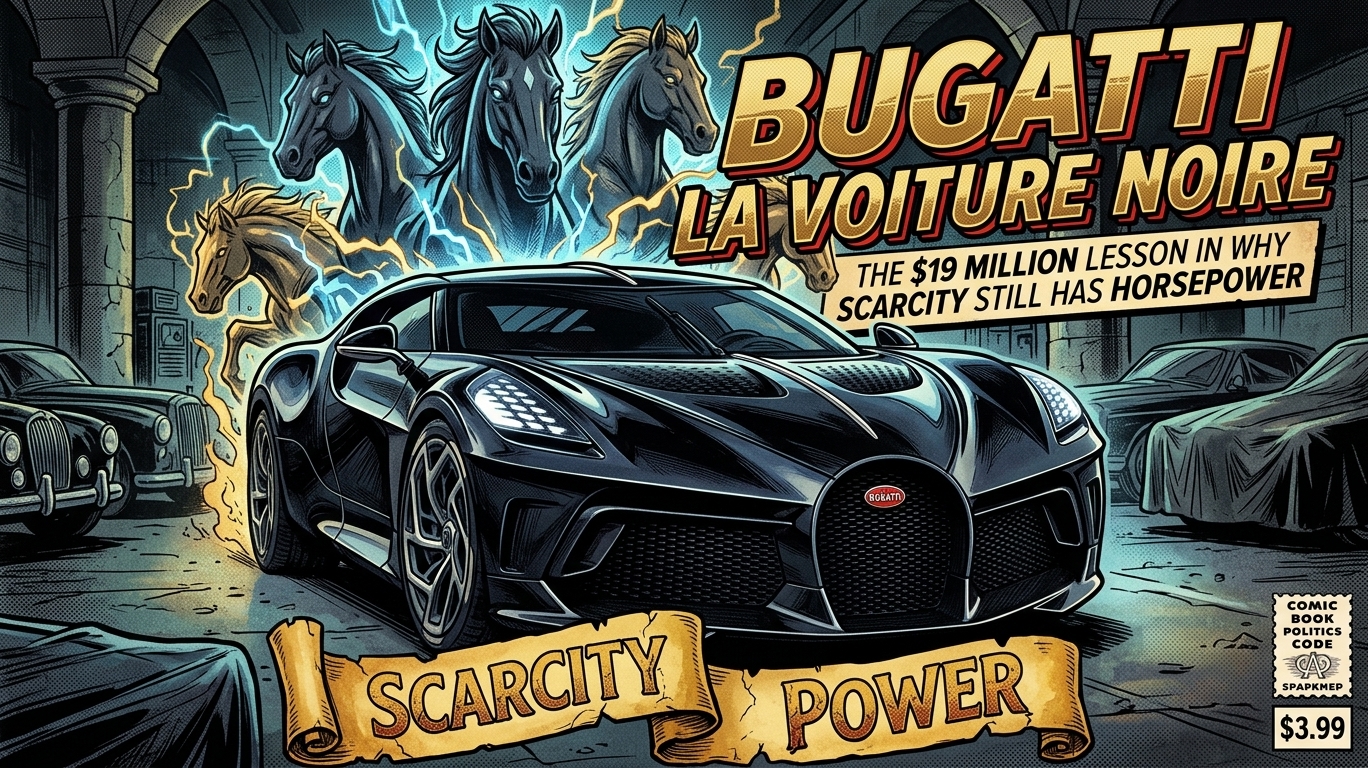
The one-off Bugatti La Voiture Noire is more than a hypercar with a spectacular price tag. It is a rolling argument for ultra-luxury’s most durable formula: heritage, technical theater, and the rarest commodity of all, something no one else can buy.
For investors watching the premium automotive market, the Bugatti La Voiture Noire offers a useful reminder: when a brand has enough history, craftsmanship and engineering credibility, conventional notions of unit volume can become almost beside the point. This is not a car designed to conquer a production target. It was designed to own a conversation and, at more than $19 million, it has done so with the calm assurance of a tuxedo that knows it will never see coach class. The video’s central theme is correct even if some of its workshop narration leans cinematic: La Voiture Noire was conceived as a one-off, hand-finished statement piece that turns carbon fiber, aluminum, leather and a W16 engine into a luxury asset with deeply limited supply. It is Bugatti’s tribute to the long-lost black Type 57 SC Atlantic once associated with Jean Bugatti, a mystery from the prewar era that still carries the kind of mythology most modern brands would hire three agencies to manufacture.
The Investment Case Starts With One
La Voiture Noire was never intended to be a high-volume product. That is precisely the point. In most corners of the automotive industry, scale lowers unit costs and supports margins. At the extreme end of luxury, however, scarcity can become the product itself. A one-off vehicle transforms the transaction from a conventional car sale into a demonstration of pricing power, brand equity and collector demand. Bugatti describes La Voiture Noire as a singular homage to the Type 57 SC Atlantic, one of the company’s most recognizable historical designs. Only four original Atlantics were made, and the company says three are known to remain while Jean Bugatti’s black example—the inspiration for the modern car—has long been missing.That historical connection matters because collectors rarely pay merely for acceleration. They pay for an irreplaceable narrative: a lost prewar icon, revived in modern form, wrapped in a body that does not need a resale brochure to announce its exclusivity. It is an equation that has fewer variables than a modern infotainment system and, arguably, more emotional torque.
Carbon Fiber, Craftsmanship and a W16 Heart
The above video emphasizes La Voiture Noire’s development as a patient, hand-led process rather than an ordinary assembly-line exercise. That portrayal fits the broader logic of a one-off hypercar: individual body panels require exacting fitment, critical mechanical systems must be validated repeatedly, and the materials must communicate both lightweight performance and tactile luxury. At its core, La Voiture Noire uses Bugatti’s iconic 16-cylinder engine architecture, with six tailpipes serving as a visible nod to the powertrain underneath. Bugatti itself calls attention to the car’s “iconic 16-cylinder engine,” while the vehicle’s exterior design links contemporary carbon-fiber hypercar construction to the Atlantic’s celebrated central dorsal seam. The video highlights several ingredients that explain why halo cars carry halo-car economics:
- A carbon-fiber monocoque that balances low weight with structural stiffness.
- Precision-machined aluminum components and carefully integrated subframes.
- Hand-assembled mechanical, suspension, braking and steering systems.
- Extensive paint, interior-leather and finishing work intended to make the car feel commissioned rather than configured.
- A quad-turbocharged 8.0-liter W16 engine, an architecture that helped define the modern Bugatti era.
This is not simply mechanical excess for its own sake. The W16 platform gives Bugatti a technological identity that is as recognizable in the hypercar world as a blue box is in luxury jewelry, except this blue box can make an unreasonable number of very expensive noises.
Why This Matters to Porsche Investors
Public-market investors cannot buy stock in Bugatti Automobiles directly. But they can assess what the brand’s ownership transition may mean for Porsche AG (OTC: POAHY; XETRA: P911) and for the broader valuation logic surrounding luxury automotive intellectual property. Porsche completed the sale of its stakes in Bugatti Rimac and Rimac Group on September 9, 2026, receiving approximately €1 billion in proceeds. Before the transaction, Porsche owned 45% of Bugatti Rimac and held a separate stake in Rimac Group. The exit changes the investment frame in two important ways. First, it provides Porsche with a meaningful capital inflow at a time when automotive manufacturers are balancing spending on electrification, software, supply-chain resilience and global market competition. Roughly €1 billion does not solve every industry challenge, but it gives management more flexibility than a garage full of inspirational posters. Second, the sale separates Porsche’s listed equity story from Bugatti’s ultra-low-volume hypercar business. Investors in Porsche AG (OTC: POAHY; XETRA: P911) should not treat La Voiture Noire as a direct revenue driver for Porsche going forward. Instead, it remains a valuable case study in the premium-brand economics Porsche itself understands well: limited-production, emotionally resonant products can strengthen a marque far beyond their unit count. The company’s completed transaction leaves Bugatti Rimac under the continued control of Rimac Group and new financial investors led by HOF Capital, with BlueFive Capital identified as the largest investor in the incoming consortium.
Bugatti’s Bullish Signal: Luxury Is Becoming More Bespoke
The La Voiture Noire story arrives at a time when high-end automotive demand increasingly prizes personal commission, heritage-led design and limited production. The most affluent buyers are not necessarily looking for another vehicle with more screens, more modes and more electronic ways to ask the driver whether they are enjoying themselves. They are looking for objects with provenance. Bugatti’s model offers a template for the industry’s top tier:
| Value Driver | La Voiture Noire Example | Investor Relevance |
|---|---|---|
| Absolute scarcity | One vehicle was created | Limits direct comparables and supports exclusivity |
| Heritage | Inspired by Jean Bugatti’s missing Type 57 SC Atlantic | Converts history into brand value |
| Engineering identity | Iconic 16-cylinder architecture and extreme-performance design | Reinforces technical credibility |
| Bespoke execution | Hand-finished materials, tailored details and exacting fit-and-finish | Supports premium pricing |
| Global collector appeal | A one-off purchase positioned as automotive art | Expands the buyer relationship beyond transportation |
Bugatti itself characterizes La Voiture Noire as a one-off blending speed, luxury and automotive haute couture. The company’s design language deliberately references the flowing surfaces, extended front end and central spine of the Type 57 SC Atlantic. For many, the broader takeaway is not that every automaker should begin building $19 million black hypercars. Most balance sheets would object, often loudly. It is that brand scarcity, credible design heritage and technical differentiation can produce a different kind of economic moat—one rooted in desire rather than production scale.
The Fine Print Beneath the Gloss
A bullish story still needs its brake pedal. La Voiture Noire is an extraordinary branding exercise, but a one-off hypercar does not establish a mass-market automotive trend or guarantee future collector appreciation. Its economics are fundamentally unlike those of mainstream vehicle programs, where manufacturing efficiency, regulatory compliance, financing conditions, dealer inventories and volume demand determine results. It is also worth noting that this is a decidedly old-school expression of performance. Bugatti’s disclosed figures list La Voiture Noire at combined WLTP fuel consumption of 22.3 liters per 100 kilometers and combined CO2 emissions of 506 grams per kilometer, numbers that reinforce its status as a highly exclusive combustion-era statement rather than a sustainability template. For Porsche AG (OTC: POAHY; XETRA: P911), the completed divestiture means future Bugatti performance should not be counted as a direct operating contributor. The more immediate investor question is how Porsche deploys the approximately €1 billion of proceeds and whether that capital strengthens the company’s broader profitability, product and technology strategy.
The Bottom Line
Bugatti La Voiture Noire is a $19 million argument that the luxury market still rewards the things spreadsheets struggle to quantify: rarity, craftsmanship, mythology and the particular satisfaction of owning the only one. For automotive investors, the car illustrates the enduring commercial power of elite brands when they pair authentic heritage with engineering spectacle. For collectors, it is automotive art with an 16-cylinder signature. And for everyone else, it is a reminder that while most cars are built to take us somewhere, a very small number are built to make an arrival.
The Sources
- Bugatti La Voiture Noire
Official Bugatti model page covering La Voiture Noire’s one-off status, Type 57 SC Atlantic inspiration, design philosophy and 16-cylinder engine reference. - Bugatti Newsroom La Voiture Noire
Official Bugatti newsroom page with related La Voiture Noire press materials, model documentation and disclosed fuel-consumption/emissions information. - Bugatti Rimac Ownership Transition and New Leadership
Official company announcement detailing the ownership transition, the prior Rimac Group/Porsche structure and new investor consortium. - Bugatti Rimac Porsche Sells Stakes to HOF Capital Consortium
Official release outlining Porsche’s divestiture agreement involving its holdings in Bugatti Rimac and Rimac Group. - Porsche Newsroom Porsche Completes Sale of Stakes in Bugatti Rimac and Rimac Group
Official Porsche statement on completion of the transaction and the approximately €1 billion in proceeds. - Reuters Porsche Completes Bugatti Rimac Exit, Raises 2026 Cash-Flow Outlook
Independent reporting on Porsche’s completed divestiture, the regulatory approval process and the company’s updated financial outlook. - YouTube “The Birth of the Bugatti La Voiture Noire” Video
Source video supplied for the story, describing the vehicle’s conceptual build process, carbon-fiber construction, W16 engine integration, handcrafted finishing and final testing.
Stay Updated with Vista Partners
Subscribe to receive market insights, investing ideas, and the latest updates directly in your inbox.