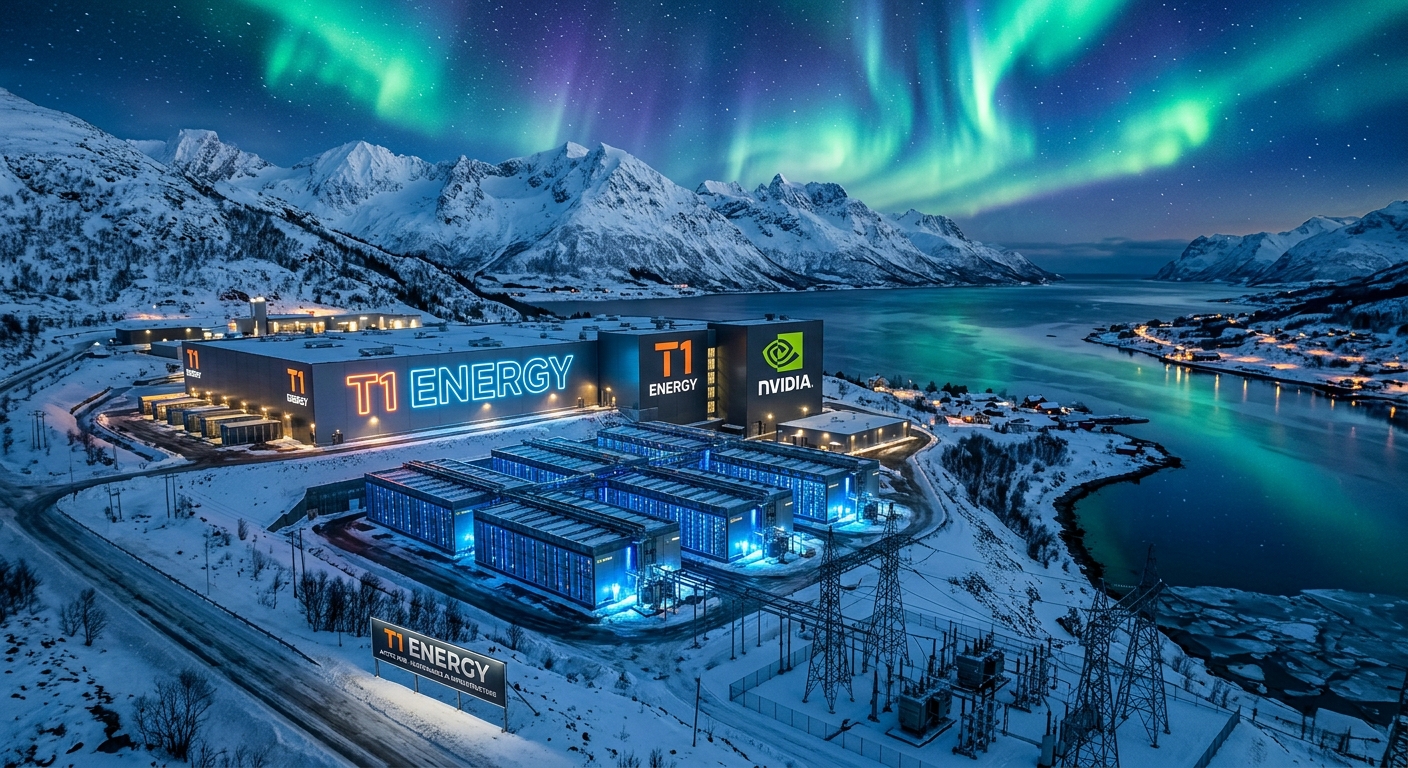
T1 Energy Inc. (NYSE: TE) has received local approval to convert part of its Giga Arctic campus in Mo i Rana, Norway, into a data center, a development that could give investors a distinctly different way to view the solar manufacturer’s European asset base. In a market hunting for power, permitted sites and AI-ready capacity, a 926,000-square-foot facility beside low-cost hydropower is not exactly an unwanted houseguest.
An Arctic Asset Meets AI Demand
T1 Energy said local officials approved the rezoning of 161,000 square feet at Giga Arctic for industrial or data-center use. The company believes a 50-megawatt data center could be operating in 2027 and says it holds a place in the grid-capacity queue totaling 396 MW, creating a potential route to much larger development over time. That combination matters because the AI investment cycle has moved well beyond the question of who can design the fastest accelerator. Increasingly, the limiting factors are physical: available electricity, grid interconnection, permits, cooling, real estate and construction-ready infrastructure. Northern Norway offers several attributes investors may appreciate:
- Electricity sourced primarily from abundant regional hydropower.
- An existing industrial-scale building rather than a blank sheet of land and a multiyear construction wish.
- Support from the Mo i Rana community and a 50-year site lease, with extension options.
- A path to scale if additional power capacity and further zoning are secured.
For T1 Energy (TE), this is less a detour from its solar-manufacturing mission than an exercise in asset-value optimization. In capital markets, as in Scandinavian weather, optionality can be more valuable than it first appears, particularly when it comes with a roof, grid access and a permit.
Jensen Huang’s New Math: Compute Is Infrastructure
The broader backdrop is a decisive change in how the market finances artificial-intelligence capacity. NVIDIA Corp. (NASDAQ: NVDA) Chief Executive Jensen Huang has argued that high-performance compute is not merely expensive equipment; it is a revenue-producing infrastructure asset. NVIDIA has entered memorandums of understanding with Apollo Global Management Inc. (NYSE: APO), BlackRock Inc. (NYSE: BLK), Blackstone Inc. (NYSE: BX), Brookfield Asset Management Ltd. (NYSE: BAM), The Goldman Sachs Group Inc. (NYSE: GS) and KKR & Co. Inc. (NYSE: KKR) to develop financing platforms aimed at mobilizing more than $500 billion of third-party capital for AI infrastructure. The key insight is straightforward: If compute can generate contracted or recurring revenue, institutional capital may finance it much as it finances other long-lived productive assets. Huang described the thesis with characteristic brevity: “In AI, compute is revenue.” That is a meaningful evolution for the AI supply chain. The early stages of the buildout were principally funded by hyperscalers and well-capitalized technology companies. The next phase could invite a far wider base of private credit, infrastructure capital, insurers, pension funds and alternative asset managers. Data centers, in other words, are becoming less like a corporate IT expense and more like a modern utility, with considerably more servers and considerably fewer people asking where the breaker box is.
Why T1 Energy Could Be Timely
The Giga Arctic approval positions T1 Energy (TE) near an intersection where several powerful investment themes meet:
| Investor theme | Why it matters to T1 Energy |
|---|---|
| AI compute expansion | The world needs more locations capable of hosting high-density computing workloads |
| Power scarcity | Access to low-cost, dependable electricity is becoming a strategic differentiator |
| Permitted development | Zoning approval and a large existing facility may reduce some early-stage development friction |
| Institutional capital | NVIDIA’s financing initiative suggests more capital may pursue AI infrastructure opportunities |
| Asset monetization | T1 could seek partnerships, leases, joint ventures or other structures to unlock value from Giga Arctic |
T1’s management has said it is discussing possible strategies and structures with multiple counterparties. That matters because T1 does not necessarily need to become a stand-alone hyperscale operator to benefit. It could monetize the asset through a lease, sale, joint venture, development partnership or other arrangement, depending on capital availability and economics. For many, the appeal is that the Arctic site may represent a source of strategic optionality separate from the company’s core U.S. solar and storage ambitions.
The Power Trade Is Becoming the AI Trade
Wall Street’s enthusiasm for NVIDIA (NVDA) has long centered on GPUs. The next leg of the AI story, however, may focus just as intensely on the infrastructure that makes those GPUs productive. A data center cannot train a frontier model on a PowerPoint slide. It needs electricity, transmission access, cooling systems, fiber connectivity, land, permits, construction labor and substantial financing. The scarcity of those inputs can turn an existing, grid-adjacent industrial facility into a strategically important asset. This is the context in which T1’s Norwegian development should be viewed. A prospective 50 MW facility is not simply another data-center announcement. It is a potential foothold in the physical economy of AI, one backed by a substantial building, hydropower-linked regional electricity and a pathway toward considerably greater grid capacity. The 396 MW grid-queue position is especially worth watching. It does not guarantee that all capacity will become operational or economically usable, but it frames the size of the prize if T1 can convert approvals, infrastructure and counterparties into a larger development platform.
What Many Should Watch Next
The bullish thesis for T1 Energy (TE) is compelling, but it remains a developing story rather than a completed transaction. The most consequential milestones are likely to include:
- A named tenant, development partner, buyer or financing counterparty for Giga Arctic.
- Confirmation of the economics for a first 50 MW buildout.
- Progress toward the company’s 2027 operating target.
- Further zoning approvals for additional portions of the 926,000-square-foot campus.
- Grid-capacity allocation and clarity on how much of the 396 MW queue position converts into usable power.
- The financing structure, including whether T1 retains ownership, secures a recurring revenue stream or realizes a one-time monetization gain.
- Continued demand for AI infrastructure from hyperscalers, AI labs and enterprise customers.
The risks are equally real: data-center development is capital intensive, power allocation can take time, tenant negotiations may not produce an agreement, and future AI hardware can depreciate rapidly. NVIDIA’s financing push itself highlights the opportunity and the challenge, Wall Street may be willing to finance the machines, but it will pay close attention to utilization rates, collateral values and revenue durability.
A Solar Company With an AI Call Option
T1 Energy’s core identity remains tied to building an integrated U.S. solar supply chain. Yet the Giga Arctic rezoning gives TE an additional narrative that few renewable-energy manufacturers can credibly claim: an existing European industrial asset that may be repositioned for an AI-era infrastructure market hungry for clean, scalable power. That does not make the outcome certain. But it does make the company more interesting. With NVIDIA (NVDA) and major asset managers such as APO, BLK, BX, BAM, GS and KKR working to bring institutional capital into AI factories, the market is signaling that compute capacity may be treated increasingly as productive infrastructure rather than fleeting hardware. For T1 Energy (TE), the Arctic opportunity is a potentially elegant second act: take a large legacy industrial facility, pair it with low-cost hydropower and AI demand, and let the infrastructure cycle do what infrastructure cycles do best, make yesterday’s overlooked asset look suspiciously well positioned.
The Sources
- T1 Giga Arctic Approved for Data Center Development Yahoo Finance
- Jensen Huang Just Sent Wall Street a Message About AGI TheStreet
- Jensen Huang Explained $500 Billion of Wall Street Money in Five Words Yahoo Finance
- Wall Street Endorsed Jensen Huang’s “Big Concept” for AI CNBC
- Nvidia and Wall Street Asset Managers Partner on $500 Billion AI Push CNBC
- Nvidia’s $500 Billion AI Financing Plan Faces a Major China Risk CNBC
- Nvidia’s $500 Billion AI Bet: Jensen Huang Brings Wall Street Into the Race BigDATAwire
- Nvidia’s $500 Billion Bet To Make AI Compute Wall Street’s Next Asset Class Forbes
Disclosure: This article is for informational purposes only and is not investment advice. Forward-looking statements regarding T1 Energy’s data-center plans, capacity, timeline, commercialization and asset value are subject to substantial risks and uncertainties, including financing, zoning, grid availability, tenant demand, permitting, construction and market conditions.
Stay Updated with Vista Partners
Subscribe to receive market insights, investing ideas, and the latest updates directly in your inbox.