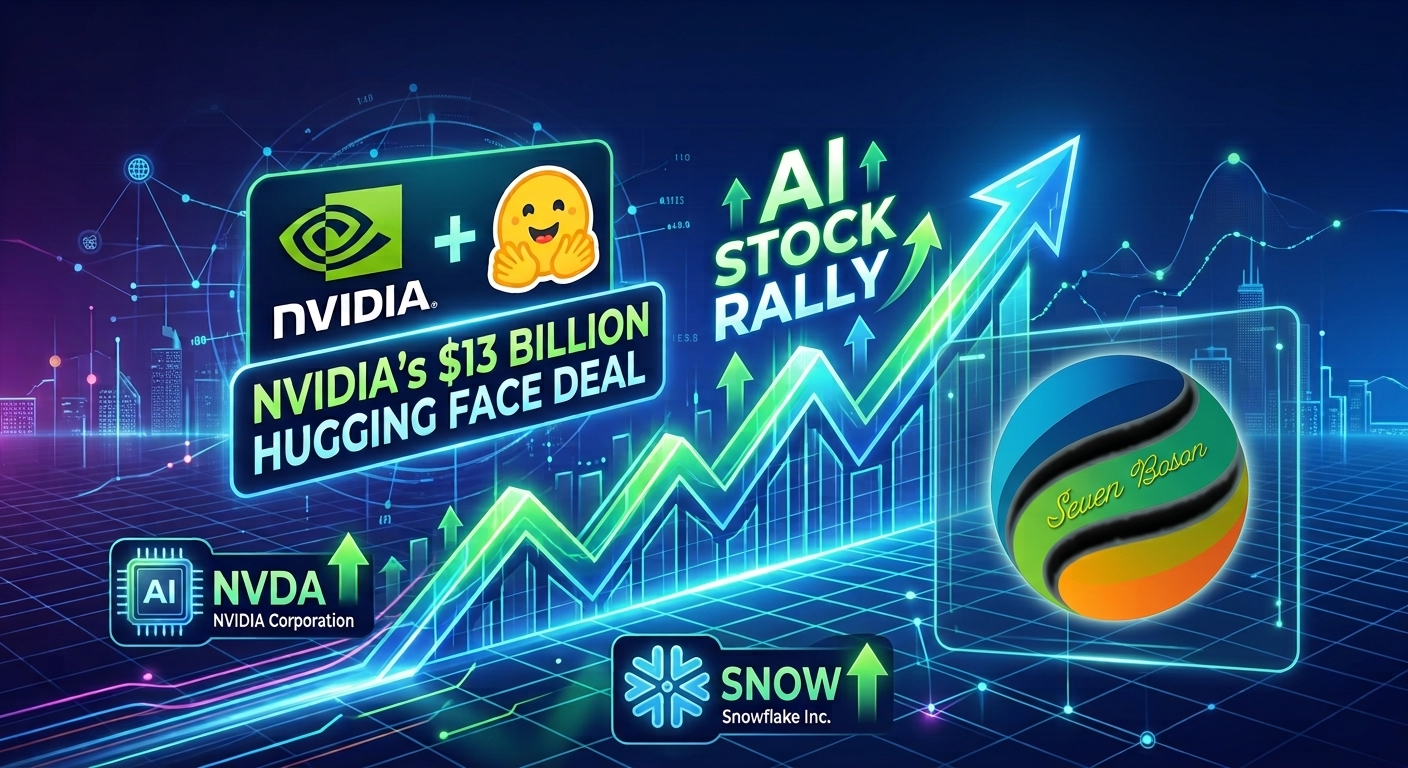
NVIDIA Corp. (NASDAQ: NVDA) has spent the past several years selling the shovels for the artificial-intelligence gold rush. Its planned $12.93 billion acquisition of Hugging Face suggests it now wants a more influential place in the mine, the marketplace and perhaps the town square where the next generation of AI applications is built. That is the leading signal in a broader bullish story: AI is moving from a concentrated infrastructure trade toward a full-stack deployment cycle. NVIDIA is expanding from compute into the developer ecosystem; Snowflake Inc. (NYSE: SNOW) is translating AI adoption into cloud-data consumption; Tesla Inc. (NASDAQ: TSLA) is pressing toward commercial autonomy; and Seven Boson Group’s work with Google Cloud points to a rapidly growing requirement for secure, governed and sovereign AI systems. The market will still have its regular arguments about valuations, of course. Wall Street regards a good argument as other people regard a holiday. But the commercial evidence is widening: AI is no longer simply an announcement category. It is becoming an operating-budget category.
NVIDIA Wants the AI On-Ramp
NVIDIA’s agreement to acquire Hugging Face for $12.9303 billion is a strategic expansion into the software and developer layer that sits upstream of AI infrastructure demand. Hugging Face describes itself as a platform that enables developers, researchers and companies to discover, build, share and deploy AI models and applications; it has said its ecosystem includes more than 18 million users, over 3 million models and more than 1 million applications. The significance for NVIDIA is not merely that it is buying a widely recognized AI brand. Hugging Face is a major gathering point for open-weight models, datasets, tools and developers, the people and organizations deciding which models to test, fine-tune and ultimately run in production. Every production-grade AI project needs an answer to a stubbornly practical question: where will the workload run? That question often leads back to accelerated computing, networking, inference infrastructure and the software layers NVIDIA has steadily assembled around its chips. NVIDIA said Hugging Face will continue to support all models, frameworks, clouds, inference providers and computing platforms. That is strategically important. Maintaining openness can help Hugging Face retain its broad ecosystem role, while NVIDIA gains greater connectivity to the developers and enterprises that may generate future AI demand.
The NVDA bull case
For NVIDIA (NASDAQ: NVDA) shareholders, the Hugging Face transaction reinforces several longer-term advantages:
- Developer distribution: Hugging Face gives NVIDIA deeper access to an enormous global AI-builder community.
- Open-model exposure: Open-weight AI can broaden experimentation among startups, enterprises, researchers and governments that want flexibility and customization.
- Inference opportunity: As AI shifts from training large models to serving millions of daily requests, recurring inference demand could become a major compute market.
- Ecosystem leverage: Hardware, networking, CUDA software, enterprise deployment tools and developer platforms can reinforce one another.
- Platform optionality: NVIDIA is strengthening its relevance earlier in the AI-development process—before an experiment becomes a budgeted, production-scale workload.
The transaction is expected to close in the first half of 2027, pending customary conditions and regulatory clearance. NVIDIA’s central investment appeal has always been its ability to turn technical leadership into an ecosystem advantage. Hugging Face suggests management is not waiting for competitors to decide where the AI developer’s front door should be.
Snowflake Turns AI Into Revenue
If NVIDIA is extending its reach to the front end of AI development, Snowflake (SNOW) is showing what happens when AI workloads begin to consume data and cloud services inside real enterprises. Snowflake reported second-quarter fiscal 2027 revenue of $1.55 billion, up 35% year over year and above the $1.48 billion consensus estimate tracked by LSEG. Product revenue rose 37% to $1.49 billion. Its shares jumped sharply following the results this week, as investors focused on the company’s stronger outlook and evidence that AI-related demand is contributing to growth. The numbers matter because data is the raw material for enterprise AI. Most companies do not need another novelty chatbot that can summarize a policy document with the confidence of a junior consultant on three espressos. They need secure access to proprietary data, governance, data pipelines, analytics, permissions and a way to turn AI experimentation into reliable business workflows. That is the terrain Snowflake is trying to own.
AI’s enterprise monetization test
Snowflake (NYSE: SNOW) sits at an attractive point in the AI value chain because its revenue model is tied to customer consumption. When organizations store more data, run more queries, build more applications and put AI agents to work against enterprise information, platform usage can rise. Management has emphasized its AI Data Cloud strategy, which seeks to combine data governance, application development and AI capabilities across a single platform. Snowflake’s better-than-expected quarterly revenue and 37% product-revenue increase suggest that customers are continuing to expand cloud-data workloads even as they scrutinize technology budgets. For many, the broader read-through is important: the AI opportunity may not depend solely on the next training cluster. It may also depend on a much more recurring enterprise cycle in which companies modernize data estates, build AI applications and pay for the compute and data services those applications consume.
Tesla Takes AI Into the Physical World
Tesla’s Cybercab event in Austin introduces a different, higher-risk and potentially much larger version of the AI proposition: autonomous mobility. Tesla (NASDAQ: TSLA) is set to unveil its purpose-built Cybercab, a two-seat electric robotaxi with no steering wheel or pedals, designed to operate through the company’s Full Self-Driving system. Tesla’s existing robotaxi service uses autonomous Model Y vehicles, while the Cybercab is intended to become the specialized vehicle at the center of a broader driverless ride-hailing network. Tesla had 420 autonomous vehicles registered in Texas as of Wednesday evening, including 45 Cybercabs, according to state records cited by Reuters. The company has also expanded its robotaxi service from an initial Austin pilot begun in June 2025 to a limited number of cities in Texas and Florida. The investment case hinges on whether Tesla can make autonomy work safely, economically and at scale—not merely whether it can stage a memorable event. The company’s long-term ambition is to evolve from selling vehicles to operating, and potentially licensing, an AI-driven transportation network.
The TSLA upside and the reality check
| Potential catalyst | Why it matters | Key constraint |
|---|---|---|
| Cybercab deployment | A purpose-built robotaxi could reduce cost per ride and improve fleet economics | Production and fleet-scale execution remain unproven |
| Robotaxi-network expansion | A functioning network could add recurring, platform-style revenue | Regulations vary by city and state |
| Full Self-Driving software | Software upgrades and autonomous capability may raise lifetime vehicle value | Safety performance and regulatory acceptance remain central |
| Real-world data advantage | Tesla’s fleet can generate large volumes of driving data | Data volume alone does not guarantee fully autonomous performance |
The bullish thesis for Tesla is not that a two-seat vehicle without pedals automatically becomes a profit machine. It is that autonomy could unlock a substantially different earnings architecture if Tesla can pair software, AI compute, a large installed vehicle base and fleet operations into a commercial service. That remains a high-stakes execution story. Yet the Cybercab’s arrival matters because it makes Tesla’s robotaxi strategy more tangible and makes the company’s AI ambitions harder to categorize as merely future tense.
Seven Boson and Sovereign AI
The AI market is also expanding in a direction that public markets are only beginning to appreciate: AI systems increasingly need to be governed, localized and deployable under national, enterprise and regulatory constraints. Seven Boson Group’s participation in the Google Cloud Partner Advantage program adds a sovereign-AI layer to the investment narrative. The company positions its AI decision-intelligence offering for nations, public-sector institutions and regulated enterprises that want access to advanced AI while maintaining control over data residency, policy enforcement, security and operational authority. That proposition is increasingly relevant as AI enters sectors where data sovereignty is not a branding flourish. Governments, healthcare systems, banks, critical-infrastructure operators and defense-linked institutions may require systems that can operate within domestic or institutionally controlled environments. Seven Boson has said its sovereign AI decision-intelligence services are designed to enable countries and institutions to own, deploy and govern frontier AI without dependency on foreign providers. In practical terms, this means the AI stack must be able to handle more than models and compute. It must also address identity, cybersecurity, governance, policy controls, auditability, edge deployment and data localization. The cloud was once sold as a borderless abstraction. AI is teaching it about passports.
Google Cloud’s strategic read-through
For Alphabet Inc. (NASDAQ: GOOGL) (NASDAQ: GOOG), partnerships such as Seven Boson’s can help extend Google Cloud’s infrastructure, AI and security tools into specialized sovereign and regulated deployments. Google has described its partner-network strategy as centered on customer outcomes, co-selling, service delivery and shared innovation. Seven Boson’s relevance to investors is as an indicator of where AI spending may broaden: deployments that pair global cloud technology with local governance, national policy authority and secure data controls. This is a meaningful read-through for companies supplying the underlying AI stack:
- Alphabet Inc. (NASDAQ: GOOGL) (NASDAQ: GOOG): Cloud, AI tools, security capabilities and partner-led deployments.
- NVIDIA Corp. (NASDAQ: NVDA): Accelerated compute, networking and deployment infrastructure for AI workloads.
- Advanced Micro Devices Inc. (NASDAQ: AMD): Alternative AI compute and server-platform exposure as sovereign and enterprise AI infrastructure expands.
- Cisco Systems Inc. (NASDAQ: CSCO): Networking, security and enterprise-integration needs in distributed AI deployments.
- Qualcomm Inc. (NASDAQ: QCOM): Edge-AI exposure where workloads require local processing, reduced latency or strict data-control requirements.
The Bullish AI Blueprint
NVIDIA’s Hugging Face acquisition is the clearest headline because it illustrates a shift in the AI market’s center of gravity. The industry leader in accelerated computing is not content to supply the hardware beneath the AI economy; it is seeking greater relevance to the developers and open-model ecosystems that help determine where the next workloads are created. Snowflake provides the enterprise proof point. Its $1.55 billion quarter and 37% product-revenue growth indicate that AI, cloud data and application development can translate into measurable customer consumption. Tesla provides the physical-world optionality. The Cybercab could become a pivotal commercial test of whether AI can transform transportation from a vehicle-selling business into a networked service platform. And Seven Boson, through its Google Cloud Partner Advantage participation, provides the governance dimension. As AI becomes embedded in national and enterprise operations, the ability to deploy it securely, locally and under clear policy control could be as important as the model itself. The investment conclusion is not that every AI-adjacent company should be priced as though it has invented electricity. The more compelling argument is that the addressable market is spreading across multiple durable layers:
- Compute and infrastructure
- Developer platforms and open-model ecosystems
- Data clouds and enterprise applications
- Autonomy and physical AI
- Cloud security, governance and sovereign AI
- Edge systems, networking and localized deployments
That is why NVIDIA’s Hugging Face deal deserves to lead the conversation. It is a bet that the AI economy’s next chapter will be shaped not only by who makes the most powerful chips, but by who helps developers, enterprises and governments put AI to work. For NVIDIA, that is a familiar playbook: own the engine, improve the road and make sure the most interesting destinations are easier to reach with its map.
The Sources
- NVIDIA to Acquire Hugging Face NVIDIA Blog
- Nvidia confirms $13 billion acquisition of open-weight AI platform Hugging Face Yahoo Finance
- Nvidia Buys Hugging Face in $12.9 Billion Deal CNBC
- Nvidia Buying Artificial Intelligence Platform Hugging Face for $12.93 Billion Associated Press
- Snowflake Stock Skyrockets on AI-Driven Q2 Revenue Jump Yahoo Finance
- Snowflake Lifts Annual Revenue Forecast on Cloud and AI Demand Reuters
- Snowflake Spikes 22% on Healthy Results and AI Coding Momentum CNBC
- Tesla’s Cybercab Event Is Tonight: What the Industry and Wall Street Expect Yahoo Finance
- Tesla Set to Hold Cybercab Event in Austin, Texas Reuters
- Tesla’s Cybercab Event Set for Thursday, With Few Details Reuters
- Seven Boson Group Announces Participation in Google Cloud Partner Advantage Seven Boson Group
- Seven Boson Group Press Releases Seven Boson Group
- Seven Boson Group Launches Sovereign AI Decision Intelligence Service for the AGI Era GlobeNewswire via IT News Online
- Seven Boson Group Launches Sovereign AI Decision Intelligence Service Europe Says
- Introducing Google Cloud Partner Network and Three New Ways to Engage Google Cloud Blog
- Google Cloud Partner Advantage Momentum Google Cloud Blog
- Google Cloud Partner Home Google Cloud
- HUMAIN and KORA Partner to Build Operating System at LEAP 2026 PR Newswire
- HUMAIN and KORA Systems Partner to Develop an AI-Native Operating System for Enterprise Computing FinTech Gate
- About HUMAIN HUMAIN
- HUMAIN and KORA Partner to Build an Operating System HUMAIN
Stay Updated with Vista Partners
Subscribe to receive market insights, investing ideas, and the latest updates directly in your inbox.