


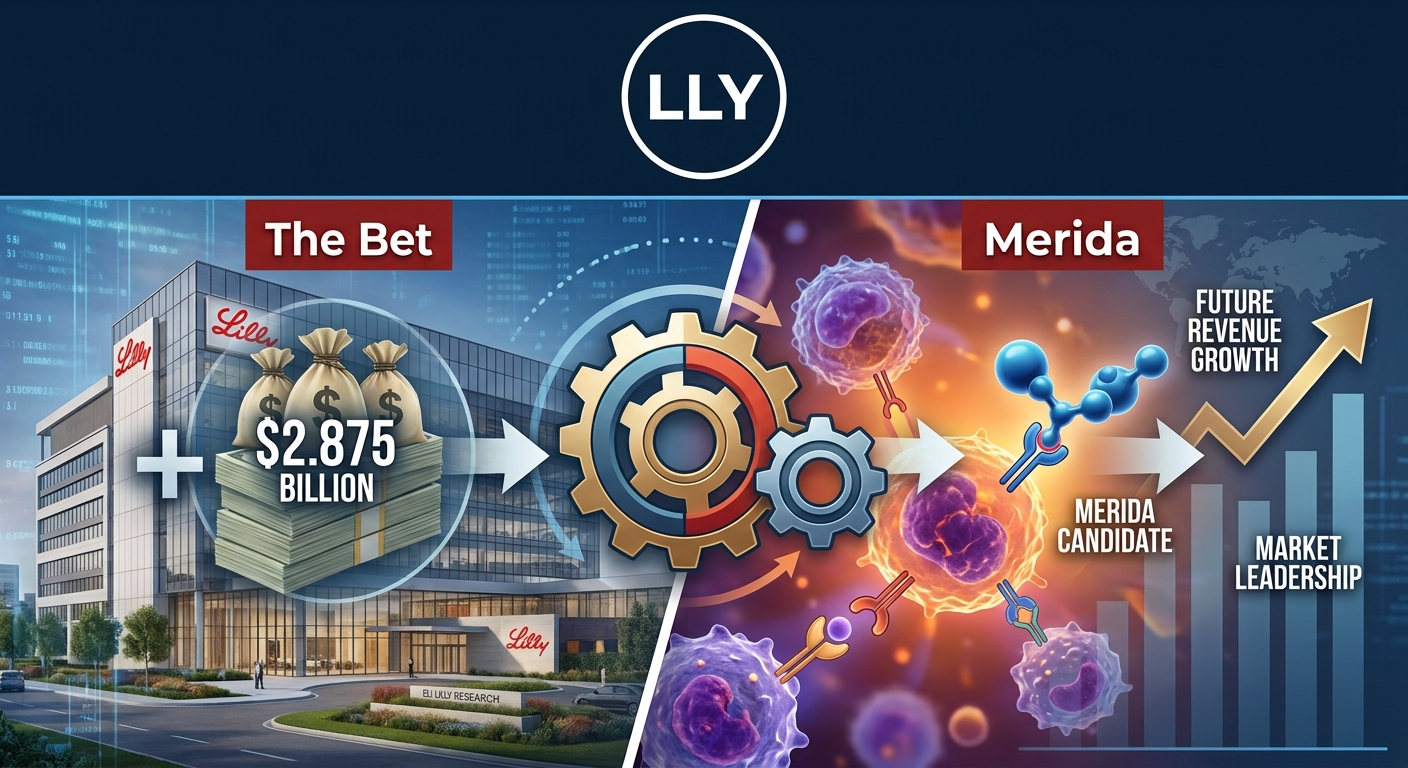
Eli Lilly and Company (NYSE: LLY) is making a confident and distinctly forward-looking move beyond its blockbuster obesity and diabetes franchises. Its agreement to acquire privately held Merida Biosciences for up to $2.875 billion in cash is a bullish vote for precision immunology: the idea that autoimmune and allergic diseases may be treated by removing the specific antibodies driving illness, rather than broadly dampening the immune system and hoping the collateral damage stays polite. The transaction, expected to close in the fourth quarter of 2026 subject to customary conditions and regulatory approvals, gives LLY a potential platform play in antibody-driven disease, not simply a single early-stage drug candidate.
The Bull Case: Lilly Is Buying a Scientific Platform
Merida’s core proposition is sophisticated but intuitively compelling: engineer biologics to selectively degrade pathogenic autoantibodies, the antibodies that cause disease, while preserving normal immune function. Existing autoimmune treatments can be highly effective, but many work through broad immune modulation or suppression. Merida’s approach aims to be more targeted, potentially reducing the biological “friendly fire” that can accompany less selective therapies. That distinction matters to many because successful biotechnology platforms can generate more value than one successful molecule. If Merida’s antibody-engineering technology proves clinically durable and safe, Lilly could potentially apply it across multiple diseases driven by harmful antibodies. The company’s lead candidate, MER511, is in Phase 1 development for:
- Graves’ disease.
- Thyroid eye disease, or TED.
- Potentially other autoantibody-mediated disorders over time.
Early Phase 1 findings showed robust reductions in pathogenic thyroid-stimulating antibodies and a favorable initial safety profile, according to the companies. Those are encouraging biological signals, but they are still early signals. Phase 1 is the beginning of the clinical journey, not the victory lap.
A Large Disease Opportunity Hiding in Plain Sight
Graves’ disease affects roughly 3 million people in the United States, according to the acquisition announcement. Approximately 25% to 40% of patients with Graves’ disease may develop thyroid eye disease, a painful and potentially disfiguring condition that, in severe cases, can impair vision.The commercial appeal is not merely patient count. It is the possibility of treating the underlying driver of disease. Thyroid-stimulating immunoglobulins activate the thyroid-stimulating hormone receptor and contribute to both Graves’ disease and TED. Merida’s thesis is that eliminating those disease-causing antibodies could potentially alter the disease process more directly than therapies aimed primarily at downstream symptoms or generalized immune activity. No currently approved treatment directly targets the pathogenic antibodies implicated in these conditions, according to the company announcement. For LLY, that potentially creates an intriguing long-term opportunity: a precision approach that could complement, rather than simply replicate, established immunology strategies.
MER769 Expands the Optionality
The Merida deal is not limited to Graves’ disease and thyroid eye disease. Its pipeline also includes MER769, a preclinical program aimed at IgE-driven allergic conditions, including:
- Food allergy.
- Asthma.
- Chronic spontaneous urticaria.
- Other antibody-mediated allergic disorders.
Merida also has earlier research programs in kidney diseases, including membranous nephropathy, and other immune-mediated conditions. This is where the investor narrative becomes potentially more compelling. The immediate asset is MER511, but the strategic asset may be Merida’s ability to generate a portfolio of antibody-degradation medicines across autoimmune, allergic, and renal diseases.Put differently: Lilly is not merely buying a seat at one clinical table. It is buying a possible invitation to several large and under-served medical banquets, where the menu may be expensive, but the addressable markets can be even more so.
Why This Could Be Bullish for LLY Stock
The Merida acquisition reinforces a broader strategic message for Eli Lilly (NYSE: LLY): the company intends to use its current financial strength to build the next generation of growth drivers. Lilly’s obesity and diabetes medicines have helped transform the company into one of the market’s defining pharmaceutical growth stories. But sophisticated investors understand that durable large-cap pharma value depends on more than one therapeutic category, no matter how fashionable that category may be. Markets enjoy a blockbuster; they value a portfolio. The acquisition offers several bullish features:
| Investor consideration | Why it matters for Eli Lilly (NYSE: LLY) |
|---|---|
| Precision-immunology platform | Could create multiple programs across autoimmune and allergic disease categories |
| Differentiated mechanism | Selectively targeting harmful antibodies may offer a distinct alternative to broad immune suppression |
| Early clinical validation | MER511 has shown reductions in disease-associated antibodies with favorable preliminary safety findings |
| Pipeline diversification | Expands Lilly’s growth opportunity beyond obesity, diabetes, neuroscience, oncology, and established immunology assets |
| Milestone-based structure | Part of the $2.875 billion consideration is contingent on future milestones, aligning a portion of the payout with program advancement |
| Significant unmet need | Graves’, TED, food allergy, asthma, urticaria, and kidney diseases represent meaningful areas of patient need and commercial potential |
The structure deserves attention. Lilly will pay up to $2.875 billion in cash, including an upfront payment plus contingent milestone payments. That does not remove clinical risk, but it means the full headline valuation is tied in part to future execution rather than simply being handed over with a congratulatory bow and a fruit basket.
The Market May Be Missing the Point
Shares of LLY were reported modestly lower on the announcement day, a reaction that appears to reflect the early-stage nature of MER511 and the absence of disclosed detail around the upfront payment. One report cited a decline of around 1.7% during Monday trading, while another described the reaction as slight. That restrained response is not necessarily a bearish verdict. It may instead reflect a market doing what markets often do with large pharmaceutical acquisitions of early-stage assets: separating near-term earnings arithmetic from long-term strategic value. MER511 remains a Phase 1 program. It must still demonstrate safety, efficacy, durability, clinical relevance, and ultimately regulatory approvability in larger studies. There is no guarantee that the acquisition will close, that the programs will succeed, or that Merida’s technology will yield approved products. Lilly itself highlighted those risks in its forward-looking statement. Yet that is precisely why the opportunity exists. If Merida had already produced definitive late-stage data in several major indications, the acquisition price would almost certainly have reflected a more mature asset profile and the potential upside would be far less asymmetric. For many, the question is not whether a Phase 1 immunology platform is risk-free. It plainly is not. The sharper question is whether LLY has the scientific depth, clinical-development resources, manufacturing scale, and balance-sheet capacity to turn an early validation signal into a multi-indication franchise. Lilly is betting that it does.
The Bigger Investment Narrative
Lilly’s Merida agreement supports a constructive view of Eli Lilly (NYSE: LLY) as a company seeking to convert today’s commercial strength into tomorrow’s therapeutic leadership. The deal seems to bring three attractive ingredients together:
- A potentially differentiated approach to treating diseases caused by pathogenic antibodies.
- An early clinical asset in Graves’ disease and thyroid eye disease with encouraging preliminary biomarker and safety observations.
- A broader discovery and development platform that could reach into allergy, asthma, chronic urticaria, kidney disease, and other immune-mediated disorders.
For shareholders, the central takeaway is straightforward: LLY is behaving like a company that expects to remain a growth company after the current GLP-1 era matures. The Merida transaction may not move next quarter’s earnings needle, and it is unlikely to settle any valuation debates by breakfast. But it adds another potentially consequential pillar to Lilly’s long-term growth architecture. In an industry where “pipeline” can sometimes be shorthand for “please see our PowerPoint,” Merida gives Lilly something more tangible: early human data, a differentiated scientific thesis, and multiple shots on goal in some of medicine’s most stubborn disease categories. That is not a guarantee of success. It is, however, the kind of calculated ambition investors generally prefer to find inside a premium pharmaceutical franchise.
The Sources
- Merida Biosciences “Lilly to Acquire Merida Biosciences to Advance Treatments for Serious Autoimmune and Allergic Diseases”
- PR Newswire “Lilly to acquire Merida Biosciences to advance treatments for serious autoimmune and allergic diseases”
- PharmExec “Eli Lilly to Acquire Merida Biosciences for $2.8 Billion”
- GuruFocus “Eli Lilly Stock Falls After Pharma Giant Unveils $2.9 Billion Acquisition”
- Investing News Network “Lilly to acquire Merida Biosciences to advance treatments for serious autoimmune and allergic diseases”
- Yahoo Finance “Eli Lilly (LLY) Makes a $2.88 Billion Autoimmune Bet. What Could Go Right or Wrong?”
- Pharmaceutical Technology “Lilly’s $2.875B Merida Deal Has Implications for Autoantibody Diseases”
- Quartz “Eli Lilly buying Merida Biosciences for up to $2.875 billion”
- Investing.com “Lilly to acquire Merida Biosciences for up to $2.875 billion”
Stay Updated with Vista Partners
Subscribe to receive market insights, investing ideas, and the latest updates directly in your inbox.

Daily Market Summary Aug. 31, 2026: Stocks Retreat as Oil Spike and Rate Fears Pressure Risk Assets -( $CVX $LPL $MODD $MU $NVDA $SMWB $SOC $TSLA $ULTA $VIX )