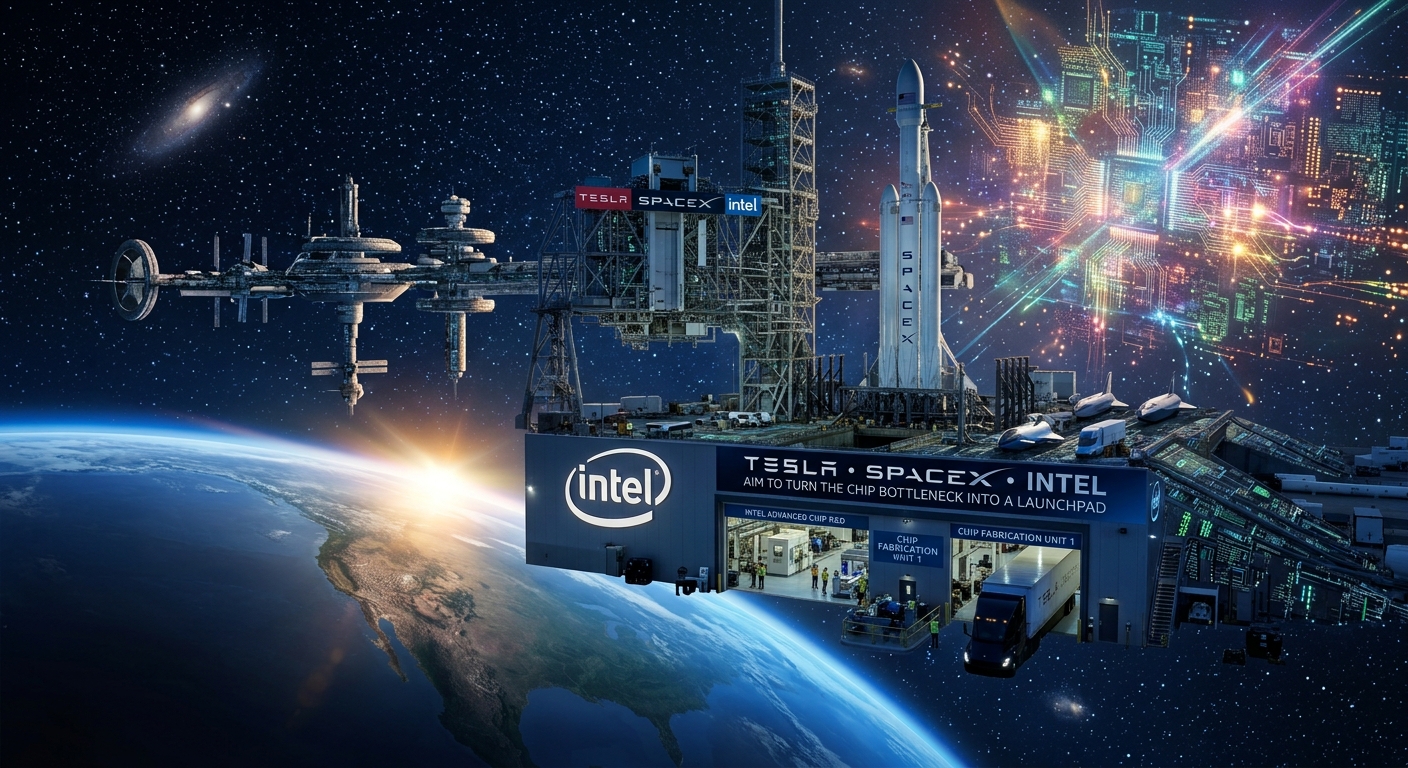
The latest vision circulating around Tesla, Inc. (NASDAQ: TSLA) and SpaceX (NASDAQ: SPCX) is not merely another large factory proposal. It is a bid to secure the compute supply chain for a future in which electric vehicles, humanoid robots, artificial intelligence and orbital infrastructure all compete for the same scarce resource: advanced semiconductors.
The video’s message is deliberately grand, humanity, solar power and space-based AI do not tend to arrive in modest PowerPoint decks. Yet the investment logic underneath the cosmic language is concrete: if demand for proprietary AI chips grows faster than external foundries can allocate capacity, vertical integration becomes less a flourish of ambition and more a strategic necessity.
TERAFAB: A Factory Built for a Compute-Hungry Future
Tesla’s TERAFAB presentation describes a proposed chip-manufacturing complex developed alongside SpaceX and xAI, designed to unite logic-chip fabrication, memory and advanced packaging in one operation. Its long-range target is striking: as much as 1 terawatt of AI-compute hardware annually. That number should be understood as an aspiration rather than near-term production guidance. Still, the project reveals where the Musk-led ecosystem sees its constraint: not a shortage of ideas, batteries, rockets or software engineers, but a shortage of silicon.Tesla has said the initiative is intended to serve an expanding roster of compute-intensive products, including autonomous vehicles, robotaxis, Optimus humanoid robots and solar-powered AI satellites. In the company’s framing, Optimus alone could ultimately require 100–200 gigawatts of chips, while space-based AI infrastructure could require capacity measured in terawatts. That is a demand forecast with enough voltage to make a utility executive reach for a decaf.
Why Tesla Stock Could Have More Than One Growth Engine
The traditional debate over Tesla stock often centers on deliveries, vehicle margins, pricing and the timing of autonomy. Those remain essential. But TERAFAB introduces a larger strategic question for Tesla (NASDAQ: TSLA): can the company transform itself from a major buyer of AI chips into an architect of its own compute supply? The bull case rests on several connected possibilities:
- Autonomy at scale: Tesla’s full-self-driving ambitions depend on efficient inference hardware in vehicles and massive training capacity behind the scenes. Greater control over chip design and manufacturing could reduce supply-chain exposure and give Tesla more flexibility in performance, cost and deployment cadence.
- Optimus as a silicon-demand machine: A large-scale humanoid-robot business would not be just a robotics story; it would be a semiconductor story. Each robot requires onboard intelligence, sensors, control systems and continuous software improvement. If Tesla reaches anything close to its most ambitious Optimus targets, securing dedicated chip capacity could become a competitive advantage rather than a capital-expenditure indulgence.
- Vertical integration, revisited: Tesla has repeatedly tried to bring strategic technologies closer to home, from vehicle software and battery systems to charging infrastructure. TERAFAB extends that logic to the most precious ingredient in the AI economy: compute. It is vertical integration with a clean-room suit.
Tesla’s investor-relations site currently provides its quarterly disclosures, earnings materials and SEC filings, which remain the appropriate primary references for investors evaluating company guidance, spending plans and execution progress.
SpaceX: The Orbital Demand Curve Arrives on Wall Street
For SpaceX (NASDAQ: SPCX), TERAFAB broadens the investment narrative beyond rockets and connectivity. SpaceX already occupies a rare position at the intersection of reusable launch services, satellite communications and space infrastructure. The TERAFAB concept adds a prospective fourth layer: a potentially captive supply of AI-oriented hardware for an orbital computing network. The premise is bold. Tesla’s presentation envisions sending vast solar-capture infrastructure into space and using solar-powered AI satellites, supported by massive launch capability and industrial-scale robotics. Whether that exact architecture arrives on schedule, or at all, is an open question. The investor-relevant point is that SpaceX is positioning launch capacity as an input to a broader compute-and-energy platform, not simply a transportation service to low-Earth orbit. That matters because space-based systems could create demand for:
- Frequent and lower-cost launches.
- Satellite manufacturing and deployment.
- High-performance, potentially radiation-hardened compute.
- Communications networks and ground infrastructure.
- Energy collection and data-processing systems operating beyond terrestrial power-grid constraints.
For SpaceX shareholders, the attractive scenario is an expanding flywheel: launch supports satellites, satellites support connectivity and data services, and future AI infrastructure increases the value of both. Rockets may be the visible product; the durable economic prize could increasingly be the network and compute capacity those rockets make possible.
Intel Could Be the Quiet Winner
Intel Corporation (NASDAQ: INTC) is the public semiconductor name most directly tied to the TERAFAB narrative. CNBC reported that Intel joined the project in April to help design, fabricate and package high-performance chips at scale, while Tesla indicated an interest in using Intel’s forthcoming 14A manufacturing process. For Intel, the arrangement could represent more than a contract or a headline. It would be an opportunity to validate its foundry ambitions with an unusually demanding customer ecosystem—one that wants leading-edge hardware for cars, robots, AI systems and space applications. The potential upside for Intel includes:
- A marquee commitment to its foundry and advanced-packaging capabilities.
- Greater credibility with large customers seeking alternatives to concentrated global semiconductor supply.
- A possible multi-year demand stream tied to Tesla, SpaceX and xAI compute requirements.
- A strategic role in reshoring advanced chip manufacturing capacity in the United States.
The caution is equally obvious: foundry manufacturing is capital-intensive, technically unforgiving and measured in years, not quarters. A chip fab is not a food truck with better ventilation. But if execution advances, Intel could gain a high-profile proof point for its return to leading-edge manufacturing relevance.
The Capital Tab Is Enormous, So Is the Strategic Prize
The numbers attached to TERAFAB are substantial enough to make even Silicon Valley’s usual tolerance for big spending pause politely. Public filings cited by CNBC indicated an estimated first-phase cost of about $55 billion, with potential spending rising to as much as $119 billion for a full buildout in Grimes County, Texas. The initiative reportedly involves Tesla, SpaceX and xAI, while SpaceX is expected to handle the initial scaled phase. Investors should therefore avoid treating the project as near-term earnings fuel. It is better viewed as a long-duration strategic option with several execution gates:
| Investor question | Bullish interpretation | Key risk |
|---|---|---|
| Can TERAFAB be financed? | The combined Tesla–SpaceX–xAI ecosystem may marshal capital and demand at a scale few technology groups can match. | The investment requirement is immense and could pressure capital allocation. |
| Can Intel deliver leading-edge capacity? | A major anchor project could accelerate Intel’s foundry validation and ecosystem momentum. | Process-node, yield and ramp delays can be expensive. |
| Will Tesla monetize autonomy and Optimus? | Proprietary chips could support margins, product differentiation and deployment speed. | Commercial timelines for autonomy and humanoid robotics remain uncertain. |
| Can orbital AI become economic? | SpaceX may possess a differentiated launch-cost and satellite-network advantage. | The technical, regulatory and economic hurdles are formidable. |
| Is the market underestimating compute scarcity? | Dedicated supply could prove valuable if AI demand remains structurally tight. | Demand assumptions may outrun practical deployment. |
A Bullish Throughline: Control the Constraint
The central investment thesis is simple: the companies with the greatest ambitions in AI may eventually be constrained not by models, but by the ability to manufacture, power, package and deploy enough chips. For Tesla, TERAFAB could reinforce the transition from EV manufacturer to integrated physical-AI platform spanning mobility, robotics, energy and compute. For SpaceX, it could add a powerful long-range rationale for launch infrastructure that supports communications, orbital systems and eventually off-planet processing. For Intel, it could offer a consequential chance to anchor its manufacturing comeback in a project with few historical peers. None of this removes the risks. A 1-terawatt semiconductor ambition, millions of humanoid robots and AI satellites powered by sunlight make conventional growth plans look like they were assembled by a committee with a sensible thermostat. Timelines may slip, costs may rise and technical realities will have the final word. But markets frequently reward companies that convert a recognized bottleneck into proprietary infrastructure. If Tesla, SpaceX and Intel can translate TERAFAB from a sweeping vision into credible production milestones, investors may conclude that the project is not simply about building a giant factory in Texas. It may be about building the industrial backbone for the next era of artificial intelligence, on Earth first, and, if the pitch works, considerably farther afield.
The Sources
- TERAFAB Official Website Project overview describing the Tesla, SpaceX and xAI semiconductor initiative, including its logic, memory and advanced-packaging ambition.
- Tesla on X: TERAFAB Announcement Tesla’s public announcement describing TERAFAB as a joint effort with SpaceX and xAI targeting 1 terawatt per year of compute capacity.
- Reuters: Tesla Plans to Use Intel’s 14A Process for TERAFAB Reporting on Tesla’s stated intention to use Intel’s next-generation 14A manufacturing process and the project’s focus on chips for vehicles, humanoid robots and prospective space data centers.
- The Wall Street Journal: Intel Partners With SpaceX and Tesla on New Chip Plant Coverage of Intel’s participation in the TERAFAB project and its role in designing, fabricating and packaging high-performance chips.
- TechCrunch: Tesla and SpaceX Plan Initial TERAFAB Investment Reporting on the planned Grimes County, Texas location and the companies’ stated initial $16.8 billion TERAFAB investment.
- CNBC: TERAFAB Texas Chip Factory Could Cost Up to $119 Billion Coverage of public filings indicating a potential $55 billion first phase and up to $119 billion for a full TERAFAB buildout.
- Intel on X: Intel Joins TERAFAB Intel’s announcement that it will work with SpaceX, xAI and Tesla on semiconductor fabrication technology and high-performance-chip packaging.
- Tesla Investor Relations Tesla’s primary investor-information source for quarterly results, shareholder materials, SEC filings and disclosures relevant to Tesla (TSLA).
- CNBC: SpaceX (SPCX) Quote and Company Page Market-information page for SpaceX (SPCX), including stock quote data, company news and financial-market coverage.
Stay Updated with Vista Partners
Subscribe to receive market insights, investing ideas, and the latest updates directly in your inbox.