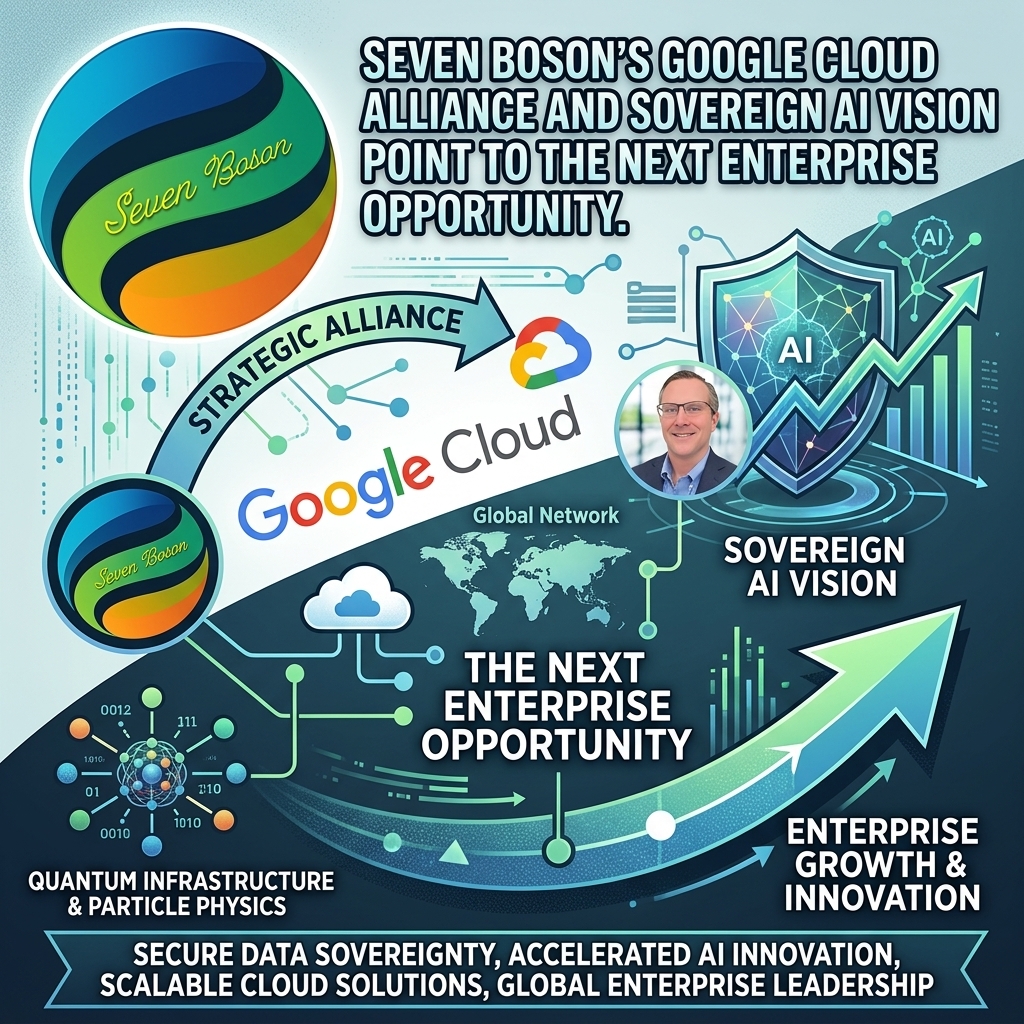
Seven Boson Group’s expansion within the Google Cloud partner ecosystem and its increasingly defined sovereign-AI strategy offer a bullish picture of a company aiming to participate in a more mature phase of the artificial-intelligence buildout. The premise is compelling: as AI moves from dazzling demonstrations toward critical infrastructure, the market may place greater value on systems enterprises and governments can control, audit, secure and operate on their own terms. It is less about renting the cleverest chatbot by the minute and more about owning the institutional-grade plumbing behind consequential decisions. Wall Street has, after all, repeatedly shown an affection for toll roads, particularly digital ones.
A Strategic Link to Google Cloud
Seven Boson’s Google Cloud partner relationship is a meaningful commercial and technical milestone. Google Cloud’s partner framework is designed to recognize partners based on customer outcomes, technical capability, service delivery, innovation and co-selling contribution across the customer lifecycle. For Seven Boson, that affiliation can provide a more credible foundation for engaging organizations that need help deploying cloud, AI, data and security infrastructure. The opportunity is not simply access to a logo or a directory listing. It is the ability to build skills, customer references and potentially repeatable offerings around one of the world’s most important enterprise-cloud platforms. Google Cloud’s partner ecosystem increasingly rewards real-world execution rather than program participation alone. Its framework measures capacity and customer-facing capability, including presales and post-sales contributions tied to successful deployments. That orientation is well suited to firms that can translate AI strategy into working systems rather than merely turn “transformation” into a noun.
The Sovereign AI Thesis
At Tribe Public’s Recent CEO Presentation and Q&A Webinar Event on Friday, August 7, 2026, Chet White—Chairman, CEO and Managing General Partner of Seven Boson Group, MGP/PM Helios Alpha and MP Carat Ventures, outlined that transition in his presentation, “The Next Wave of AI Growth – Cheap, Opensource, Safe, and Sovereign.” The core proposition was straightforward: the AI market’s most durable opportunity may be moving beyond centralized, costly model access toward AI systems that can be operated securely, affordably and independently by enterprises and nations. That is an investment thesis with fewer fireworks than the first large-language-model boom, but potentially far more plumbing—and the market has historically learned to appreciate the firms that own the plumbing.
White’s public comments describe a three-wave framework:
- The first wave centered on high-cost, centralized frontier AI access.
- The second wave has emphasized inexpensive, capable open-source models, including models with growing global usage.
- The third, or “Sovereign Wave,” centers on AI that organizations can own, contain, audit and power within their own operational, regulatory and security boundaries.
That framing aligns with Seven Boson’s previously announced Sovereign AI Decision Intelligence offering, which the company says combines sovereign-compute infrastructure, multi-agent orchestration, a human-in-the-loop governance layer, and vertical application packages for sectors including healthcare, defense, cybersecurity, finance, energy and communications.
Why Sovereignty Has Begun To Matter Globally
Sovereign AI refers broadly to AI systems designed so the organization, or, in some cases, a nation, retains meaningful control over data, infrastructure, model deployment, governance and regulatory compliance. The relevant architecture may span cloud, on-premises and edge environments while maintaining security, performance and control. For a bank, healthcare system, defense organization or public-sector agency, this is not an academic distinction. Sending sensitive data to an outside AI endpoint can create questions around jurisdiction, security, auditability, vendor dependency and compliance. A model may be inexpensive to access, but it becomes much more expensive if its use introduces a material governance problem. Seven Boson’s strategic language targets that gap. Its stated approach combines open-source models, security embedded in the architecture and customer ownership rather than dependence on a remote, opaque model provider. The company has highlighted applications in healthcare, cyber defense, finance, robotics and autonomous systems.
Where Google Cloud Fits
The Google Cloud relationship could give Seven Boson an important route to market as it builds sovereign and enterprise-oriented solutions. Sovereignty does not necessarily mean rejecting public cloud. In practice, many customers will require hybrid architectures that combine controlled data environments, local or regional infrastructure, private deployments and cloud-scale tools.
That is where the partnership has strategic logic:
| Strategic element | Potential investor relevance |
|---|---|
| Google Cloud ecosystem | Provides access to a globally recognized cloud, data, security and AI platform through Alphabet Inc. (NASDAQ: GOOGL, NASDAQ: GOOG) |
| Open-source model strategy | May lower deployment costs and give customers more control over model selection and customization |
| Sovereign deployment focus | Addresses government and regulated-enterprise demand for data control, security and jurisdictional compliance |
| Governance and auditability | Helps address adoption barriers in high-consequence sectors such as healthcare, finance, defense and cybersecurity |
| Vertical AI applications | Creates potential for specialized, higher-value services instead of undifferentiated model access |
Google Cloud has stated that its partner program is structured to reward joint customer success, including strong service delivery, co-selling activity and innovation with independent software vendors. For Seven Boson, the task is now to turn program participation into named deployments, recurring relationships and measurable customer outcomes.
The Bullish Investment Narrative
The bullish case does not depend on the proposition that public cloud or frontier-model providers disappear. They will not. Instead, it rests on the possibility that the next leg of AI spending becomes more distributed, more regulated and more operationally demanding.
Organizations increasingly need more than an AI subscription. They need systems that can:
- Keep sensitive data within required borders and approved environments.
- Run selected models under enterprise or national controls.
- Produce auditable records of how AI-driven outputs were generated and used.
- Integrate safely with legacy systems, security workflows and mission-critical data.
- Control long-term compute, model and vendor costs.
Seven Boson’s thesis is that open-source models make AI more accessible, while sovereign infrastructure and governance make it usable in settings where a public endpoint is insufficient. The company’s public materials describe this as an AI operating approach spanning infrastructure, orchestration, security and vertical solutions rather than a standalone-model offering. If management can execute, the economic opportunity could shift from isolated AI experiments toward recurring infrastructure, implementation, security, governance and managed-service relationships. That is the sort of revenue mix investors often find more durable than a one-off consulting engagement or a popular demo with a short attention span.
What Investors Should Watch
The Google Cloud connection and sovereign-AI presentation are positive strategic markers, but they should be evaluated as early-stage indicators rather than proof of financial performance. Seven Boson’s investor narrative will gain force as its vision becomes visible in commercial milestones.
The most important indicators include:
- Named customer wins in government, healthcare, finance, cybersecurity, defense or other regulated sectors.
- Commercial deployments of Seven Boson’s Sovereign AI Decision Intelligence platform or Sovereign Agent Operating Service.
- Disclosed recurring-revenue, contract-value, backlog or customer-retention metrics.
- Evidence that Google Cloud enablement is generating joint customer opportunities, implementation wins or co-selling results.
- Further technical validations, partner specializations and deployed use cases.
- Clear disclosure regarding Seven Boson’s corporate structure, capitalization and public-market status before applying traditional valuation frameworks.
The Bottom Line
Seven Boson is placing its bet on the proposition that AI’s next major value pool will not belong solely to the companies that create the largest models. It may also accrue to those that make AI affordable, controlled, auditable and usable where the stakes are highest. The Google Cloud relationship offers a credible ecosystem connection, while Chet White’s “cheap, open-source, safe and sovereign” framework supplies a clear strategic identity. Together, they suggest a company aiming to build for the point when enterprises stop asking whether AI is exciting and start asking whether it can be trusted with their data, their operations and their reputations. That may be a quieter question than “What can this model write?”—but it is one with a considerably larger procurement committee.
The Sources
- Seven Boson Group Launches Sovereign AI Decision Intelligence Software and Services Yahoo Finance / GlobeNewswire
- Google Cloud Partner Network
- Google Cloud Partner Home
- Google Cloud Partner Network Overview Video YouTube
- Google Cloud Partner Network: Simplified Outcomes and Automation LinkedIn
- Google Cloud to Launch New Partner Program in 2026 CRN
- Sovereign AI and Data Sovereignty: Secure AI Infrastructure EnterpriseDB
- Sovereign AI: The Next Wave of AI Ownership Chet White, LinkedIn
- Seven Boson Combines AI With Security and Open-Source Models Chet White, LinkedIn
- Seven Boson Group Google Cloud Partner Advantage Announcement
- “The Next Wave of AI Growth – Cheap, Opensource, Safe, and Sovereign” Chet White, Tribe Public CEO Presentation & Q&A Webinar
Stay Updated with Vista Partners
Subscribe to receive market insights, investing ideas, and the latest updates directly in your inbox.