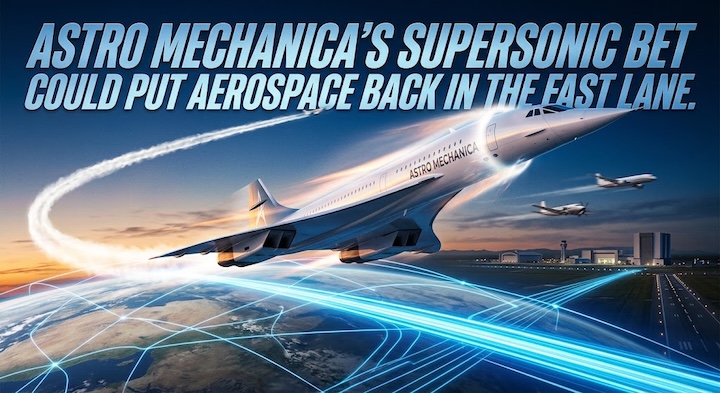
Commercial aviation has spent decades becoming safer, more efficient, and—if we are being candid—somewhat allergic to surprise. Astro Mechanica is making the bullish case that the next great aviation platform will not come from simply refining yesterday’s jet engine. It will come from redesigning propulsion and aircraft architecture together, with the goal of efficient flight from takeoff through Mach 3 and beyond. The company remains private, but its strategic relevance is rising for public-market investors watching advanced aerospace, airline innovation and defense technology. United Airlines Holdings, Inc. (NASDAQ: UAL) has already put capital behind the effort through United Airlines Ventures, while the broader thesis offers a fresh lens on the long-term innovation agenda across commercial aviation and propulsion.
The Engine Is the Investment Thesis
Astro Mechanica’s centerpiece is Duality™, an adaptive propulsion concept designed to act differently at different stages of flight. Rather than asking one conventional engine configuration to perform every task—a little like asking one executive to run sales, legal, human resources and the holiday party—the architecture seeks to adapt. At lower speeds, Duality is designed to behave like a turbofan; at faster, near-supersonic speeds, like a turbojet; and at Mach 3-plus speeds, like a ramjet. The underlying hybrid-electric approach separates propulsion units from the turboshaft using electric motors, theoretically allowing the system to optimize performance across a far broader speed range than a traditional jet engine. That is the core bull case: if the architecture works at commercial scale, it could address the historical compromise that made prior supersonic travel economically difficult. Concorde proved that passengers enjoy arriving early. Its fuel bill, however, made the experience less of a transportation revolution and more of a very fast reminder that physics invoices everyone.
Building the Aircraft Around the Powerplant
The video’s most compelling strategic point is not merely that Astro Mechanica wants to build a better engine. It wants to develop the engine and airframe as an integrated system from the outset. That matters because supersonic aircraft are not ordinary planes with an extra espresso shot. Intake geometry, thermal loads, aerodynamics, weight distribution and propulsion packaging must work together. Astro Mechanica’s approach turns the traditional sequencing on its head: instead of selecting an engine after the airframe is largely defined, it is designing the aircraft around the propulsion system the mission demands. For investors, vertical integration can be a double-edged wing. It increases technical and capital requirements, but it could also create deeper intellectual-property control, reduce dependence on legacy propulsion suppliers and make the platform more difficult to replicate if successful.
A Roadmap That Starts Small
The company’s staged plan is unusually rational for a business pursuing a goal that sounds like it was drafted during a particularly ambitious lunch. Astro Mechanica describes a progression from engine development to unmanned systems, then smaller passenger aircraft, private-aviation operations and eventually larger commercial platforms. The initial passenger concept highlighted in the video is a five-seat aircraft with a targeted range of 5,000 nautical miles. The company also discussed a roughly 30-seat business-class-oriented aircraft and, later, a 100-passenger platform aimed at broader market participation. This matters because the first viable market may not be mass-market passenger travel. It may be defense, cargo, specialized unmanned applications, private aviation or premium long-haul routes. Those segments can provide operating data, revenue opportunities and manufacturing learning curves before the company attempts the much harder task of making supersonic travel an everyday commercial product.
United Airlines Adds Strategic Credibility
United Airlines Ventures’ investment is an important external validation, even though financial terms were not disclosed. The venture arm of United Airlines Holdings, Inc. (NASDAQ: UAL) said Astro Mechanica’s adaptive-engine concept could have applications in national defense, orbital launch and long-range cargo delivery, in addition to eventual commercial aviation. That does not mean a near-term airline order book is guaranteed. It does mean a major carrier sees enough strategic potential to participate early, when the risks are highest and the spreadsheets contain more assumptions than seat assignments. For UAL, the investment fits a broader strategic posture: obtain early visibility into technologies that could reshape long-distance travel, aircraft economics and the passenger experience. United Airlines Ventures had made more than 30 investments across aerospace, technology and energy-transition themes as of its Astro Mechanica announcement.
Funding Signals a Serious Capital Base
Astro Mechanica announced a $27.1 million financing round in 2025 co-led by Andreessen Horowitz, Lowercarbon Capital and Giant Step, with participation from additional investors. The company also had earlier backing from a16z’s American Dynamism practice and participated in Y Combinator’s Winter 2024 cohort. A $27 million round does not finance a certified global airliner program; aerospace development has a healthy appetite for both capital and patience. But it can fund critical engine demonstrations, team-building, subscale testing and the next layer of evidence investors should demand: repeatable performance, durability, thermal management and eventually flight-test validation. The video indicates Astro Mechanica is using subscale “Gen 4” testing to advance toward a flight-capable “Gen 5” engine, with a stated goal of getting an engine airborne within roughly two years of the interview.
Public-Market Read-Through
Astro Mechanica is private, so there is no direct public-equity ticker. The investable read-through lies with strategic participants and aerospace incumbents whose markets could eventually be influenced by adaptive propulsion and high-speed travel.
| Company | Ticker | Investor relevance |
|---|---|---|
| United Airlines Holdings, Inc. | NASDAQ: UAL | Strategic investor through United Airlines Ventures; potential future beneficiary if high-speed routes become economically viable. |
| Boeing Company | NYSE: BA | A future competitor, partner or industry benchmark in commercial-aircraft design and high-speed aviation. |
| RTX Corporation | NYSE: RTX | Exposure to aerospace propulsion through Pratt & Whitney; adaptive engines underscore the strategic value of next-generation propulsion. |
| General Electric Company | NYSE: GE | GE Aerospace remains a major engine industry reference point, even as new architectures challenge conventional propulsion assumptions. |
| Northrop Grumman Corporation | NYSE: NOC | Potential defense read-through from high-speed, unmanned and advanced-propulsion applications. |
| Lockheed Martin Corporation | NYSE: LMT | Relevant to defense demand for high-speed aerospace systems and advanced aviation technologies. |
| Kratos Defense & Security Solutions, Inc. | NASDAQ: KTOS | A more direct thematic beneficiary of investor attention toward unmanned aircraft, affordable systems and defense innovation. |
The key distinction is simple: Astro Mechanica is not yet a public-company substitute for GE, RTX, BA, NOC, LMT or KTOS. It is an early-stage signal that propulsion innovation may be entering a more competitive era, potentially creating opportunities for incumbents, suppliers, strategic investors and defense-focused technology companies.
The Catalysts That Matter
The next catalysts are likely to be technical rather than quarterly. Investors should watch for:
- Successful integrated ground tests of the Duality engine architecture.
- First flight of a flight-capable propulsion system.
- Evidence that efficiency can be sustained across multiple flight regimes, not merely demonstrated in a controlled test.
- New defense, cargo, unmanned or airline partnerships.
- A credible aircraft prototype timeline and certification strategy.
- Additional strategic investment or manufacturing partnerships.
A successful flight test would not prove that global supersonic travel has arrived. It would prove something almost as important: that a new propulsion architecture has graduated from a compelling presentation into the unforgiving world of flight hardware.
The Real Risk Is Still Physics
The opportunity is substantial, but so are the obstacles. Supersonic aviation must overcome engineering complexity, certification requirements, sonic-boom restrictions, airport and route constraints, manufacturing scale-up, fuel economics and the unforgiving arithmetic of airline operations. Astro Mechanica’s fuel-efficiency ambitions are company targets, not independently verified commercial performance. Its goal of making long-range supersonic travel efficient enough to compete with subsonic widebodies remains a high-conviction technical proposition rather than an established fact. Still, the strategic logic is compelling. Aviation’s biggest breakthroughs have often begun by challenging a supposedly settled tradeoff: speed versus efficiency, performance versus affordability, or ambition versus the procurement calendar. Astro Mechanica is betting that the next era of flight will not be defined by choosing between speed and efficiency. If Duality delivers even part of its promise, the aerospace industry may find that the most valuable thing in the sky is not another incremental improvement—it is optionality at altitude.
The Sources
- S3 | Science, Startups, & Stories — “The Founder Challenging Modern Aviation | Astro Mechanica”
- Axios — “Exclusive: United Airlines Ventures backs Astro Mechanica”
- AirlineGeeks — “United’s Venture Arm Bets on Supersonic Tech”
- Investing.com — “United Airlines Ventures invests in aerospace startup Astro Mechanica”
- MaC Venture Capital — “Astro Mechanica is building the future of sustainable supersonic flight”
- Tectonic Defense — “Exclusive: Astro Mechanica Raises $27.1M for Supersonic Flight”
- PR Newswire — “United Airlines Ventures Invests in Aerospace Startup Astro Mechanica”
- Not Boring — “Astro Mechanica”
- Astro Mechanica — News and Company Updates
Stay Updated with Vista Partners
Subscribe to receive market insights, investing ideas, and the latest updates directly in your inbox.