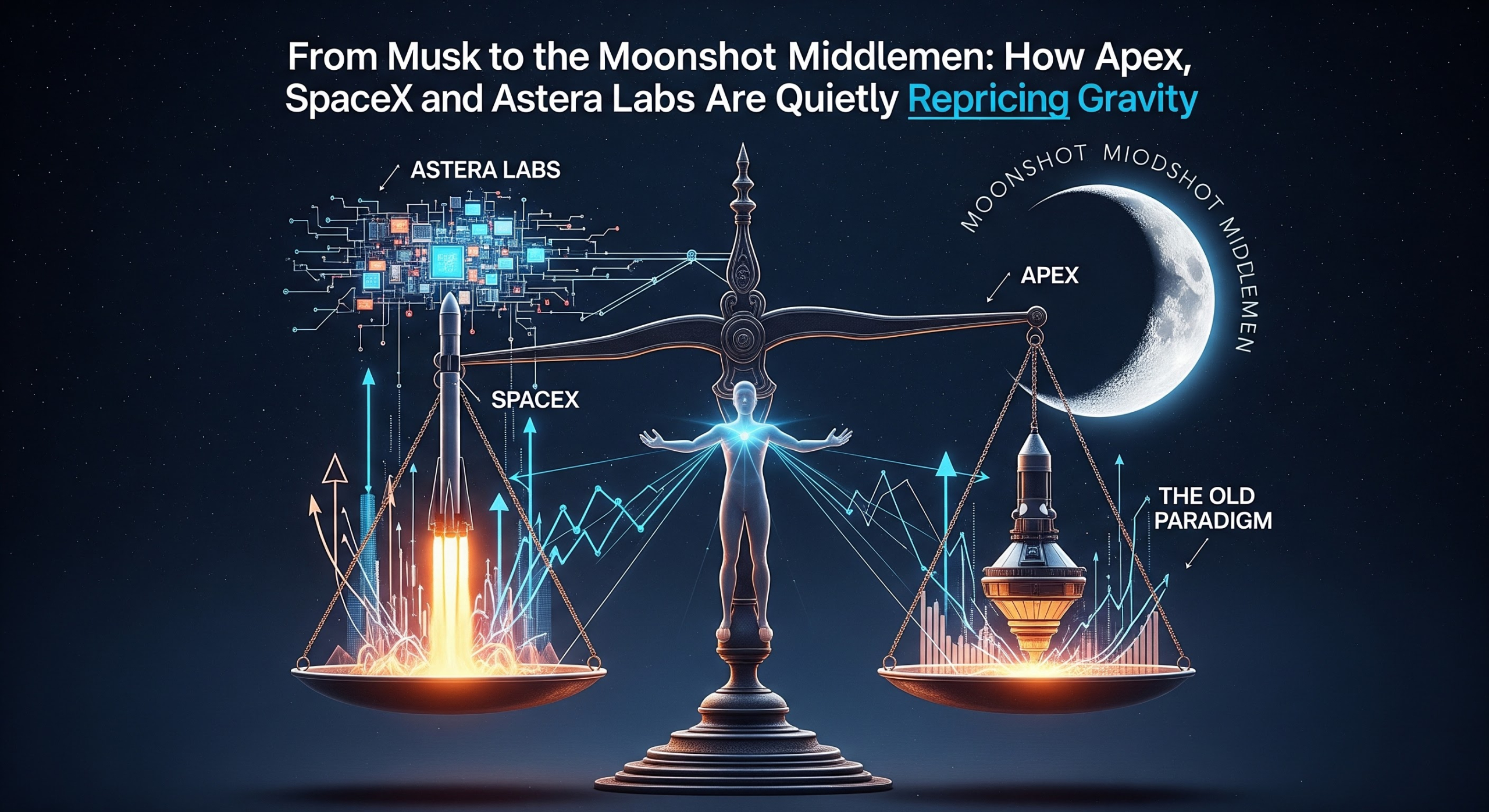
Investors are quietly drawing up a new constellation map, and three names keep blinking brighter on the screen: Apex, SpaceX and Astera Labs (NASDAQ: ALAB). Together they sketch a story of how space hardware, AI plumbing and one very determined billionaire are rewiring where the next decade of returns may come from.
Apex: The “AWS of Orbit” Grows Up
In Los Angeles, Apex is turning satellite buses into something closer to enterprise-grade hardware than bespoke science projects. The company designs standardized, configurable spacecraft that let customers bolt on their payloads and get to orbit in months instead of years, a value proposition that resonates as low Earth orbit (LEO) constellations proliferate.
Recent funding rounds have pushed Apex into unicorn territory, with cumulative capital raised north of half a billion dollars and a valuation that has effectively doubled as demand for its platforms accelerates. For investors, it resembles the early cloud era: you no longer build your own data center; you rent infrastructure, and now the same logic is migrating 500 kilometers up.
Apex’s customer mix spans commercial operators and government buyers, including U.S. national security programs that care as much about speed and resilience as they do about raw capability. If you are underwriting the space theme, this is the kind of picks‑and‑shovels profile that often compounds quietly while headline-grabbing launch providers hog the limelight.
Musk’s March Toward Trillions
Hovering over the entire sector is Elon Musk, whose personal balance sheet has turned into a multi-asset experiment in how far platform leverage can stretch. Tesla, Inc. (NASDAQ: TSLA) remains his primary publicly traded wealth engine, but the center of gravity for incremental value creation increasingly sits in private assets like SpaceX and xAI.
Forecasts from market observers now place Musk on a trajectory to become the world’s first trillionaire within a few years, thanks mainly to the compounding equity value of his space and AI holdings layered on top of Tesla and the social platform X. Shareholders at Tesla have already approved a massive performance-based stock package that, if fully realized, would alone be measured in twelve figures—an options package that reads less like compensation and more like a leveraged buyout of the future
For public‑equity investors, that creates a peculiar situation: the man whose empire may define the next wave of industrial infrastructure is only partially accessible through the ticker tape. Owning TSLA gets you exposure to EVs, energy storage and a slice of the Musk narrative, but the real torque may sit in businesses no retail investor can yet buy directly.
SpaceX IPO: The Most Anticipated Launch
That tension is precisely why every whisper of a SpaceX IPO lands like a seismic event in trading rooms. Recent reporting indicates SpaceX is preparing to list shares with an indicative price around 135 dollars, implying a valuation near 1.77 trillion dollars and a capital raise in the ballpark of 75 billion dollars. If those numbers hold, the offering would be less a debut and more a coronation of the space economy as a core asset class.
Musk is not expected to use the IPO as an exit; estimates suggest he would retain more than 80% of the voting power, keeping strategic control while tapping public markets to fuel Starlink expansion, launch cadence and deep‑space ambitions. For investors, that means buying into a company where the float may be relatively thin, the growth runway enormous and the governance structure unapologetically founder‑centric.
The knock‑on effects could be profound. A successful SpaceX listing would likely reset valuation expectations across the entire space stack, potentially lifting the multiples of hardware integrators, component suppliers and data analytics firms that depend on ever‑cheaper access to orbit. In that world, Apex’s off‑the‑shelf satellite buses move from curiosity to essential infrastructure for the constellations that SpaceX and its peers will be launching.
Astera Labs: Quiet Power Behind AI Racks
Meanwhile, down on Earth—but very much pointed at the same future—Astera Labs (NASDAQ: ALAB) is busy making sure AI infrastructure doesn’t choke on its own ambition. The company specializes in semiconductor-based connectivity for cloud and AI systems, building the links that let high‑performance GPUs and CPUs talk to each other at the speeds modern models demand.
Astera recently announced a major expansion of its Taiwan operations and its Cloud-Scale Interop Lab, a move designed to sit within arm’s reach of the world’s most important semiconductor manufacturing ecosystem. By planting more engineering and interoperability resources in Taiwan, Astera can co‑design and validate solutions alongside OEMs and ODMs, from server vendors to hyperscale cloud operators seeking to deploy rack‑scale AI systems faster and with fewer painful surprises.
The company collaborates closely with a who’s‑who of AI platform providers, including Advanced Micro Devices, Inc. (NASDAQ: AMD), Arm Holdings plc (NASDAQ: ARM), Intel Corporation (NASDAQ: INTC) and NVIDIA Corporation (NASDAQ: NVDA), alongside major Taiwan manufacturers like GIGABYTE Technology Co., Ltd. (TWSE: 2376), Inventec Corporation (TWSE: 2356) and Wiwynn Corporation (TWSE: 6669). It is not the name on the headline when a new data center comes online, but it is increasingly embedded in the plumbing that makes those multi‑billion‑dollar capex budgets actually produce usable AI capacity..
One Theme: Infrastructure for the Exponential
What ties Apex, SpaceX and Astera Labs together is not simply technology; it is their positioning at the infrastructure layer of two compounding curves: space access and AI compute. Apex turns satellites into modular products, SpaceX industrializes launch and orbital broadband, and Astera Labs accelerates the dense connectivity that lets AI systems scale from racks to entire data halls.
For investors, this suggests three practical takeaways. First, the investable expression of the “new space” economy may arrive sooner than expected via a SpaceX IPO, with second‑derivative beneficiaries like Apex squarely in the crosshairs of growth capital. Second, public‑market names such as TSLA and ALAB already offer partial access to the Musk complex and the AI‑infrastructure build‑out, respectively. Third, the most attractive narratives over the next cycle may be less about the apps we see on our phones and more about the hardware, launch capacity and connectivity that quietly make those apps possible.
If you had to choose a single sentence to summarize this emerging playbook, it might be this: in a world where Elon Musk is plausibly on a glide path to trillionaire status, the more interesting question for the rest of us is not how high he goes—but how early we position around the infrastructure that gets him there.
The Sources
- Yahoo Finance – Apex space startup doubles valuation (Apex satellite bus funding and valuation context)
https://finance.yahoo.com/markets/stocks/articles/space-startup-apex-doubles-valuation-141722882.html[linkedin] - Payload Space – “Apex Closes $200M Series D” (details on capital raised and unicorn status)
https://payloadspace.com/apex-closes-200m-series-d/[payloadspace] - StartupHub.ai – “Apex Space — $518M Raised” (summary of total funding, valuation trajectory)
https://www.startuphub.ai/startups/apex-space[startuphub] - Collectiveliquidity – Apex valuation data (recent secondary-market valuation reference)
https://www.collectiveliquidity.com/companies/apex[collectiveliquidity] - Yahoo Finance – “Elon Musk poised to be world’s first trillionaire” (net worth trajectory and drivers)
https://finance.yahoo.com/markets/article/elon-musk-poised-to-be-worlds-first-trillionaire-143438498.html[cnn] - PBS NewsHour – “Musk could become world’s first trillionaire as Tesla shareholders approve giant pay package”
https://www.pbs.org/newshour/economy/musk-could-become-worlds-first-trillionaire-as-tesla-shareholders-approve-giant-pay-package[pbs] - 7NEWS (YouTube) – “Elon Musk on track to become world’s first trillionaire | 7NEWS” (SpaceX IPO pricing and valuation indication)
https://www.youtube.com/watch?v=Zy49GA5h25U[youtube] - Yahoo Finance – Astera Labs expands Taiwan operations (base article you provided)
https://finance.yahoo.com/sectors/technology/articles/astera-labs-expands-taiwan-operations-010000210.html[asteralabs] - Astera Labs – “Astera Labs Expands Taiwan Operations to Accelerate Global AI Infrastructure Buildout” (company news release)
https://www.asteralabs.com/news/astera-labs-expands-taiwan-operations-to-accelerate-global-ai-infrastructure-buildout/[asteralabs] - GuruFocus – “Astera Labs (ALAB) Expands Taiwan Operations to Boost AI Infrastructure” (public-market perspective, partner list)
https://www.gurufocus.com/news/8898176/astera-labs-alab-expands-taiwan-operations-to-boost-ai-infrast[gurufocus] - HostingJournalist / related coverage – Astera Labs Taiwan expansion, partner OEM/ODM details
(Representative example)
https://www.facebook.com/HostingJournalist/posts/ai-astera-labs-expands-taiwan-lab-to-speed-global-ai-rack-deployment-astera-lab[facebook]
Stay Updated with Vista Partners
Subscribe to receive market insights, investing ideas, and the latest updates directly in your inbox.