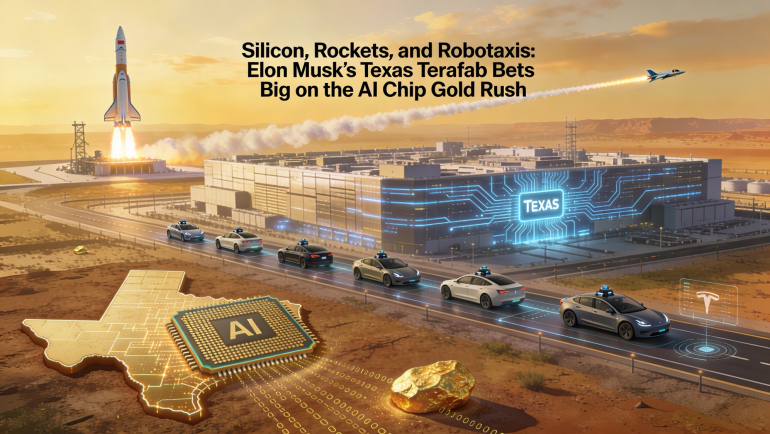
Tesla’s (TSLA) Robotaxi moonshot is finally rolling off real assembly lines just as SpaceX heads for what could be the biggest IPO in Wall Street history—and both bets revolve around the same thing: turning Elon Musk’s talent for missed deadlines into a very real, very monetizable network effect. For investors, the question isn’t whether Musk is late, but whether he’s early enough to dominate two of the most valuable mobility platforms ever built—one in orbit and one at the curb.
From Futurama to Full Self-Driving
The Cybercab story starts long before butterfly doors in Austin; it begins with 1939’s “Futurama” exhibit and DARPA’s desert obstacle courses. General Motors’ (GM) World’s Fair vision of guided electric cars inspired decades of rule‑based experiments that largely broke down the moment reality threw a plastic bag and a chasing child into the lane. Only when modern neural networks and GPU compute arrived did self‑driving become a statistical learning problem instead of a software rules worksheet, the same AI wave that made large language models viable now powering Tesla’s Full Self‑Driving (FSD).
Carnegie Mellon’s NavLab vans and Ernst Dickmanns’ camera‑equipped Mercedes were early hints that vision systems could drive at highway speeds, but engineers still had to hand‑code every contingency. The 2005 DARPA Grand Challenge—where Stanford’s “Stanley” finally finished a 142‑mile course—marked the birth of the modern autonomous car era and seeded Google’s (GOOG) self‑driving project, which became Waymo, Tesla’s most credible robotaxi rival today.
Tesla’s Master Plans and Missed Deadlines
Tesla’s original 2006 “Master Plan” didn’t mention autonomy at all; it was about using a high‑end sports car to fund progressively cheaper EVs. Self‑driving only becomes explicit in 2016’s “Master Plan, Part Deux,” which promised that once regulators blessed “true self‑driving,” owners could summon their cars, sleep in transit, and rent their vehicles into a Tesla “shared fleet” to offset loan payments.
What followed was a decade‑long master class in over‑promising: 90% self‑driving by 2014, full autonomy “about two years away” in 2015 and 2016, a coast‑to‑coast Los Angeles–New York run by 2017, “feature‑complete” FSD in 2019, and an audacious prediction of one million robotaxis on the road by 2020. None of that happened on schedule, but the underlying thesis—that a software update could wake up an installed fleet into a money‑earning robotaxi network—is exactly what Tesla is now trying to convert from slide deck to street reality.
How Tesla’s Camera‑and‑AI Stack Actually Works
Where much of the industry embraced sensor redundancy with lidar, radar, and cameras, Tesla doubled down on a “pure vision” approach. Eight cameras provide 360‑degree coverage, feeding video into an onboard neural network that estimates depth, motion, and semantics for every pixel, mimicking how humans drive with two eyes and a brain rather than lasers on the roof.
The latest FSD release—version 14 on Hardware 4—moves to an end‑to‑end neural network architecture, with an entirely rebuilt AI compiler based on MLIR and roughly 20% faster reaction times. Tesla has layered “fleet learning” into this stack, where edge cases encountered on the road are automatically flagged, curated, and fed back into training so the next model is explicitly optimized for scenarios that previously tripped it up.
Why Vision Only, While Rivals Love Lidar
Musk and former AI head Andrej Karpathy argue that if humans can drive with vision alone, then a sufficiently trained neural net should be able to do the same thing more cheaply and at scale. The economic argument is blunt: cameras are inexpensive, while a single automotive‑grade lidar can cost more than an entry‑level EV, making Waymo‑style sensor stacks inherently capital‑heavy.
This is where Tesla’s strategy diverges from lidar‑centric robotaxi fleets that retro‑fit premium vehicles. The upside is unit cost and scalability; every Tesla produced with FSD‑capable hardware becomes a potential robotaxi via software update, while rivals must custom‑equip vehicles one by one. The downside is safety skepticism from researchers who see lidar as “ground truth” for depth, while vision systems infer distance and must prove they can do so as reliably across all conditions.
The Data Moat: Billions of Miles and a Niagara Falls
The bet behind Cybercab is less about any single chip than about data gravity. As of early 2026, Tesla’s fleet has logged over 8.4 billion miles on supervised FSD, adding about a billion miles every 7–8 weeks, or roughly 19 million miles per day. In the first 50 days of 2026 alone, Tesla owners chalked up another billion FSD miles, all feeding into that “Niagara Falls of data” Tesla’s AI lead describes as the company’s daily training diet.
Waymo remains the paid‑trip leader, delivering about 500,000 robotaxi rides per week across 11 U.S. cities on a fleet of roughly 3,000 heavily instrumented vehicles and a cumulative autonomous mileage around 100 million miles. Tesla, by contrast, has 80–90 times more real‑world FSD miles—but supervised—creating a unique training corpus that blends human oversight with autonomy, and Tesla owns this dataset outright.
Unboxed Manufacturing: Printing Robotaxis Like Smartphones
What makes a sub‑$30,000 robotaxi conceivable is not just AI; it’s a manufacturing revolution Tesla calls “unboxed.” Instead of inching a car down a traditional line, Tesla builds major subassemblies in parallel—front and rear structures, battery floor, side panels—then snaps them together in a single “marriage” step.
On the Q1 2026 earnings call, Tesla disclosed that this approach cuts factory footprint by about 40%, reduces labor cost by 30%, and halves overall production cost versus a conventional assembly line. The goal at full ramp is a Cybercab every 10 seconds—three times faster than today’s Model Y line—which, if achieved, would turn Giga Texas into something closer to a robotaxi printer than a car factory.
Inside the Cybercab: The Gold‑Plated Shuttle
The Cybercab, first shown publicly at the October 2024 “We Robot” event, is a two‑seat coupe roughly 14 feet long with a teardrop body optimized for aero efficiency. Butterfly doors open automatically without external handles, while molded polyurethane body panels integrate color directly into the material, obviating the paint shop—traditionally one of the most capital‑intensive parts of auto manufacturing.
Inside, the cabin is closer to a lounge than a sedan: two padded seats, no steering wheel, no pedals, and a single 20.5‑inch center display that handles navigation, entertainment, climate, and trip controls. Beneath the floor sits a 35 kWh battery targeting around 200 miles of range and roughly 5.5 miles per kWh, which would make Cybercab Tesla’s most efficient EV to date.
Wireless Charging and 24/7 Operations
A robotaxi that can’t plug itself in is a very expensive sculpture, so Tesla is going inductive‑only for Cybercab charging. The car parks itself over a wireless pad that transfers about 19 kW of power at over 90% efficiency, guided by ultra‑wideband positioning; Tesla even sought an FCC waiver because the system exceeds standard inductive limits.
To make 24/7 operation viable, Tesla’s engineers turned the frunk into a gigantic washer fluid reservoir for automated camera cleaning, eliminating the need for a human to wipe lenses in the field. Newly built robotaxi‑focused Model Y vehicles already include washer jets for critical cameras and multiple wiper passes over the front module, indicating Tesla is hardening the entire fleet for around‑the‑clock autonomy.
Where and When Cybercab Actually Arrives
Production‑intent Cybercabs started rolling off the Giga Texas line on February 17, 2026, with drone footage showing roughly 60 units staged on site, some with steering wheels, some without. Tesla targets sub‑$30,000 retail pricing, with Musk repeatedly guiding closer to $25,000, and plans to sell Cybercabs to consumers as well as operate its own network.
Volume ramp expectations run from “tens per day” today to about 1,000 units per week mid‑year and 5,000 per week by the end of 2026. Tesla aims for volume Cybercab production by late 2026, with Musk previously suggesting widespread Cybercab robotaxi service toward late 2026 or early 2027, dependent on “unsupervised” FSD availability and regulatory approvals in key markets such as Texas and California.
The Robotaxi Network: Austin First, Then Everywhere
While the Cybercab is the poster child, Tesla’s first real robotaxi business is running on modified Model Y vehicles in Austin. The company launched a commercial robotaxi service there in June 2025 with 10–20 vehicles, then began offering paid unsupervised rides (no safety driver, just remote monitoring) on January 22, 2026, with about 13 fully unsupervised Model Ys and a total fleet of roughly 37–44 vehicles.
Austin’s geofence expanded from roughly 20 square miles at launch to over 245 square miles today. Tesla is also operating in the San Francisco Bay Area (still with safety drivers) and has extended early robotaxi service to Dallas and Houston, while planning expansions into Phoenix, Miami, Orlando, Tampa, and Las Vegas in the first half of 2026.
Why a Two‑Seat, Sub‑$30,000 Robotaxi Makes Economic Sense
Critics like to point out that a two‑seat shuttle can’t serve families, but trip data suggests the Cybercab is engineered for the statistical norm, not the exception. Peer‑reviewed studies of Uber (UBER) and Lyft (LYFT) show average ride‑hailing occupancy around 1.3–1.4 passengers, while U.S. household travel surveys put personal vehicle trips at around 1.6 occupants; Tesla design head Franz von Holzhausen has said 90–95% of rides involve one or two people.
By focusing on that dominant use case, Tesla can minimize materials, cabin complexity, and support equipment, and then rely on larger vehicles like Model Y and future variants for edge‑case trips. The combination of unboxed manufacturing, polyurethane body panels, smaller packs, and inductive charging is what gets the bill of materials and factory capex low enough to hit a sub‑$30,000 price point while still promising attractive margins per mile.
The Competitive Field: Waymo, Zoox, and the Graveyard
Waymo leads in paid robotaxi trips, but does so with costly, lidar‑laden retrofits of Jaguar I‑Pace vehicles that industry estimates put well above $150,000 per unit. Amazon’s (AMZN) Zoox takes a Cybercab‑like, steering‑wheel‑less design into Las Vegas, San Francisco, and soon Austin and Miami, with more than 350,000 passengers served but capped near 2,500 vehicles pending federal regulatory decisions.
Meanwhile, the robotaxi graveyard is growing: GM shuttered Cruise after more than $10 billion in losses, Ford and Volkswagen wound down Argo AI in 2022, and Apple canceled its decade‑long Project Titan in 2024 after reportedly burning $10 billion. The gap between impressive demos and profitable fleets turned out wider than many boardrooms expected, leaving Tesla and Waymo as the primary scale contenders—and Tesla as the only one consistently generating profits on its core vehicles.
SpaceX IPO: The Other Musk Network Effect
While Tesla tries to dominate terrestrial mobility economics, SpaceX is preparing to go public in what is widely anticipated to be the largest IPO in stock‑market history. The company has filed to raise as much as $75 billion, issuing roughly 555.6 million shares at an indicative price near $135, implying a valuation in the $1.25–$1.77 trillion range and positioning Musk as a potential first‑ever trillionaire..
SpaceX’s story rhymes with Tesla’s: high fixed‑cost infrastructure (launch vehicles and Starlink satellites instead of gigafactories and Cybercabs) amortized across a growing network of recurring‑revenue services. For public‑market investors, the SpaceX IPO and Tesla Robotaxi are two sides of a Musk‑style platform trade—buying into regulated, capital‑intensive markets where scale, data, and vertical integration can eventually crush unit economics for slower rivals.
Investment Angle: One Founder, Two Mobility Platforms
For investors, the core analytical challenge is separating Musk’s timeline optimism from underlying trajectory. On one side, you have Cybercab and the broader Tesla robotaxi network, backed by billions of supervised FSD miles, unboxed manufacturing, and a sub‑$30,000 purpose‑built vehicle that could flip ride‑hailing cost per mile on its head if “unsupervised” autonomy lands on time.
On the other, you have SpaceX heading into the public markets with a launch and satellite communications franchise that already throws off significant revenue and benefits from similar flywheel dynamics: each additional launch and satellite improves performance and lowers average cost. In both cases, you are underwriting Musk’s ability to convert technically credible but delayed visions into dominant, cash‑generating networks faster than regulators and competitors can react.
When the Robotaxi Future Is Actually Priced In
The calendar is simple, the valuation isn’t. Cybercab production is underway in Texas now, with Tesla guiding to a steep ramp through 2026 and broad robotaxi deployment in the 2026–2027 window, subject to “unsupervised” FSD approval and local regulation. SpaceX, meanwhile, is expected to list as early as mid‑June, potentially setting a valuation anchor for Musk’s broader ecosystem and re‑pricing appetite for high‑capex, high‑moat platforms.
For investors, the key is not whether Musk hits his dates to the quarter—history suggests he won’t—but whether the structural advantages in data, cost per mile, and manufacturing are durable enough to justify giving him more time. If they are, Tesla’s Cybercab network and SpaceX’s orbital infrastructure could end up as twin toll roads on the future of mobility—one in low Earth orbit, the other at the curb outside your favorite coffee shop.
Learn More By Watching This Video
The Sources
- Tesla official Robotaxi page
https://www.tesla.com/robotaxi - Tesla Robotaxi overview (service launch, tech stack)
https://en.wikipedia.org/wiki/Tesla_Robotaxi - Tesla Cybercab details: unveil, price target, production timing
https://www.teslaoracle.com/2024/10/11/elon-musk-unveils-the-tesla-robotaxi-cybercab-shares-the-price-and-launch-timeline/ - Cybercab production timing and delays discussion
https://finance.yahoo.com/news/tesla-begin-cybercab-production-april-141056411.html - Musk confirming sub‑$30,000 Cybercab and consumer sale plans
https://www.teslarati.com/elon-musk-confirms-tesla-cybercab-pricing-consumer-release-date/ - Historical timeline of Tesla robotaxi promises
https://www.reddit.com/r/RealTesla/comments/1iwxh29/history_of_tesla_robotaxi_announcements/ - Technical breakdown: Tesla camera‑only vs lidar approaches
https://lidarnews.com/tesla-autopilot-vs-lidar-vehicle/ - Vision‑only FSD and AI stack explanation
https://www.edge-ai-vision.com/2024/04/teslas-robotaxi-surprise-what-you-need-to-know/ - Tesla vs Waymo sensor stack and autonomy architecture
https://www.thinkautonomous.ai/blog/tesla-vs-waymo-two-opposite-visions/ - Tesla Robotaxi AI camera assistant hardware evolution
https://www.basenor.com/blogs/news/tesla-robotaxi-ai-camera-assistant-original-vs-new-system - Video analysis: Tesla Robotaxi vs Waymo fleet data, pricing, safety
https://www.youtube.com/watch?v=M4Mms2BHSsw - High‑level SpaceX IPO overview and implications
https://www.zacks.com/featured-articles/741/spacex-ipo - Reuters coverage of SpaceX S‑1 filing, valuation, governance
https://www.reuters.com/legal/transactional/bound-mars-elon-musks-spacex-unveils-filing-blockbuster-ipo-2026-05-20/ - BBC coverage: potential trillionaire outcome and valuation ranges
https://www.bbc.com/news/articles/cg4pe2953q1o - AP coverage: record‑size IPO, Musk wealth impact
https://apnews.com/article/spacex-tesla-elon-musk-ipo-public-offering-6490112997adcbc47235479685a89b72 - NBC coverage: S‑1 details and potential trillionaire headlines
https://www.nbcnews.com/tech/elon-musk/spacex-files-s-1-ipo-make-elon-musk-trillionaire-rcna346157 - NYT deeper dive on SpaceX finances and strategy
https://www.nytimes.com/2026/05/20/technology/elon-musk-spacex-ipo.html - Short video explainer on IPO terms, size, and timing
https://www.youtube.com/watch?v=jRjxvYda0kQ - Waymo vs Tesla: technical comparison and Level 5 pathway
https://www.thinkautonomous.ai/blog/tesla-vs-waymo-two-opposite-visions/ - General autonomous and robotaxi strategy context (market reports hub)
https://www.yolegroup.com/
Stay Updated with Vista Partners
Subscribe to receive market insights, investing ideas, and the latest updates directly in your inbox.