Nvidia’s (NVDA) Jensen Huang just turned another chip maker into Wall Street’s latest trillion‑dollar daydream—and he did it with essentially four well‑placed words at Computex.
The Computex Moment: Four Words That Moved a Market
It is not every Monday morning in Taipei that a passing remark from the world’s most valuable chip CEO adds tens of billions of dollars in implied future value to a peer, but here we are. Sharing the stage with Marvell Technology (MRVL) CEO Matt Murphy at Computex, Nvidia’s Jensen Huang described Marvell as the “next trillion‑dollar company,” effectively handing the Santa Clara networking specialist a golden ticket in front of a global audience of investors, partners, and rivals. The market, never accused of being shy around a good AI superlative, responded by sending Marvell shares up roughly 22–25% in early trading, extending a year‑to‑date rally that has already exceeded 150%.
That the compliment came from a company now worth about 5.4 trillion dollars only sharpened the punchline. Nvidia itself has gained more than 1,400% since the start of 2023, so when Huang points to a neighbor on the semiconductor block and suggests it might be next in line, investors at least feel compelled to run the numbers. There is also the small matter of alignment of interests: Nvidia quietly took a roughly 2 billion dollar stake in Marvell earlier this year as part of a broader partnership, ensuring that any cheering from the sideline comes with real capital on the field.
Why Marvell Suddenly Matters So Much
Behind the breathless price action is a fairly sober infrastructure story: Marvell designs chips that live in the connective tissue of the AI era. Its silicon underpins data‑center networking, custom accelerators, and increasingly the optical links that shuttle data at high speed between the thousands of GPUs inside modern AI clusters. As Huang explained, the age of “useful AI” is shifting the bottleneck from raw compute to how quickly those chips can talk to each other, making high‑performance networking and photonics less of a supporting cast and more of a co‑star.
Huang’s thesis is simple enough to fit on the back of a conference badge: if AI data centers are the new factories of the digital economy, then Marvell is selling the pipes, roads, and traffic lights. Nvidia’s own money backs up that narrative; its multibillion‑dollar push into companies working on optical interconnects and photonics is essentially a bet that moving bits with light, not copper, will define the next leg of AI infrastructure. For equity investors used to hunting for leverage to AI beyond the obvious GPU winners, a high‑beta networking name blessed onstage by the category king is understandably magnetic.
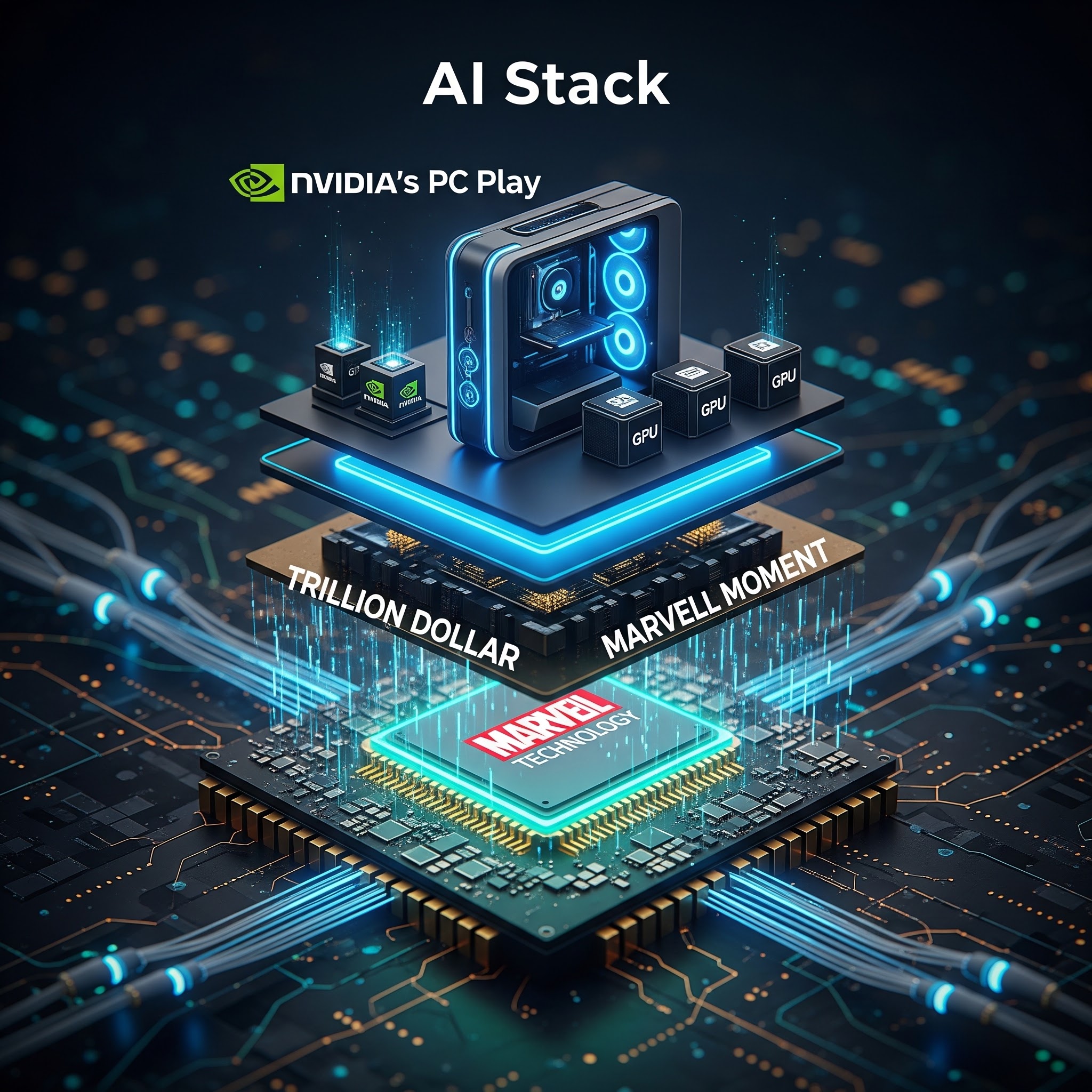
Nvidia’s Bigger Play: Owning the AI Stack
The Marvell moment, however, was just one subplot in a broader Computex script that made clear Nvidia intends to stretch its ambitions from cloud to couch. In his keynote, Huang formally unveiled RTX Spark, a new system‑on‑chip designed with Taiwan’s MediaTek to power Windows PCs from brands like Microsoft, Dell, HP, ASUS, Lenovo, and MSI later this year. The chip fuses Nvidia’s Blackwell‑class GPU with a MediaTek CPU and unified memory, allowing both to tap the same pool of RAM—a subtle architectural tweak with less subtle implications for running large AI models locally on laptops and desktops.
Huang pitched RTX Spark as a “superchip” for personal AI agents, describing it as the foundation of the “new PC” that can run frontier‑scale models and sophisticated local assistants without shipping every query back to a data center. Wall Street heard something slightly different: Nvidia is no longer content to dominate the data‑center GPU market; it wants to “own” every meaningful layer of the AI compute stack, from hyperscale clusters to edge devices on your desk. The mere announcement was enough to send shares of incumbent PC chip makers such as Intel, AMD, and Qualcomm lower as investors contemplated yet another front where Nvidia could compress industry economics.
From Data Center to Desk: The Personal AI Computer
The RTX Spark narrative does not stand alone; it arrives alongside DGX Station for Windows, a deskside AI supercomputer that Nvidia says can run models with up to 1 trillion parameters locally. That sort of specification would have sounded like science fiction just a few hardware cycles ago, but it now neatly fits into Huang’s vision of AI supercomputers becoming as commonplace in homes and offices as televisions or dishwashers. For enterprises, the promise is the ability to run heavy AI workloads adjacent to knowledge workers rather than deep inside a remote data center, with latency and privacy benefits that CFOs and CISOs can both understand.
If RTX Spark is the mass‑market catalyst and DGX Station the professional’s new status symbol, together they mark Nvidia’s attempt to turn the PC from a general‑purpose device into a dedicated personal AI terminal. Analyst Tom Mainelli of IDC framed it more dryly, noting that Nvidia’s PC push underscores Huang’s ambition to dominate “every aspect of the AI ecosystem,” but investors know ambition is the one input this company never seems to run short of. In practical terms, these products also deepen Nvidia’s ties with Microsoft and the broader Windows ecosystem, which is racing to embed AI agents into everything from office suites to operating systems.
The Investor Angle: Trillion‑Dollar Clubs and Second‑Derivative Bets
For investors trying to position capital in this expanding AI universe, the day’s headlines offer two distinct—but related—storylines. First is Nvidia itself, now trading as a kind of de facto AI operating system whose influence extends well beyond its own product line into the valuations of partners, suppliers, and rivals. The second is Marvell, a reminder that in AI infrastructure, the companies that move data can sometimes be as important as those that crunch it, particularly when the market receives a high‑profile nudge to update its mental model.
The risk, as always when trillion‑dollar language enters the chat, is that narrative briefly outruns fundamentals. Marvell’s business still has to execute through cycles, competition, and capital intensity, and Nvidia’s run‑rate valuation assumes that its current dominance in AI accelerators and now PC silicon will face only modest friction. But viewed together, Huang’s blessing of Marvell and his push into PCs sketch a coherent map: build the full AI compute stack, invest in the key interconnects that tie it all together, and make sure that whether AI lives in the cloud or on the desk, Nvidia’s fingerprints—and sometimes equity stake—are on the invoice.
The Sources
- Yahoo Finance – “Jensen Huang calls Marvell next trillion-dollar company”
https://finance.yahoo.com/markets/stocks/articles/jensen-huang-calls-marvell-next-112630287.html[finance.yahoo] - Reuters – “Marvell Technology surges after Nvidia’s Huang calls it ‘next trillion-dollar company’”
https://www.reuters.com/business/marvell-technology-surges-after-nvidias-huang-calls-it-next-trillion-dollar-2026-06-02/[reuters] - Bloomberg – “Marvell Soars After Nvidia Chief’s $1 Trillion Stock Call”
https://www.bloomberg.com/news/articles/2026-06-02/marvell-surges-after-huang-calls-it-the-next-1-trillion-company[bloomberg] - Wall Street Journal – “Nvidia’s Huang Says Marvell May Join $1 Trillion Club”
https://www.wsj.com/tech/ai/nvidias-huang-says-marvell-may-join-1-trillion-club-bf018449[wsj] - CNBC – “Marvell stock jumps on Jensen Huang’s trillion-dollar forecast”
https://www.cnbc.com/2026/06/02/jensen-huang-nvidia-marvell-technology-trillion-dollar-ai.html[cnbc] - Fast Company – “MRVL: Why is AI chipmaker Marvell’s stock price surging today?”
https://www.fastcompany.com/91552239/marvell-mrvl-stock-price-up-today-ai-chipmaker-4-words-from-jensen-huang-nvidia[fastcompany] - MarketWatch – “Nvidia’s Huang says Marvell could join the trillion-dollar club — and the stock immediately surges”
https://www.marketwatch.com/story/nvidias-huang-said-marvell-could-join-the-trillion-dollar-club-and-the-stock-immediately-surge[marketwatch] - CNBC – “Nvidia’s new PC chips are CEO’s bid to ‘own’ every part of AI stack”
https://www.cnbc.com/2026/06/02/nvidias-new-pc-chips-are-ceos-bid-to-own-every-part-of-ai-stack.html[cnbc] - CIO Dive – “Nvidia stretches compute power to Windows PCs in AI shift”
https://www.ciodive.com/news/nvidia-compute-power-windows-pc-agentic-ai/821655/[ciodive] - New York Times – “Nvidia Has a Plan to Put Its Chips in Personal Computers”
https://www.nytimes.com/2026/06/01/technology/nvidia-chips-personal-computers.html[nytimes]
Stay Updated with Vista Partners
Subscribe to receive market insights, investing ideas, and the latest updates directly in your inbox.