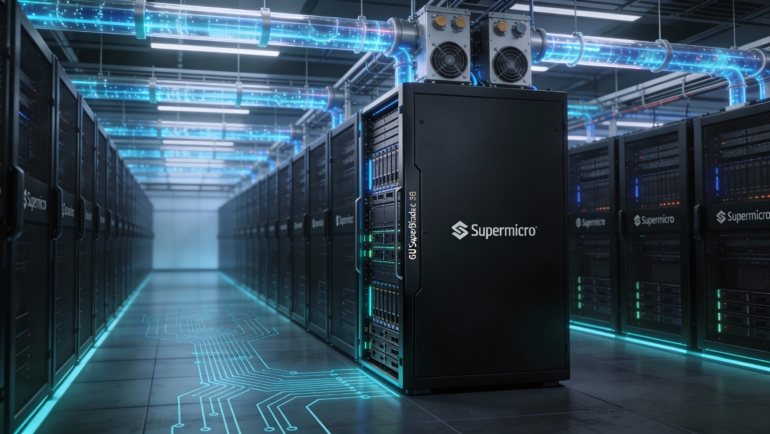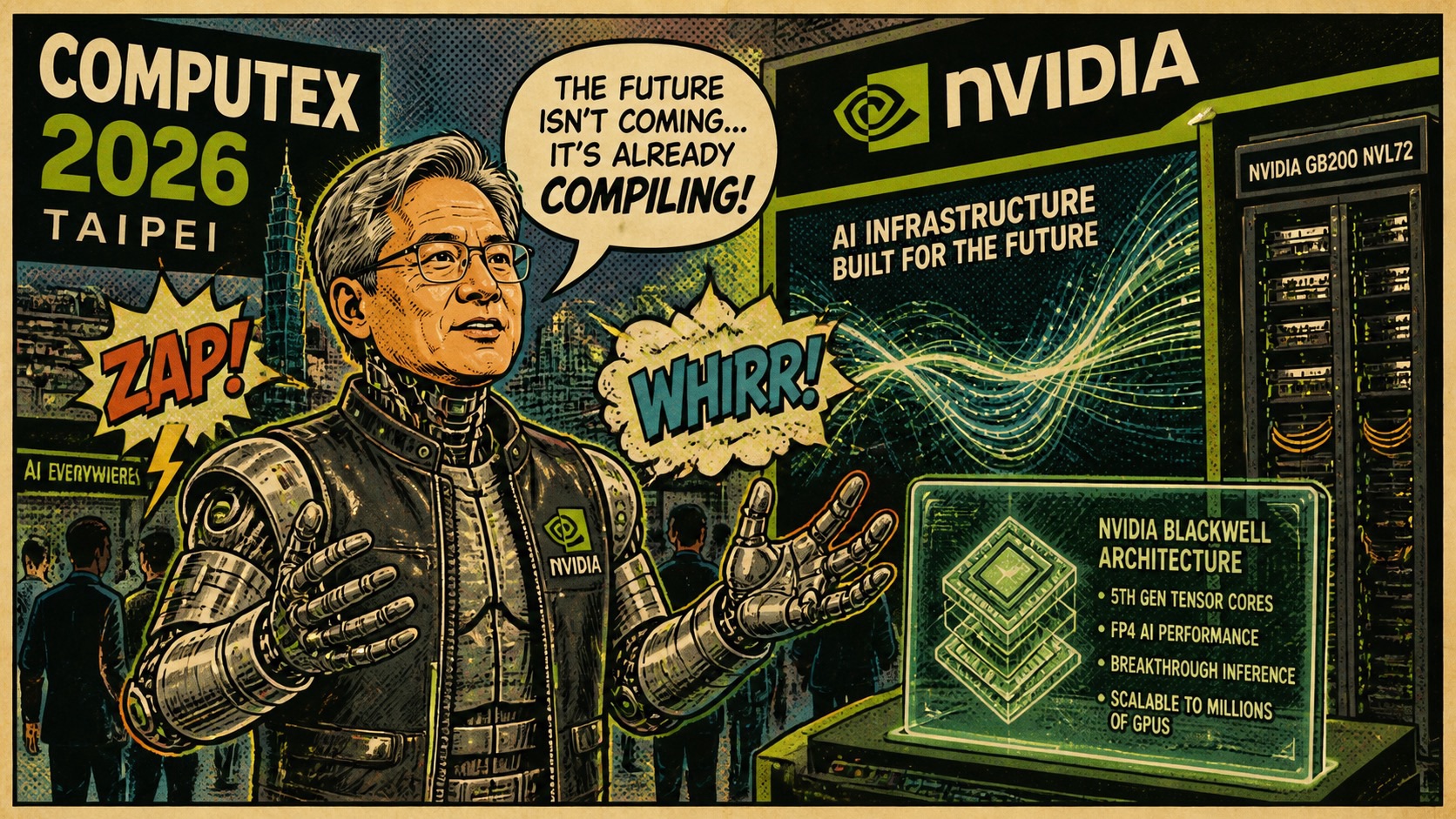
Computex 2026 in Taipei is shaping up as this year’s most important AI confab for investors, where silicon dreams, data centers, and “agentic” robots all compete to see who can justify the fattest forward multiples.
The Street Goes to Taipei
Wall Street likes to think of itself as the world’s center of gravity, but for one week in early June the pole shifts about 6,400 miles west to Taipei. Computex 2026, the long-running tech trade show that once obsessed over motherboards and beige boxes, has recast itself as a global summit on artificial intelligence, accelerated computing, and what vendors now call “AI factories.” The rebrand comes with a theme—“AI Together”—and a guest list of chipmakers, cloud platforms, and upstart infrastructure vendors all eager to convince investors that they are indispensable in the coming AI economy.
For portfolio managers, the event has become less of a gadget fair and more of a forward‑looking earnings call conducted at stadium volume. The booths might be in Taipei’s Nangang and Xinyi districts, but the audience, judging by the valuation chatter, is sitting on trading floors in New York, London, and Singapore.
From PC Show to AI Factory Floor
Computex started life in 1981 as an information and communications technology bazaar, a place to survey the full PC and component supply chain in one jet‑lagged lap. Taiwan’s dense industrial clusters turned the show into a barometer for hardware cycles: more laptops and routers one year, more servers and motherboards the next.
Today, the event’s organizers describe it as a “global benchmark” for AI and startups, with this year’s show bringing together roughly 1,500 exhibitors across 6,000 booths—numbers that would make most investor conferences look like a small‑cap roadshow. The focus now spans AI and computing, robotics and mobility, and a grab bag of “next‑gen tech,” shorthand for anything that might justify another turn of the multiple.
Jensen’s World: AI at Stadium Scale
This year, one of the marquee attractions isn’t on the show floor at all but on stage at the Taipei Music Center, where Nvidia (NVDA) chief executive Jensen Huang is scheduled to deliver a keynote as part of an adjacent GTC Taipei event. The company bills it as a tour of “AI factories and scaling infrastructure,” the kind of phrasing that makes data centers sound less like buildings and more like money‑printing machines.
The semantics matter. “AI factory” implies a production system that converts capex into recurring intelligence, a comforting metaphor for investors hunting for durable free‑cash‑flow stories in a market that has already repriced anything with “GPU” in its slide deck. With Huang’s appearances now treated by some funds as quasi‑macro events, the Computex keynote doubles as a sentiment check on whether the AI infrastructure cycle can remain in “up and to the right” territory for another year.
Edge, Physical AI, and the Robots That Want Your Job (In a Good Way)
On the exhibitor floor, the AI story is fragmenting into niches, each promising to be the missing layer in someone else’s stack. ADLINK, a Taiwan‑based industrial computing firm, arrives touting “Physical AI” and edge AI agents, a phrase that sounds like science fiction until you notice the robots scanning shelves, inspecting parts, and politely threatening to obviate a few low‑margin workflows. Its booth, in the Industrial IoT and Embedded Systems zone, leans into manufacturing and healthcare use cases, the kind of operational‑efficiency stories CFOs like to hear when they are asked for another round of AI budget.
Nearby, other vendors push their take on edge intelligence, positioning themselves as the complement to hyperscale data centers rather than the competition. The subtext is clear: if AI truly migrates from a handful of cloud regions to every warehouse, clinic, and retail aisle, the companies wiring up the “boring” endpoints may enjoy some of the most durable growth.
Turning Compute Into a “Real” Economy
In the software aisles, the buzzword of choice is “compute economy.” INFINITIX, an AI infrastructure software provider, is using Computex to promote a three‑layer architecture it says turns raw compute into a commercial platform: infrastructure at the bottom, an AI platform in the middle, and cloud‑style services on top. The pitch is that its AI‑Stack and ixCSP products help enterprises both govern their GPU resources and sell them as services, a nod to the idea that unused cycles are as wasteful as empty airline seats.
If that sounds esoteric, remember that Wall Street has already learned to value businesses on metrics like “GPU hours consumed” and “tokens processed.” The notion that compute capacity could be flexibly packaged, monetized, and traded appeals to investors accustomed to slicing telecom bandwidth and cloud storage into recurring revenue streams. In the halls, one hears a familiar refrain: AI is no longer just a capex line; it is a product.
ASUS, ROG, and the Consumer Side of AI
Not everything at Computex is aimed directly at CIOs and data‑center architects. ASUS, along with its long‑running Republic of Gamers (ROG) brand, plans an extensive showcase highlighting AI‑infused devices for both enterprise and everyday use, while also marking ROG’s 20th anniversary in gaming hardware. The company’s booth at Taipei Nangang Exhibition Center puts AI‑enhanced laptops, edge devices, and gaming systems front and center, a reminder that the consumer side of AI still matters for volumes and brand affinity.
For investors, these demos serve as a reminder that AI demand doesn’t flow in a straight line from cloud to chipmaker. It also depends on whether consumers and prosumers perceive meaningful value in the “smarter” devices arriving on store shelves, from battery life and frame rates to AI‑assisted workflows. If the next generation of AI PCs and gaming rigs can command pricing power, that could ripple back through component suppliers and foundries alike.
Why This Matters for Portfolios
Computex has always been a place to gauge where the hardware cycle is headed, but in its AI‑centric incarnation it doubles as a cross‑section of the entire value chain—from chip design and manufacturing to cloud platforms, edge devices, and vertical applications. For investors, that makes Taipei a useful, if crowded, field trip.
Several themes stand out:
- The show’s “AI Together” framing reinforces the idea that no single vendor owns the stack; interoperability and ecosystem positioning matter as much as raw performance specs.
- The sheer scale—1,500 exhibitors and 6,000 booths—suggests that competition will intensify not just at the high end of GPUs, but across middleware, orchestration, and edge deployments.
- The emergence of concepts like “Physical AI” and “compute economy” shows that AI is breaking out of the lab and into industrial workflows and monetization models that can be measured in utilization rates and ROI.
Investors inclined to buy the AI story via a narrow set of megacaps may come away from Computex with a more nuanced view. The upside case is that AI spending broadens across hardware, software, and services. The risk case is that profit pools fragment just as quickly.
The Sophisticated Investor’s Checklist
For those toggling between Taipei livestreams and earnings models, Computex 2026 offers a working checklist:
- Watch how often companies talk about AI “factories” versus individual products; the more they sound like platforms, the more durable their narratives may be.
- Pay attention to who is solving unglamorous problems—governance of compute, edge deployment, integration into legacy systems—rather than just showcasing glossy demos.
- Track whether consumer‑facing brands can translate AI features into pricing and volume, not just marketing slogans.
In a market that has already rewarded anything with an AI ticker, Computex functions as both a hype filter and a discovery engine. The challenge for investors is not spotting the booths with the longest lines, but identifying which of these AI stories can survive a full cycle of rates, regulation, and reality.
The Sources
[1] NVIDIA GTC Taipei at COMPUTEX: Live Updates on … https://blogs.nvidia.com/blog/nvidia-gtc-taipei-computex-2026-news/
[2] COMPUTEX Taipei 2026 https://semiwiki.com/event/computex-taipei-2026/
[3] COMPUTEX 2026 Brings the Global AI Ecosystem to Taipei https://www.hpcwire.com/off-the-wire/computex-2026-brings-the-global-ai-ecosystem-to-taipei/
[4] COMPUTEX 2026 Brings the Global AI Ecosystem to Taipei https://www.prnewswire.com/news-releases/computex-2026-brings-the-global-ai-ecosystem-to-taipei-302702075.html
[5] INFINITIX at COMPUTEX 2026: Turning AI Infrastructure … https://finance.yahoo.com/sectors/technology/articles/infinitix-computex-2026-turning-ai-020000153.html
[6] COMPUTEX TAIPEI https://www.youtube.com/user/COMPUTEXtv
[7] COMPUTEX Taipei https://www.nxp.com/company/about-nxp/events/computex-taipei:NXP-AT-COMPUTEX-TAIPEI
[8] ADLINK Unleashes Physical AI at COMPUTEX 2026 https://www.adlinktech.com/en/news/adlink-computex-2026
[9] ASUS will present AI innovations at Computex 2026 … https://press.asus.com/news/press-releases/computex-2026-asus-rog-ai-gaming-innovation/
[10] Meet the ‘Corporate Bro’ Making Millions Satirizing Tech … https://www.wsj.com/business/media/meet-the-corporate-bro-making-millions-satirizing-tech-sales-dccaf132
[11] The Anti-Status Watch: Why Men in Finance Love Cheap … https://www.wsj.com/style/fashion/the-anti-status-watch-why-men-in-finance-love-cheap-cheesy-watches-d3c905fc
Stay Updated with Vista Partners
Subscribe to receive market insights, investing ideas, and the latest updates directly in your inbox.