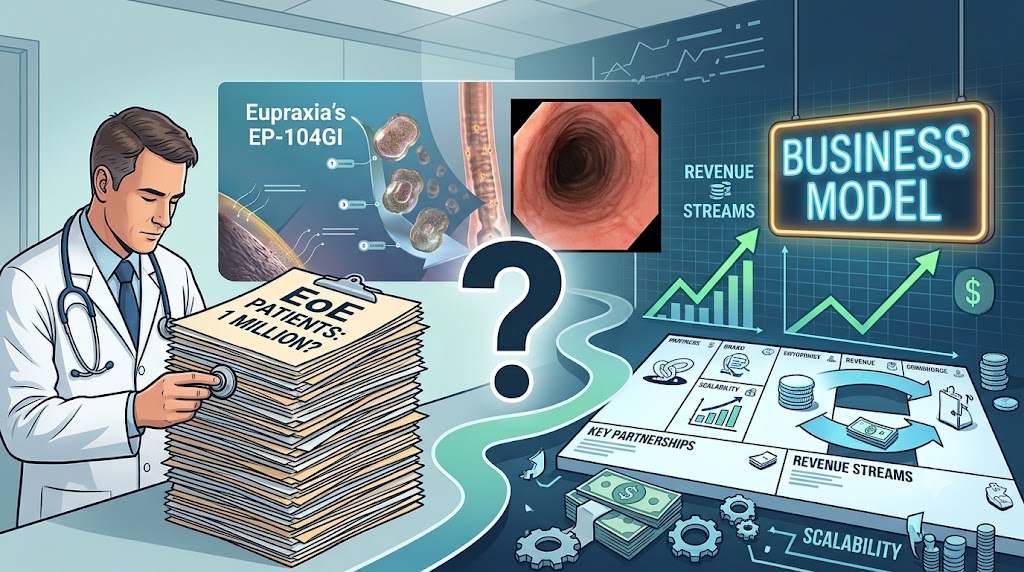
Eupraxia Pharmaceuticals (NASDAQ: EPRX) wrapped up its KOL event today with a clear message for Wall Street and the GI community: EP‑104GI is not just another esophageal steroid, it is being architected to live comfortably inside real‑world upper endoscopy practice for eosinophilic esophagitis (EoE) patients. By the end of the session, the tone had shifted from “could this work?” to “this is how we would use it on Monday,” which is exactly the inflection investors watch for.
EoE: The Esophageal Disease That’s No Longer Niche
Today’s event repeatedly underscored that EoE has evolved from a rare curiosity into a chronic, progressive esophageal disease with meaningful prevalence and growing diagnostic momentum. KOLs reviewed how EoE presents clinically – dysphagia, chest discomfort and food impaction – and how dense eosinophilic infiltration of the mucosa, confirmed on biopsy with at least 15 eosinophils per high‑power field, anchors the diagnosis.
The panel highlighted data showing rising global incidence and prevalence over the last two to three decades, with recent estimates around 6.8 cases per 100,000 person‑years and roughly 74 cases per 100,000 in the general population. In the United States, they emphasized that prevalence has climbed to approximately 1 in 700 individuals, positioning EoE as a leading cause of food impaction and a driver of upper endoscopy volumes in both adult and pediatric populations.
Eupraxia’s own projections – nearly half a million EoE patients today in the US, potentially exceeding one million by 2029 – gave the room a clear sense that this is a growth market, not a rounding error.
What The KOLs Said About Upper Endoscopy And EoE Workflows
Because upper endoscopy (EGD) sits at the center of EoE care, much of the discussion focused on how EoE patients move through the scope room. KOLs walked through their typical sequence: pre‑procedure assessment, sedation, esophageal visualization, targeted biopsies, documentation of rings, furrows, exudates and strictures, and occasional dilations for narrowed segments. The candid part of the conversation centered on economics and friction. Repeat endoscopies, anesthesia exposure, biopsies and emergency procedures for food impaction combine into a resource‑intensive care pathway. Yet upper endoscopy itself remains largely diagnostic; it records the esophageal story but does not, in most practices, deliver long‑acting therapy in that same moment. The panel made it clear: if a therapy can be integrated into that existing workflow without derailing scheduling or procedure times, it has a genuine shot at real‑world uptake.
EP‑104GI: How KOLs See It Fitting Into The Scope Room
EP‑104GI, Eupraxia’s locally acting, extended‑release corticosteroid designed for EoE, was the star of the afternoon. The company summarized RESOLVE trial data showing positive tissue‑health outcomes at 12 and 36 weeks in adults with biopsy‑confirmed active EoE, including improvements in histologic markers of inflammation with endoscopically delivered injections into the esophageal wall,
What mattered most to the audience, however, was the “how” rather than the “what.” KOLs dug into:
- Where in the upper endoscopy sequence EP‑104GI injections would occur – typically after initial visualization and mapping, and in conjunction with biopsies.
- How much procedure time the injection step would realistically add, with several panelists suggesting the increment appeared modest and manageable in high‑volume endoscopy units.
- The feasibility of standardizing injection techniques across centers so that EP‑104GI could be incorporated into routine EoE scopes rather than reserved for a small subset of experts.
By the end of the session, multiple KOLs were describing EP‑104GI as a “natural extension” of what they already do in EoE endoscopy, rather than a disruptive new ritual. That framing – procedural familiarity plus therapeutic upgrade – is exactly the kind of narrative that reduces adoption risk in investors’ minds.
Endoscopy‑Plus Economics: What Today’s Discussion Signaled
The economic thread running through the event was straightforward: EoE care is increasingly expensive and increasingly visible, and payers are looking for interventions that improve outcomes while stabilizing resource use. KOLs highlighted the burden of emergency visits for food impaction, urgent scopes, repeat biopsies and ongoing pharmacotherapy, all layered on top of chronic patient anxiety and lifestyle disruption. EP‑104GI’s proposition, as articulated today, is to transform upper endoscopy from a purely diagnostic encounter into an “endoscopy‑plus” event – one that visualizes, samples and treats the inflamed esophagus with a long‑acting local steroid in a single, planned procedure. If future data continue to show durable symptom and tissue control from limited EP‑104GI administrations, the panelists suggested three economic benefits:
- Fewer emergency visits and urgent scopes for food impaction and severe dysphagia.
- More predictable, scheduled intervention cycles tied to follow‑up endoscopies rather than crisis‑driven care.
- A clearer case for value‑based reimbursement, as procedure‑linked therapy is associated with measurable reductions in downstream utilization.
From a payer’s perspective, the story that emerged today is not “pay more for another drug,” but “pay differently for a smarter procedure that reduces tail‑risk costs.” From a GI practice standpoint, upper endoscopy becomes a higher‑value node in the EoE pathway, reinforcing the endoscopy suite’s role in both diagnosis and durable disease control.
Why Today’s KOL Event Moves The Needle For EPRX
For Eupraxia Pharmaceuticals (NASDAQ: EPRX), today’s KOL event did more than share slide decks; it functioned as a live stress‑test of whether EP‑104GI can live comfortably in real clinical workflows. The takeaway was encouraging: seasoned endoscopists saw EP‑104GI as feasible to administer, aligned with how they already stage EoE scopes, and promising in terms of tissue‑level outcomes. For investors, this matters because it bridges the gap between “trial result” and “operational reality.”
A therapy that shows histologic and symptomatic benefit but requires radical changes to procedure flow carries hidden friction; a therapy that folds into existing patterns with modest adjustments and clear billing pathways is inherently more scalable. Eupraxia’s story after today’s event is therefore sharper: in a fast‑growing, under‑served EoE population that may exceed a million patients in the US within a few years, the company is developing EP‑104GI to be delivered where the disease is already being seen – the upper endoscopy suite – and to act for longer than the scope ride itself.
If subsequent data and payer dialogues reinforce the clinical and economic themes KOLs explored today, EPRX’s EoE program may start to look less like an interesting idea and more like the nucleus of a procedure‑anchored franchise in chronic esophageal inflammation.
Sell Side Analysts
Both Cantor and Oppenheimer analysts issued reports post the KOL event today with respective price targets of $19 and $17.
The Sources
- Eupraxia Pharmaceuticals – EP‑104GI for EoE: RESOLVE Phase 1b/2a tissue‑health data and trial overview
Eupraxia Press Release – Tissue Health Data - Eupraxia Pharmaceuticals – Corporate overview and description of EP‑104GI for EoE and platform technology
Eupraxia Corporate Page – EP‑104GI & Diffusphere - Extended‑release drug delivery concept for EP‑104GI and EoE prevalence estimates (1 in 700 in the US)
Extended‑Release Drug Delivery – EP‑104GI in EoE - RESOLVE Phase 1b/2a trial design for EP‑104GI in adults with EoE (clinicaltrials.gov entry)
A Trial to Evaluate EP‑104GI in Adults With EoE - Eupraxia RESOLVE trial: nine‑month and cohort data showing sustained improvements and safety
Eupraxia Press Release – Nine‑Month RESOLVE Data - First 1‑year clinical results from RESOLVE trial in EoE, including SDI and EoEHSS outcomes and safety profile
Eupraxia Press Release – 1‑Year RESOLVE Results - EP‑104GI 24‑week data: clinical remission, SDI reductions and histologic improvements
EP‑104GI Performs Well in EoE - EoEHSS sub‑analyses and standardized tissue‑damage scoring explanation for EoE
Eupraxia – First Release of EoEHSS Sub‑Analyses - Eupraxia investor/Edgar‑style disclosure on EP‑104GI injection technique and dosing (esophageal wall injections)
Edgar Filing – EP‑104GI Administration Details - Eupraxia update on RESOLVE: pooled SDI outcomes, long‑term remission and safety (no SAEs, no candidiasis)
Eupraxia Press Release – March 16, 2026 Update - EoE epidemiology: early foundational review of incidence, prevalence and diagnostic criteria
NIH/PMC – Epidemiology of Eosinophilic Esophagitis - Recent global data on EoE incidence and prevalence (2017–2022)
EoE Incidence and Prevalence Growing - Overview of EoE as a chronic allergic inflammatory disease of the esophagus and US prevalence estimates
American Partnership for EoE – Eosinophilic Esophagitis - Eupraxia “Patients” page describing EoE symptoms, patient experience, and diagnostic journey
Eupraxia Patients – EoE Information - Vista‑style clinical trial explainer: EP‑104GI injections during upper EGD (patient‑facing study description)
EP‑104GI Study – Upper Endoscopy Administration - Eupraxia LinkedIn post announcing the virtual KOL event on upper endoscopies and EoE
Eupraxia Pharmaceuticals LinkedIn – KOL Event Invite - Eupraxia press release announcing a virtual KOL event focused on RESOLVE trial and EP‑104GI for EoE
Eupraxia Virtual KOL Event Announcement - Earlier RESOLVE cohort data: SDI and EoEHSS outcomes comparable to approved therapies
Eupraxia Press Release – Cohort Data
Stay Updated with Vista Partners
Subscribe to receive market insights, investing ideas, and the latest updates directly in your inbox.