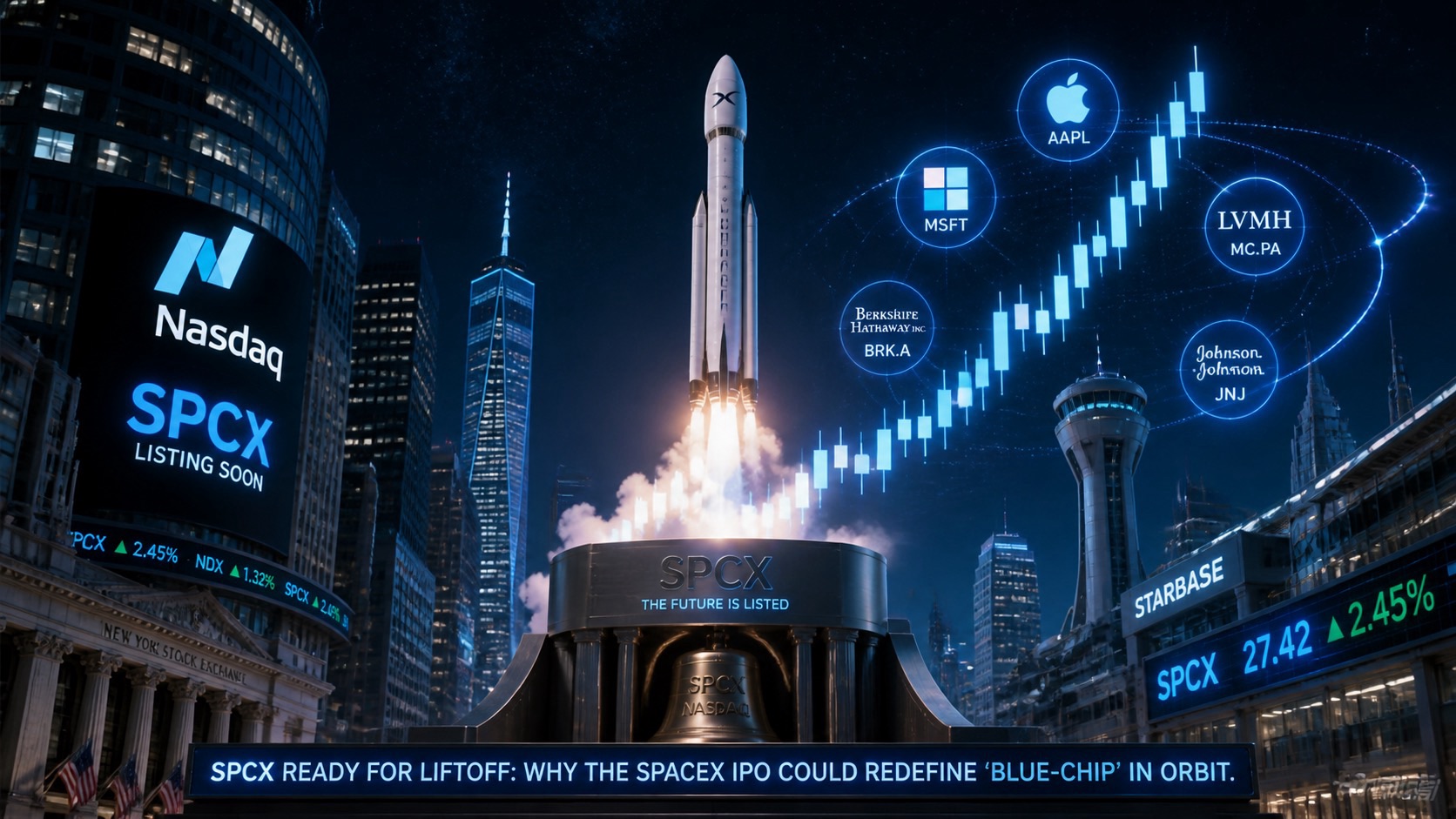
SpaceX’s long-awaited leap to the public markets is finally underway, and Wall Street is treating it less like a traditional IPO and more like the financial equivalent of a rocket launch countdown. With a Nasdaq listing planned under the ticker “SPCX,” Elon Musk is about to test investor appetite for a rare mix of rockets, satellites and artificial intelligence in a single equity story.
A Market Debut Decades in the Making
SpaceX is moving to flip its IPO documents into the public domain as early as late May, setting up a June marketing blitz, June 11 pricing and a potential June 12 Nasdaq debut, according to multiple reports. The listing, which follows a confidential SEC filing earlier this year, would give public investors first direct access to one of the most closely watched private companies of the past two decades.
The company is reportedly targeting as much as 75 billion dollars in IPO proceeds at a valuation north of 2 trillion dollars, a level that would make the offering the largest in history by deal size and implied market cap. That scale puts SpaceX in a different orbit from even Saudi Aramco’s (SAR) 2019 debut, which raised about 29 billion dollars.
Why “SPCX” Matters for Nasdaq
SpaceX has chosen Nasdaq as its listing venue and will trade under the ticker symbol “SPCX,” a four-letter code that has been quietly cleared in anticipation of the deal. A fund manager recently relinquished the symbol, effectively rolling out the red carpet for Musk’s company.
For Nasdaq, landing SpaceX is a marquee win in the perennial duel with the New York Stock Exchange for high-profile tech and growth listings. For index providers and ETF sponsors, “SPCX” is likely to become compulsory real estate in future space, AI and disruptive innovation products almost as soon as the stock is seasoned.
From Underdog to Space Infrastructure Giant
SpaceX has evolved from a scrappy upstart into what amounts to critical infrastructure for the U.S. space program and a growing number of commercial customers. Its launch business now commands a dominant share of the global market, fueled by the reusable Falcon rockets and the development of the heavy-lift Starship system.
The company holds billions of dollars in government contracts and has become the go-to launch provider for both NASA and private satellite operators, shrinking lead times and cost per kilogram to orbit. In practical terms, SpaceX turned what was once a rare national event—launch day—into something closer to a regular programming slot.
Starlink: Cash Flow in Low Earth Orbit
If the rockets provide the spectacle, Starlink provides the cash flow. SpaceX’s satellite broadband arm operates the largest constellation of satellites in low Earth orbit, offering high-speed internet service from rural communities to conflict zones.
Analysts estimate that the launch and Starlink businesses together are approaching roughly 20 billion dollars in revenue in 2026, making them the financial backbone of the SpaceX story heading into the IPO. That level of scale helps explain how the company can credibly pursue both ambitious infrastructure buildouts and capital-intensive deep-space projects while still talking about a public listing that investors can model.
The AI Angle: Grok Joins the Flight Manifest
Adding a modern twist, SpaceX also owns the Grok AI assistant, acquired in an all-stock deal when Musk’s xAI was folded into the company earlier this year. While Grok’s expected revenue contribution is modest—likely less than 1 billion dollars near term—it gives SpaceX exposure to one of the hottest themes in the public market: generative AI.
The combined narrative of a space-and-AI platform ties neatly into Musk’s broader pitch of building infrastructure for a multiplanetary future while monetizing data, connectivity and intelligence in the present. It also gives equity analysts something familiar to anchor on, even as they navigate discounted cash flow models that include rockets, satellites and neural networks in the same spreadsheet.
Bankers, Roadshows and a Very Crowded Room
On the banking side, SpaceX has assembled a who’s who of Wall Street, including Bank of America, Citigroup, Goldman Sachs (GS), JPMorgan and Morgan Stanley in senior underwriting roles. Additional firms have been added further down the roster, reflecting the scale of both the deal size and investor demand.
A formal roadshow is expected to begin in early June, with executives fanning out—physically and virtually—to court institutional capital ahead of the June pricing date. Given the profile of the issuer and the scarcity of comparable public names, the bigger challenge for underwriters may be managing allocations than stoking interest.
Record-Breaking Aspirations and Valuation Gravity
Valuing SpaceX at more than 2 trillion dollars puts it in the same conversation as the largest technology platforms on earth, despite operating hardware-intensive businesses that historically have traded at lower multiples. Supporters argue that the combination of recurring Starlink revenue, high barriers to entry and potential AI upside justifies a premium more akin to a dominant cloud and data platform than a traditional aerospace contractor.
Skeptics, for their part, will likely focus on capital intensity, regulatory risk and the long timelines associated with deep-space projects that generate more headlines than near-term free cash flow. As always in growth stories, gravity eventually shows up in the form of quarterly earnings, but for now the narrative is operating comfortably in orbit.
Retail Investors Eye the Launch Pad
Retail investors who have watched SpaceX’s rise from the sidelines are already gaming out how to get a seat on the mission. Once the Nasdaq debut occurs, buying shares will be as straightforward as opening or funding a brokerage account with access to U.S. markets and entering the “SPCX” ticker, though early trading could be volatile given expected demand.
Until the listing is complete, SpaceX remains a private company, meaning there is no direct access to the shares on public exchanges, aside from limited secondary-market transactions for accredited investors. The IPO effectively turns what was once the domain of venture funds and private secondary desks into a liquid security that can sit next to megacap tech names in portfolios.
The Bigger Question: What Comes After Liftoff?
Beyond the day-one pop, the more interesting question may be how public ownership influences SpaceX’s next chapter. Public markets reward execution, visibility and discipline; Musk’s companies, historically, have specialized more in audacious timelines and radical ambition.
If SpaceX can translate its private-market track record into consistent public-market performance, SPCX could become a bellwether for a new class of “infrastructure-tech” companies that blend hard assets, software and AI. And if not, investors at least will have had front-row seats to one of the most fascinating experiments in turning science fiction into GAAP financials.
Learn More Here
The Sources
- Reuters – “Exclusive: SpaceX accelerates IPO timeline, targets June 12 listing on Nasdaq”
https://www.reuters.com/world/spacex-accelerates-ipo-timeline-targets-june-11-pricing-nasdaq-2026-05-15/reuters - Fortune – “SpaceX said to plan public IPO filing as soon as Wednesday”
https://fortune.com/2026/05/15/spacex-ipo-public-filing-elon-musk-trading-debut-ticker-spcx/fortune - Bloomberg – SpaceX IPO / Nasdaq listing coverage (homepage link; article-level link may require subscription)
https://www.bloomberg.combloomberg - Yahoo Finance – “Exclusive: SpaceX accelerates IPO timeline, targets June 12 listing on Nasdaq” (syndicated)
https://finance.yahoo.com/markets/stocks/articles/exclusive-spacex-accelerates-ipo-timeline-194800007.htmlfinance.yahoo - Stake – “SpaceX IPO: How to buy SpaceX shares?”
https://hellostake.com/au/blog/trending/how-to-invest-in-spacex-stockhellostake - YouTube – “SpaceX Files For IPO – Here’s What To Know”
https://www.youtube.com/watch?v=gq0-6U_bQbQyoutube - Forge Global – “Invest and Sell SpaceX Stock” (private-market background)
https://forgeglobal.com/spacex_stock/forgeglobal
Stay Updated with Vista Partners
Subscribe to receive market insights, investing ideas, and the latest updates directly in your inbox.