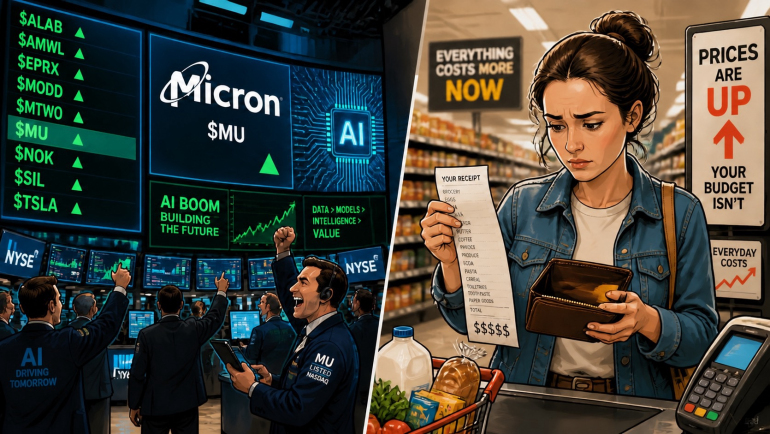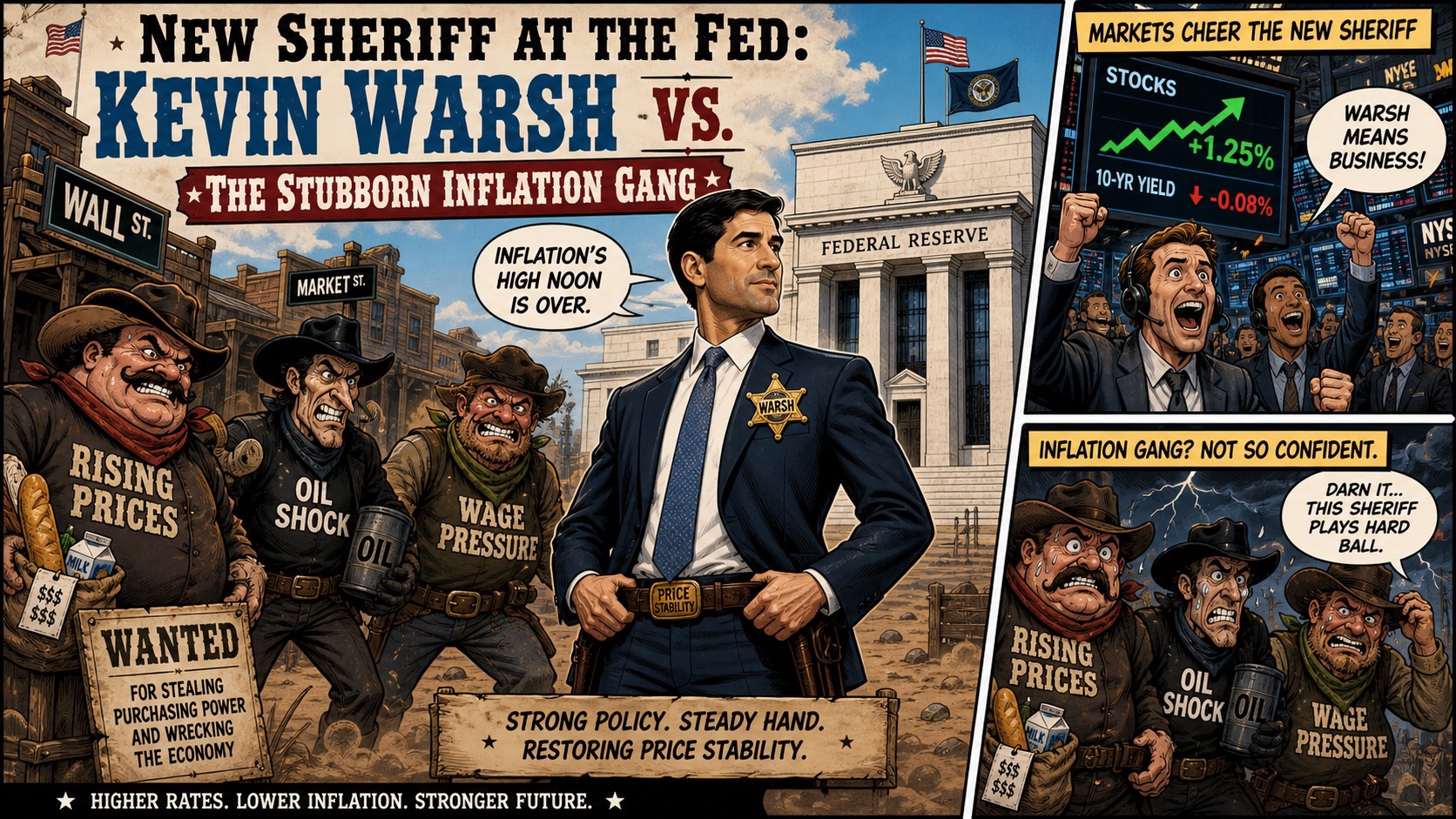
Kevin Warsh is stepping into the Fed chair just as inflation ‘re-accelerates’, and markets are treating his arrival like a high-stakes regime change rather than a routine promotion.
Warsh Takes the Helm as Prices Heat Up
Kevin Warsh is inheriting a Federal Reserve that hasn’t quite finished its last battle before starting the next one. Consumer price inflation has pushed back toward the high‑3% range year‑on‑year, with April’s headline reading around 3.8%, powered less by animal spirits and more by oil tankers struggling through a war‑shaken Middle East. Core inflation, the Fed’s preferred barometer of underlying pressure, is hovering near 2.8%, proving that what used to be “transitory” has become stubbornly tenant‑like.
Warsh’s timing evokes comparisons to Paul Volcker’s arrival in the late 1970s—minus the three‑piece suits and chain‑smoked cigars—because he is taking over just as inflation refuses to glide back to target on schedule. Investors who had grown comfortable pricing in imminent rate cuts are now discovering that the new chair’s first gift to markets may be a delay, not a dovish surprise.
A Fed Chair Boxed In Before Day One
The latest consumer price report has done Warsh no favors. Oil prices, jolted higher by the Iran conflict and disruptions around the Strait of Hormuz, have flowed straight into gasoline and transportation costs, leaving the incoming chair with considerably less room to maneuver on policy than campaign rhetoric implied. One large global advisory firm warned that the CPI print has “boxed” Warsh in before he even sits down, since cutting rates into an inflation flare‑up would test the Fed’s credibility faster than any Senate hearing ever could.
Inside the central bank, policymakers face a familiar but uncomfortable trade‑off: inflation that is too hot for comfort and growth that is only just cool enough to make pre‑emptive tightening politically awkward. Warsh will have to convince both markets and Congress that a pause—or even another hike—reflects discipline, not panic, a distinction that matters profoundly when the institution’s main asset is its reputation.
Regime Change at Constitution Avenue
Warsh has signaled that he wants more than cosmetic tweaks to the Fed’s playbook. He has been openly critical of the central bank’s response to the pandemic‑era inflation surge, arguing that policy stayed too loose for too long and that balance‑sheet expansion turned into a habit rather than an emergency tool. His call for “regime change” includes shrinking the Fed’s multi‑trillion‑dollar portfolio and reassessing how inflation is measured in the first place.
Where his predecessors leaned on core PCE, Warsh has expressed a preference for trimmed‑mean measures that downplay extreme price moves at the tails. Conveniently, some of those gauges run about a percentage point lower than the Fed’s traditional benchmark, which could give him rhetorical breathing room even as headline numbers remain elevated. Markets, ever alert to such nuances, are parsing his language for hints as to whether this is a statistical refinement or a quiet redefinition of victory.
Inflation Risks: Not Quite Yesterday’s Problem
While consensus forecasts coming into the year imagined inflation gliding gently toward 2%, several economists have warned that the more realistic risk is another upside surprise, potentially north of 4% by the end of 2026. They point to an unhelpful cocktail: lingering tariff pass‑through, a wider fiscal deficit, a tighter labor market shaped by immigration policy, and financial conditions that are looser than headline rates might suggest. Put differently, the macro backdrop Warsh inherits is less “soft landing” and more “bumpy glide path with occasional turbulence.”
These structural pressures mean that even if energy prices stabilize, underlying inflation momentum may prove harder to extinguish than markets assume. That is precisely the environment in which a mis‑timed rate cut could entrench higher inflation expectations, forcing the Fed into harsher measures later—a scenario Warsh has hinted he would prefer to avoid, even if it disappoints rate‑sensitive corners of Wall Street.
Global Central Bankers Share the Headache
Warsh won’t lack for sympathetic peers abroad. The European Central Bank, grappling with its own Iran‑related energy shock, is expected to raise rates twice this year after survey data showed inflation pressures re‑accelerating. ECB officials recently held policy steady but signaled that headline inflation is likely to run above target for years, with the Middle East conflict nudging their 2026 forecast to about 2.6%.
This global context matters because U.S. financial conditions don’t operate in a vacuum. A Warsh‑led Fed that leans more hawkish on inflation will be part of a broader shift away from the ultra‑accommodative era, with spillovers into exchange rates, capital flows, and asset valuations worldwide. For investors, the message is uncomfortably clear: the tide of easy money is receding, and it is worth checking who has been swimming with too much leverage.
Markets Reprice the “Fed Put”
Financial markets began adjusting to the new regime even before Warsh’s confirmation. Probability estimates of his elevation to the chair’s role climbed to the high‑90% range, and with them came a reassessment of how generous a Warsh Fed would be in cushioning every bout of volatility. Analysts expect a more disciplined, less interventionist central bank that is willing to tolerate market discomfort if that is the price of restoring price stability.
For equity investors, that likely means a sharper focus on earnings power and balance‑sheet resilience rather than multiple expansion driven purely by lower discount rates. Credit markets may also become more discriminating, with spreads for weaker borrowers reflecting the reality that a quicker policy rescue is no longer guaranteed. In this environment, the legendary “Fed put” looks less like a guaranteed floor under asset prices and more like a pricey out‑of‑the‑money option.
The Politics of Patience
Overlaying all of this is a charged political backdrop. President Donald Trump, who nominated Warsh and has never been shy about airing his views on interest rates, will be watching closely as the new chair decides how quickly to respond to inflation risks and growth scares. Warsh, for his part, must persuade both the White House and Capitol Hill that a steadier, less reactive Fed is in the country’s long‑term interest, even when the short‑term optics are uncomfortable.
That task won’t be made easier by households who experience inflation not as an elegant time‑series but as higher grocery bills and more expensive commutes. If price pressures surprise on the upside again, the political temptation will be to look for a scapegoat at the central bank, even if the roots of the problem lie in fiscal choices, global shocks, and structural constraints outside the Fed’s direct control. Warsh’s communication skills may prove as important as his models.
Investors Confront a Post‑Complacency World
The arrival of Kevin Warsh at the Federal Reserve marks a pivot point for markets that had grown comfortable with the idea that inflation was yesterday’s story and rate cuts were tomorrow’s certainty. Instead, investors face a world in which inflation is still misbehaving, fiscal policy is expansionary, and central bankers from Washington to Frankfurt are preparing to keep policy tighter for longer than consensus once assumed.
For asset allocators, the adjustment will be less about panic than about discipline: shortening duration where appropriate, favoring quality over speculation, and stress‑testing portfolios for a world in which 2% inflation is a goal, not a guarantee. If Warsh succeeds, he may restore something Wall Street hasn’t seen in years: a Fed that is less market‑centric, more inflation‑obsessed, and just independent enough to disappoint everyone in the short run in order to help them in the long run.
The Sources
- Wall Street Journal – “Jerome Powell’s Inflation Legacy for Kevin Warsh”wsj
https://www.wsj.com/opinion/federal-reserve-kevin-warsh-jerome-powell-inflation-donald-trump-c58679fc - Yahoo Finance – “Kevin Warsh wins Senate confirmation to Federal Reserve Board of Governors …”finance.yahoo
(Use your original article link here; Yahoo’s tool output truncated the URL, but it’s the Warsh confirmation piece you shared.)finance.yahoo - CNBC – Coverage of Kevin Warsh’s inflation views and preferred measurescnbc
https://www.cnbc.com/2026/04/22/kevin-warsh-inflation-trend-pce-trump.html - Barron’s – “Why Kevin Warsh Thinks Inflation Isn’t Being Measured …”barrons
https://www.barrons.com/articles/kevin-warsh-federal-reserve-trimmed-mean-inflation-3a2fe515 - The Hill – “Kevin Warsh: The Fed Chairman America Needs Now”thehill
https://www.thehill.com/opinion/finance/5847714-senate-confirm-warsh-urgency/ - deVere via Finopotamus – “Hot US Inflation Leaves Fed’s New Chair Warsh Cornered on Rates”finopotamus
https://www.finopotamus.com/post/hot-us-inflation-leaves-fed-s-new-chair-warsh-cornered-on-rates-devere-ceo - ValueTheMarkets – “Kevin Warsh’s Confirmation as Fed Chair: Implications for Investors”valuethemarkets
https://www.valuethemarkets.com/cryptocurrency/news/kevin-warshs-confirmation-as-fed-chair-implications-for-investors - Fairtree – “Macro Alert: New Fed Chair incoming – What Warsh Means for Markets”fairtree
https://www.fairtree.com/nam/individual/resource-hub/article/new-fed-chair-incoming-what-warsh-means-for-markets/ - Peterson Institute – “The risk of higher US inflation in 2026”piie
https://www.piie.com/blogs/realtime-economics/2026/risk-higher-us-inflation-2026 - Bloomberg – “ECB to Hike Rates Twice in 2026 as Inflation Jumps, Survey Shows”bloomberg
https://www.bloomberg.com/news/articles/2026-05-11/ecb-to-hike-rates-twice-in-2026-as-inflation-jumps-survey-shows - CentralBanking – “ECB holds rates, predicts 2.6% inflation for 2026”centralbanking
https://www.centralbanking.com/central-banks/monetary-policy/monetary-policy-decisions/7975422/ecb-holds-rates-predicts-26-inflation
Stay Updated with Vista Partners
Subscribe to receive market insights, investing ideas, and the latest updates directly in your inbox.