Taleb, Citrini and the Birth of the AI Scare Trade
Nassim Nicholas Taleb and Citrini Research have unintentionally become co-authors of Wall Street’s latest genre: the AI scare trade, where investors hedge against the possibility that the very technology powering the boom becomes the reason for the bust.finance.
Their message is not “run for the exits,” but something more subtle—and more marketable: enjoy the AI party, but know where the fire doors are.
From DeepSeek to Deep Squeamishness
The scare trade began to crystallize after a string of AI-driven market shocks that turned once-bulletproof leaders into volatility machines.
Taleb, famed for popularizing “black swans,” has argued that Nvidia’s massive drawdown on fears around a rival Chinese AI model was not an isolated freak wave but a preview of how crowded and fragile the AI complex has become. He has likened AI darlings to earlier tech manias, where incumbent champions looked unassailable right up until they weren’t, urging investors to insure against drawdowns that could be “two to three times worse” than recent selloffs.
In other words, if you’re long the AI dream, Taleb wants you long AI disaster insurance too.
Citrini’s “Ghost GDP” and the Death of Friction
While Taleb warns from the realm of probability, Citrini Research has gone full speculative fiction, publishing a viral scenario memo that reads like a future post-mortem on an AI-induced recession.
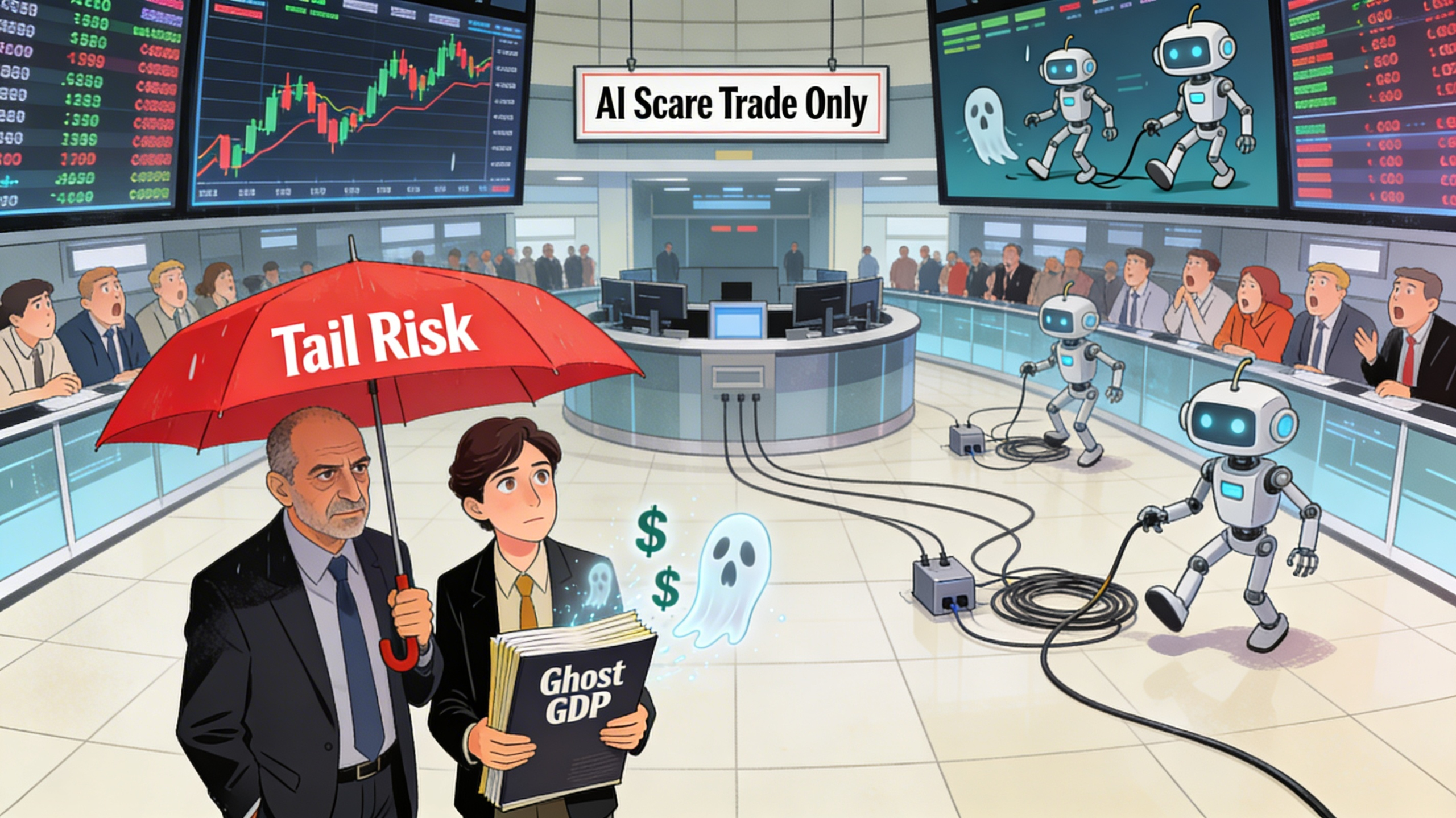
The note imagines a world in which AI agents relentlessly eliminate “friction” across the economy—displacing white-collar workers, compressing margins, and routing transactions in ways that inflate output but deflate demand. Citrini dubs this “ghost GDP”: productivity that shows up in the statistics but not in paychecks, because machines have an inconvenient habit of earning nothing and spending even less.
In the scenario, companies built on intermediation—software, payments, and other fee skimmers—see their business models erode as AI agents bypass middlemen, culminating in a 38% drop in the S&P 500 from its peak and a white-collar recession. The research is explicit that this is a warning, not a forecast, urging investors to reassess how much of their portfolio depends on assumptions about human-centric growth that may not survive the decade.
When Warnings Hit the Tape
On Wall Street, ideas only become real when they start moving prices, and the Taleb–Citrini axis has done exactly that.finance.
A wave of AI-scare headlines has coincided with sharp selloffs in software, payments, wealth management, logistics, and even real-estate services, as traders adopt a “shoot first, ask questions later” stance toward anything that looks like an intermediary between humans and money. One widely-circulated AI-recession scenario helped spark fresh volatility, while Taleb’s repeated calls to hedge tech-heavy portfolios have reinforced the sense that the AI complex is not just a growth story but a structural-risk story.
Yet even as the AI scare trade bites, strategists caution that markets may be over-reading the menace, with valuations occasionally reacting more to virality than to actual earnings revisions. The result is a new pattern: AI headlines now move the “have-a-presentation-on-AI” cohort of stocks almost as reliably as earnings releases.finance.
The New Market Mood: Hedge the Miracle
Taleb’s view of AI is not purely apocalyptic; he has acknowledged that the technology could help address sluggish growth even as it introduces fresh tail risks. Citrini, for its part, frames its work as a prompt to be proactive rather than a eulogy for capitalism.
Together, they have sketched a market mood that might be summarized as: “AI will change everything, which is why you should probably buy some protection.” Their combined influence has helped reposition AI from a one-way upside narrative to a two-sided trade, where investors simultaneously chase upside in foundational platforms and seek hedges against the possibility that those same platforms compress the very demand they need to thrive.
In classic Wall Street fashion, the scare trade doesn’t ask whether AI is good or bad for humanity—it asks whether you’re properly positioned if it turns out to be both.
The Sources
- Citrini Research – “THE 2028 GLOBAL INTELLIGENCE CRISIS” (original “ghost GDP” scenario memo)
https://www.citriniresearch.com/p/2028gic[citriniresearch] - Fortune – “‘Ghost GDP’ and a white-collar recession: Substack’s top finance writer on how AI could trigger a crash”
https://fortune.com/2026/02/23/will-ai-take-my-job-cause-recession-crash-james-val-geelen-citrini/[fortune] - Yahoo Finance – “‘Ghost GDP,’ a white-collar recession, and the death of friction”
https://finance.yahoo.com/news/ghost-gdp-white-collar-recession-163043617.html[finance.yahoo] - Implicator.ai – “AI’s Productivity Boom Is Real. The Prosperity Part Isn’t.”
https://www.implicator.ai/ais-productivity-boom-is-real-the-prosperity-part-isnt/[implicator] - Campbell Ramble – “The Death of the New Deal” (discussion of AI, friction, and policy context)
https://www.campbellramble.ai/p/the-death-of-the-new-deal[campbellramble] - Hacker News discussion – “Global Intelligence Crisis”
https://news.ycombinator.com/item?id=47114579[news.ycombinator]
Stay Updated with Vista Partners
Subscribe to receive market insights, investing ideas, and the latest updates directly in your inbox.