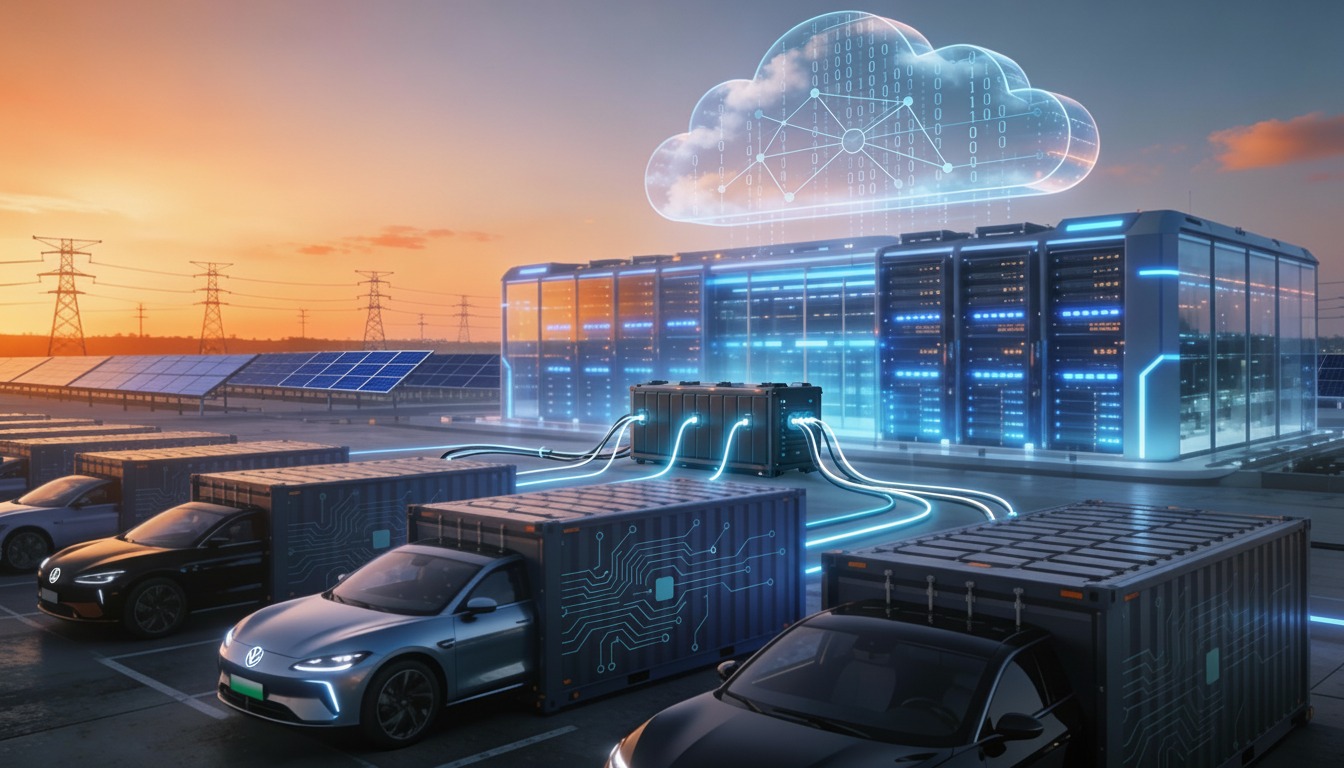
U.S. automakers are repositioning their EV battery bets into a new growth story: supplying grid and on‑site energy storage, with AI data centers emerging as one of the most coveted customers.
Core narrative
As EV demand cools and sales forecasts reset, automakers that spent tens of billions building battery plants suddenly face excess capacity and pressured margins. Rather than abandon those assets, companies like Ford, GM and Tesla are reframing themselves as energy companies, chasing a young but fast‑growing market for large battery packs that can soak up cheap electricity and discharge it when power is scarce and expensive.
Ford’s $2 billion pivot
Ford becomes the central character in this story when it quietly turns a flagship EV battery project in Kentucky into the backbone of a brand‑new energy storage division. The company commits about $2 billion over two years to retrofit its Kentucky and Michigan plants, shifting from batteries destined for big electric trucks to lithium iron phosphate (LFP) systems designed for utilities, commercial customers and data centers, while also carving out smaller packs for homes. By 2027, Ford aims to ship roughly 20 GWh of storage systems a year, effectively transforming a symbol of its EV ambitions into a factory for containerized battery blocks that can sit behind warehouses, substations and server farms.
Tesla’s playbook as proof
In the background of this pivot is Tesla, which has already shown how lucrative energy storage can be when EV growth slows. As Tesla’s vehicle sales stumbled for a second straight year in 2025, its energy segment—bundling large‑scale storage like Megapacks with solar—became its fastest‑growing business, delivering roughly 44% year‑over‑year sales growth in the third quarter and contributing about a quarter of company revenue, with margins around 30%, roughly twice those of its cars. That financial profile becomes the template the traditional Detroit automakers now want to copy: take EV‑grade batteries, repackage them into stationary blocks, and sell them into a market less sensitive to consumer whims and discount wars.
AI data centers as power‑hungry client
The story’s tension comes from AI itself, whose rapid spread is quietly reshaping the U.S. power grid. General Motors and battery recycler‑builder Redwood Materials sign a deal to deploy both new and second‑life EV batteries into modular storage systems, explicitly targeting the surging electricity demand of AI data centers, which are projected to triple their share of U.S. power use from about 4.4% in 2023 to roughly 12% by 2028. These systems charge when power is cheap or when renewables are plentiful, then discharge when the grid strains under the weight of GPU‑packed server halls, turning a former car battery into a buffer that keeps the lights—and the algorithms—on.
Opportunities and risks
Industry insiders frame the move as both logical and fraught. On one hand, regulators in states like California are already nudging utilities toward storage, federal incentives now favor U.S.‑made systems over Chinese imports, and the need to balance a grid saturated with renewables and AI demand is only growing. On the other hand, selling containerized batteries to utilities, cloud providers and industrial customers is nothing like selling pickups and SUVs: the buyers are different, sales cycles are longer, the field is quickly crowding with newcomers, and the EV battery market is still roughly three times larger than storage, meaning a sharp rebound in EV demand could yank these same factories back in the opposite direction.
Where the story lands
By the end, the narrative casts automakers as reluctant yet opportunistic power companies, racing to turn a perceived EV miscalculation into a bet on the infrastructure behind the AI boom. Whether these repurposed plants become the backbone of America’s next‑generation grid or another detour on the road to electrification depends on two uncertainties that hang over the story: how fast AI data centers really grow, and whether drivers eventually fall back in love with electric cars.
The Sources
- CNBC – “Why Automakers Want To Power AI Data Centers” (video)
https://www.youtube.com/watch?v=YdySswIbgyE[youtube] - CNBC – “Automakers Ford and GM jump into energy storage as EV demand slows”
https://www.cnbc.com/2026/01/15/ford-gm-tesla-energy-storage.html[cnbc] - LinkedIn News – “Major US automakers pivot from EVs to batteries”
https://www.linkedin.com/news/story/major-us-automakers-pivot-from-evs-to-batteries-6892508/[linkedin] - Mexico Business News – “US Automakers Expand Into Energy Storage as EV Demand Slows”
https://mexicobusiness.news/automotive/news/us-automakers-expand-energy-storage-ev-demand-slows[mexicobusiness] - TechCrunch – “Ford is starting a battery storage business to power data centers and the grid”
https://techcrunch.com/2025/12/15/ford-is-starting-a-battery-storage-business-to-power-data-centers-and-the-grid[techcrunch] - Yahoo Finance (rehost of TechCrunch) – “Ford is starting a battery storage business to power data centers and the grid”
https://finance.yahoo.com/news/ford-starting-battery-storage-business-211745514.html[finance.yahoo] - Ford – “Reinvests in Trucks, Hybrids, Affordable EVs, Battery Storage”
https://www.fromtheroad.ford.com/us/en/articles/2025/ford-reinvests-trucks-hybrids-affordable-electric-vehicles[fromtheroad.ford] - Planet Detroit – “Ford takes $19.5 billion hit in shift from EVs to battery storage”
https://planetdetroit.org/2025/12/ford-shifts-ev-battery-plans/[planetdetroit] - Data Centre Magazine – “GM and Redwood Target Battery Storage for Data Centres”
https://datacentremagazine.com/news/gm-and-redwood-target-battery-storage-for-data-centres[datacentremagazine] - GM Newsroom – “GM and Redwood Materials to pursue use of U.S.-built batteries for energy storage”
https://news.gm.com/home.detail.html/Pages/news/us/en/2025/jul/0716-GM-Redwood-Materials-pursue-use-US-built-batteries-energy-storage.html[news.gm]
Stay Updated with Vista Partners
Subscribe to receive market insights, investing ideas, and the latest updates directly in your inbox.