Smart Glasses, Lunar Logistics and Simpler Diabetes Care Offer a Compelling Growth Theme
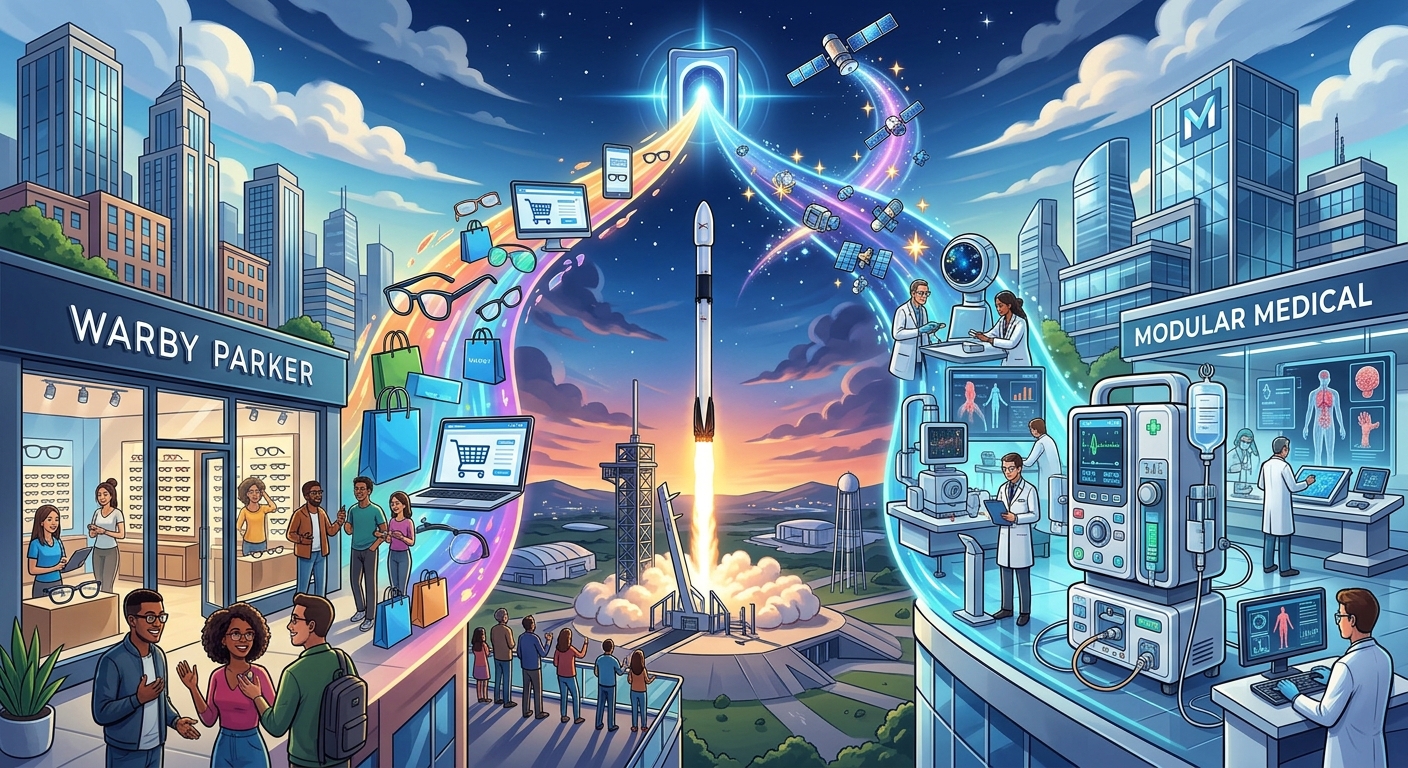
Wall Street’s most interesting growth stories do not always share an industry. Sometimes they share a commercial breakthrough: making something difficult easier to buy, use or deliver. Warby Parker (NYSE: WRBY) is approaching its intelligent-eyewear launch with a growing optical business already underneath it. SpaceX (NASDAQ: SPCX) and a group of lunar-service providers have gained access to a larger NASA contracting opportunity. Modular Medical (NASDAQ: MODD), meanwhile, has released patient research pointing to substantial interest in simpler insulin delivery. Different markets, different execution risks, but a common attraction: innovation moving closer to everyday commercial use. The connecting idea is access. Technology becomes more commercially interesting when it reaches a customer, wins a funded mission or solves a problem that people encounter repeatedly. For many, that is a more useful growth framework than simply finding the company with the most futuristic presentation.
Warby Parker Stock: A Growing Optical Business Gets an Intelligent Upgrade
Warby Parker’s third-quarter results provide a useful starting point for its next chapter. Revenue rose 10.4% to $244.7 million, active customers increased 3% to 2.74 million, and trailing-12-month average revenue per customer climbed 6.7% to $342. The company also opened 12 net new stores, ending September with 364 locations. Those numbers describe more than a retailer adding square footage. Warby Parker is growing its customer base while generating more revenue per customer. Its quarterly filing attributes the latter improvement primarily to premium lenses and enhancements, including precision progressives, alongside more customers purchasing eye exams with glasses or contacts. That matters because intelligent eyewear will enter an established vision-care business rather than an empty showroom. The company plans to begin accepting preorders for its first Intelligent Eyewear collection on November 12, with customer deliveries expected during the holiday season. Its collaboration with Google, part of Alphabet (NASDAQ: GOOGL, GOOG), includes a commitment of up to $75 million toward product development and commercialization costs. The bullish argument is straightforward: Warby Parker already has customers, physical stores and experience fitting a product people wear on their faces. That is a useful foundation for introducing new technology. A demonstration can make smart glasses look impressive. Getting someone to wear them comfortably through lunch is a different business discipline.
The Financial Foundation Matters as Much as the Frames
Warby Parker ended the quarter with $287.9 million in cash and cash equivalents. It generated $24.7 million in operating cash flow, although capital spending left quarterly free cash flow at negative $2 million. Net income was $5.6 million, slightly below the prior-year quarter, while adjusted EBITDA, a non-GAAP measure, increased to $28.6 million. Management’s full-year outlook calls for revenue of $966 million to $976 million and adjusted EBITDA of $117 million to $119 million. Guidance now includes a modest intelligent-eyewear contribution and associated launch costs. There is an important distinction beneath those encouraging figures. Earlier guidance included a $14.4 million full-year tariff-refund benefit intended to offset strategic investment. The earnings outlook should therefore not be mistaken for a pure measure of recurring operating improvement. Even with that qualification, the setup is attractive: an expanding core business, financial flexibility and a new product category whose contribution remains modest in the current outlook. The next test is whether consumer curiosity becomes orders, successful deliveries and repeatable demand.
Space Stocks: NASA Expands the Lunar Opportunity
NASA’s November 7 announcement gave the commercial lunar market a larger, longer runway. The agency selected eight companies eligible to compete under CLPS 2, the next phase of its Commercial Lunar Payload Services initiative. The framework is a 10-year, multiple-award contract with a combined maximum value of $10 billion. NASA also increased the existing CLPS contract ceiling from $2.6 billion to $4.2 billion. Selected providers include SpaceX (NASDAQ: SPCX), Firefly Aerospace (NASDAQ: FLY), Intuitive Machines (NASDAQ: LUNR), Voyager Technologies (NYSE: VOYG), Lockheed Martin Space, part of Lockheed Martin (NYSE: LMT), and Northrop Grumman Space Systems, part of Northrop Grumman (NYSE: NOC). Blue Origin and ispace-U.S. were also selected. The essential distinction is that eligibility is not booked revenue. The $10 billion figure is a combined ceiling across the framework, not a check handed to each participant. Companies still need to win individual missions and perform them successfully. Nevertheless, the commercial significance is substantial. NASA’s CLPS model purchases end-to-end delivery services, including payload integration, launch, mission operations and lunar landing. It gives commercial providers a route to compete for complex transportation work rather than merely sell individual components. The Moon may lack shopping districts, but its logistics requirements are becoming increasingly well specified.
Why the Opportunity Extends Beyond a Single Announcement
NASA’s broader exploration plans help explain the strategic value of that delivery network. The agency’s November update described an Artemis III test flight in 2027 and an Artemis IV lunar landing mission in 2028, with SpaceX and Blue Origin developing lunar landers. Those remain program targets, not completed milestones, but they provide context for sustained transportation and infrastructure demand. SpaceX also has work beyond the lunar program. NASA’s September announcement awarded it three additional crew-transportation missions under a $946 million contract modification, bringing the Commercial Crew Transportation Capability contract’s total value to $5.92 billion. Rocket Lab (NASDAQ: RKLB) belongs in the wider space discussion, but not in the CLPS 2 winner column. It was not among the eight providers named in NASA’s announcement. Sector enthusiasm and direct contract participation are different propositions, even when share prices appear to attend the same launch party. For many following space stocks, the most useful milestones are now concrete: task-order awards, funded missions, reliable delivery and evidence that technical achievement can produce durable economics.
Modular Medical Stock: Patient Research Sharpens the Pivot Opportunity
Modular Medical’s November 9 announcement addresses a less theatrical but deeply practical market: the daily burden of insulin delivery. The company’s research with Thrivable involved more than 540 people with Type 1 or Type 2 diabetes across three phases. In the final survey of 303 multiple-daily-injection users, approximately nine in 10 said they would consider a simpler insulin-delivery option, while 48.5% expressed strong interest in the company’s Pivot tubeless patch pump. Among highly burdened respondents, 82.8% said they would discuss Pivot with their healthcare provider. Lower cost and reduced effort were the leading factors that could encourage consideration of an alternative delivery method, cited by 59.7% and 57.4%, respectively. That points toward a potentially productive commercial strategy: address the reasons people have not adopted pump therapy, rather than assume another technical feature will do the selling. The provider relationship is particularly important. Among pump-naïve participants, 41.8% identified the absence of a healthcare-provider recommendation as their primary reason for not adopting a pump. Education and clinical engagement could therefore be as consequential as consumer messaging..
From Patient Interest to Commercial Execution
Modular Medical’s SEC-filed materials state that Pivot received FDA clearance in April 2026 and that initial U.S. shipments began in June. The company described plans to expand commercial activity across metropolitan markets by late 2026. Those milestones make the patient research commercially timely. It can help guide a product rollout already moving beyond development. Still, this was company-announced market research, not a clinical efficacy trial or a record of completed purchases. Reported interest cannot establish future adoption, reimbursement, retention or sales. The opportunity lies in converting that interest into a workable patient and provider experience. For many, the appeal is the combination of a cleared product and research identifying specific adoption barriers. The next chapter will be written through manufacturing execution, access, provider engagement and actual commercial uptake.
The Bullish Thread: Innovation With a Route to Revenue
These companies occupy different points on the commercialization curve. Warby Parker has an operating retail platform and a new technology category approaching launch. NASA’s selected lunar providers have a larger framework within which to compete for delivery missions. Modular Medical has begun shipping a cleared product and now has additional patient research to inform its expansion. That distinction makes the combined story more useful, not less. It separates established revenue from contract opportunity and expressed demand. The positive case is not that every new product will succeed or every contract ceiling will become sales. It is that each story has identifiable next steps through which promise can become measurable business progress. For many seeking growth beyond the familiar technology giants, that is an appealing place to focus: where innovation begins meeting the purchase order.
The Sources
- SEC.gov: Warby Parker third-quarter 2026 earnings release, including results, liquidity and full-year guidance.sec
- SEC.gov: Warby Parker Form 10-Q for the quarter ended September 30, 2026, including customer trends and the Google collaboration.sec
- SEC.gov: Warby Parker second-quarter 2026 earnings release, including tariff-refund benefits and intelligent-eyewear investment.sec
- NASA: “NASA Awards Moon Base Transportation, Technology, Science Projects,” November 7, 2026.nasa
- NASA: Commercial Lunar Payload Services program overview and explanation of commercial delivery services.nasa
- NASA: “NASA Shares Plans to Accelerate Artemis, Return to Moon,” November 4, 2026.nasa
- NASA: “NASA Awards SpaceX Three Crew Flights to Space Station,” updated September 18, 2026.nasa
- SEC.gov: Space Exploration Technologies Corp. Form 10-Q for the quarter ended June 30, 2026, including trading symbol and IPO details.sec
- SEC.gov: Modular Medical filing describing Pivot’s FDA clearance, initial shipments and commercialization plans.sec
- Modular Medical company announcement: “Modular Medical Completes Comprehensive Patient Market Research Study with Thrivable, Reinforcing Strong Interest in Simplified Insulin Delivery,” November 9, 2026.accessnewswire
Stay Updated with Vista Partners
Subscribe to receive market insights, investing ideas, and the latest updates directly in your inbox.