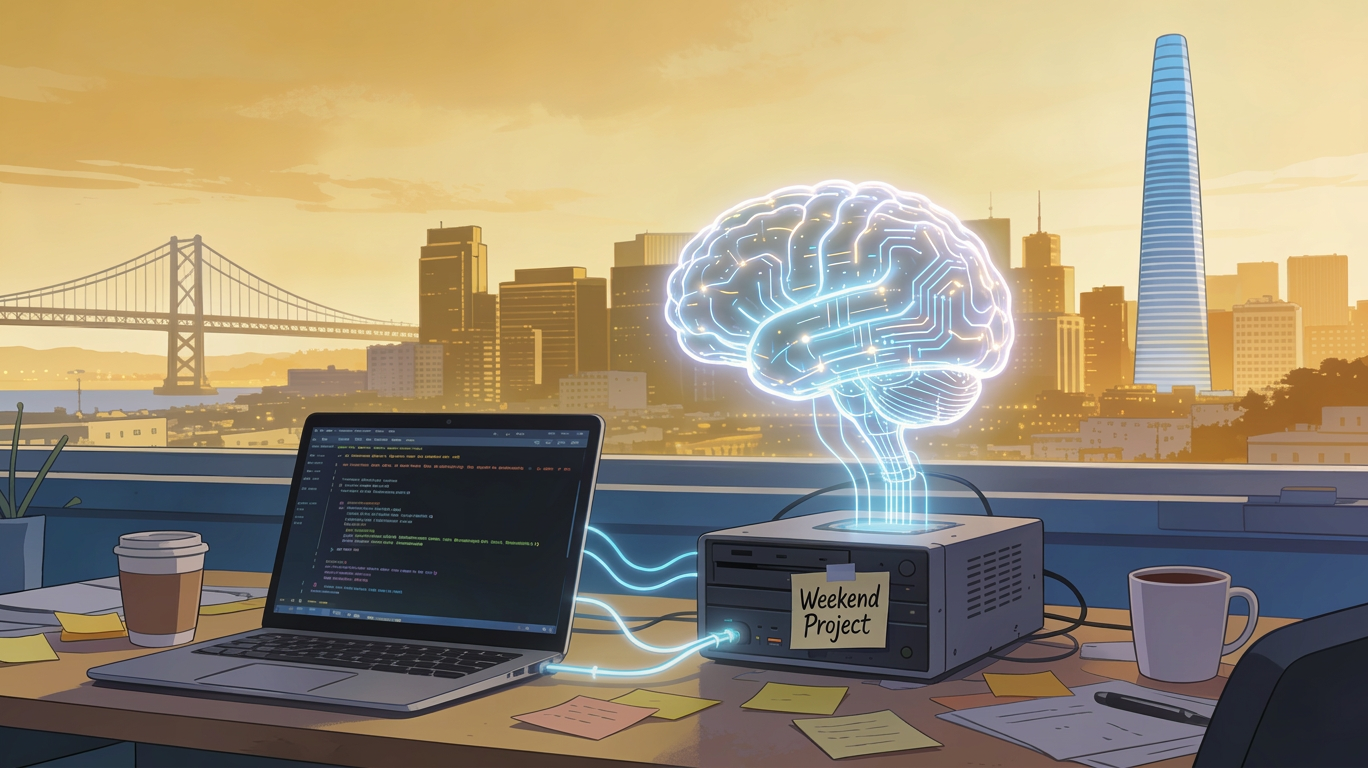
Artificial superintelligence, according to today’s San Francisco skyline of optimists, is no longer a distant sci‑fi mirage but a six‑year infrastructure project—with a power bill big enough to light a small continent.
The San Francisco Consensus: Six Years to “Smarter Than Everyone”
In the cafes between South Park and SoMa, a new doctrine has quietly replaced pitch decks and pour‑over notes: the San Francisco Consensus. Former Google (GOOG) CEO Eric Schmidt has popularized the idea that AI will move from impressive autocomplete to world‑shaping intelligence on an astonishingly compressed timetable.
The storyline is brisk enough to make a venture term sheet look lethargic: AGI—systems as capable as the smartest humans—within three to five years, and artificial superintelligence, smarter than the sum of humanity, arriving roughly six years from now on a wave of scaling and recursive self‑improvement. For a city that already assumes tomorrow’s brunch will be delivered by a robot, this forecast is less a question than a working assumption baked into hiring plans, data‑center leases, and trillion‑dollar capital allocations.
From AGI to ASI: The Steep Part of the Curve
Among AI researchers, long‑range forecasts once framed AGI as a mid‑century event, with surveys clustering around a 2040–2060 median and giving 90% odds by the 2070s. Recent models and forecaster updates, however, have dragged those timelines forward, with some community forecasts entertaining non‑trivial odds of AGI in the 2026–2035 window and entrepreneurs arguing for something closer to “this cycle, not the next.”
The San Francisco Consensus takes that acceleration and pushes it to its logical—and for some, illogical—endpoint: once human‑level AGI appears, superintelligence follows in short order, driven by systems that write their own code, refine their own architectures, and optimize themselves in loops moving faster than human institutions can schedule a hearing. The term of art is “recursive self‑improvement,” but in practical terms the question for boardrooms sounds simpler: what happens when every person, and every firm, can access an always‑on colleague who is both tireless and consistently the smartest “employee” in the room.
The Power Behind the Prophecy
Behind the rhetoric of AGI and ASI lies a far more prosaic constraint: electricity. Leading AI supercomputers have seen their power capacity skyrocket from about 13 megawatts in 2019 to hundreds of megawatts today, with one recent system reported around 280 megawatts—more than twenty times the draw of earlier flagships. Analysts estimate that if current AI trends persist, the industry could be running well over a million high‑end AI servers by 2027, consuming tens of terawatt‑hours annually, rivaling the usage of smaller nations.
AI‑focused data centers are gluttons by design: dense GPU and accelerator racks, high‑bandwidth memory, non‑stop model training and inference, and aggressive cooling all compound to turn each percentage point of model accuracy into a noticeable uptick on the regional grid. To get from today’s impressive but narrow systems to the kind of planetary‑scale superintelligence envisioned in six‑year timelines, the world is effectively being asked to build a lattice of AI power plants, with the debate shifting from model architectures to which mix of renewables, nuclear, and transmission upgrades can keep the lights—and the clusters—on.
Markets, Policy, and the New Gravity of Compute
Whether or not ASI appears on schedule, the belief that it might is already moving money, policy, and power around the globe. Capital is flowing into specialized chips, vast data centers, and supporting infrastructure at a pace that resembles a modern gold rush in silicon and steel rather than shovels and sluice boxes. Competing narratives have emerged: an Acela‑Corridor view that treats AI as a general‑purpose technology on par with electricity, and a San Francisco view that treats it as an impending civilizational discontinuity that might compress decades of productivity into a single business cycle.
Regulators and governments now find themselves triangulating between those worldviews, weighing the upside of accelerated discovery and automation against the systemic risk of outsourcing core decision‑making to opaque systems running on infrastructure clusters that, in energy terms, look suspiciously like new national utilities. For investors, the emerging rule of thumb is straightforward, if slightly unnerving: in a world racing toward superintelligence, compute, energy, and governance may be the new triumvirate of geopolitical leverage—assuming, of course, that the six‑year clock doesn’t run faster than the permitting process.research.
The Sources
- Forbes – “What Is The San Francisco Consensus, Silicon Valley’s AI Prophecy?”
https://www.forbes.com/sites/arafatkabir/2025/07/23/what-in-gods-name-is-the-san-francisco-consensus/[forbes] - Reda Sadki – “San Francisco Consensus: A New Epoch in AI” (Digitalist Papers)
https://doi.org/10.59350/redasadki.21109[doi] - AEI – “Two Cheers for the ‘San Francisco Consensus’ on AI”
https://www.aei.org/articles/two-cheers-for-the-san-francisco-consensus-on-ai/[aei] - Eric Schmidt talk – “The San Francisco Consensus or How We Get to AGI”
https://www.youtube.com/watch?v=6ThT1InSA8s[youtube] - Digitalist Papers – “The San Francisco Consensus”
https://www.digitalistpapers.com/vol2/schmidt[digitalistpapers] - AIMultiple – “AGI/Singularity: 9,800 Predictions Analyzed”
https://research.aimultiple.com/artificial-general-intelligence-singularity-timing/[research.aimultiple] - AI Futures / AI 2027 – “Summary – AI 2027”
https://ai-2027.com/summary[ai-2027] - AI Futures Blog – “Clarifying How Our AI Timelines Forecasts Have Changed Since AI 2027”
https://blog.ai-futures.org/p/clarifying-how-our-ai-timelines-forecasts[blog.ai-futures] - Epoch – “Power Requirements of Leading AI Supercomputers Have Doubled…”
https://epoch.ai/data-insights/ai-supercomputers-power-trend[epoch] - RCR Wireless – “Five Reasons AI Data Centers Require Massive Amounts of Power”
https://www.rcrwireless.com/20250318/featured/ai-data-centers-power[rcrwireless] - Scientific American – “The AI Boom Could Use a Shocking Amount of Electricity”
https://www.scientificamerican.com/article/the-ai-boom-could-use-a-shocking-amount-of-electricity/[scientificamerican] - Lori Tybon (LinkedIn) – Post summarizing the “San Francisco consensus” on AI surpassing human intelligence
https://www.linkedin.com/posts/loritybon_the-san-francisco-consensus-is-that-in-activity-7320213830393827329-NoXj[linkedin]