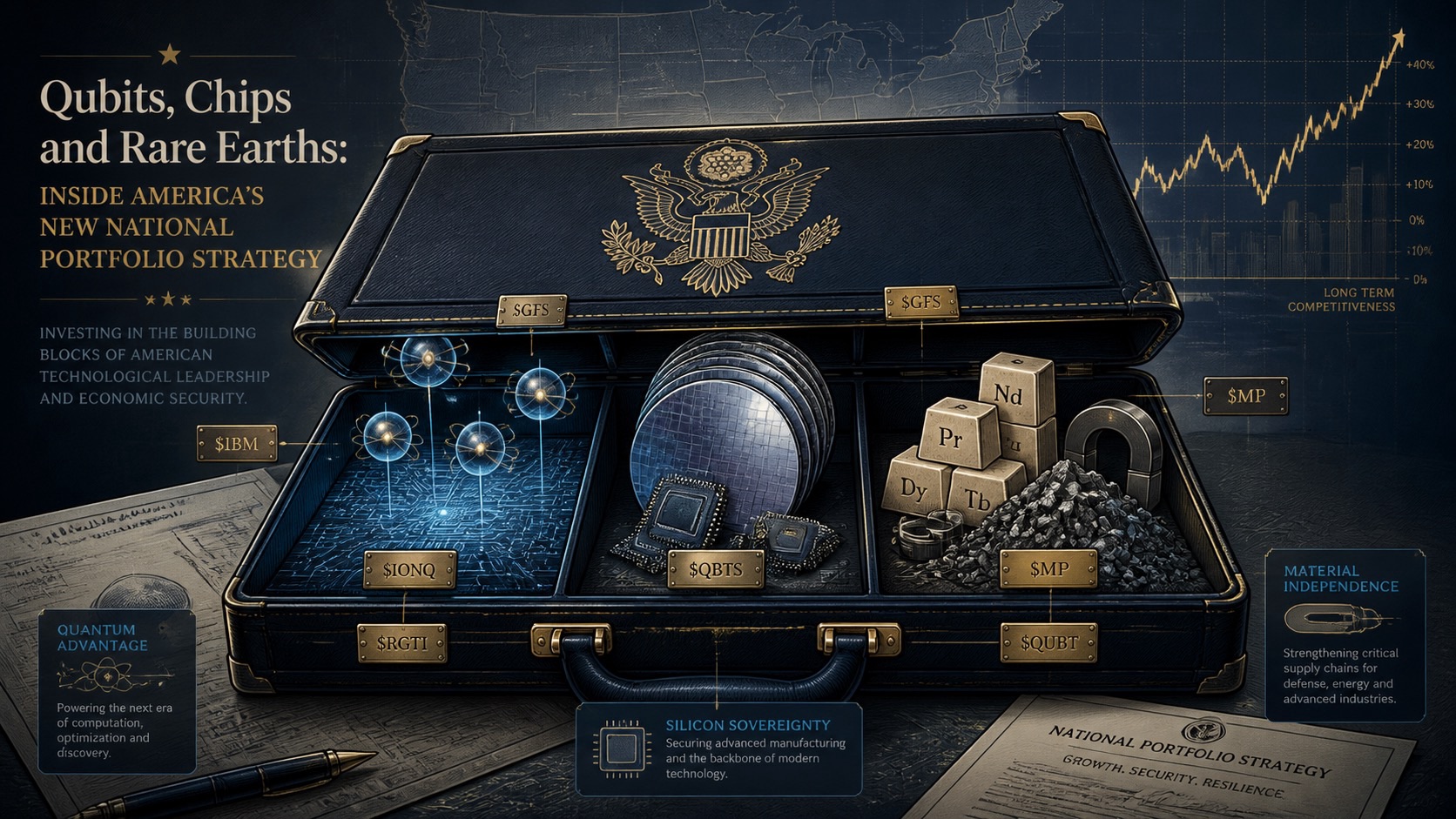
The United States’ latest move into quantum computing reads less like a science project and more like a sprawling, government-run portfolio spanning semiconductors, steel, nuclear power and rare earth metals—just with a few more qubits than usual.
Quantum Becomes the New National Industry
In Washington’s newest industrial experiment, the Trump administration is reportedly extending its investment spree from chips and rare earths into quantum computing, offering roughly 2 billion dollars in grants to nine companies in exchange for equity stakes. The idea is that if taxpayers are footing the bill for cutting‑edge hardware, they should also enjoy a sliver of any upside that comes when those qubits finally earn their keep.
The centerpiece is a proposed 1 billion dollar award to International Business Machines Corp. (IBM), which will build what officials pitch as America’s first purpose‑built “quantum foundry”—a kind of fabrication facility where quantum machines and components can graduate from lab curiosity to reliable infrastructure. It is the kind of project that lets policymakers talk about “strategic capacity” and “resilience” while quietly inching Uncle Sam closer to becoming a long‑term tech investor.
A Portfolio That Thinks Like a Hedge Fund
Quantum may be the shiny new object, but it’s being dropped into a portfolio that already ranges from semiconductors to steel, nuclear reactors and rare earth supply chains. The through‑line is geopolitical: in each case, Washington is deciding that certain technologies and materials are too important to leave entirely to the invisible hand and quarterly guidance.
Semiconductors are the familiar anchor, with GlobalFoundries Inc. (GFS) in line for about 375 million dollars and the government taking an equity interest estimated around 1 percent—small enough to keep markets calm, large enough to show this is more than a grant with patriotic branding. On the materials side, the government has already taken stakes in rare‑earth players such as MP Materials Corp. (MP), which operates one of the few non‑Chinese rare‑earth mines, and a magnet‑maker known as Vulcan Elements, aiming to shore up the permanent magnets that make everything from electric vehicles to missiles spin.
The result looks suspiciously like a diversified national balance sheet: qubits via IBM (IBM), fabrication capacity via GlobalFoundries (GFS), magnets and rare earths via MP Materials (MP) and Vulcan Elements, plus earlier bets in nuclear fuel and heavy industry. If the 20th century’s big question was which companies filled the Dow, the 21st century’s version might be which ones end up on the Department of Commerce’s cap table.
Quantum Start‑Ups Join the Club
While IBM (IBM) and GlobalFoundries (GFS) give the program blue‑chip gloss, the more speculative action is happening in the pure‑play quantum names that now find themselves negotiating term sheets with Washington. D‑Wave Quantum Inc. (QBTS), the annealing‑focused pioneer that has been selling early quantum systems for years, is in line for around 100 million dollars; Rigetti Computing Inc. (RGTI), which builds superconducting‑qubit machines, is in the same ballpark.
A cluster of other firms—often still closer to the lab bench than the earnings call—rounds out the list. Atom Computing, PsiQuantum, Infleqtion and Quantinuum are widely cited as participants or likely beneficiaries, though several remain privately held and therefore more familiar to venture capitalists than to retail investors. For the public‑market crowd, names like IonQ Inc. (IONQ) and Quantum Computing Inc. (QUBT) sit just offstage, as investors parse whether government equity programs eventually sweep them in as well.
Collectively, these deals illustrate how the state is trying to smooth out the notorious boom‑bust cycle of frontier hardware. In exchange, the firms accept that their next big investor is less a Sand Hill Road partnership and more a cabinet department with a fondness for compliance paperwork.
How the Equity Experiment Works
The mechanics of these arrangements are straightforward in outline and complex in execution: companies receive grants under the CHIPS Act and related programs, while the government receives a minority, non‑controlling equity stake. For IBM (IBM), that billion‑dollar check comes paired with a slice of stock that turns the federal government into a small but real shareholder; for GlobalFoundries (GFS), officials expect a similar arrangement at a lower dollar level and roughly 1 percent ownership.
Smaller quantum firms such as D‑Wave Quantum (QBTS) and Rigetti Computing (RGTI) are reportedly in talks for at least 10 million dollars each, enough to fund additional hardware generations without relying solely on the next capital raise. Officials argue that this structure gives taxpayers a shot at capturing upside if quantum turns into a commercially meaningful industry, rather than leaving all future gains to private shareholders.
The move also sets a precedent: if quantum grants come with equity hooks, it’s easier to imagine future rounds in areas such as advanced nuclear, grid‑scale storage or new rare‑earth refining capacity operating on similar terms. At that point, the question for CFOs may be less whether to take government money and more which alphabet soup of programs offers the most favorable cap‑table math.
A Strategic Bet on Qubits and Supply Chains
The strategic logic behind this portfolio is that quantum machines, like chips and rare earths, are both economic assets and geopolitical tools. A mature quantum sector promises speed‑ups in areas such as optimization, cryptography and materials science, even if the revenue line is still more theory than practice.
By backing players from IBM (IBM) and GlobalFoundries (GFS) to MP Materials (MP) and Vulcan Elements, Washington is trying to stitch together an ecosystem that can fabricate, power and supply the hardware stack without leaning on rival powers. Think of it as a supply chain that runs from the rare‑earth mine to the superconducting chip, with the federal government acting as both limited partner and ultimate customer.
Critics worry about politicizing capital allocation, but the administration’s view is that the larger risk lies in leaving critical technologies under‑invested or over‑concentrated abroad. If the price of more resilient supply chains is that Washington occasionally sounds like a sector‑focused hedge fund, officials appear willing to live with the comparison.
Market Reaction: Qubits Meet Quotes
Investors, for their part, have treated the news as a fresh catalyst in a sector prone to long droughts between headlines. IBM (IBM) shares reportedly jumped more than 7 percent after the quantum foundry plan surfaced, while some of the smaller quantum names saw moves of up to 20 percent as traders extrapolated what a government on their shareholder registry might mean.
GlobalFoundries (GFS), already a key beneficiary of earlier chip subsidies, stands to deepen its relationship with Washington, giving investors another reason to treat the stock as a long‑cycle beneficiary of industrial policy. And even downstream players such as MP Materials (MP) have been pulled into the narrative, as markets revisit which companies sit closest to the converging fault lines of technology, security and policy.
Of course, quantum’s revenue line still looks more like a thesis than a cash flow statement, and the path from prototype system to profitable product remains hazy. But in a market where imagination often trades at a premium, the promise of billion‑dollar foundries and government‑backed balance sheets is enough to put qubits squarely back on investors’ dashboards.
Learn More By Watching This Video
This video examines the transformation of the global critical minerals supply chain at a time when resilience, innovation, and policy leadership are more urgent than ever. From mineral extraction and refinement, to government action and private sector innovation, each episode will bring you closer to the people and ideas shaping the future of resource security.
The Sources
[1] US move into quantum computing adds to a portfolio that spans … https://finance.yahoo.com/economy/policy/article/us-move-into-quantum-computing-adds-to-a-portfolio-that-spans-semiconductors-steel-nuclear-and-rare-earths-173919828.html
[2] $100M Diraq: $38M Also in: Atom Computing, PsiQuantum … https://x.com/insidermonkey/status/2057434954846400612
[3] Trump administration in talks to take stakes in quantum-computing … https://www.reuters.com/business/trump-administration-talks-take-stakes-quantum-computing-firms-wsj-reports-2025-10-23/
[4] IBM and U.S. Department of Commerce Announce America’s First … https://newsroom.ibm.com/ibm-and-u-s-department-of-commerce-announce-americas-first-purpose-built-quantum-foundry
[5] US move into quantum computing adds to a portfolio that spans … https://www.aol.com/articles/us-move-quantum-computing-adds-173919000.html
[6] First rare earths and chips, now quantum computers – Reddit https://www.reddit.com/r/StockMarket/comments/1odzvam/first_rare_earths_and_chips_now_quantum_computers/
[7] VanEck Rare Earth and Strategic Metals ETF (US) – REMX https://www.vaneck.com/us/en/investments/rare-earth-strategic-metals-etf-remx/
[8] Quantum computing stocks spike on reported US interest in stakes … https://www.investing.com/news/stock-market-news/us-govt-in-talks-to-take-stakes-in-quantumcomputing-firms-wsj-reports-4303307
[9] 8 Best Quantum Computing Stocks to Buy in 2026 – U.S. News Money https://money.usnews.com/investing/articles/best-quantum-computing-stocks-to-buy
[10] Finance and Markets https://www.wsj.com/finance
[11] Trump Administration in Talks to Take Equity Stakes in Quantum … https://www.wsj.com/business/entrepreneurship/trump-administration-in-talks-to-take-equity-stakes-in-quantum-computing-firms-60ee5143
[12] Best Quantum Computing Stocks to Buy for May 2026 https://www.zacks.com/featured-articles/361/best-quantum-computing-stocks
[13] Dow Jones – Trusted News & Data https://www.dowjones.com
[14] Quantum Computing & Nuclear Energy – YouTube https://www.youtube.com/watch?v=5iFwzUomXns
[15] 3 Stocks & 1 ETF To Buy Now For Quantum Computer Investing? https://www.youtube.com/watch?v=vVVyzya6gr4
Stay Updated with Vista Partners
Subscribe to receive market insights, investing ideas, and the latest updates directly in your inbox.