Skip to content Skip to sidebar Skip to footer

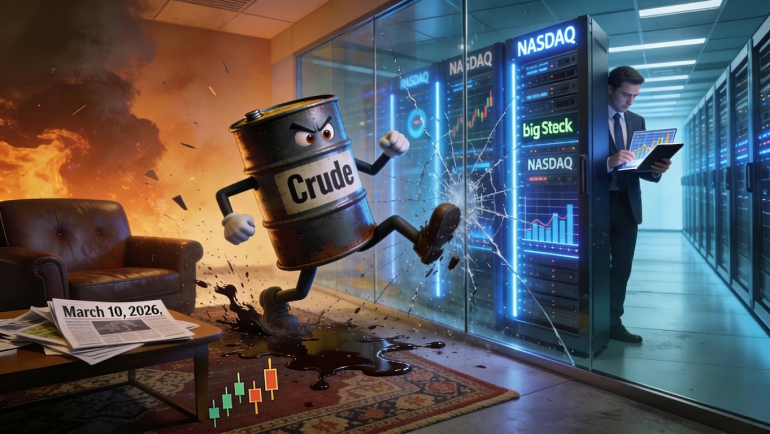
March 10, 2026 – Nasdaq Hides In The Server Room While Crude Kicks Over The Furniture -( $EPRX $FIGS $GOVX $HIMS $MODD $NVDA $ORCL $SOAR $VRTX Rise!)

US stocks chopped sideways into the close Tuesday as oil’s historic round‑trip kept nerves frayed, leaving the Dow and S&P 500 slightly lower while the Nasdaq clung to a fractional .01% gain and traders tried to game the next headline out of Iran and the White House.

Opening Take: Geopolitics, Oil And AI

The tape still traded like a geopolitical market in recovery mode, not one that has fully priced the end of the Iran war. President Trump’s repeated hints that the conflict could end “soon” helped oil extend its two‑day slide and took some pressure off risk assets, but the lingering question of how secure the Strait of Hormuz really is kept a lid on any broad‑based relief rally.

AI‑linked large caps again played the role of shock absorber, i.e. NVIDIA (NVDA, $184.77, +1.16%) allowing the Nasdaq to edge green even as the broader market softened, with investors rotating toward cash‑rich, data‑center‑exposed franchises and away from more levered cyclicals that are one oil spike away from a margin squeeze.

Energy: From Panic To Hangover

Oil was the main story again, only this time on the way down. After spiking roughly two‑thirds from pre‑war levels as U.S. and Israeli strikes hit Iranian assets and choked traffic through Hormuz, crude has now retreated below 90 dollars a barrel, leaving energy bulls with a geopolitical hangover and options traders nursing quickly decaying upside hedges.

Energy equities tracked the give‑back, with the Energy Select Sector SPDR (XLE, $55.60, -1.28%) underperforming as investors marked down war‑premium cash flows and questioned how sustainable recent earnings beats look if crude settles closer to the mid‑80s than the triple‑digit levels some banks had started to pencil in. At the same time, the speed of oil’s reversal — helped along by talk of G7 reserve releases and the possibility of easing constraints on other producers — is forcing macro desks to rethink just how persistent any inflation shock will be if supply keeps flowing despite the fighting.

Tech: AI As Default Shelter

If the old playbook said “hide in defensives,” today’s version is closer to “hide in AI‑plumbing.” Big tech and communication services names with heavy data‑center and cloud exposure stayed in demand as investors favored balance‑sheet strength, recurring revenues, and exposure to secular capex over more economically sensitive stories.

Oracle (ORCL, up +8.63% in the aftermarket) drew interest into its earnings setup as a key beneficiary of the AI database and cloud build‑out, while broader chatter around “safe haven” tech again centered on giants like Microsoft and IBM as investors look for ways to stay in the market without being fully hostage to oil or tariffs. Under the surface, options desks reported healthy demand for downside protection tied to smaller, more speculative AI names, a reminder that even within tech there is a sharp divide between perceived infrastructure winners and story‑rich, cash‑poor hopefuls.

Biotech: Idiosyncratic Moves In A Macro Tape

Biotech traded on its own news flow, with headlines reminding investors that clinical data and C‑suite changes can still matter more than crude for individual names. Vertex Pharmaceuticals (VRTX, $499.17, +8.31%) extended gains after a late‑stage win in IgA nephropathy, reinforcing its pipeline‑execution narrative and giving fundamental investors something tangible to underwrite beyond the company’s dominant cystic fibrosis franchise.

On the flip side, BioNTech (BNTX) cratered after announcing that co‑founders Ugur Sahin and Özlem Türeci will step down to launch a new mRNA venture, rekindling questions about succession, platform value, and how much COVID‑era cash can be redeployed into a post‑pandemic pipeline. For allocators, the message was clear: in a market obsessed with oil and Iran, biotech (iShares Biotechnology ETF, IBB, $172.27, +.57%) is still delivering stock‑specific winners and losers that can move double digits on days when the major indexes barely budge.

What Today Signals

Today’s action keeps the market in a familiar holding pattern: oil and Iran define the left‑tail scenarios, AI‑linked megacaps underpin the right side of the distribution, and everything else trades in between, buffeted by each new headline. For now, the path of least resistance is a grudging grind punctuated by sharp intraday reversals — a backdrop that rewards selective risk‑taking in high‑conviction stories and punishes anyone assuming that one presidential comment is enough to declare the all‑clear on geopolitics.

VP Watchlist Updates

Below is an update‑style snapshot on the VP Watchlist names for the week, focused on recent catalysts, positioning, and narrative rather than precise price moves.

Hims & Hers Health, Inc. (NYSE: HIMS, $23.47, +5.91%)

Hims & Hers Health, Inc. (NYSE: HIMS) announced (March 9) a collaboration with Novo Nordisk as part of a new strategy for weight loss care treatments involving GLP-1s, evolving its US offering to match the company’s approach globally. In the US, the company now plans to provide GLP-1 customers with access to a broad assortment of FDA-approved medications and offer compounded semaglutide through the platform on a limited scale. By aligning its domestic and international models in weight loss, Hims & Hers will become the largest global consumer health platform for access to more affordable, approved medications.

Eupraxia Pharmaceuticals (EPRX, $8.02, +2.56%)

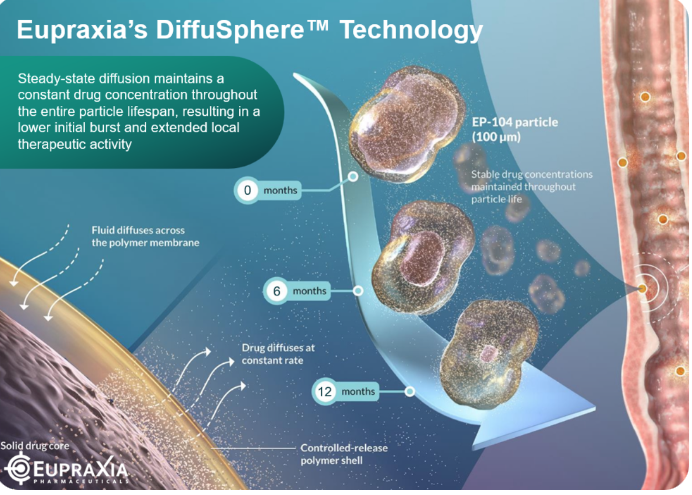
Eupraxia Pharmaceuticals Inc. (“Eupraxia” or the “Company”), a clinical-stage biotechnology company leveraging its proprietary Diffusphere™ technology designed to optimize local, controlled drug delivery for applications with significant unmet need, recently announced the successful closing of its previously announced public offering (the “Offering”) of 7,607,145 common shares of the Company (the “Common Shares”), which includes the full exercise of the option to purchase additional shares granted to the underwriters, at a price to the public of US$7.00 per Common Share, and pre-funded warrants to purchase up to 1,428,571 Common Shares in lieu thereof (the “Pre-Funded Warrants”) at a price of US$6.99999 per Pre-Funded Warrant, which equals the public offering price per Common Share less the C$0.000001 per share exercise price of each Pre-Funded Warrant, for gross proceeds of approximately US$63.2 million, before deducting the underwriting commissions and estimated expenses incurred in connection with the Offering.“We are pleased to complete this financing, allowing us to significantly expand our pipeline, reach several additional development milestones with EP-104GI for eosinophilic esophagitis, and make meaningful progress towards commercial readiness,” said James Helliwell, CEO of Eupraxia. “We appreciate the support from both existing and new investors as we execute our mission and pursue the next phase of growth for Eupraxia.” Cantor and LifeSci Capital acted as joint book-running managers for the Offering. Bloom Burton and Craig-Hallum also acted as co-managers for the Offering. As previously stated, the Company intends to use the net proceeds from the Offering primarily for the continued advancement of EP-104GI for Eosinophilic Esophagitis, including the completion of ongoing preclinical studies, and Phase 2 clinical trials, preparations for a Phase 3 clinical trial including the related regulatory submissions, and manufacturing activities, and to undertake the necessary commercial/market development activities to prepare for the eventual product launch. The Company also intends to use a portion of the proceeds to accelerate and expand its plans to pursue clinical studies with EP-104GI in multiple additional gastrointestinal indications, including in esophageal strictures and fibrostenotic Crohn’s disease. A portion of the proceeds will be allocated to research and development of additional pipeline candidates, business development initiatives, and general corporate purposes, which may include but are not limited to employee salaries, working capital, leases for facilities, administrative expenses, and capital expenditures. The Company may also use a portion of the proceeds to expand its intellectual property portfolio and strengthen its corporate infrastructure to support future growth.

Modular Medical (MODD $.2148, +8.70%)

FIGS, Inc. (FIGS, $16.10, +4.07%)

  • FIGS, the direct‑to‑consumer healthcare apparel brand, operates at the intersection of e‑commerce and specialty retail, with a loyal professional customer base and a growing product portfolio. While macro headwinds and digital‑ad volatility have pressured some consumer names, FIGS’ brand equity in the medical community and ongoing product innovation offer levers for renewed growth as conditions normalize.
  • After the close (Feb. 26), FIGS released its fourth quarter and full year 2025 financial results and published a financial highlights presentation on its investor relations highlighting the following: Exceeded Top and Bottom Line Expectations, Grew Q4 2025 Net Revenues 33.0% to a Record $201.9 Million, Achieved Q4 2025 Net Income Margin of 9.2% and Adjusted EBITDA Margin of 13.2% & Plans Low Double-Digit Net Revenues Growth and Margin Expansion in FY 2026. FIGS shares have traded up to $13.74 in the aftermarket today.

GeoVax Labs (GOVX, $1.93, +3.21%)

DoubleVerify (DV, $10.61)

  • DoubleVerify, the leading software platform for digital media measurement, data and analytics, today announced financial results for the fourth quarter and full year ended December 31, 2025 and highlighted the following: Increased 2025 Revenue by 14% Year-over-Year to $748.3 Million, Driven by Global Growth in Social, CTV Measurement, and Programmatic Activation, Achieved 2025 Net Income of $50.7 Million and Adjusted EBITDA of $245.6 Million, representing a 33% Adjusted EBITDA margin, & $300 Million Authorized for Share Repurchases, the Largest Amount in DoubleVerify’s History.

The InterGroup Corporation (INTG, $37.51)

  • InterGroup Corporation delivered (Feb. 17) a notably stronger quarter, highlighted by a 20% jump in total revenue to $17.3 million and a 27% surge in hotel revenue as renovated rooms returned to service and travel demand improved. The company swung from a prior-year net loss to $1.0 million in net income, with operating income more than doubling to $2.0 million, underscoring better cost control and improved operating efficiency. Management further enhanced liquidity and sharpened strategic focus by selling a non-core 12‑unit Los Angeles multifamily property, generating a meaningful gain and additional working capital while maintaining stable performance across its real estate portfolio.

Serina Therapeutics (SER, $1.62, +1.89%)

  • Serina Therapeutics, a clinical-stage biotechnology company advancing drug candidates enabled by its proprietary POZ Platform™ drug optimization technology, announced (Feb. 19) that the first patient has been enrolled in the Company’s Phase 1b registrational trial evaluating. The Phase 1b registrational study is designed to evaluate the safety, tolerability, pharmacokinetics, and preliminary efficacy of SER-252 in patients with advanced Parkinson’s disease whose symptoms are inadequately controlled by current standard-of-care therapies. Serina remains on track to initiate dosing during the current quarter, consistent with previously disclosed guidance.

Volato Group, Inc. (SOAR, +16.97%) & M2i Global, Inc. (MTWO)

  • Volato Group, Inc. today announced that it has entered into an amendment to its Aircraft Management Services Agreement with flyExclusive, Inc. (“FLYX”) providing for the sale of certain legacy intellectual property assets. The agreement provides for consideration valued at approximately $1.3 million, payable in FLYX Class A common stock, subject to customary conditions. The assets relate to legacy intellectual property developed during earlier stages of the Company’s technology initiatives and are not part of Volato’s current operating platforms. Volato continues to evaluate opportunities to streamline its asset base and focus resources on strategic priorities, including the continued development of its core software platforms and the pending business combination with M2i Global, Inc.
  • Volato and M2i Global reaffirmed their goal of closing their business combination in the first quarter of 2026, citing steady advancement through SEC review and integration planning as they move toward a combined listing. The deal, originally announced in 2025, will effectively transition Volato from a pure‑play private aviation operator into a diversified platform spanning aviation technology and critical minerals, with M2i shareholders expected to own the majority of the combined entity. Operationally, the partnership is already visible: the two companies recently initiated their first shipment of titanium ore from Western Australia to the United States from Titanium X, underscoring how the critical‑minerals vertical could become a meaningful growth engine as domestic supply‑chain security rises in strategic importance.
  • On Feb. 4, M2i Global,Inc.along with Volato Group, Inc. announced that Titanium X has initiated its first shipment of titanium ore from Western Australia to the U.S. under its collaboration agreement.

NVIDIA (NVDA, $184/77, +1.16%)

  • Nvidia delivered strong fourth-quarter results recently, posting revenue of $68.1 billion, well above analyst expectations. Looking ahead, the company projects $7.8 billion in revenue for the first quarter of 2026, reflecting continued robust demand for its AI chips even amid broader market headwinds.

McDonald’s (MCD, $327.94)

  • In the run-up to World Protein Day on 27th February, McDonald’s India (West & South), owned and operated by Westlife Foodworld, is celebrating Protein Week, reinforcing its leadership in nutrition-led innovation. Making protein more accessible, affordable and customizable, Indian consumers can use the McDonald’s app to explore these nutritious offerings and avail of protein burgers starting at just INR 69. Enhancing this convenience, consumers ordering via McDelivery can also enjoy free delivery on the Protein Plus meal range.

Nokia (NOK, $7.80)

  • Nokia Corporation is attracting renewed investor interest after FMR LLC lifted its indirect stake above the 5% voting-rights threshold, a move disclosed under Finnish securities law. At the same time, its new role in Palo Alto Networks’ expanded AI and 5G security ecosystem reinforces Nokia’s position in safeguarding next-generation networks, a development that could support its standing in telecom and infrastructure markets.
  • On March 2, Nokia (NOK) and TIM Brasil announced and are are quietly rewriting the script for Latin America’s telecom sector, rolling out an AI‑ready 5G network that targets nearly half of Brazil’s population while giving enterprises a front‑row seat to the AI industrial era. The expanded partnership takes what TIM started in São Paulo and extends it across 14 additional states, ultimately reaching regions that together represent roughly 42% of Brazil’s population. The upgraded network leans on Nokia’s latest AirScale portfolio, including energy‑efficient Habrok Massive MIMO radios, Remote Radio Heads and small cells designed to boost capacity, improve indoor coverage and cut power consumption at the same time. In practical terms, this is less about bragging rights on speed tests and more about building a platform for AI‑driven services: the architecture is being designed from the ground up to support 5G Advanced, 6G and AI‑native workloads at the edge, not just another round of radio swaps.

Opendoor (OPEN, $5.01)

The Sources

  1. Yahoo Finance – “Stock market today: Dow, S&P 500 end lower, oil slides as Wall Street weighs Iran war signals”
    https://finance.yahoo.com/news/live/stock-market-today-dow-sp-500-end-lower-oil-slides-as-wall-street-weighs-iran-war-signals-200022720.html[finance.yahoo]​
  2. Yahoo Finance – “Oil Prices Tumble After Trump Signals Iran War Could End Soon”
    https://finance.yahoo.com/news/oil-prices-tumble-trump-signals-022636898.html[finance.yahoo]​
  3. Yahoo Finance – “Oil plunges 10% on Trump’s Iran comments, but the chaos could …”
    https://finance.yahoo.com/news/oil-plunges-10-trumps-iran-022328794.html[finance.yahoo]​
  4. Yahoo Finance – “Oil Slides as Global Leaders Seen Acting to Blunt Supply Shock”
    https://finance.yahoo.com/news/oil-slides-trump-seeks-ease-233049150.html[finance.yahoo]​
  5. Yahoo Finance – “Oil price shock slams stocks as war against Iran drags on”
    https://finance.yahoo.com/news/oil-price-shock-slams-stocks-133024953.html[finance.yahoo]​
  6. Yahoo Finance – “Iran oil price shock scrambles Fed outlook, rate discussions”
    https://finance.yahoo.com/news/iran-oil-price-shock-scrambles-fed-outlook-rate-discussions-183201187.html[finance.yahoo]​
  7. Yahoo Finance – “Oil Prices Have Skyrocketed 66% Since the Iran War Began — Is a Stock Market Crash Next?”
    https://finance.yahoo.com/news/oil-prices-skyrocketed-66-since-015600187.html[finance.yahoo]​
  8. Yahoo Finance – “Oil jumps, stocks fall as Iran war threatens global economy”
    https://finance.yahoo.com/news/oil-jumps-stocks-fall-iran-120457934.html[finance.yahoo]​
  9. Yahoo Finance – “Oil prices surge on Iran strikes: Here’s what to expect” (video)
    https://finance.yahoo.com/video/oil-prices-surge-iran-strikes-153508648.html[finance.yahoo]​
  10. Yahoo Finance – “Oil prices: This would be a ‘fair target’ amid US–Iran tensions” (video)
    https://finance.yahoo.com/video/oil-prices-fair-target-amid-173000986.html[finance.yahoo]​
  11. Yahoo Finance – “Oil prices fall 25% after soaring to 4-year highs as Trump says war is …”
    https://finance.yahoo.com/news/oil-prices-fall-25-after-soaring-to-4-year-highs-as-trump-says-war-is-very-complete-224917378.html[finance.yahoo]​
  12. ABC News – “Calm returns to Wall Street as oil prices retreat below $90 per barrel”
    https://abcnews.com/US/wireStory/calm-returns-wall-street-oil-prices-retreat-below-130923564[abcnews]​
  13. WAND / AP – “Calm returns to Wall Street and the oil market following Monday’s …”
    https://www.wandtv.com/news/national/calm-returns-to-wall-street-as-oil-prices-retreat-below-90-per-barrel/article_eee750ac-42dc[wandtv]​
  14. Bloomberg via Yahoo Finance – “Option Frenzy From Oil to Corn Highlights Iran War Market Stress”
    https://finance.yahoo.com/news/option-frenzy-oil-corn-highlights-140000647.html[finance.yahoo]​
  15. Pittsburgh Post-Gazette – “U.S. stocks hold steadier as Wall Street waits for the next signal on …”
    https://www.post-gazette.com/business/money/2026/03/10/stock-market-today-march-10-2026/stories/202603100045[post-gazette]​

Mira Murati’s Thinking Machines: The AI Lab That Raised Billions Before Saying “Hello, World” -( $AMD $CSCO $NVDA )

In a funding climate where many startups now need revenue, a roadmap, and perhaps a minor miracle to get a Series A, Mira Murati’s Thinking Machines Lab just secured roughly $2 billion at a $12 billion valuation before launching a single product. Investors led by Andreessen Horowitz, joined by heavyweights like Nvidia (NVDA), Accel, ServiceNow, Cisco (CSCO), AMD, and Jane Street, effectively decided that waiting for revenue was so 2023.

The startup, founded in February 2025 by OpenAI’s former chief technology officer, is now one of the most richly valued early-stage AI labs on record, dwarfing traditional seed round vocabulary along the way. Wall Street has seen hot deals before, but a pre-product AI lab at a double‑digit billion valuation is the sort of thing that makes even seasoned venture capitalists check whether someone added an extra zero.

Talent Walks Out Of OpenAI — And Straight Into A16z’s Checkbook

Thinking Machines was born out of a familiar Silicon Valley storyline: elite talent departs a flagship AI lab and immediately becomes a magnet for capital. Nearly two‑thirds of the company’s early team are former OpenAI staffers, a detail that reads less like a hiring update and more like a cap table cheat code. That continuity of talent slots Murati’s outfit into the same breakaway cohort that produced Anthropic and Safe Superintelligence, both founded by OpenAI alumni who also raised multi‑billion‑dollar war chests.

The message to markets is straightforward: the asset isn’t just code; it’s the people who know how to ship models like ChatGPT, GPT‑4, and DALL·E at scale. When that group forms a new lab, investors move quickly, not least because in this cycle, “former OpenAI leadership” has become its own asset class.

Building Safer, More Reliable AI — With An Open‑Source Twist

Murati has been careful not to over‑define the company’s flagship product, but the broad thesis is clear: Thinking Machines wants to build AI systems that are safer, more reliable, and useful across a wider range of real‑world applications than today’s incumbent models. The lab is working on multimodal AI that interacts through language and visual input, targeting the messy ways humans actually collaborate rather than pristine benchmark tests.

Crucially, the startup has promised that its initial product will include a substantial open‑source component designed for researchers and startups fine‑tuning custom models, while also planning to publish research on advanced AI systems. In an era when some leading players are tightening access to their most powerful models, that blend of commercial ambition and open‑source rhetoric gives Thinking Machines a differentiated narrative—and just enough ambiguity to keep both academics and enterprise buyers intrigued.

A Record Seed Round Riding An AI Funding Wave

Thinking Machines’ seed round is not just large; it is historically outsized, ranking as one of the biggest early‑stage financings ever recorded for an AI startup. The raise lands against a backdrop of resurgent U.S. startup investment, with funding jumping roughly 76% to about $162.8 billion in the first half of 2025, and AI deals accounting for more than 60% of that value.

In that context, the round looks less like an outlier and more like the logical extreme of an AI capital super‑cycle where investors race to lock in exposure to any team that might define the next platform. While some in the market remain wary of ballooning valuations and long‑dated business models, the Thinking Machines deal suggests that for top‑tier AI founders, capital is still abundant—and patient enough to wait for product‑market fit to catch up with the headline number.

From Hype To Hard Problems

Behind the headlines, the real test now shifts from fundraising to execution. Murati’s lab has signaled ambitions to make AI behavior more consistent, reduce erratic outputs, and open up tools that make it easier for organizations to fine‑tune large language models for their own domains. Early work, including a product that helps users customize models more easily and has already attracted academic and commercial interest, suggests that the company is moving quickly to justify its valuation.

Still, the competitive landscape is unforgiving, with giants like OpenAI, Google, and Anthropic pouring billions into research while new entrants sprint up the curve. If Thinking Machines can turn its war chest, elite talent bench, and open‑source posture into dependable, differentiated AI systems, its $12 billion starting line may look less like excess and more like early entry into the next phase of AI infrastructure.[4][8][2][3]

The Sources


[1] Mira Murati’s AI startup Thinking Machines valued at $12 billion in … https://finance.yahoo.com/news/mira-muratis-ai-startup-thinking-170344492.html
[2] Mira Murati’s Thinking Machines Hits $12B Valuation in Seed Round https://financialit.net/news/fundraising-news/mira-muratis-thinking-machines-hits-12b-valuation-seed-round
[3] Thinking Machines Lab Raises a Record $2 Billion, Announces … https://www.wired.com/story/thinking-machines-lab-mira-murati-funding/
[4] Mira Murati’s AI startup Thinking Machines valued at $12 … – Reuters https://www.reuters.com/technology/mira-muratis-ai-startup-thinking-machines-raises-2-billion-a16z-led-round-2025-07-15/
[5] The A.I. Start-Up Soap Opera Riveting Silicon Valley https://www.nytimes.com/2026/01/22/technology/thinking-machines-ai-startup-openai.html
[6] Thinking Machines To Release Models in 2026 : r/singularity – Reddit https://www.reddit.com/r/singularity/comments/1pq4jkh/thinking_machines_to_release_models_in_2026/
[7] AI startup Thinking Machines Lab raises $2bn – Yahoo Finance https://finance.yahoo.com/news/ai-startup-thinking-machines-lab-111549134.html
[8] Thinking Machines Lab wants to make AI models more consistent https://finance.yahoo.com/news/thinking-machines-lab-wants-ai-213011412.html
[9] Thinking Machines Lab in talks for funding at $50 billion valuation … https://www.investing.com/news/company-news/thinking-machines-lab-in-talks-for-funding-at-50-billion-valuation-bloomberg-reports-93CH-4357412
[10] The chaotic ‘$50bn’ start-up where relationship drama burst the bubble https://finance.yahoo.com/news/chaotic-50bn-start-where-relationship-151000628.html
[11] Mira Murati’s Thinking Machines seeks $50 billion valuation in … https://finance.yahoo.com/news/mira-muratis-thinking-machines-seeks-212328387.html
[12] Mira Murati’s Thinking Machines Lab is worth $12B in seed round https://finance.yahoo.com/news/mira-murati-thinking-machines-lab-175929212.html
[13] Thinking Machines Raises $85M Series B to | SalesTools AI https://salestools.io/report/thinking-machines-85m-series-b-september-2025
[14] Anthropic clinches $380bn valuation after latest funding round https://www.facebook.com/nikkeiasia/posts/anthropic-clinches-380bn-valuation-after-latest-funding-round/1315059330657329/
[15] AI opening doors for startups, entrepreneurs – Yahoo Finance https://finance.yahoo.com/video/booming-entrepreneurship-ai-opening-doors-214348075.html

Oklo and Centrus Fire Up Piketon: Nuclear’s New Power Couple in Ohio-( $LEU $OKLO )

Oklo’s planned joint venture with Centrus (LEU) reads less like a routine fuel contract and more like a quiet inflection point for America’s nuclear comeback story.

Nuclear’s New Power Couple in Piketon

In southern Ohio, two neighbors are plotting a distinctly 21st‑century version of “company town” economics, built not on steel or coal, but on high‑assay low‑enriched uranium, or HALEU. Oklo Inc., the advanced fission upstart, and Centrus Energy, the veteran uranium enrichment specialist, have agreed to pursue a joint venture that would bolt deconversion services onto Centrus’s growing HALEU enrichment footprint in Piketon. The proposed venture aims to stitch together enrichment and deconversion under one roof, trimming time, cost, and logistical friction in a fuel supply chain that has historically been about as streamlined as an interstate highway at rush hour.

For a region that once watched legacy nuclear infrastructure fade into the rearview mirror, the prospect of a modern fuel hub offers a rare combination: industrial jobs, energy security, and a shot at decarbonization bragging rights that don’t require a wind turbine in every cornfield. If it works, Piketon becomes less of a historical footnote and more of a launchpad for the next wave of reactors waiting in the regulatory queue.

Oklo’s Advanced Fission Ambition

Oklo has built its brand around compact advanced fission plants designed to deliver clean, reliable power to data centers, industrial sites, remote communities, and defense facilities—a clientele that prefers its electrons punctual and its outages theoretical. The company is developing reactors that pair high‑efficiency designs with the ability to use advanced fuels, including HALEU, and is also working on recycling technologies to turn certain nuclear wastes into usable fuel. It is, in effect, trying to turn yesterday’s liabilities into tomorrow’s baseload, a trick Wall Street usually applauds when it’s done with bad loans, let alone radioactive leftovers.

Oklo has not been shy about partnerships, already striking an agreement with newcleo on fuel fabrication and manufacturing infrastructure in the United States. The Centrus tie‑up pushes that strategy deeper into the fuel cycle itself, aiming to ensure that when Oklo’s reactors are ready for prime time, the fuel supply isn’t stuck in development hell—or worse, geopolitically compromised.

Centrus: From Legacy Supplier to HALEU Linchpin

Centrus, meanwhile, arrives with a different résumé: decades of experience supplying low‑enriched uranium to utilities and a recent pivot toward becoming the Western world’s go‑to name in HALEU. Under contract with the U.S. Department of Energy, the company has already launched first‑of‑a‑kind HALEU production at its American Centrifuge Plant in Piketon, marking the first U.S.‑owned enrichment plant to start up since 1954—an industrial throwback with decidedly modern implications. That plant underpins a multibillion‑dollar order book and places Centrus at the center of efforts to wean Western utilities off Russian supply while supporting advanced reactor developers at home.

By adding deconversion services—turning enriched uranium feed into the chemical forms reactor designers actually need—the planned venture with Oklo could reduce bottlenecks and give Centrus a more vertically integrated role in the fuel market. In an industry where lead times are measured in years and risk tolerance is measured in legal disclaimers, shaving logistical complexity can be as valuable as shaving basis points off financing costs.

Why the Fuel Cycle Suddenly Matters

To the casual observer, splitting atoms may seem like the exciting part; in the real world, moving, converting, and qualifying the fuel is where dreams of next‑gen nuclear often go to stall. HALEU, enriched to higher levels than conventional reactor fuel, is a cornerstone for many advanced designs promising higher efficiency, better load‑following, and smaller physical footprints—features that pair nicely with data centers and industrial campuses that don’t fit neatly into yesterday’s grid blueprints. But without reliable domestic HALEU supply, those ambitious designs risk becoming the nuclear equivalent of concept cars: adored at conferences, scarce on highways.

By co‑locating enrichment and deconversion at Piketon, Oklo and Centrus are trying to build an integrated fuel “on‑ramp” tailored to advanced reactors. The idea is straightforward: fewer handoffs, shorter timelines, tighter quality control, and a supply chain less exposed to geopolitical crosswinds—a combination that regulators, investors, and utilities tend to find reassuring, even if they rarely use that word out loud.

Risks, Disclaimers, and the Fine Print Investors Actually Read

No modern energy story is complete without a generous paragraph of forward‑looking statements, and this one is no exception. Oklo and Centrus have signaled this is an agreement to pursue discussions, not a fully formed venture with contracts inked, shovels in the ground, and fuel rolling off the line. Regulatory approvals, financing, market demand, and policy support will all have a say in whether Piketon becomes a flagship HALEU hub or a case study in how many acronyms can fit into one risk‑factor section.

Still, the direction of travel is clear: advanced reactors are moving from PowerPoint to procurement, and the fuel‑cycle infrastructure is racing to catch up. In that race, Oklo brings the reactor vision, Centrus brings the enrichment muscle, and Piketon brings the real estate—and if all goes well, investors get something rarer than uranium isotopes: a vertically aligned nuclear growth narrative with a plausible path from term sheet to terawatt‑hours.

The Sources


[1] Oklo, Centrus Announce Planned Joint Venture to Advance Nuclear … https://finance.yahoo.com/news/oklo-centrus-announce-planned-joint-105000676.html
[2] Oklo, Centrus Announce Planned Joint Venture to Advance Nuclear … https://investingnews.com/oklo-centrus-announce-planned-joint-venture-to-advance-nuclear-fuel-services-in-ohio/
[3] Oklo, Centrus explore advanced nuclear fuel joint venture https://world-nuclear-news.org/articles/oklo-centrus-explore-advanced-nuclear-fuel-joint-venture
[4] Centrus Energy Corp: Home https://www.centrusenergy.com
[5] Oklo and Centrus Plan Venture to Supply Advanced Nuclear Fuel https://news.bgov.com/environment-and-energy/oklo-and-centrus-plan-venture-to-supply-advanced-nuclear-fuel
[6] Centrus Energy Positioned for Growth as HALEU Demand Accelerates https://www.nasdaq.com/articles/centrus-energy-positioned-growth-haleu-demand-accelerates
[7] Oklo Inc. (BCBA:OKLO) Company Profile & Description https://stockanalysis.com/quote/bcba/OKLO/company/
[8] Oklo (NYSE:OKLO) – Stock Analysis – Simply Wall St https://simplywall.st/stocks/us/utilities/nyse-oklo/oklo
[9] Oklo Technologies Inc – Company Profile and News – Bloomberg.com https://www.bloomberg.com/profile/company/2292575D:US
[10] Centrus Energy – Wikipedia https://en.wikipedia.org/wiki/Centrus_Energy
[11] Oklo, Centrus Energy plan joint venture for nuclear fuel services in … https://seekingalpha.com/news/4562230-oklo-centrus-energy-plan-joint-venture-for-nuclear-fuel-services-in-ohio
[12] Oklo, Centrus Energy announce planned joint venture in Ohio https://www.tipranks.com/news/the-fly/oklo-centrus-energy-announce-planned-joint-venture-in-ohio-thefly-news
[13] Oklo Inc. (OKLO) Latest Press Releases & Corporate News https://finance.yahoo.com/quote/OKLO/press-releases/
[14] Oklo Inc. – Facebook https://www.facebook.com/okloinc/posts/news-oklo-and-centrus-energy-corp-neighbors-in-southern-ohio-are-exploring-advan/1336157998531891/
[15] Oklo and Centrus announce planned joint venture to expand U.S. … https://www.reddit.com/r/stocks/comments/1rp1k7j/oklo_and_centrus_announce_planned_joint_venture/

AI or Die Trying: Why Lifelong Learning Is Wall Street’s Quiet Bull Market -( $DIA $QQQ $SPY )

For decades, markets rewarded management teams that could master a strategy, stick to it, and talk about it in perfect bullet points. Today, investors are quietly rerating a different skill: the ability to discard that strategy on demand when the world—and the models—change.

The modern portfolio is built on the same uncomfortable premise. Knowledge is no longer a moat; it is a rental asset with a shrinking half‑life. In an era where artificial intelligence can reframe an industry thesis overnight, the cost of clinging to yesterday’s expertise shows up in underperforming funds, style drift, and awkward quarterly letters.


From Reading the 10‑K to Prompting the Model

The old definition of literacy in markets was straightforward: read the 10‑K, build a model, listen to the call, repeat. That loop is still necessary, but no longer sufficient. The new differentiator is whether investors can continuously learn, unlearn, and relearn as tools, data sets, and competitive landscapes evolve.

AI has turned that from a philosophical stance into an operating requirement. It is reshaping research workflows, compressing information advantages, and bringing institutional‑grade analytics within reach of smaller firms and sophisticated individuals. In this environment, literacy looks less like defending a static DCF and more like interrogating an evolving ecosystem of tools at 6:30 a.m., before futures fully digest the news.

Many market participants still treat AI the way previous generations treated options pricing models: mysterious, useful, and ideally someone else’s problem. They can recite every covenant in a credit agreement, yet feel oddly illiterate when confronted with a prompt window. The irony is that the next edge may lie not in knowing more than everyone else, but in being faster to update what you think you know.


AI Literacy as an Investing Edge

For investors, “AI literacy” is no longer an abstract tech buzzword; it is quickly becoming part of process risk. It shapes how efficiently research is done, how well risks are surfaced, and how agilely portfolios can respond to regime shifts.

Practically, AI literacy in investing means three things. First, understanding what these systems can and cannot do—where they excel at pattern recognition across filings, transcripts, and alternative data, and where they confidently fabricate detail. Second, knowing how to apply them to real decisions, from screening ideas and scenario testing to monitoring factor exposures and sentiment. Third, building the muscle of ongoing learning so each new tool or model release is viewed as incremental infrastructure, not an existential threat to a career.

The real productivity gap is emerging not between funds with AI and funds without it, but between those who embed these capabilities into disciplined investment processes and those who bolt them on as marketing copy. Capital allocators are increasingly probing managers on how they integrate new tools into risk management, research, and execution, rather than accepting a generic “AI strategy” slide.


The Humble Art of Unlearning a Thesis

If learning a new framework is hard, unlearning an old thesis is even harder—and far more relevant to performance. This is where the modern literacy test for investors quietly bites.

The AI era shortens the half‑life of conviction. Competitive advantages erode faster, business models pivot more abruptly, and new data can invalidate neat narratives in a single product announcement or regulatory shift. The investors who once traded on deep, static domain knowledge now differentiate themselves by their willingness to revise that knowledge in public, and to do so quickly.

There is a certain dark humor in watching investment committees debate “agile” decision‑making while still scheduling risk reviews on a quarterly cadence. But beneath the irony sits a serious point: capital pools that reward intellectual flexibility—rather than punishing every change of mind—are better positioned to harness AI as a tailwind instead of treating it as background noise.


Portfolio Construction as a Learning Loop

For investors, the emerging edge lies less in owning a specific sector or style, and more in mastering the cycle of learning itself. The durable skill is not any single factor model, screening framework, or valuation approach; it is the ability to update these as markets evolve.

That means treating every major technological shift, from new AI capabilities to data‑infrastructure upgrades, as a catalyst to re‑examine assumptions about risk, correlation, and return drivers. It means building feedback loops into the investment process—reviewing not only what worked or failed, but how quickly the team recognized the signal and course‑corrected. And for CIOs and portfolio managers, it requires the humility to admit that the market may be repricing adaptability itself.

Markets have always put a price on behavior; now they are increasingly discriminating between strategies that can incorporate new tools and information flows at scale and those that cannot. Investors who remain teachable—willing to learn, unlearn, and relearn—are better equipped to navigate regimes where yesterday’s backtests offer only partial comfort.


The Upside of Being Perpetually “In Draft”

“Lifelong learner” used to sound like something you write on a scholarship application. In the context of investing, it reads more like prudent risk management—and, for the optimist, a compelling upside case. There is real value in being perpetually in draft mode.

The investors best positioned for the next decade will not simply be those with the longest track records, but those with the most adaptive ones. In a sense, market literacy has come full circle: it is still about decoding signals and stories, but the text now scrolls by as real‑time data, AI‑generated insights, and rapidly shifting competitive dynamics.

If the truly “illiterate” investors of this era are the ones who refuse to adapt, then the bull case for the rest is straightforward: stay curious, stay analytical, and treat every new tool and dataset as both a challenge and an invitation—to your process, and to your returns.

The Sources

  1. U.S. Department of Labor – AI Literacy Framework (official workforce guidance)
    https://www.dol.gov/newsroom/releases/eta/eta20260213
  2. U.S. Department of Labor – Full AI Literacy Framework PDF
    https://www.dol.gov/sites/dolgov/files/ETA/advisories/TEN/2025/TEN%2007-25/TEN%2007-25%20(complete%20document).pdf
  3. American Enterprise Institute – “Advancing AI Literacy in the US Workplace”
    https://www.aei.org/technology-and-innovation/advancing-ai-literacy-in-the-us-workplace/
  4. ET-Mag – “AI Literacy: The Newest 21st Century Competency”
    https://et-mag.com/ai-literacy-the-newest-21st-century-competency/
  5. John Jermain – “Bridging the AI Literacy Gap: Education and Equity in a Changing World”
    https://www.johnjermain.org/bridging-the-ai-literacy-gap-education-and-equity-in-a-changing-world/
  6. Research Leap – “Digital Literacy for Workforce Readiness: Bridging the Skills Gap in the 21st Century”
    https://researchleap.com/digital-literacy-for-workforce-readiness-bridging-the-skills-gap-in-the-21st-century/
  7. World Economic Forum – “In the age of AI, human skills are the new advantage”
    https://www.weforum.org/stories/2026/01/ai-and-human-skills/
  8. Wall Street Journal (Opinion) – “AI Means the End of Entry-Level Jobs”
    https://www.wsj.com/opinion/ai-means-the-end-of-entry-level-jobs-6b268661
  9. Wall Street Journal – “CEOs Say AI Is Making Work More Efficient. Employees Tell a Different Story.”
    https://www.wsj.com/lifestyle/workplace/ceos-say-ai-is-making-work-more-efficient-employees-tell-a-different-story-6613ce9d
  10. Wall Street Journal Podcast – “AI Is Coming for Entry-Level Jobs” (The Journal.)
    https://www.wsj.com/podcasts/the-journal/ai-is-coming-for-entry-level-jobs/e9f9eb31-14ad-498d-94f3-11ce91e9c464

Oil’s 4‑Year High Hangover: How Crude Went From Panic to Pullback Overnight -( $BNO $USO $VDE $XLE )

Oil’s latest whiplash session today delivered a rare gift to anxious markets: a reminder that even in wartime, panic pricing has a half‑life.

Oil Soars, Then Sinks: A War Premium With Stage Fright

Brent and West Texas Intermediate futures briefly sprinted above 4‑year highs near 120 dollars a barrel in Sunday night trading as headlines around the US‑Iran war darkened and tankers queued behind a tense Strait of Hormuz. By Monday’s close, that fever broke, with prices tumbling more than 25% intraday and settling back in the high‑80s to mid‑80s range, still elevated but no longer screaming “energy crisis” in all caps.

The reversal unfolded as traders recalibrated from worst‑case to merely bad‑case scenarios, reassessing how much physical supply was truly being removed versus merely delayed. In a market where every headline adds or subtracts a few dollars a barrel, oil’s performance looked less like a straight‑line war story and more like a volatility workshop.

Trump Says War Is “Very Complete,” Traders Hear “Maybe Not 150 Dollars”

President Donald Trump, facing criticism over both the war and the pump price, framed the Iran campaign as “very complete,” suggesting the operation was advancing faster than initial military timelines. Markets, conditioned to parse adjectives for policy clues, appeared to hear something closer to “finite” rather than “open‑ended,” and promptly trimmed the war premium baked into crude.

The president has repeatedly brushed off the recent oil spike as a “very small price to pay” for security, while insisting that once the campaign winds down, prices will “fall very quickly.” In effect, the White House is arguing that the surge at the pump is a tactical surcharge, not a structural tax—an argument traders tentatively, if skeptically, tested in Monday’s session.

Strategic Reserves, Shipping Rules, And The Art Of Not Panicking

Behind the scenes, policy options are being quietly arrayed like fire extinguishers no one wants to admit might be needed. Officials are weighing a potential release from the Strategic Petroleum Reserve, temporary curbs on crude exports, and even a waiver of the Jones Act, the century‑old rule that makes shipping between US ports more expensive by requiring American‑built, -owned, and -crewed vessels.

So far, the G7 has opted against coordinated reserve releases, signaling a preference to let market mechanisms work before reaching for the big red lever labeled “emergency.” The message to traders is subtle but clear: there is spare oil, there are tools, and there is at least a passing interest in not repeating the worst of the 1970s.

Hormuz On Edge: Supply Disruptions Without Full‑Scale Shortage

The real nerve center of this drama remains the Strait of Hormuz, the narrow maritime choke point that normally hustles around one‑fifth of the world’s seaborne crude to market. Missile and drone attacks on tankers and energy infrastructure, alongside Iranian threats against vessels transiting the strait, have already snarled logistics and left millions of barrels effectively stranded.

Producers in Iraq and Kuwait have started to cut output as shipping bottlenecks pile up, and JPMorgan analysts warn that sustained disruption could push shut‑in supply toward 4–5 million barrels a day within weeks. Strategists at banks such as Goldman Sachs have floated 150 dollars as a plausible upside in a prolonged blockage scenario—a reminder that Monday’s pullback is a repricing of odds, not a declaration of victory.

Inflation Fears, Market Relief, And A Consumer On The Clock

For households, the war’s impact is showing up most tangibly on the forecourt, with national US gasoline prices jumping more than 10% in barely a week as crude vaulted past the 100‑dollar mark. Economists estimate that a sustained spike to triple‑digit oil could add several tenths of a percentage point to global headline inflation while shaving growth, an unhelpful combination for central banks already trying to choreograph a gentle landing.

Yet Monday’s oil retreat helped US equities claw back early losses, offering a sliver of relief to investors who had briefly dusted off their 2022 playbooks. For now, markets appear to be betting that the war will remain painful but manageable for the global economy—provided Hormuz does not cross from “disrupted” into “closed” and that policymakers remain willing to lean against energy‑market hysteria when necessary.

ETF Scorecard: From Panic Trade To Measured Bet

Oil’s overnight mood swing was written just as clearly in the ETF aisle as it was on the futures screen, with products like BNO and USO handing back a chunk of their recent war‑premium gains as crude retreated from 4‑year highs. These funds, which track Brent and WTI futures respectively, had rallied sharply on fears of a prolonged Iran conflict, only to see inflows cool as traders priced in a less apocalyptic supply scenario and a lower probability of 150‑dollar oil.

The story was similar, though slightly more diversified, in energy‑sector ETFs such as VDE and XLE, where oil majors and integrated producers slipped but remained well above their pre‑war levels. Investors appear to be shifting from outright panic hedges to more measured exposure, treating these ETFs less like fire alarms and more like strategic allocations to companies that can still print cash at 80–90‑dollar crude.

The Sources

Here’s a sources list with direct links you can drop at the end of the article:

  1. Yahoo Finance – “Oil prices fall 25% after soaring to 4-year highs as Trump says war is ‘very complete’”
    https://finance.yahoo.com/news/oil-prices-fall-25-after-soaring-to-4-year-highs-as-trump-says-war-is-very-complete-224917378.html[finance.yahoo]​
  2. Yahoo Finance – “Oil falls 15% after soaring to 4-year highs on reports White House weighs options to ease price run-up”
    https://finance.yahoo.com/news/oil-falls-15-after-soaring-to-4-year-highs-on-reports-white-house-weighs-options-to-ease-price-run-up-151825107.html[finance.yahoo]​
  3. Reuters – “Dollar higher as US-Israeli war on Iran sends oil prices soaring”
    https://www.reuters.com/world/asia-pacific/dollar-surges-us-iran-war-pushes-oil-past-100-barrel-2026-03-08/[reuters]​
  4. U.S. News & World Report – “US Dollar Surges as Middle East War Sends Oil to Cusp of $120”
    https://money.usnews.com/investing/news/articles/2026-03-08/dollar-surges-as-us-iran-war-pushes-oil-past-100-a-barrel[money.usnews]​
  5. NBC News – “Live updates: Oil prices soar past $100 per barrel; Iran celebrates …”
    https://www.nbcnews.com/world/iran/live-blog/live-updates-iran-war-oil-prices-khamenei-supreme-leader-israel-trump-rcna262378[nbcnews]​
  6. Yahoo News – “Trump says ‘only fools’ should worry about Iran war increases”
    https://www.yahoo.com/news/articles/trump-calls-rising-oil-prices-152532706.html[yahoo]​
  7. CNN (Facebook post) – “US stocks recovered steep losses Monday, while oil prices hit the highest level in 4 years …”
    https://www.facebook.com/cnn/posts/us-stocks-recovered-steep-losses-monday-while-oil-prices-hit-the-highest-level-i/130465354486[facebook]​
  8. Reddit r/stocks – “Oil futures dropping rapidly after Trump claims war is ‘very complete’”
    https://www.reddit.com/r/stocks/comments/1rpabjj/oil_futures_dropping_rapidly_after_trump_claims/[reddit]​
  9. Bloomberg/YouTube – “Trump Pledges Safe Mideast Oil Transit, Chance of Quick Iran War Fades | The Opening Trade”
    https://www.youtube.com/watch?v=CB6qsYQgJNk[youtube]​
  10. Reuters – “Oil jumps to 2022 high on Iran war, falls after close as Russia …”
    https://www.reuters.com/business/energy/us-oil-prices-jump-supply-fears-amid-expanding-us-israeli-war-with-iran-2026-03-08/[reuters]​
  11. Forbes – “Trump’s Iran War Could Help These Companies The Most”
    https://www.forbes.com/sites/alisondurkee/2026/03/05/these-companies-stand-to-benefit-from-trumps-iran-war-exxon-raytheon-and-more/[forbes]​

March 9, 2026 – Wall Street Ducks a Bullet: Markets Rebound as Oil Loses Its Nerve -( $GOVX $HIMS $INTG $NOK $NVDA $OPEN $XENE Rise!)

U.S. stocks staged a dramatic intraday reversal on Monday, March 9, 2026, with the major indexes erasing steep early losses as oil prices retreated from their highs and investors latched onto signs the Iran conflict might deescalate.

Indexes: From Rout To Rebound

Markets opened under heavy pressure after futures plunged overnight, with Dow, S&P 500, and Nasdaq contracts all down more than 1% as traders reacted to crude spiking above 100 dollars a barrel and renewed war fears. Early in the session, financials and industrials led declines on worries that a sustained energy shock would squeeze margins and choke off growth. As the day progressed, equities clawed back ground and the major averages swung into the green, leaving the Dow and S&P 500 modestly higher and the tech‑heavy Nasdaq outperforming after being down sharply at the open. The reversal underscored how headline‑driven and liquidity‑sensitive the tape remains, with intraday point swings in the hundreds now common as traders respond to war and commodity headlines.

Macro Backdrop And Policy Jitters

Monday’s trading came on the heels of a weak February jobs report, which showed a surprise decline in nonfarm payrolls and a rise in the unemployment rate, amplifying fears that a slowing labor market is colliding with resurgent inflation. That dynamic has revived stagflation worries, as investors weigh whether the Federal Reserve can continue to lean against price pressures without inflicting deeper damage on growth. War‑driven oil volatility is complicating the outlook for upcoming inflation releases, with analysts warning that if crude stays elevated, the impact will start to bleed into headline inflation data in the months ahead. Rate expectations remain fluid, and commentary from strategists has shifted toward capital preservation and sectors with relatively limited downside in a higher‑for‑longer inflation regime.

Oil Shock And Energy Markets

Crude oil prices swung violently after opening the week with another powerful spike fueled by supply fears tied to the Iran conflict and disruptions around the Strait of Hormuz, a chokepoint that carries a large share of global seaborne crude. Brent and WTI briefly traded well above 100 dollars per barrel, extending an extraordinary multi‑week rally that has left crude up more than 60 percent year‑over‑year on some benchmarks. As the session wore on, however, oil pulled back from its intraday highs, helped by talk of tapping strategic reserves and by market hopes that intensified diplomacy could limit the duration of supply outages. Energy equities, already the standout winners of 2026 with gains north of 25 percent year‑to‑date, saw another volatile day as traders balanced record cash flows against the risk that any cease‑fire or coordinated supply response could cap further upside.

Geopolitics, Trump’s Comments, And Market Sentiment

The dominant driver of risk assets remains the war involving Iran, which has roiled commodity markets and injected significant uncertainty into the global growth outlook. President Donald Trump signaled in recent remarks that the conflict is “very complete” and suggested a resolution could come sooner than markets had feared, comments that helped spark the afternoon equity rebound and took some air out of crude’s surge. Strategists note that investors are struggling to assign probabilities to the range of geopolitical outcomes, leading to episodic de‑risking followed by sharp relief rallies whenever headlines hint at deescalation. For now, the playbook has tilted toward owning energy and defense beneficiaries of the conflict while trimming exposure to rate‑sensitive and cyclical pockets most vulnerable to a prolonged oil shock.

Sector And Earnings Highlights

Beneath the index‑level volatility, sector performance remained starkly bifurcated, with energy and select defense names staying resilient while most other groups continue to nurse year‑to‑date losses. Mega‑cap technology and software, which had come under pressure during the latest risk‑off phase, participated in the afternoon bounce as bargain hunters tiptoed back into high‑quality growth after recent drawdowns. At the same time, financials, industrials, and other economically sensitive sectors lagged, reflecting concern that higher fuel costs will compress margins and weigh on business investment. On the micro front, investors also kept an eye on a busy earnings calendar, with names like Hewlett Packard Enterprise and several large software and retail companies set to report results that could either validate or challenge the market’s cautious macro narrative.

VP Watchlist Updates

Below is an update‑style snapshot on the VP Watchlist names for the week, focused on recent catalysts, positioning, and narrative rather than precise price moves.

Hims & Hers Health, Inc. (NYSE: HIMS, $22.16, +40.79%)

Hims & Hers Health, Inc. (NYSE: HIMS) today announced a collaboration with Novo Nordisk as part of a new strategy for weight loss care treatments involving GLP-1s, evolving its US offering to match the company’s approach globally. In the US, the company now plans to provide GLP-1 customers with access to a broad assortment of FDA-approved medications and offer compounded semaglutide through the platform on a limited scale. By aligning its domestic and international models in weight loss, Hims & Hers will become the largest global consumer health platform for access to more affordable, approved medications.

Eupraxia Pharmaceuticals (EPRX, $7.82)

Eupraxia Pharmaceuticals Inc. (“Eupraxia” or the “Company”), a clinical-stage biotechnology company leveraging its proprietary Diffusphere™ technology designed to optimize local, controlled drug delivery for applications with significant unmet need, recently announced the successful closing of its previously announced public offering (the “Offering”) of 7,607,145 common shares of the Company (the “Common Shares”), which includes the full exercise of the option to purchase additional shares granted to the underwriters, at a price to the public of US$7.00 per Common Share, and pre-funded warrants to purchase up to 1,428,571 Common Shares in lieu thereof (the “Pre-Funded Warrants”) at a price of US$6.99999 per Pre-Funded Warrant, which equals the public offering price per Common Share less the C$0.000001 per share exercise price of each Pre-Funded Warrant, for gross proceeds of approximately US$63.2 million, before deducting the underwriting commissions and estimated expenses incurred in connection with the Offering.“We are pleased to complete this financing, allowing us to significantly expand our pipeline, reach several additional development milestones with EP-104GI for eosinophilic esophagitis, and make meaningful progress towards commercial readiness,” said James Helliwell, CEO of Eupraxia. “We appreciate the support from both existing and new investors as we execute our mission and pursue the next phase of growth for Eupraxia.” Cantor and LifeSci Capital acted as joint book-running managers for the Offering. Bloom Burton and Craig-Hallum also acted as co-managers for the Offering. As previously stated, the Company intends to use the net proceeds from the Offering primarily for the continued advancement of EP-104GI for Eosinophilic Esophagitis, including the completion of ongoing preclinical studies, and Phase 2 clinical trials, preparations for a Phase 3 clinical trial including the related regulatory submissions, and manufacturing activities, and to undertake the necessary commercial/market development activities to prepare for the eventual product launch. The Company also intends to use a portion of the proceeds to accelerate and expand its plans to pursue clinical studies with EP-104GI in multiple additional gastrointestinal indications, including in esophageal strictures and fibrostenotic Crohn’s disease. A portion of the proceeds will be allocated to research and development of additional pipeline candidates, business development initiatives, and general corporate purposes, which may include but are not limited to employee salaries, working capital, leases for facilities, administrative expenses, and capital expenditures. The Company may also use a portion of the proceeds to expand its intellectual property portfolio and strengthen its corporate infrastructure to support future growth.

Xenon Pharmaceuticals Inc. (Nasdaq: XENE, $62.76, +49.64%)

Xenon Pharmaceuticals Inc. (Nasdaq: XENE), a neuroscience-focused biopharmaceutical company dedicated to drug discovery, clinical development and commercialization of life-changing therapeutics for patients in need, today announced positive topline results from the Phase 3 X-TOLE2 study of azetukalner in focal onset seizures (FOS). Azetukalner is a novel, potent, KV7 potassium channel opener currently in clinical development for epilepsy and depression.

Modular Medical (MODD $.1976)

FIGS, Inc. (FIGS, $15.47)

  • FIGS, the direct‑to‑consumer healthcare apparel brand, operates at the intersection of e‑commerce and specialty retail, with a loyal professional customer base and a growing product portfolio. While macro headwinds and digital‑ad volatility have pressured some consumer names, FIGS’ brand equity in the medical community and ongoing product innovation offer levers for renewed growth as conditions normalize.
  • After the close (Feb. 26), FIGS released its fourth quarter and full year 2025 financial results and published a financial highlights presentation on its investor relations highlighting the following: Exceeded Top and Bottom Line Expectations, Grew Q4 2025 Net Revenues 33.0% to a Record $201.9 Million, Achieved Q4 2025 Net Income Margin of 9.2% and Adjusted EBITDA Margin of 13.2% & Plans Low Double-Digit Net Revenues Growth and Margin Expansion in FY 2026. FIGS shares have traded up to $13.74 in the aftermarket today.

GeoVax Labs (GOVX, $1.92, +7.26%)

DoubleVerify (DV, $10.80)

  • DoubleVerify, the leading software platform for digital media measurement, data and analytics, today announced financial results for the fourth quarter and full year ended December 31, 2025 and highlighted the following: Increased 2025 Revenue by 14% Year-over-Year to $748.3 Million, Driven by Global Growth in Social, CTV Measurement, and Programmatic Activation, Achieved 2025 Net Income of $50.7 Million and Adjusted EBITDA of $245.6 Million, representing a 33% Adjusted EBITDA margin, & $300 Million Authorized for Share Repurchases, the Largest Amount in DoubleVerify’s History.

The InterGroup Corporation (INTG, $37.97 +4.17%)

  • InterGroup Corporation delivered (Feb. 17) a notably stronger quarter, highlighted by a 20% jump in total revenue to $17.3 million and a 27% surge in hotel revenue as renovated rooms returned to service and travel demand improved. The company swung from a prior-year net loss to $1.0 million in net income, with operating income more than doubling to $2.0 million, underscoring better cost control and improved operating efficiency. Management further enhanced liquidity and sharpened strategic focus by selling a non-core 12‑unit Los Angeles multifamily property, generating a meaningful gain and additional working capital while maintaining stable performance across its real estate portfolio.

Serina Therapeutics (SER, $1.59, +3.92%)

  • Serina Therapeutics, a clinical-stage biotechnology company advancing drug candidates enabled by its proprietary POZ Platform™ drug optimization technology, announced (Feb. 19) that the first patient has been enrolled in the Company’s Phase 1b registrational trial evaluating. The Phase 1b registrational study is designed to evaluate the safety, tolerability, pharmacokinetics, and preliminary efficacy of SER-252 in patients with advanced Parkinson’s disease whose symptoms are inadequately controlled by current standard-of-care therapies. Serina remains on track to initiate dosing during the current quarter, consistent with previously disclosed guidance.

Volato Group, Inc. (SOAR) & M2i Global, Inc. (MTWO)

  • Volato and M2i Global reaffirmed their goal of closing their business combination in the first quarter of 2026, citing steady advancement through SEC review and integration planning as they move toward a combined listing. The deal, originally announced in 2025, will effectively transition Volato from a pure‑play private aviation operator into a diversified platform spanning aviation technology and critical minerals, with M2i shareholders expected to own the majority of the combined entity. Operationally, the partnership is already visible: the two companies recently initiated their first shipment of titanium ore from Western Australia to the United States from Titanium X, underscoring how the critical‑minerals vertical could become a meaningful growth engine as domestic supply‑chain security rises in strategic importance.
  • On Feb. 4, M2i Global,Inc.along with Volato Group, Inc. announced that Titanium X has initiated its first shipment of titanium ore from Western Australia to the U.S. under its collaboration agreement.

NVIDIA (NVDA, $182.65, +2.68%)

  • Nvidia delivered strong fourth-quarter results recently, posting revenue of $68.1 billion, well above analyst expectations. Looking ahead, the company projects $7.8 billion in revenue for the first quarter of 2026, reflecting continued robust demand for its AI chips even amid broader market headwinds.

McDonald’s (MCD, $328.06)

  • Options data around the February 2026 expiries highlight active positioning near the 300–305 strike range, consistent with expectations for steady but not explosive upside from here.
  • In the run-up to World Protein Day on 27th February, McDonald’s India (West & South), owned and operated by Westlife Foodworld, is celebrating Protein Week, reinforcing its leadership in nutrition-led innovation. Making protein more accessible, affordable and customizable, Indian consumers can use the McDonald’s app to explore these nutritious offerings and avail of protein burgers starting at just INR 69. Enhancing this convenience, consumers ordering via McDelivery can also enjoy free delivery on the Protein Plus meal range.

Nokia (NOK, $7.89, +1.94%)

Opendoor (OPEN, $5.08, +1.60%)

The Sources

Here’s a clean list of solid sources you can cite and link out to:

From Chips to Kilowatts: Vertiv, NVIDIA and Nokia Quietly Rewire the AI Boom -( $NOK $NVDA $VRT )

Vertiv’s (VRT) latest move reads like a front‑page Wall Street story for the AI era: a power-and-cooling heavyweight teaming with a deep‑pocketed infrastructure investor to keep NVIDIA‑class data centers humming in markets where the grid is already wheezing.

Vertiv, Generate Capital and the Race to Power AI

Vertiv and Generate Capital have announced a strategic collaboration to deliver “bring your own power and cooling” solutions that help data center operators deploy capacity faster in power‑constrained regions across the U.S. The model blends Vertiv’s modular power and thermal infrastructure with Generate’s project financing, asset ownership and long‑term operations, aiming to shorten time to operation while easing upfront capex.

Instead of simply selling equipment, Vertiv is effectively graduating into co‑designer and co‑owner of AI‑ready capacity, positioning itself higher in the data center value chain. Initial deployments may tap reciprocating engines, turbines, fuel cells, integrated cooling and battery storage to deliver on‑site power today, with the flexibility to transition to utility power as grid capacity catches up later. For hyperscalers on NVIDIA GPU shopping sprees, it is a bit like having an on‑call electrician, plumber and project financier rolled into one.

NVIDIA’s AI Factories Turn Heat into a Headline Risk

NVIDIA’s (NVDA) Blackwell‑based GB200 NVL72 and successors push compute density to levels at which conventional air‑cooled designs start to look nostalgic, if not reckless. Liquid‑cooled GB200 NVL72 systems offer up to 40x higher revenue potential, 30x higher throughput, 25x greater energy efficiency and 300x better water efficiency versus traditional air‑cooled architectures, but they require equally advanced thermal and power ecosystems around them.

At nearly 1,000x the density of air, liquid‑cooling fluids can carry away the intense thermal loads generated by high‑performance GPUs far more efficiently, enabling warmer water temperatures and reducing reliance on mechanical chillers. Vertiv, for its part, has reference architectures for NVIDIA GB200 NVL72 racks that can cut annual energy consumption by 25%, trim rack space needs by 75% and shrink power footprints by 30%—the sort of numbers that make both sustainability officers and CFOs nod approvingly. Pair that with Generate’s capital and the industry gets something rare in data centers: an elegant solution to both physics and financing.

Nokia’s Efficient Networks: Trimming the AI Power Tab

If Vertiv and Generate are helping build the AI factory floor, Nokia (NOK) is busy rewiring the aisles and exits so that every bit travels efficiently from chip to cloud. Nokia supplies networking inside and between data centers as well as from users to applications, and it has highlighted optical networking advances that can lower network power consumption by about 60% per bit even as traffic is expected to grow 18%–27% annually through 2033.

Nokia’s own data center in Finland already recycles waste heat to warm roughly 14,000 homes, underscoring how smarter design can make AI infrastructure a net contributor to local energy systems. Bell Labs research into smaller, domain‑specific language models also points to AI that does more with less power, complementing NVIDIA’s hardware efficiency and Vertiv’s thermal gains with software‑driven frugality on the network side. In boardrooms, that combination increasingly sounds like the holy trinity of AI build‑outs: performance, latency and a power bill that doesn’t read like a sovereign‑debt prospectus.

Grid Constraints Meet Capital Innovation

Behind the elegance, there is a hard constraint: grid access. Studies backed by the U.S. Energy Department suggest American data center power demand could triple in the next three years, forcing operators to look beyond traditional utility timelines and interconnect queues. Vertiv and Generate’s collaboration is designed specifically to address delays in grid connections and infrastructure bottlenecks, synchronizing technology deployment and project financing so new capacity can come online months or even years sooner.

Generate is prepared to own assets and fund initial infrastructure, giving operators a way to conserve capital while moving aggressively on AI capacity—particularly useful in markets where NVIDIA‑class systems are sold out long before the substations are ready. Customers can start with on‑site generation, battery storage and pre‑engineered cooling, then pivot toward cleaner grid power or renewables as they become available, effectively treating the grid as an optional subscription rather than a prerequisite.

A New AI Infrastructure Playbook

Taken together, NVIDIA’s AI factories, Vertiv’s power‑and‑cooling platforms, Generate’s capital and Nokia’s efficient networks sketch a new AI infrastructure playbook built around density, efficiency and financial creativity. Data centers no longer resemble simple rows of servers; they are evolving into tightly integrated, liquid‑cooled, high‑voltage “AI plants” that demand as much attention to thermodynamics and capital structure as to FLOPs per second.

For investors, the story is not just about chipmakers; it is about the ecosystem of companies making sure those chips have power, cooling, bandwidth and capital exactly when and where they are needed. For policy makers and communities, the emerging model—where waste heat warms homes and off‑grid power keeps AI running without overwhelming local utilities—offers an early glimpse of how the AI boom might be squared with climate and infrastructure realities.

The Sources

Wegovy Goes Online, Insulin Goes Tubeless: Why Metabolic Care Suddenly Looks Sexy -( $HIMS $MODD $NVO )

Hims & Hers (HIMS) just turned a courtroom drama into a growth story and its stock has flown +40% higher today, and a little-known insulin pump maker may be quietly scripting the sequel in metabolic health.

Hims & Hers: From GLP-1 Outlaw to Ozempic Insider

In a matter of days, Hims & Hers went from defending itself against a pharma giant to becoming one of its chosen digital storefronts. Novo Nordisk (NVO) will now distribute its blockbuster weight-loss drugs, including Ozempic and Wegovy, through the Hims platform, giving the telehealth company something many rivals envy: direct access to branded GLP-1 therapies that still define the obesity gold rush.

Investors noticed immediately. Hims shares surged more than 40% on the news, as the market recalibrated the company from GLP-1 agitator to strategically indispensable partner. For Novo Nordisk, the deal is equally pragmatic; the company gains a high-traffic digital channel for its medications, aligning with its stated goal of expanding access to patients “regardless of their chosen care provider.”

A Truce That Resets the Playing Field

The partnership effectively buries a legal hatchet that had been swinging uncomfortably close to Hims’ business model. The dispute centered on compounded GLP-1 alternatives — cheaper knockoffs that Novo Nordisk argued infringed its Wegovy patents and undermined safety controls around its flagship obesity drugs. Under the new agreement, Hims will stop promoting compounded GLP-1s and help current users transition to FDA-approved options when clinically appropriate, while Novo Nordisk drops its lawsuit.

It is a rare Wall Street moment when the “copycat” gets invited into the brand house instead of thrown out of it. Yet it neatly fits Hims’ evolution: the company has been repositioning its weight-loss business as a holistic, subscription-based service rather than a race to the lowest-cost injection. Management has already highlighted weight-loss offerings as one of the fastest-growing specialties, tracking toward a nine-figure revenue run-rate, and this truce gives that trajectory a more durable foundation.

Telehealth Meets Hardware: Enter Modular Medical

While Hims and Novo Nordisk are redefining how obesity drugs reach patients, another player is working on how insulin reaches them — and how painless that experience can be. Modular Medical, trading under the ticker MODD, is preparing to launch its Pivot tubeless insulin patch pump, aiming squarely at the large population of “almost-pumpers”: adults with diabetes who still inject multiple times a day but have balked at traditional pump complexity and cost, an approximately $3 Billion Market opportunity.

Pivot is designed as a removable, tubeless 3 milliliter patch pump with a detachable two-part design that lets users remove it for showers or exercise and deliver boluses without a separate dedicated controller. The company has validated its controller manufacturing line and begun producing validation lots for cartridges and infusion sets, signaling readiness for high-volume production once regulators sign off. A 510(k) submission was filed with the FDA in November 2025, and Modular is targeting a commercial launch in the first quarter of 2026, subject to clearance.

Two Sides of the Metabolic Coin

At first glance, Hims’ GLP-1 deals and Modular’s insulin pump push might look like separate stories. In reality, they are chapters in the same narrative: the industrialization of metabolic care. Obesity drugs such as Wegovy and Ozempic have captured the headlines, but long-term diabetes management still depends on a mix of medications, devices, and data — and investors are increasingly funding the full stack.

Hims is building the demand interface: a consumer-friendly gateway that simplifies how patients discover, qualify for, and receive evidence-based therapies, now including branded GLP-1s supplied directly by Novo Nordisk. Modular is working on the delivery infrastructure: an insulin pump intended to make advanced therapy feel as simple as a patch, targeting a multibillion-dollar market of patients not yet captured by existing pump incumbents. Put together, they highlight a market moving from episodic prescription refills to continuous, device-enabled and platform-managed care.

Why Wall Street Is Listening

The appeal for investors goes beyond a single stock pop. Hims’ agreement clarifies regulatory risk around compounded GLP-1s, replaces a legal overhang with a marquee partnership, and strengthens a business line that was already outpacing the rest of the platform. For Novo Nordisk, partnering with digital clinics like Hims is a capital-light way to expand capacity and capture demand without being dragged into the compounded-drug gray zone.

Modular Medical (NASDAQ: MODD), meanwhile, is pursuing a classic medtech playbook: de-risk manufacturing ahead of approval, aim at an underserved segment, and position Pivot as a simpler, more approachable, less expensive alternative in an insulin pump category that still leaves roughly 70% of insulin-dependent adults on multiple daily injections and approximately $3 Billion Market. If the company executes on its Q1 2026 launch target and secures clearance, it will step into a global insulin pump market it estimates in the multi-billion-dollar range, with a product deliberately tuned for ease-of-use, not just engineering elegance.

In a market fixated on weight-loss miracles, the real story may be more prosaic and more durable: platforms that route the right drugs to the right patients, and devices that quietly make daily therapy less of a burden. Today that story stars Hims & Hers and Novo Nordisk; tomorrow, it may feature an unobtrusive patch pump called Pivot just as prominently.

The Sources

The Billion-Dollar Hangover of Falling Vaccination Rates And Why GeoVax Brought the Coffee -( $GOVX $IBB $XBI )

GeoVax Labs (NASDAQ: GOVX) sits at the intersection of a public health problem and a balance-sheet opportunity: falling vaccination rates are quietly inflating a future bill that taxpayers, hospitals and employers will all be forced to pay. As policymakers tally the hidden economic cost of vaccine-preventable disease, GeoVax’s durable, broad-spectrum vaccine platform reads less like a science project and more like a fiscal defense strategy.

The Hidden Price Tag of Skipping Shots

The debate over vaccines is often framed in emotional terms, but the ledger tells its own story. A modeling study has shown that even a 5% drop in measles vaccination can triple annual cases in the United States and add millions in direct medical expenses. More recent analyses warn that if measles coverage erodes by just 1 percentage point a year, annual U.S. outbreak costs could swell to as much as $1.5 billion within a few years, as hospitalizations, emergency response and lost productivity compound. In other words, every missed shot quietly creates a future liability that does not show up in a quarterly earnings report—but will absolutely show up in public budgets.

Why GeoVax Thinks Like a Risk Manager

GeoVax Labs is a clinical-stage biotechnology company developing vaccines and immunotherapies for infectious diseases and solid tumors, with its stock listed on the Nasdaq under the ticker GOVX. At the core of the company’s strategy is a Modified Vaccinia Ankara (MVA) vector platform that has demonstrated a strong safety profile, including in immunocompromised populations, a group that current vaccines often underserve. The MVA technology is designed to induce durable immune responses—on the order of a year in some settings—potentially reducing the need for frequent boosters that strain both health systems and patient patience. By encoding multiple antigens in a single construct and generating virus-like particles in vivo, the platform aims for broad and long-lasting protection, an attractive characteristic in a world that dislikes surprises from new variants.

Durable Immunity as an Economic Asset

Longer-lasting vaccines do more than simplify the appointment calendar. A booster that genuinely extends protection for high-risk groups can reduce repeat clinic visits, free up nursing capacity, and lower the churn of emergency responses that follow preventable outbreaks. GeoVax’s next-generation COVID-19 candidate, GEO-CM04S1, is being developed as a dual-antigen booster with data suggesting robust responses in vulnerable populations, including patients with chronic lymphocytic leukemia where traditional mRNA boosters have struggled. More durable, broad-spectrum immune protection in such groups can blunt hospitalizations and intensive care stays that are among the costliest line items when vaccine-preventable diseases resurface.

From COVID-19 to Biodefense: A Wider Moat

While much of the public’s attention has drifted from COVID-19, GeoVax has broadened its ambitions beyond a single pathogen. The company is advancing a suite of MVA-based vaccines against mpox and smallpox, as well as hemorrhagic fevers such as Marburg, Sudan, Ebola and Lassa, all of which sit high on government biodefense priority lists. U.S. authorities have backed the company’s COVID-19 work with BARDA-supported trials, underscoring how durable, variant-resilient vaccines fit into a national strategy that aims to modernize stockpiles before the next crisis, rather than after the headlines hit. In practical terms, every validated MVA program can become a reusable chassis that shortens response time—the vaccine equivalent of having a standing army instead of forming a committee after the invasion.

Cancer, Checkpoints

GeoVax is not limiting its ambitions to infectious disease. The company’s Gedeptin program, a gene-directed oncolytic therapy for head and neck cancer, is moving toward Phase 2 evaluation in combination with an immune checkpoint inhibitor, an approach that targets solid tumors while leveraging the broader immuno-oncology wave. That diversification adds another potential revenue stream if the data cooperate, while still playing to the company’s core competence in immune modulation.

The Investment Angle: Vaccines as Infrastructure

For investors, the story around falling vaccination rates is not merely one of public health risk; it is a structural demand driver. As counties slip below herd-immunity thresholds, the economic logic for more durable, broad-coverage vaccines strengthens, particularly for governments tasked with managing both outbreak risk and budget realities. GeoVax’s MVA-based pipeline—spanning next-generation COVID-19, mpox/smallpox, hemorrhagic fevers and cancer—positions the company as a niche player in what increasingly looks like a long-term “immunity infrastructure” build-out. The valuation still reflects clinical and financing risk, but in an environment where under-vaccination is quietly compounding future liabilities, a platform designed for durability, breadth and rapid redeployment may appeal to investors who prefer to hedge pandemics before they show up on the evening news

The Sources

  1. GeoVax corporate overview and pipeline
  2. Company description and key points on GOVX
  3. GeoVax MVA technology and public health positioning
  4. GeoVax news, 2026 outlook and manufacturing
  5. Platform differentiation and COVID-19 vaccine approach
  6. Stock and market information on GOVX
  7. Economic cost of declining vaccination rates and measles outbreaks

From Under the Radar to Over the Moon? Raymond James Puts a Strong‑Buy Spotlight on Eupraxia – $EPRX $IBB $SNY $XBI )

Eupraxia Pharmaceuticals (NASDAQ: EPRX) just earned a fresh vote of confidence from Raymond James, which is doubling down on its bullish thesis and arguing that the small-cap biotech now offers one of the most attractive risk/reward setups heading into 2026. The Raymond James update, issued on March 9, 2026, adds further institutional heft to a story that has been quietly building momentum.

A Strong-Buy Call With 2026 in Focus

Raymond James reiterates a Strong Buy rating on Eupraxia Pharmaceuticals (EPRX), highlighting the setup into Phase 2b RESOLVE data for lead asset EP‑104GI in eosinophilic esophagitis (EoE) expected in the second half of 2026. At a recent share price of 7.99 dollars and a market cap of roughly 405 million dollars, the firm argues that investors are still paying small‑cap prices for what could evolve into a much larger EoE franchise if upcoming clinical milestones break right.

EP‑104GI: A Differentiated Bet on EoE

Raymond James frames EoE as a nascent, underpenetrated growth market with an estimated 3 to 5 billion dollars or more in peak U.S. addressable market potential alone. EP‑104GI, an extended‑release DiffuSphere formulation of fluticasone, has already posted encouraging open‑label efficacy in the RESOLVE Part A study, with limited systemic exposure and a once‑yearly administration concept that can be layered into routine endoscopy—an administration profile tailor‑made, as the analysts gently note, for gastroenterologists who prefer to be paid for their trouble.

Chasing Dupixent’s Neighborhood

In Raymond James’ view, the placebo‑controlled RESOLVE Part B study could deliver an efficacy profile that is roughly competitive with Sanofi’s (SNY) Dupixent, the current biologic weekly injectible heavyweight in EoE. If that thesis holds, the team sees room for more than a two‑times upside to its current net present value assumptions, suggesting that the market is treating Eupraxia like a prospect while the data package is quietly auditioning for the majors.

Financing Fuel and a “Pipeline-in-a-Product”

Eupraxia recently raised about 63 million dollars in equity financing, leaving the company well funded to deliver RESOLVE Part B topline results and move EP‑104GI into Phase 3 on positive data. The same capital also supports a broader gastrointestinal strategy, with planned expansion into fibrostenotic Crohn’s disease and esophageal strictures—indications the analysts describe as high‑need, high‑interest territories where a locally delivered, extended‑release steroid could evolve from single‑asset story to platform narrative.

Under-the-Radar Now, But Not Forever

Raymond James notes that, despite the recent launch of its coverage and a steadily rising price target history, EPRX and the RESOLVE Part B readout remain off the radar for many investors. Yet conversations with new shareholders suggest growing receptivity to the story, and the firm expects ongoing RESOLVE Part A updates through 2026 to help reframe Eupraxia from obscure Canadian clinical‑stage biotech to a name that portfolio managers feel compelled to have an opinion on—if not a position in.

Risks Still Matter – This Is Biotech, After All

The report is careful to remind readers that this is classic aggressive‑risk biotech territory, with the usual suspects in play: clinical and regulatory uncertainty, commercial and competitive pressure, intellectual‑property considerations, and the possibility of future financing needs if the development timeline stretches. Still, within that high‑beta universe, Raymond James’ analysts position Eupraxia as one of their better calibrated risk/reward ideas for 2026, arguing that Part A data have already de‑risked key aspects of the program and left meaningful upside tied to a single, highly visible catalyst.

Who Wrote the Report – And How to Reach Them

The Eupraxia report was authored by lead analyst Martin Auster, MD, with contributions from Thomas Deal, CPA (Senior Research Associate), Joshua Yan (Research Associate), and Jakob Hebert, PhD (Research Associate). Institutional investors typically can request the full report or engage with the Raymond James team by contacting their Raymond James sales representative or relationship manager, or by reaching out through the firm’s published research contact channels listed on the report cover or the Raymond James institutional research portal.

The Sources

  1. Raymond James – “Eupraxia Pharmaceuticals Inc. (EPRX): Following Up Post Launch: We See an Attractive Setup for 2026 Into Ph2b RESOLVE EoE Data,” Global Research report, March 9, 2026
    (Access typically via Raymond James institutional research platforms or your Raymond James representative: https://www.raymondjames.com)
  2. Raymond James – Legal disclosures, methodology, rating definitions, and global distribution notices (embedded in the Eupraxia Global Research report, pages 2–9).
Your Guide To Staying Informed In The Markets

Subscribe For Free Email Updates Access To Exclusive Research

Vista Partners — © 2026 — Vista Partners LLC (“Vista”) is a Registered Investment Advisor in the State of California. Vista is not licensed as a broker, broker-dealer, market maker, investment banker, or underwriter in any jurisdiction. By viewing this website and all of its pages, you agree to our terms. Read the full disclaimer here