A Leadership Shock Meets a Substantial Business
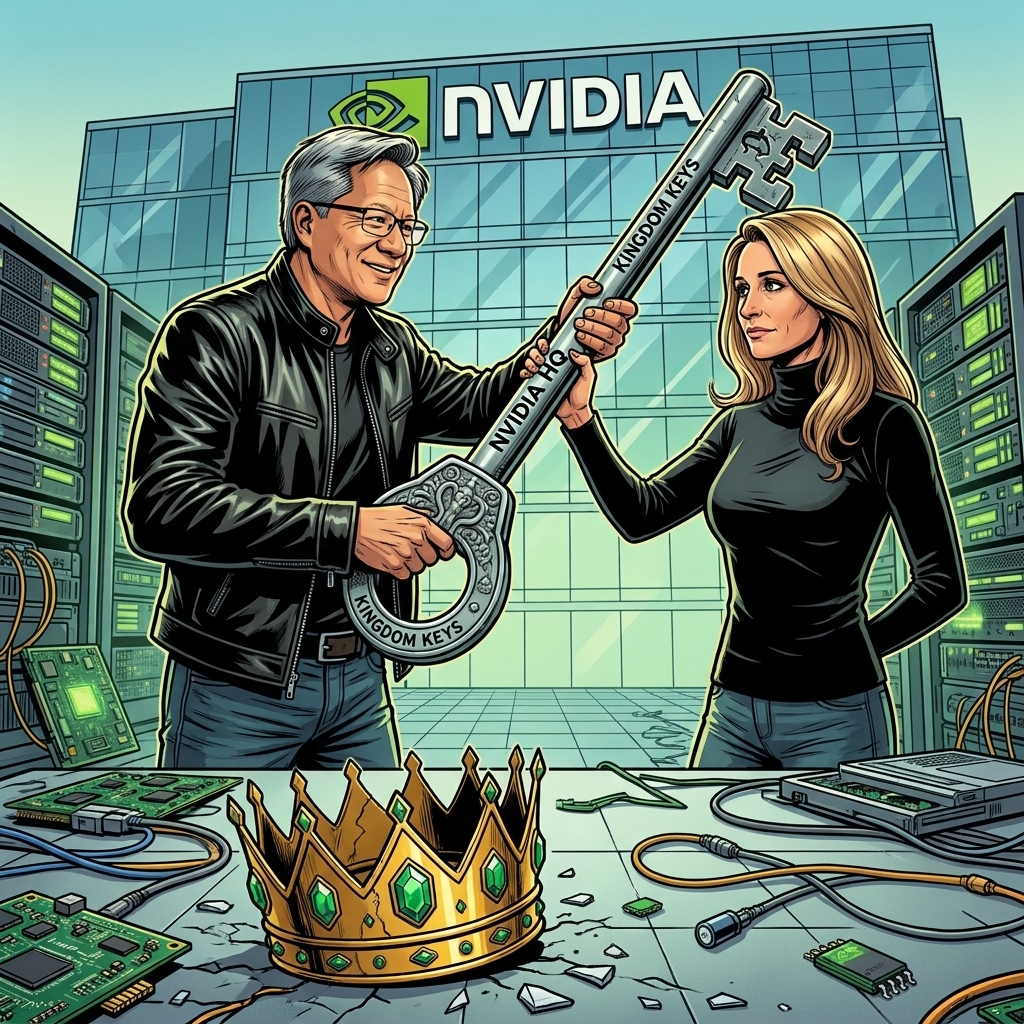
Nvidia’s next chapter begins with an executive who knows where the numbers come from. Colette Kress, the company’s longtime chief financial officer, has become interim chief executive following Jensen Huang’s resignation. Nvidia (NASDAQ: NVDA) disclosed that its board accepted Huang’s departure as president, CEO and director on November 11. Kress will retain her CFO responsibilities while the board searches for a permanent successor, considering both internal and external candidates. The transition presents a serious governance and execution test. It also places a seasoned technology executive in charge of a business whose commercial momentum extends well beyond the reputation of its founder. Nvidia’s most recently reported quarterly revenue reached $96.2 billion, up 106% from a year earlier. Data Center revenue accounted for $89 billion, increasing 117%. Those figures provide a substantial starting point for the new leadership team, although maintaining that trajectory will require considerably more than reassuring language. For many evaluating Nvidia and the broader artificial intelligence sector, the constructive thesis is straightforward: a leadership crisis can change a company’s risk profile without eliminating the demand supporting its products. The boardroom has changed. The computing requirements have not automatically changed with it.
Who Is Colette Kress? A Technology Veteran With Relevant Experience
Kress is not arriving at Nvidia with a fresh orientation packet. She joined the company in September 2013 after nearly 25 years in technology finance. Her background spans semiconductors, enterprise software, servers, networking and corporate operations, a combination directly relevant to the infrastructure business Nvidia has become. Before Nvidia, Kress spent three years as senior vice president and CFO of the Business Technology and Operations Finance organization at Cisco Systems (NASDAQ: CSCO). Her responsibilities included financial strategy, planning, reporting and business development across business segments, engineering and operations. Earlier, she spent 13 years at Microsoft (NASDAQ: MSFT), including four years as CFO of its Server and Tools division, alongside senior corporate planning and finance roles. Before Microsoft, she held several finance positions at Texas Instruments (NASDAQ: TXN). Kress holds a bachelor’s degree in finance from the University of Arizona and an MBA from Southern Methodist University. Nvidia’s SEC filing identifies her as 59 and confirms that she has served as executive vice president and CFO since 2013. That résumé does not guarantee success as chief executive. It does establish that Nvidia’s interim leader has experience with the economics and operating demands of several industries now converging inside AI infrastructure. She has worked across the technology stack. Now she must keep one of its most consequential businesses operating smoothly.
Why Kress Represents Continuity, Not Reinvention
Nvidia’s board is positioning Kress as a bridge between the company’s established strategy and its next permanent leader. In announcing the transition, the company emphasized her role in its growth and evolution. Kress said the leadership team would continue advancing Nvidia’s accelerated-computing and AI work, with attention to customers, partners, developers and shareholders. That approach makes sense for a company managing rapid expansion. The immediate objective is not necessarily a dramatic strategic departure. It is to preserve customer confidence, maintain product execution and demonstrate that the organization can function effectively without its founding CEO. There is also an important distinction between familiarity and proof. Kress’s long tenure supports the continuity argument, but serving simultaneously as interim CEO and CFO concentrates responsibilities during a demanding period. The permanent CEO search therefore remains a material part of the transition. For many, the most reassuring evidence will not be a new slogan. It will be consistent deliveries, credible financial reporting and results that support the existing roadmap. A compelling keynote can command attention. A well-executed quarter tends to hold it.
Nvidia’s Revenue Base Gives the New Leadership Team Room to Execute
Nvidia’s financial expansion provides context for the opportunity Kress inherits. For fiscal 2026, which ended January 25, 2026, revenue reached $215.9 billion, up 65% from the previous year. Fourth-quarter revenue totaled $68.1 billion, while GAAP gross margin reached 75%. The company then reported fiscal 2027 first-quarter revenue of $81.6 billion, up 85% year over year, including Data Center revenue of $75.2 billion, up 92%. In the second quarter, total revenue increased to $96.2 billion, with Data Center reaching $89 billion. For fiscal 2027’s third quarter, Nvidia previously projected revenue of $108 billion, plus or minus 2%. That outlook excluded Data Center compute revenue from China and anticipated GAAP and non-GAAP gross margins of approximately 74%, plus or minus 50 basis points. These are management forecasts, not completed results. The bullish implication is that Kress takes charge of a company with documented operating momentum rather than one searching for a viable business model. The qualification is equally important: strong historical growth does not settle questions about future orders, competitive pressure or leadership execution. The next reported results will provide a more useful test than either reflexive optimism or reflexive alarm.
Nvidia’s Infrastructure Business Is Bigger Than a Single Chip
The company’s disclosures also help explain why its commercial position should be assessed as an infrastructure business rather than a personality-driven product story. In fiscal 2026’s fourth quarter, Nvidia reported networking revenue of $11 billion, up 263% year over year. Its CFO commentary attributed that expansion to NVLink compute fabric alongside Ethernet and InfiniBand platforms. By fiscal 2027’s second quarter, Nvidia’s SEC filing attributed Data Center growth to the ramp of Blackwell Ultra infrastructure. Its accompanying commentary said hyperscale revenue more than doubled from the prior year and rose 13% sequentially. These figures matter because AI deployment involves connecting large amounts of computing capacity, not simply purchasing individual processors. Nvidia’s networking growth illustrates the additional revenue opportunities surrounding its compute products. For Kress, preserving that coordinated execution is central to the assignment. The business must deliver across computing and networking while maintaining the financial discipline required to support its scale.That is a less theatrical task than introducing a new generation of technology. It is also the part customers ultimately pay for.
AMD Has a Growth Story of Its Own
Advanced Micro Devices (NASDAQ: AMD) enters this period with an expanding Data Center business, not merely the possibility of benefiting from a competitor’s distraction. AMD reported third-quarter 2026 revenue of $13.4 billion, up 45% year over year. Data Center revenue rose 97% to approximately $8.5 billion, supported by record sales of Instinct GPUs and EPYC processors. GAAP diluted earnings per share reached $1.46, while non-GAAP diluted earnings per share reached $2.09. The performance followed second-quarter revenue of $11.5 billion, when Data Center represented 58% of company sales. The progression shows that AMD’s infrastructure expansion was underway before Nvidia’s leadership change. For the fourth quarter, AMD projected approximately $17 billion in revenue, plus or minus 3%, with management pointing to strengthening demand and the scaling of Helios and “Venice” production. That forecast provides a measurable test of the company’s next growth phase. A customer preference for additional supplier diversification could create further opportunities. But that remains a possibility, not a confirmed transfer of business. AMD’s stronger argument rests on its own reported results. A rival’s uncertainty may attract attention; revenue growth is a more durable credential.
Broadcom Adds Custom Silicon and Cash Flow to the AI Equation
Broadcom (NASDAQ: AVGO) offers another way to assess the breadth of AI infrastructure demand. For its fiscal third quarter ended August 2, 2026, Broadcom reported revenue of $29.6 billion, up 86% year over year. AI semiconductor revenue reached $16.7 billion, increasing 221% from the prior year and 54% sequentially. Management attributed the growth to custom AI accelerators and networking demand. The cash-generation figures were also substantial. Broadcom reported $14.2 billion in operating cash flow and approximately $13.7 billion in free cash flow after capital expenditures during the quarter. For the fourth quarter, management projected total revenue of approximately $34.8 billion, including $21.7 billion in AI semiconductor revenue. If achieved, the latter would represent 236% year-over-year growth. Broadcom’s results reinforce an important point: AI infrastructure is developing multiple large commercial opportunities. Nvidia’s accelerated-computing platform, AMD’s processors and accelerators, and Broadcom’s custom silicon and networking businesses do not represent identical approaches. Their reported growth nevertheless suggests that demand has supported more than one supplier and more than one architecture. The sector need not have a single winner for several businesses to produce meaningful results.
Google’s Accounting AI Results Highlight the Application Opportunity
The infrastructure story becomes more compelling when connected to useful work. According to DualEntry’s November 11 benchmark announcement, Google’s Gemini 4 Argon scored 91.1% on its accounting assessment, while Gemini 4 Carbon scored 88.1%, tying for second among 24 tested models. Google is part of Alphabet (NASDAQ: GOOGL, GOOG). DualEntry reported task costs of $0.081 for Carbon and $0.115 for Argon. Its assessment used 101 synthetic accounting cases across eight areas, with each model completing the full assessment three times. Answers were evaluated against predetermined reference answers. Those details make the findings more informative than an isolated leaderboard position, but they do not eliminate the limitations. This was a vendor-reported benchmark involving synthetic cases, not an independent audit demonstrating autonomous performance in a live accounting department. Consistency remained a challenge identified in the announcement.The constructive implication is narrower and more useful: improving accuracy and task economics could expand the practical uses of AI in business workflows. For Alphabet, that suggests potential application value. For infrastructure suppliers, it points toward the kind of productive activity that could help justify continued computing expenditure. Reconciling accounts rarely earns a standing ovation. Doing it reliably and economically could still command a budget.
Governance Must Be Addressed Without Confusing Allegations With Findings
A positive assessment of Nvidia’s business should not minimize the seriousness of its governance questions. On November 8, Nvidia’s board announced an independent investigation following reporting that Huang had been the target of a foreign intelligence effort. At that time, the board said it had no reason to believe national security or Nvidia secrets had been compromised. That statement was not the conclusion of a completed investigation. In a separate company-published message, Huang acknowledged marital infidelity, apologized and said he would cooperate with the inquiry. The subsequent SEC filing confirms his resignation and the appointments of Kress and board chair Harvey C. Jones. It does not establish every allegation associated with the departure or resolve the investigation’s findings. That distinction is essential. Confirmed leadership changes, unresolved allegations and operating performance belong in the same assessment, but they are not interchangeable evidence. Nvidia’s revenue growth does not answer governance questions. Governance uncertainty, in turn, does not establish that customer demand has disappeared.
What Many Should Watch Next
The strongest bullish case will be earned through execution. For Nvidia, the priorities are performance against its previously issued outlook, continuity in customer commitments and product execution, and a credible process for selecting a permanent chief executive. The board has said it will consider internal and external candidates. For AMD, the next test is whether its growing Data Center business supports the fourth-quarter revenue target management has outlined. For Broadcom, it is delivery against projected AI semiconductor growth while sustaining substantial cash generation. For Alphabet’s business applications, the challenge is translating promising model performance into dependable real-world utility. The accounting benchmark offers an encouraging signal, but not a substitute for evidence of commercial adoption and consistent results. These are observable milestones. They offer a more disciplined framework than treating every leadership headline as a verdict on the entire AI economy.
The Bullish Case: Institutional Strength Can Outlast Individual Leadership
Kress’s appointment gives Nvidia a leader with deep internal knowledge and experience across enterprise software, networking and semiconductors. Her background does not remove the transition risk, but it provides a credible foundation for continuity. The broader AI thesis also has more than one source of support. Nvidia has reported exceptional infrastructure revenue, AMD has expanded its Data Center business, Broadcom has converted AI demand into substantial sales and cash flow, and Alphabet’s model developments point toward further efforts to make the technology useful in business. The constructive view is not that leadership is unimportant. It is that a company’s operating capabilities, customer relationships and financial resources can have value beyond the executive who helped build them. For Nvidia, Kress’s task is to demonstrate that distinction in practice. The company has spent years showing what accelerated computing can do. Its next chapter will also show what an experienced organization can do when the person at the top changes.
The Sources
- Nvidia Form 8-K, filed November 12, 2026, confirming Huang’s resignation, Kress’s interim appointment and Jones’s appointment as board chairsec
- Nvidia announcement of its CEO transition and permanent leadership search.nvidianews.nvidia
- Nvidia’s official biography of Colette Kress, detailing her career and education.nvidia
- Nvidia’s September 2013 announcement appointing Kress as CFO.nvidianews.nvidia
- Nvidia fiscal 2026 fourth-quarter and full-year earnings release, filed with the SEC.sec
- Nvidia fiscal 2026 fourth-quarter CFO commentary, filed with the SEC.sec
- Nvidia fiscal 2027 first-quarter financial results.nvidianews.nvidia
- Nvidia Form 10-Q for the quarter ended July 26, 2026.sec
- Nvidia fiscal 2027 second-quarter earnings release and third-quarter outlook, filed with the SEC.sec
- Nvidia fiscal 2027 second-quarter CFO commentary, filed with the SEC.sec
- AMD third-quarter 2026 financial results.ir.amd
- AMD third-quarter 2026 earnings presentation.ir.amd
- AMD second-quarter 2026 financial results.ir.amd
- AMD third-quarter 2026 earnings exhibit and fourth-quarter outlook.ir.amd
- Broadcom fiscal 2026 third-quarter financial results and fourth-quarter outlook.investors.broadcom
- Broadcom Form 8-K and earnings exhibit, including cash-flow results.investors.broadcom
- DualEntry’s accounting AI benchmark announcement, supplied for the article.finance.yahoo
- Nvidia board statement announcing an independent investigation, November 8, 2026.nvidianews.nvidia
- Huang’s company-published employee message, November 8, 2026.nvidianews.nvidia
Stay Updated with Vista Partners
Subscribe to receive market insights, investing ideas, and the latest updates directly in your inbox.