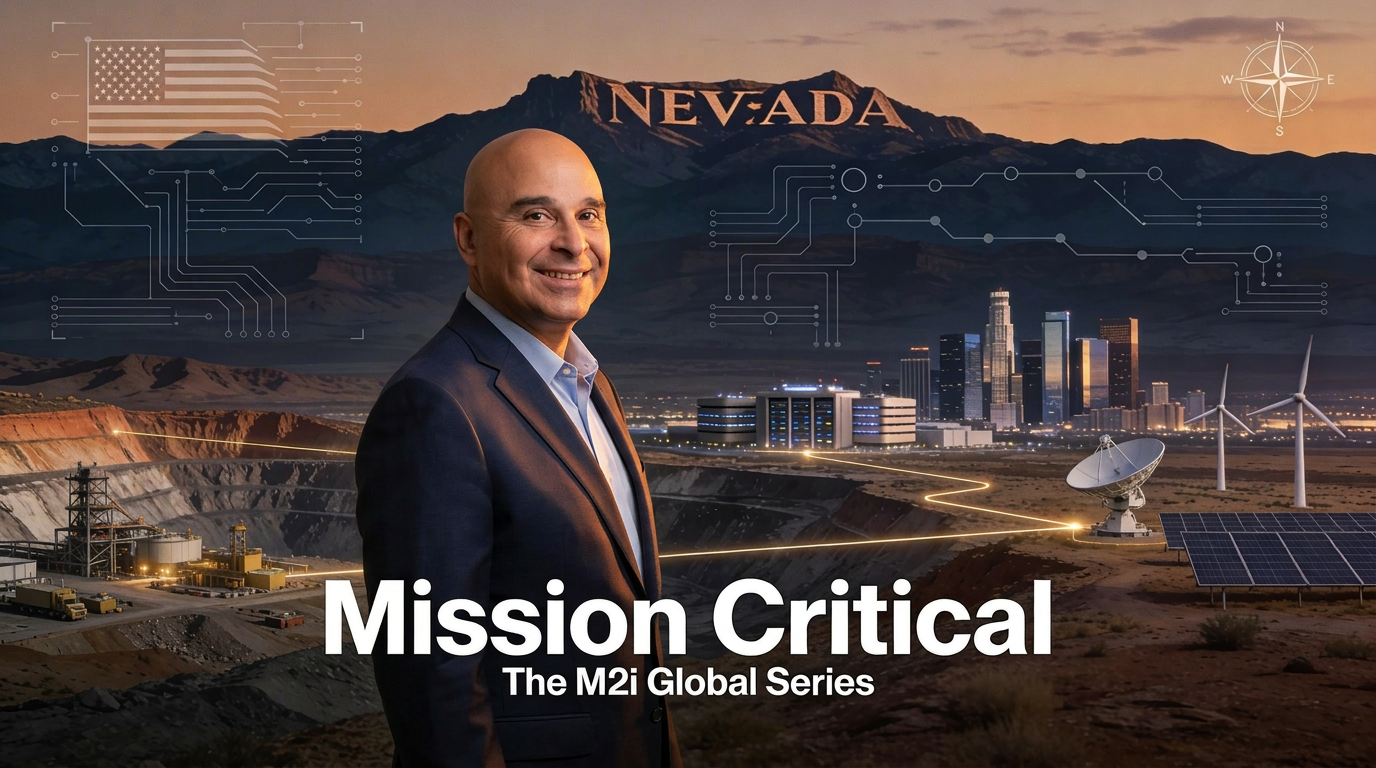
Season One of this series, hosted by Major General (Ret) Alberto “Al” Rosende, President & CEO of M2i Global (MTWO), set out to treat critical minerals not as background noise in the global economy, but as the front-page story driving technology, healthcare, infrastructure, and national security. Over the course of the season, that wager paid off, as conversations with policymakers, industry leaders, and experts revealed how deeply our prosperity—and security—now depends on minerals most people rarely think about but everyone implicitly relies on.
Major General Rosende and the M2i Mission
Guiding the discussion was Major General (Ret) Alberto Rosende, an accomplished senior executive whose career spans corporate, military, non-profit, and entrepreneurial roles. As the former Commanding General of the 63rd Readiness Division, U.S. Army Reserve, he was responsible for facilities, equipment readiness, and personnel support across a seven‑state region, with service in the United States, Puerto Rico, Afghanistan, and Iraq.
His military career, decorated with honors such as the Army Distinguished Service Medal, the Legion of Merit, and the Bronze Star Medal, gives him a unique vantage point on readiness, logistics, and national security. Complementing that experience, Rosende holds a B.S. in Business Administration (Nova Southeastern University), an M.S. in National Security and Resource Strategy (Eisenhower School, National Defense University), and an M.A. in Education and Human Development (The George Washington University), bringing academic rigor to a domain often clouded by politics and hype.
As President & CEO of M2i Global, Inc., Rosende now applies this blend of strategic, operational, and educational expertise to a new theater: securing the minerals and metals that underpin U.S. military strength, technological innovation, and economic resilience. M2i Global operates as a connector and integrator—linking high‑quality mineral assets with capital, technology, and strategic partners, while navigating regulatory, ESG, and geopolitical complexity.
From Foreign Dependency to Strategic Vulnerability
For decades, the U.S. has relied heavily on foreign imports for the essential minerals that power its defense systems, industrial base, and advanced technologies. That dependence has quietly grown into a strategic vulnerability, especially as geopolitical tensions and supply chain disruptions threaten access to critical resources just as demand is accelerating.
The shift away from domestic mining and processing ceded much of the global production landscape to nations such as China and Russia, leaving the U.S. and its allies exposed in areas ranging from batteries and semiconductors to precision munitions and advanced communications. As technological innovation and the drive toward Net Zero emissions create unprecedented demand for critical minerals, the need to rebuild a robust domestic and allied supply chain has moved from policy talking point to operational imperative.
Season One repeatedly underscored this reality: critical minerals are no longer just inputs on a corporate purchasing list. They are now core variables in national security planning, industrial strategy, and long‑term economic resilience.
M2i and the Minerals Metals Initiatives
Enter the Minerals Metals Initiatives (M2i), a pioneering effort dedicated to revitalizing America’s minerals and metals industry and realigning it with 21st‑century security and climate goals. Based in Nevada—a state that already plays an outsized role in U.S. mining—M2i is working to establish a secure, reliable supply chain for critical minerals essential to both defense and economic prosperity.
The firm’s thesis is straightforward but ambitious: you cannot secure a nation’s future if you outsource the raw materials for its military, energy systems, and digital infrastructure. With a visionary leadership team and strategic partnerships, M2i is designing an integrated model that links mining, processing, recycling, and defense relations into a cohesive, future‑focused operation. The goal is to transform a fragmented ecosystem into a deliberate architecture of readiness, resilience, and responsibility.
For investors and policymakers alike, M2i positions itself as both a catalyst and a coordinator—helping identify viable projects, align them with national priorities, and ensure they meet modern standards on ESG, traceability, and operational excellence.
From Policy Signal to Generational Project
Throughout Season One, guests described a clear shift in Washington: critical minerals are no longer treated as a niche procurement issue but as a central pillar of industrial and defense policy. Authorities once used sparingly are now being deployed to catalyze domestic production and processing, signaling a “whole‑of‑government” approach that spans energy, defense, commerce, and environmental agencies.
In market terms, critical minerals have moved from “nice to have” to “core holding” on the national balance sheet. Mining and processing are now seen as strategic capabilities rather than mere industrial activities. The United States and its allies recognize that resilient supply chains will require redundancy, regional diversification, and long‑term commitments that outlast election cycles and business headlines.
Season One captured that evolution, showing how policy is being reframed from short‑term reaction to generational project—one that will define technological leadership, military readiness, and economic competitiveness.
Outmined, Outprocessed—But Not Outinnovated
A recurring theme was the acknowledgment that the U.S. and its allies are unlikely to outmine or outprocess dominant incumbents purely on volume in the near term. However, they can out‑innovate. By focusing on advanced refining technologies, materials science, and smarter project finance structures, Western economies can stretch every ton of ore further and reduce exposure to single‑point failures.
This reframes “supply” as more than the number of mines in operation. It includes breakthroughs in refining and processing, new alloys and chemistries, and the digital tools that optimize production and logistics. Policy and technology become force multipliers, allowing resource‑rich democracies to punch above their weight—if they can execute.
Recycling: The Quiet Powerhouse
Season One also elevated recycling from a feel‑good side note to a serious strategic lever. Metals are, in principle, infinitely recyclable, and pushing recycling rates significantly higher could dramatically reduce geopolitical risk, environmental impact, and the need to bring every marginal ton out of the ground.
By integrating recycling into a broader minerals strategy, countries can reclaim value from end‑of‑life products, reduce dependence on adversarial suppliers, and build an industrial ecosystem that aligns security, environmental goals, and economic opportunity. For firms like M2i, that means viewing recycling not as an afterthought, but as a core pillar in a vertically integrated critical minerals ecosystem.
Traceability: From Compliance to Competitive Edge
Another warning light that flashed repeatedly across Season One was supply chain opacity. Many mineral flows remain tangled in networks where environmental damage and human rights abuses are invisible—until they suddenly are not, when a media report, lawsuit, or regulatory action surfaces.
The answer is robust traceability. Rather than a box‑checking exercise, traceability is evolving into a continuous visibility system that tracks materials from mine or recycler to finished product. For companies, it reduces legal and reputational risk; for governments, it supports credible policy and enforcement; for investors, it provides a clearer picture of real risk‑adjusted returns.
In this context, data becomes as valuable as ore. The ability to prove provenance, measure impacts, and enforce standards may increasingly determine which projects attract capital and long‑term offtake agreements.
Nevada, Net Zero, and the New Map of Necessity
Nevada, where M2i is based, emerged in Season One as emblematic of the new map of necessity. Already a leading gold producer and host to the only operating lithium mine in the United States, the state sits at the intersection of legacy mining know‑how, emerging battery demand, and national security priorities.
As the world races toward Net Zero, demand for key minerals used in batteries, grid infrastructure, and clean energy systems is surging. That creates both opportunity and pressure. States like Nevada will help determine how the U.S. balances domestic production, environmental stewardship, and community engagement while recalibrating its position in global supply chains.
Mining, once viewed mainly as a local economic driver, is now framed as a strategic necessity that supports healthcare, advanced manufacturing, digital infrastructure, and national defense. The pit on the horizon has become part of the conversation about alliances, deterrence, and long‑term competitiveness.
The Thread That Ties It All Together
Across Season One, one connective thread ran through every conversation: this is not just an economic story, not just a national security story, and not just a climate story. It is all of them at once—an intertwined ecosystem stretching from exploration and permitting to recycling, from the lab bench to the battlefield.
By bringing together voices from government, industry, and policy, and anchoring the series in M2i’s on‑the‑ground perspective, Season One illuminated how secure, responsible supply chains are built. It showed why traceability, ESG performance, and allied cooperation are no longer optional extras, but central design features of any serious critical minerals strategy. And it framed M2i and its partners as key contributors in translating strategy into action.
Season Two: From Insight to Execution
If Season One was about diagnosing the problem and clarifying the stakes, Season Two is about execution. The questions now shift from “Why does this matter?” to “Who is doing what, where, and on what timeline?” and “How do we measure real progress?”
Season Two will explore how the U.S. and its allies can adapt to the evolving role of critical minerals in global security and economic resilience, and how they can move from policy statements to steel‑in‑the‑ground projects, built‑out processing capacity, scaled recycling, and operational traceability. It will delve into the partnerships—between government, industry, technology providers, and capital—that will determine whether the next decade is defined by scarcity and vulnerability or by resilience and strategic advantage.
For listeners, investors, and policymakers, that is where the story becomes not only more urgent, but truly investable. And for Major General (Ret) Alberto Rosende and M2i Global, it is where decades of experience in readiness, logistics, and leadership meet the hard work of rebuilding a critical foundation of American power—one mineral, one project, and one partnership at a time.