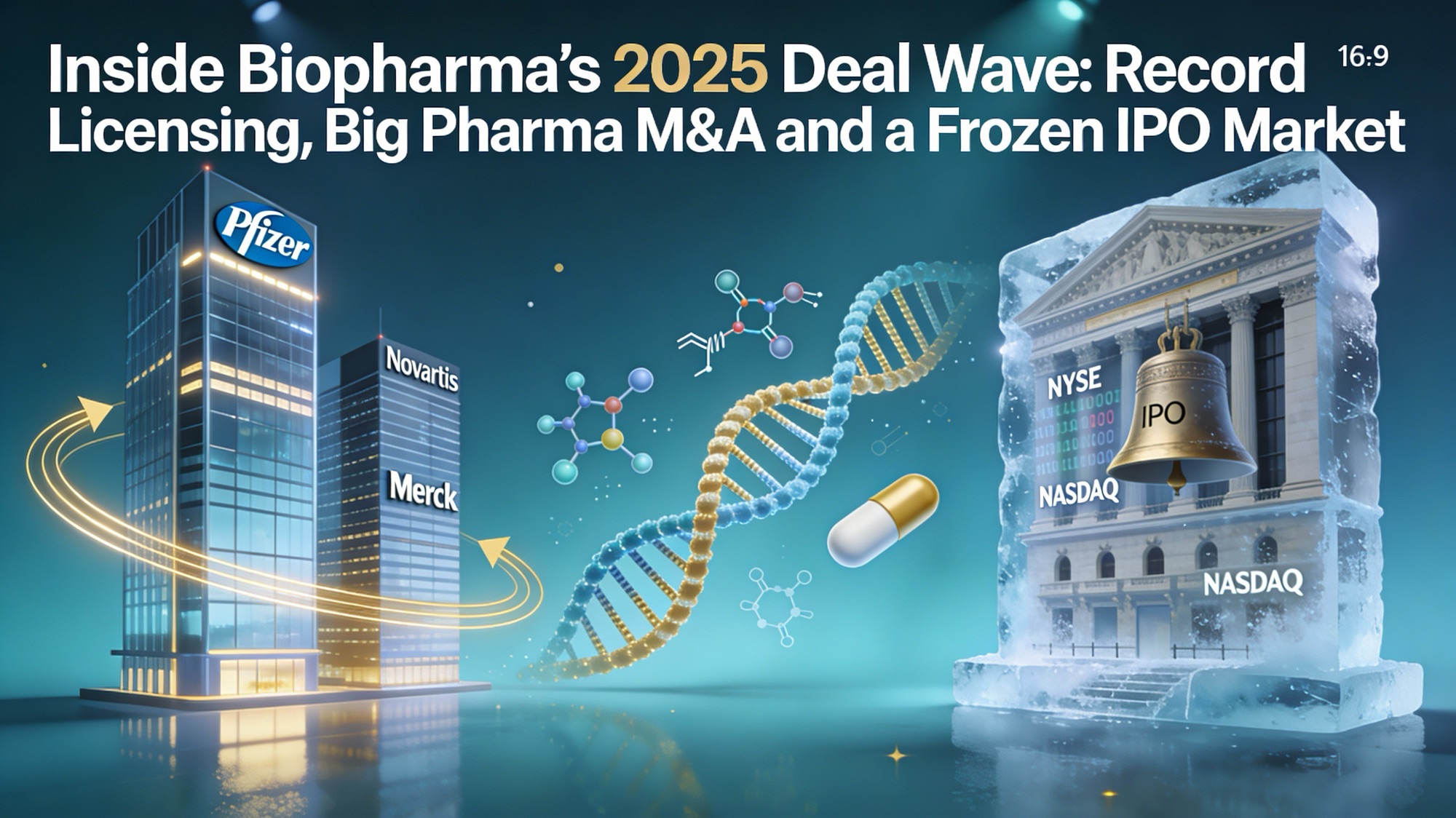
Biopharma spent 2025 behaving like a sector that has finally read the fine print on the cost of capital—and decided to let someone else pick up the bar tab. Licensing and M&A stepped into the role IPOs used to play, and did it with enough swagger to make even 2021’s unicorns blush.
A cautiously exuberant deal boom
- Venture funding for therapeutics and discovery platforms ended 2025 at a respectable $7.0 billion in Q4, matching Q4 2024, but the full-year haul slipped, a reminder that not every pipeline gets a participation trophy anymore.
- Instead, 2025’s real action came from partnerships: more than $250 billion in biopharma licensing value through Q4, the highest since 2016, with upfronts holding steady at about 7% of headline deal totals, suggesting lawyers, not froth, did most of the heavy lifting.
- M&A added emphasis rather than subtlety, with 129 deals totaling roughly $138 billion and nine transactions clearing the $5 billion mark, including fresh Q4 announcements from Novartis, Merck and Novo Nordisk that confirmed bargain-hunting is now a core therapeutic area.
Venture capital grows up (a little)
- The check-writers did not disappear; they just raised their standards, funneling capital toward later-stage companies with clinical data and near-term commercial prospects, while early-stage seed and Series A deals lost momentum into Q4.
- More than 80 venture rounds topped $100 million in 2025, a figure that sounds frothy until one remembers it is now the price of admission for programs seen as genuinely “de-risked,” a term that now means “fewer ways to blow up” rather than “no way to blow up.”
- Median round sizes climbed especially for Phase II companies, reaching about $60 million in 2025, as investors opted to finance fewer stories but insisted on thicker plot lines and clearer endings.
Licensing replaces the IPO roadshow
- If 2021 was the year every platform wanted a ticker, 2025 was the year they settled for a term sheet: licensing deals reached roughly $250.2 billion across 516 transactions, with the real upside packed into milestones rather than the opening number.
- Big pharma leaned into late-stage in-licensing, paying sharply higher upfronts for Phase III assets and stepping up payments for select preclinical programs to secure options on tomorrow’s blockbusters before rivals finished their KOL webinars.
- Oncology set the pace, with Phase II programs seeing median upfronts around $150 million and Phase III assets clearing the $1 billion upfront hurdle, a reminder that while cancer remains hard, paying up for differentiated data remains remarkably easy.
Obesity, China and the new power brokers
- Obesity and diabetes partnerships hit record heights in 2025, as GLP‑1 and GIP programs attracted nine-figure upfronts and multi-billion-dollar headline values, turning metabolic disease into the sector’s closest thing to a macro trade.
- Chinese biopharma cemented its status as a crucial innovation supplier, with a rising share of global big pharma deals featuring at least $50 million upfront going to China-based partners, underscoring that geographic risk can be negotiated, but clinical differentiation cannot.
- Biologics, particularly antibody-drug conjugates, dominated both early-stage venture funding and licensing upfronts, while small molecules quietly held the number-two slot, the dependable workhorse in a market increasingly obsessed with engineered complexity.
The IPO window: technically open, spiritually closed
- Only nine biopharma IPOs raised about $1.6 billion on U.S. exchanges in 2025, making it one of the leanest listing years in more than a decade and turning the traditional “roadshow” into something closer to a limited-release art film.
- Companies that did slip through were typically later-stage and modestly sized, signaling that public investors are still wary of paying upfront for preclinical promises when they can buy milestone‑laden exposure through better-capitalized partners.
- For now, the industry’s capital stack reads like a polite but firm note from the market: come back with data, a partner, or a term sheet—and preferably all three—then we can talk about ringing bells again.
The Sources
[1] Q4 2025 Biopharma Licensing and Venture Report https://www.jpmorgan.com/content/dam/jpmorgan/documents/cb/insights/outlook/jpm-biopharma-deck-q4-2025.pdf
Disclosure: This article is for informational purposes only and should not be construed as investment advice, a recommendation, or an offer to buy or sell any security. Market data are subject to revision, and investors should conduct independent due diligence before making investment decisions. Investments may involve substantial risk, including the potential loss of the entire investment. Investors should conduct independent due diligence and consider their individual objectives and risk tolerance. See The Complete Disclosure via this link & at the top of the page.
Stay Updated with Vista Partners
Subscribe to receive market insights, investing ideas, and the latest updates directly in your inbox.