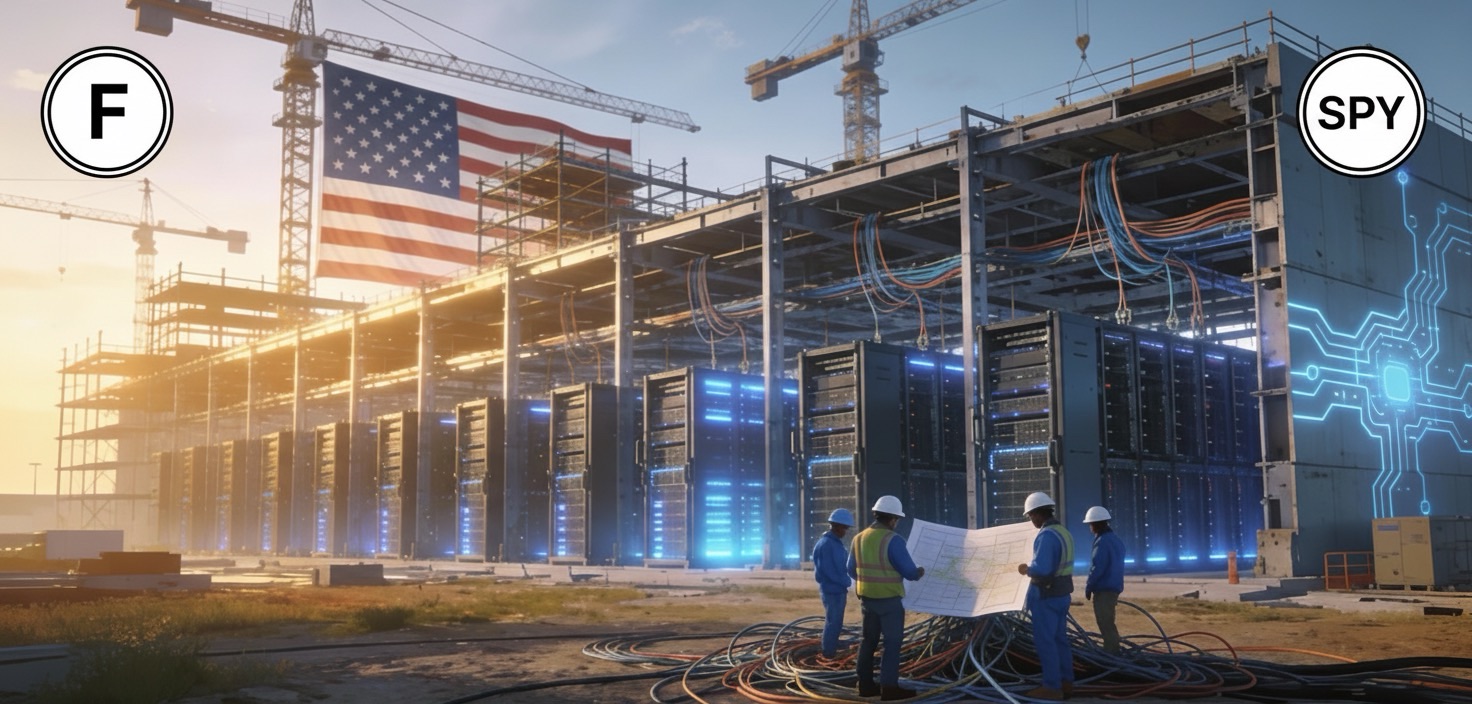
America is racing to build the AI future, but Ford’s Jim Farley is warning that the country may run out of people to pour the concrete, pull the cable, and keep the servers humming long before it runs out of capital. At the same time, a handful of industrial heavyweights now dominate the business of erecting these digital cathedrals across the U.S. and the globe.
The Essential Economy Meets the AI Gold Rush
Ford (F) CEO Jim Farley has been making an unusually sober point for an industry obsessed with robotaxis and robo‑advisers: the real AI bottleneck may be the humans in hard hats, not the chips in server racks. He argues that the essential economy of blue‑collar workers—construction crews, factory operators, technicians—has been neglected even as AI ambitions inflate toward a projected multi‑trillion‑dollar market.
Farley points to a shortfall running into the hundreds of thousands of factory workers, construction workers, and auto technicians just as America tries to reshore manufacturing and stand up fleets of AI data centers. In his telling, the country is trying to build a six‑lane digital superhighway with a two‑lane labor pipeline, and the traffic jam is already visible from Silicon Valley to Virginia’s “Data Center Alley.”
Data Centers: Modern Mills With Fewer Smokestacks
The numbers behind the build‑out explain why CEOs suddenly sound like guidance counselors begging kids to consider the trades. Global data centers now number about 10,500 across 174 countries, and demand is expected to nearly triple by 2030 as AI workloads surge past traditional computing. Analysts estimate that nearly 100 gigawatts of new capacity will be added between 2026 and 2030, effectively doubling global data center capacity in just a few years.
This isn’t a boutique niche; it is industrial policy with better branding. U.S. states like Virginia, Texas, and Ohio are each sitting on gigawatts of existing or planned capacity, with Northern Virginia alone planning roughly 16.8 GW of additional data center power. Microsoft, for its part, is building a 1.2‑million‑square‑foot “AI factory” in Wisconsin while operating more than 100 existing data centers and constructing over 100 more, a reminder that hyperscale now comes measured in both megawatts and miles of rebar.
Who Actually Builds the Digital America?
Behind the cloud logos sits a surprisingly concrete cast of characters. In the U.S., firms like DPR Construction, Bechtel, Whiting‑Turner, Holder Construction, AECOM, Jacobs, Skanska USA, Cupertino Electric, and IES Holdings are emerging as the go‑to builders of large‑scale data centers. These companies specialize in mission‑critical projects, combining engineering depth, project management, and modular techniques to deliver hyperscale campuses on tight schedules.
At the global developer and operator level, Digital Realty and Equinix sit near the top of most 2026 rankings, controlling hundreds of facilities that house enterprise and cloud tenants alike. Other global giants include NTT’s data center arm and the major cloud platforms, which collectively dominate the hyperscale segment that now numbers more than 1,000 sites worldwide, over half of them in the United States.
How Many Data Centers Are Being Built in 2026?
Counting “under construction” data centers is more art than science, but the contours are clear. Analysts expect more than 2,000 new data centers to be constructed worldwide by 2030, with the bulk of that build concentrated in the second half of the decade as capital expenditure approaches roughly 7 trillion dollars. That implies several hundred facilities either in planning or construction at any given time in the mid‑2020s, with 2026 sitting near the front edge of that wave.
In the U.S., capacity‑based metrics tell a similar story: major markets such as Dallas–Fort Worth and Chicago each have hundreds of megawatts currently under construction, while Virginia alone has nearly 17 GW either being built or planned. Put plainly, the United States remains the largest single builder and operator of data centers in 2026, but it is increasingly constrained not by money or demand, but by the availability of trained workers to turn substation permits and site plans into humming AI campuses.
The Punchline: Hard Hats as a Leading Indicator
Farley’s warning lands with an irony befitting Wall Street: AI is supposed to automate away tedious white‑collar work, yet the hottest labor market may be the people who never sit at a desk. For investors, data center builders, and policymakers, the new leading indicator may not be GPU lead times, but whether enough electricians, welders, and technicians show up on Monday morning to keep the AI boom from becoming just another beautifully financed bottleneck.
The Sources
[1] Ford CEO warns there’s a dearth of blue-collar workers able to … https://finance.yahoo.com/news/ford-ceo-warns-dearth-blue-163639026.html
[2] Ford CEO Jim Farley: Blue-collar labor shortages are hampering AI … https://fortune.com/2025/09/29/ford-ceo-jim-farley-blue-collar-worker-essential-economy-crisis-ai-data-centers/
[3] 10 Data Center Construction Companies to Watch in 2026 https://propertymanagerinsider.com/10-data-center-construction-companies/
[4] Top 10 Largest Data Center Companies in the World 2026 https://www.blackridgeresearch.com/blog/list-top-largest-biggest-data-center-providers-companies-in-the-world
[5] Measuring the Data Center Boom: Facts and Statistics (2026) https://programs.com/resources/data-center-statistics/
[6] 2026 Global Data Center Outlook – JLL https://www.jll.com/en-us/insights/market-outlook/data-center-outlook
[7] Ford CEO warns there’s a dearth of blue-collar workers able to … https://fortune.com/article/why-does-ford-ceo-jim-farley-see-blue-collar-worker-shortage-impact-data-center-reshoring/
[8] Data Center 2026 Outlook: Energy, Infrastructure, and Connectivity https://www.morganlewis.com/pubs/2025/12/data-center-2026-outlook-energy-infrastructure-and-connectivity