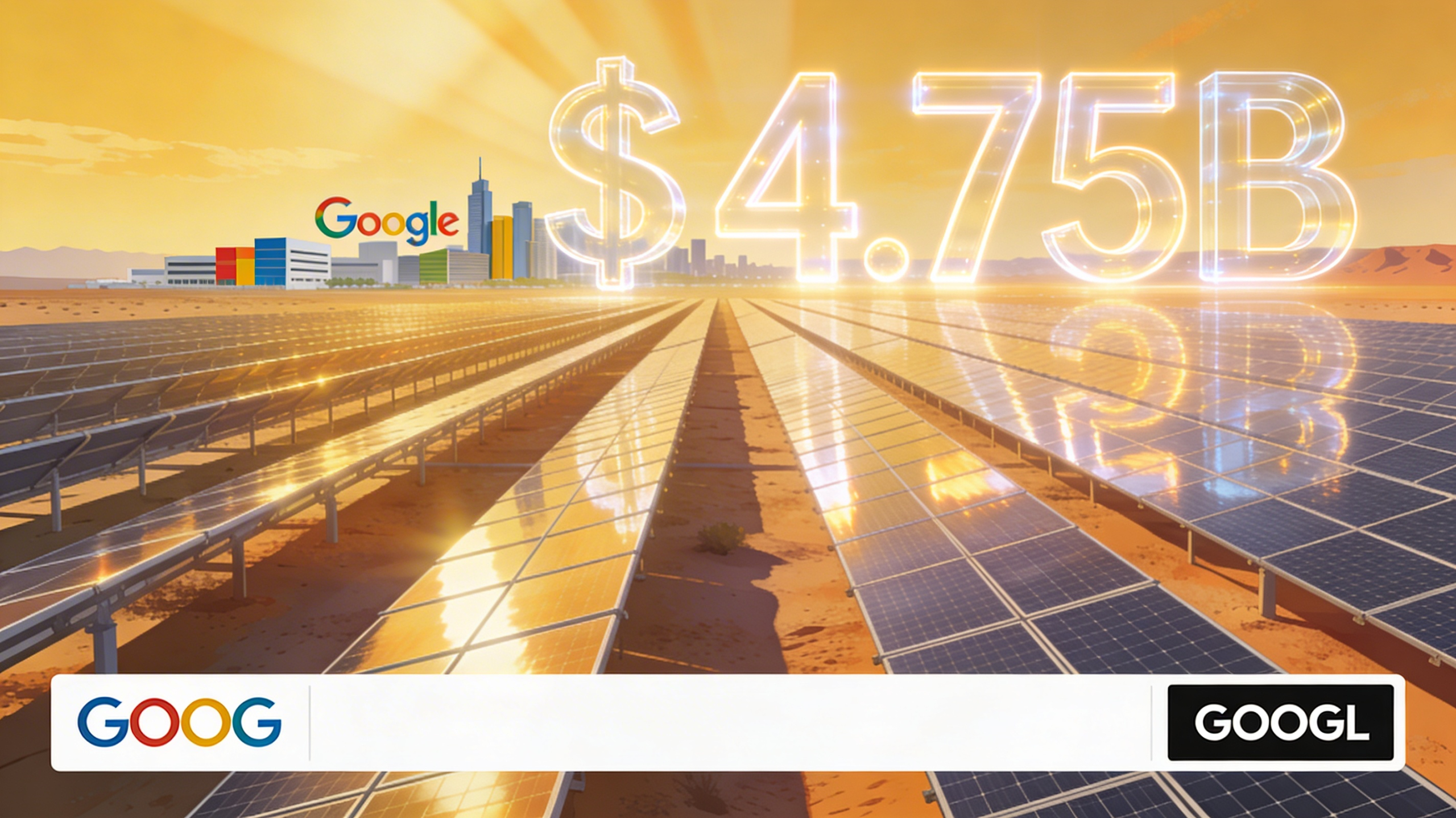
Alphabet’s decision to acquire Intersect Power for roughly $4.75 billion is less a vanity green purchase and more a hard‑nosed bet that the next edge in artificial intelligence will be measured in megawatts as much as in model parameters. In one stroke, Google has turned from power customer to power producer, effectively buying its own on‑ramp to the future of clean, always‑on energy.
A Deal Sized for the AI Age
Alphabet agreed to acquire California‑based Intersect Power, a developer of utility‑scale solar and battery storage projects, in a transaction totaling about $4.75 billion in cash plus the assumption of debt, with closing expected in the first half of 2026. Intersect brings a portfolio of roughly 2.2 GW of operating or under‑construction solar projects and 2.4 GWh of battery storage today, with ambitions to grow to around 10.8 GW of capacity by 2028.
Crucially for Google’s scale, Intersect isn’t just rich in sun and storage; it is already locked in as a major buyer of First Solar modules through 2026 and has contracted for about 15.3 GWh of Tesla Megapack battery systems through 2030, positioning it among the largest grid‑scale battery customers globally. Intersect will continue to operate as an independent subsidiary under its existing brand, led by founder and CEO Sheldon Kimber, giving Alphabet in‑house expertise without dismantling the developer culture it is paying for.
From PPAs to Owning the Power Plant
For more than a decade, Big Tech’s decarbonization playbook revolved around signing long‑term power purchase agreements and boasting about “100% renewable” targets at investor days. Google’s move marks a notable break with that tradition: this is the first time a hyperscale cloud provider has directly acquired a major renewable energy developer rather than simply contracting for its output.
The motivation is not subtle. AI‑driven data centers are driving power demand that is straining U.S. grids, and interconnection queues in some regions now stretch seven to twelve years, a timeline that makes quarterly earnings calls feel like high‑frequency trading. By vertically integrating into development, Google gains direct control over siting, timing, and configuration of new capacity instead of waiting for utilities, regulators, and transmission planners to catch up.
Energy Parks: Where Data Meets Dirt
At the heart of the transaction is a concept Intersect has been championing: “energy parks” that co‑locate hyperscale data centers with utility‑scale solar and storage, all sitting behind the meter. A flagship example is the Quantum Clean Energy Project in Haskell County, Texas, which pairs about 640 MW of solar capacity with 1.3 GWh of battery storage alongside a new data center campus, targeting completion in late spring 2026.
By generating and storing power on‑site, these parks can bypass congested transmission lines and interconnection bottlenecks, turning grid delays from existential threat into mere background noise. The model effectively transforms electricity from a volatile external input into a partially controlled infrastructure asset, giving Google more predictable costs and a cleaner pathway to its 24/7 carbon‑free energy ambitions.
Securing the Battery and Solar Supply Chain
In an era when “supply chain” can still cause boardrooms to flinch, Intersect arrives with something close to an energy hardware futures book. The company has already secured a 2.4 GW solar module supply agreement with U.S. manufacturer First Solar through 2026, a meaningful hedge against both price volatility and import risk. On the storage side, its multi‑billion‑dollar contract for 15.3 GWh of Tesla Megapacks through 2030 gives Google access to one of the most sought‑after battery products at scale.
Those contracts, combined with Intersect’s existing portfolio of 2.2 GW of solar and 2.4 GWh of storage, mean Alphabet is not starting from zero; it is effectively stepping into a fully furnished clean‑energy platform. For AI infrastructure investors, this looks less like a discretionary ESG initiative and more like locking in long‑dated input costs for what has become a core production factor: reliable, carbon‑light electricity.
AI Infrastructure: When Capital Expenditures Go Electric
Alphabet has already guided that its 2026 capital expenditures for AI infrastructure could reach between $91 billion and $93 billion, up sharply from about $52.5 billion in 2024. Under that kind of spending curve, the line between “data center capex” and “energy capex” is blurring fast, and the Intersect deal underscores that the company now views them as two sides of the same ledger.
Intersect’s energy parks are designed precisely for AI‑heavy workloads, pairing multi‑gigawatt renewable generation with large‑scale battery systems and, where needed, firming resources to ensure around‑the‑clock availability. The acquisition builds on Alphabet’s earlier $800 million minority investment in Intersect’s development pipeline, effectively moving from preferred partner to full owner of the platform most closely aligned with its AI‑era load profile.
Competitive Pressure on the Hyperscaler Block
Google’s deal lands in a landscape where major cloud providers are racing not just for compute, but for the power to run it. Microsoft has inked what Brookfield describes as the largest‑ever renewable power transaction, agreeing to buy more than 10.5 GW of clean energy between 2026 and 2030, and Amazon and Meta have announced sizable clean energy procurements of their own.
Yet most of those moves still rely on third‑party developers and traditional contract structures, leaving Google as the first major hyperscaler to buy a large clean‑energy developer outright. If Intersect’s energy parks prove as effective at de‑risking AI growth as Alphabet hopes, it could pressure rivals to respond with acquisitions of their own, accelerating consolidation across both the renewable‑energy and data‑center industries.
What It Signals for Investors and the Grid
For investors, the Intersect acquisition reframes clean energy from a nice‑to‑have sustainability banner into a strategic moat for AI infrastructure. Owning a pipeline of multi‑gigawatt solar and battery projects—backed by contracted supplies from First Solar and Tesla—gives Alphabet a differentiated handle on one of the most constrained inputs in the AI era.
For the broader grid, however, the move invites a more nuanced question: as hyperscalers increasingly build behind‑the‑meter energy parks to serve private data castles, how will regulators, utilities, and communities balance system‑wide needs with corporate energy sovereignty? For now, Wall Street seems content to let Google chase its own sunshine, on the assumption that in the AI gold rush, it pays to own the power company supplying the picks and shovels.
The Sources
[1] Google acquires clean energy developer Intersect Power for nearly … https://pv-magazine-usa.com/2026/01/02/google-acquires-clean-energy-developer-intersect-power-for-nearly-5-billion/
[2] Analysis: Why Google Bought Intersect for AI Energy Supply https://intuitionlabs.ai/articles/google-intersect-acquisition-ai-energy
[3] Google acquires data centre and energy developer Intersect for US … https://www.energy-storage.news/google-acquires-data-centre-and-energy-developer-intersect-for-us4-75-billion/
[4] Google’s $4.75B Intersect Power Acquisition Marks New Era … – Introl https://introl.com/blog/google-intersect-power-acquisition-energy-vertical-integration-january-2026
[5] Tesla and Intersect Power: A Massive Battery Storage Partnership https://www.greendrive-accessories.com/blog/language/en/tesla-and-intersect-power-a-massive-battery-storage-partnership/
[6] [PDF] Intersect battery storage – Solar Power Solutions https://wholesalesolar.co.za/wp-content/uploads/Intersect-battery-storage_Fri-27-Oct-2023-26225.pdf
[7] Alphabet in $4.75 Billion Acquisition of Intersect Power | News https://www.clearygottlieb.com/news-and-insights/news-listing/alphabet-in-4-75-billion-acquisition-of-intersect-power
[8] Tesla lands 15.3 GWh Megapack supply contract – Energy Storage https://www.ess-news.com/2024/07/19/tesla-lands-15-3-gwh-megapack-supply-contract/
[9] Tesla Signs A Landmark Multi-Billion Dollar 15 GWh Megapack Deal https://globalcarbonfund.com/carbon-news/tesla-signs-a-landmark-multi-billion-dollar-15-gwh-megapack-deal/
[10] Big Tech is upending the clean energy landscape | PA Consulting https://www.paconsulting.com/newsroom/utility-dive-big-tech-is-upending-the-clean-energy-landscape-7-october-2024
[11] PowerBank Analyzes Shifting Hyperscaler Energy Acquisition … https://www.prnewswire.com/news-releases/powerbank-analyzes-shifting-hyperscaler-energy-acquisition-strategies-302672199.html
[12] Alphabet Deepens AI Strategy With $4.75 Billion Acquisition of … https://www.channelchek.com/news-channel/alphabet-deepens-ai-strategy-with-4-75-billion-acquisition-of-clean-energy-developer-intersect
[13] Alphabet Announces Agreement to Acquire Intersect to Advance … https://abc.xyz/investor/news/news-details/2025/Alphabet-Announces-Agreement-to-Acquire-Intersect-to-Advance-U-S–Energy-Innovation-2025-DVIuVDM9wW/default.aspx
[14] Google’s Intersect deal is much more than a green power play https://www.latitudemedia.com/news/googles-intersect-deal-is-much-more-than-a-green-power-play/
[15] Google Acquires Intersect Power for $4.75B to Secure AI Energy … https://www.linkedin.com/posts/evolving-ai_google-is-taking-a-direct-approach-to-activity-7411411028493897728-cpwt