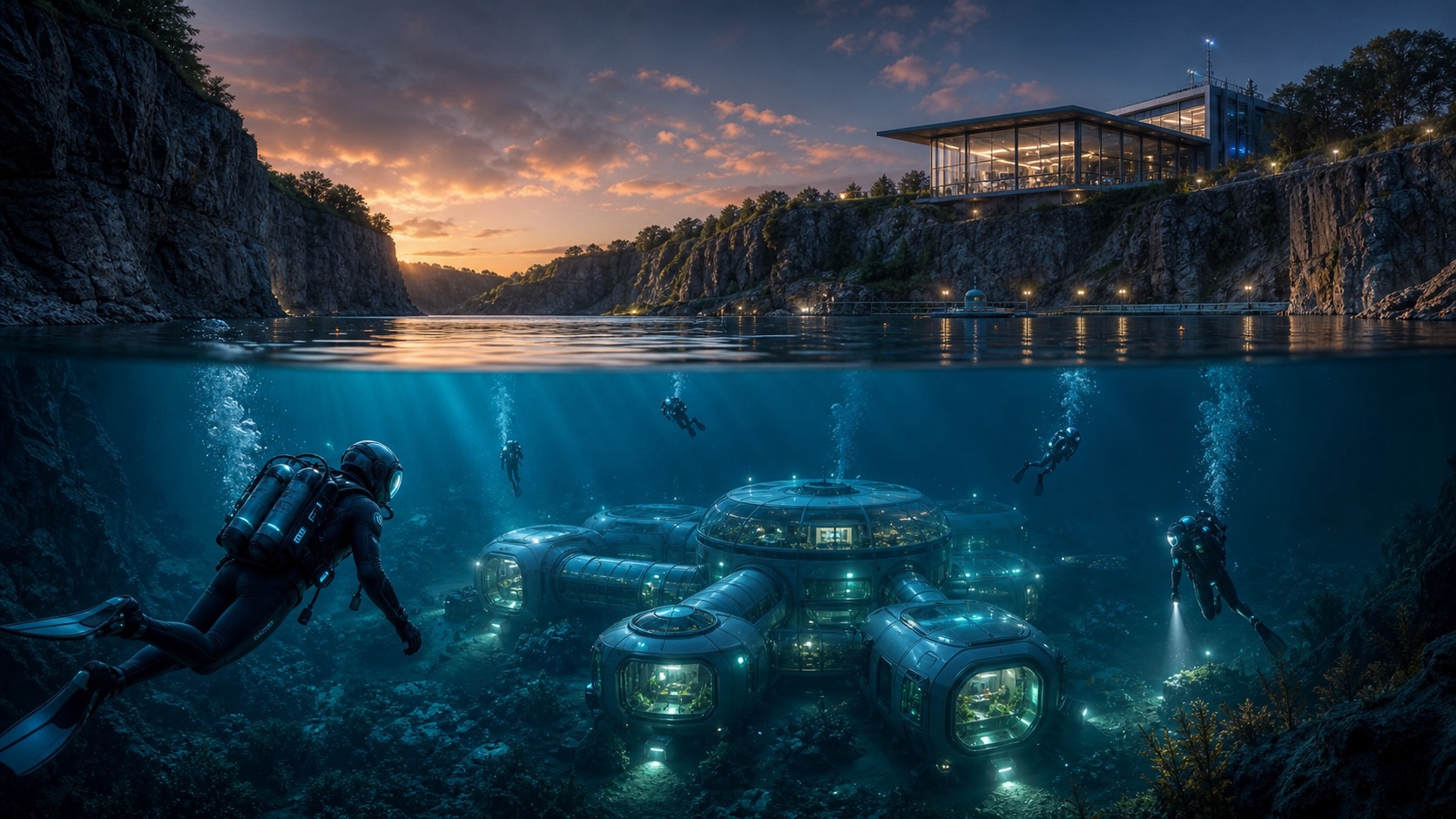
DEEP, a quietly ambitious ocean engineering company with the slogan “Make Humans Aquatic,” is turning a flooded British quarry into something between a deep‑sea university campus and a very serious playground for saturation divers. At its new Chepstow facility, a 50‑acre former limestone pit is being repurposed as a controlled underwater testbed where people will learn to live and work beneath the surface for weeks at a time rather than a single tank of air.
A Quarry Becomes a Quiet Revolution
Once known to UK divers as the National Diving and Activity Centre, the quarry at Tidenham near Chepstow was already famous for depths reaching roughly 80 meters and clear, cold water that drew technical and military divers. Now, under DEEP’s ownership, the 600‑meter‑long lake is being reimagined as “DEEP Campus,” a secure freshwater facility designed for advanced training, research and equipment testing, complete with shore‑based engineering support, accommodation and year‑round access.
On paper, the site reads like a classic repurposing story: industrial extraction gives way to intellectual exploration, as rock hauling is replaced by data gathering. In practice, it is a sizable infrastructure bet—DEEP and local officials have flagged a planned investment of around £100 million in turning the quarry into a regional hub for underwater technology, with jobs expected in engineering, R&D, logistics and hospitality.
Making Humans Aquatic (Without the Gills)
DEEP’s pitch is disarmingly simple: if you want to understand the ocean, you should spend more than a coffee break in it. Traditional diving limits researchers to a handful of underwater hours per day, with resurfacing and decompression consuming valuable time and adding risk; DEEP’s subsea habitats aim to invert that ratio by letting people stay down for days or even weeks at a stretch.
The company’s CEO has described the habitats as “time machines,” a nod to the way saturation living stretches what can be accomplished on a mission. By maintaining divers at pressure, the system cuts out the constant yo‑yoing to the surface and opens the door to continuous operations—more measurements taken, more samples collected and more problems solved before the team has to pack up and go topside.
Inside DEEP Campus: A Training Ground Below the Surface
At the heart of DEEP Campus is the controlled body of freshwater, bordered by a private 50‑acre perimeter that keeps currents, shipping lanes and curious paddleboarders out of the equation. The lake’s depth profile—down to about 80 meters, with long, clear stretches—makes it unusually well‑suited to saturation diving drills, closed‑bell operations and the careful choreography of placing and retrieving subsea hardware.
Along the shore, DEEP is building out a suite of support assets more reminiscent of an aerospace test range than a weekend dive center: engineering workshops, test rigs, accommodation blocks and shore‑based control rooms that can monitor dives, habitats and submersibles in real time. The company has flagged plans for amenities ranging from a submarine garage to visitor facilities and even a tunnel link to nearby hotel accommodation—because if you are going to ask people to live like aquatic astronauts, you may as well offer them a decent coffee when they re‑pressurize.
Vanguard, Sentinel and the Modular Ocean Frontier
The Chepstow site is not just a training pool; it is the proving ground for DEEP’s subsea habitat line‑up, a modular system built around two core platforms called Vanguard and Sentinel. Vanguard is the smaller pilot habitat—roughly 12 meters long and 7.5 meters wide—designed for missions of up to a week with three occupants and aimed at tasks such as rapid‑response search operations or short, intensive research campaigns.
Sentinel is the big swing: an expandable network of interconnected modules intended to support teams of six to 50 people at depths of up to about 200 meters for up to a month. Built from standardized, 3D‑manufactured components that can be configured into different layouts, the system is meant to be recoverable, re‑deployable and scalable, more like a subsea space station kit than a single fixed‑location lab. DEEP and its partners have talked openly about 2027 as the target date for a permanent human presence underwater, with the Chepstow campus serving as the dry run before habitats are dispatched to sites around the world.
Saturation Diving: Training for Aquatic Astronauts
The backbone of this vision is saturation diving, a technique perfected in the offshore energy sector and now poised for a broader research role. In a saturation regime, divers live in a pressurized environment—on the surface in a chamber, or underwater in a habitat—for extended periods, traveling to and from their worksite in a closed diving bell instead of constantly ascending and descending through the water column.
DEEP Campus is being promoted as home to the only closed‑bell diving system of its kind in the Northern Hemisphere, along with an extended menu of training courses spanning habitat diving, professional scuba, rebreather techniques, surface‑supplied systems and diver medic qualifications. For divers and engineers, the combination of depth, infrastructure and advanced kit effectively turns the quarry into a graduate school for extreme environments, the sort of place where you might bump into a future offshore wind engineer on one dive and a future Mars‑analogue astronaut on the next.
Why Tech and Investors Are Paying Attention
While the idea of living underwater evokes science fiction, the economics are rooted firmly in this world. As offshore wind arrays push into deeper waters, subsea data cables multiply and coastal resilience becomes a global priority, the demand for robust underwater infrastructure—and people trained to install, maintain and inspect it—is rising.
A modular habitat system that can be deployed near new fields, cable routes or research sites offers a way to cut time, cost and risk across industries from energy to telecommunications to marine biotech. Meanwhile, the research upside is substantial: with only one permanent underwater lab in operation globally today, the addition of a network of habitats could accelerate work on everything from coral resilience and carbon cycling to the engineering lessons needed for future space habitats.
Chepstow’s Deep Future
For Chepstow and the surrounding region, DEEP’s campus carries the promise of a new industrial identity built around engineering talent, high‑spec manufacturing and niche tourism, rather than quarrying and weekend thrill‑seeking. If timelines hold, the site is expected to ramp up activity through the middle of the decade and feed into the company’s broader aim of seeding underwater stations worldwide by 2027.
If it succeeds, the quiet lake on the Welsh border may become a footnote in a much larger story: the moment humans stopped treating the ocean as a destination and started treating it as an address. For now, Chepstow’s hidden campus is where that future is being pressure‑tested—one saturation dive, one modular habitat and one very patient quarry at a time.
Learn More By Watching This Video Now!
The Sources
- BBC News – “Underwater living: Deep dive site to become £100m research hub” (about DEEP’s investment in the former National Diving and Activity Centre near Chepstow).
https://www.bbc.com/news/uk-england-gloucestershire-66729172bbc - BBC – Tech Now: “Deep Dive: Underwater Tech” (Andrew Rogers visiting the former quarry where new underwater tech is being tested).
https://www.bbc.co.uk/programmes/m002wcypbbc - DEEP – Mission page: “Make Humans Aquatic” (company background and overall vision).
https://www.deep.com/missiondeep - DEEP – Main site: overview of DEEP’s ocean engineering and modular habitat concept.
https://www.deep.comdeep - DEEP Campus – “Underwater Training & Testing” (details on the Chepstow campus: size, depth, facilities, and saturation diving training).
https://www.deep.com/locations/campusdeep - DEEP Institute – training and subsea testing facility information (fresh‑water site, depth, length, and on‑site engineering support).
https://www.deepinstitute.comdeepinstitute - National Diving and Activity Centre (NDAC) – background on the former Chepstow quarry dive site, depth profile and history.
https://en.wikipedia.org/wiki/National_Diving_and_Activity_Centrewikipedia - DiveBuddies4Life – “Quarry Diving in Chepstow, England” (context on Dayhouse/NDAC as a dive site and its characteristics).
https://divebuddies4life.com/england-welcome-to-the-chepstow-diving-jungle/divebuddies4life - Facebook (Harpia News post) – Tech Now segment summary: “Deep Dive: Underwater Tech – Andrew Rogers is exploring new technological advances…”
https://www.facebook.com/harpianews/posts/tech-now-deep-dive-underwater-techandrew-rogers-is-exploring-new-technological-a/facebook - BBC News – “Habitat will allow humans to stay underwater for weeks” (broader context on subsea habitats and living underwater).
https://www.bbc.com/news/articles/cgld41y850gobbc
Stay Updated with Vista Partners
Subscribe to receive market insights, investing ideas, and the latest updates directly in your inbox.