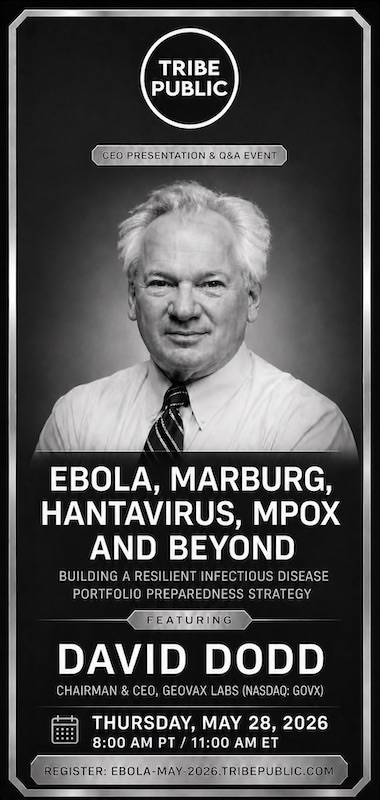
Vista Partners’ sister organization Tribe Public www.tribepublic.com is once again turning a high‑stakes public health story into a conversation, this time by putting hemorrhagic fevers and vaccine preparedness squarely on the calendar for May 28, 2026 at 8am pacific time via their Tribe Pubic CEO Presentation and Q&A webinar-based platform. The result is an event—and a narrative—that sits neatly at the intersection of science, capital markets, and the perennial investor question: “Who is actually building the fire extinguisher before the next fire?”
A Sister Organization Built For the Spotlight
Tribe Public, the San Francisco–based sister organization to Vista Partners, has carved out a niche as a kind of “idea exchange” for institutions, family offices, advisors, and sophisticated retail investors hunting for under‑followed stories with real scientific depth. Its complimentary CEO presentation and Q&A events, delivered globally via Zoom, are designed to give investors and consumers a direct, unfiltered access to management teams operating at the sharp end of innovation.
The upcoming session—“Ebola, Marburg, Hantavirus, Mpox and Beyond: Building a Resilient Infectious Disease Preparedness Strategy”—will be co-hosted by GeoVax Labs (NASDAQ: GOVX), a clinical‑stage biotech developing vaccines and immunotherapies for infectious diseases and cancer.
Why Ebola, Marburg, Hantavirus and Mpox Still Matter
The pathogens headlining this event are not newcomers to the risk matrix; they are repeat characters with unnerving résumés. Ebola and Marburg, closely related filoviruses, are notorious for causing severe hemorrhagic fever and high case‑fatality rates in outbreaks from central and eastern Africa. Hantaviruses, often spread through contact with rodent excreta, can trigger hantavirus pulmonary syndrome and hemorrhagic fever with renal syndrome. Mpox, which broke out globally in 2022, has since reminded policymakers that “niche” zoonoses can go from footnote to front page in one news cycle.
While prior waves of funding have tended to chase the last crisis—COVID here, Mpox there—the scientific and policy consensus has shifted toward platforms that can be rapidly adapted across multiple threats.
GeoVax’s Platform Pitch
GeoVax is advancing vaccine candidates based on a modified vaccinia Ankara (MVA) vector and other approaches designed to induce durable immune responses against a range of infectious threats, including Mpox and hemorrhagic fever viruses such as Ebola and Marburg.
Recent commentary on GeoVax has highlighted preclinical work across multiple filoviruses and the company’s push to position its programs within a broader global preparedness agenda. Tribe Public’s CEO forum gives management a chance to connect those scientific details to milestones investors actually model: regulatory catalysts, partnership potential, and non‑dilutive funding opportunities.
Inside the May 28 CEO Event
The webinar is scheduled for Thursday, May 28, 2026, at 8:00 a.m. Pacific / 11:00 a.m. Eastern, and is open on a complimentary basis to qualified investors and interested stakeholders. Attendees can register via the dedicated landing page at Ebola‑May‑2026.TribePublic.com and submit questions in advance to Tribe Public’s research team or live via Zoom chat during the session.
Tribe Public’s managing member will host and moderate the discussion, steering questions toward both the science and the strategy—why these indications, why now, and how GeoVax plans to convert vaccine R&D into shareholder value in a capital market that has turned decidedly more demanding with respect to data, timelines, and capital efficiency.
A Repeatable Investor Discovery Engine
This is not Tribe Public’s first outing with high‑consequence pathogens—and that repetition is, in itself, part of the thesis. Previous events have spotlighted GeoVax’s programs targeting COVID‑19 and Mpox, as well as other biotech CEOs focused on “fully engaging the human immune system to cure disease,” signaling an editorial bias toward platforms with multi‑indication potential.
The format is deliberately efficient. Tribe Public brings together management teams, institutional investors, family offices, RIAs, and sell‑side professionals who are hunting for what might be described, in classic Wall Street shorthand, as “asymmetric outcomes with real science attached.” For issuers, the reward is targeted exposure; for investors, it is the ability to interrogate the people making capital allocation decisions in real time.
Risk, Reward and the Preparedness Premium
For investors, infectious disease preparedness sits at the messy intersection of science, geopolitics, and budget cycles. Revenues often lag outbreaks, contracts can be concentrated, and valuations can swing with each headline. Yet the structural drivers—urbanization, climate‑driven shifts in vector habitats, and global mobility—continue to argue for sustained investment in broadly protective platforms.
Events like Tribe Public’s May 28 webinar do not remove that risk; they illuminate it. By putting a clinical‑stage company like GeoVax in a live Q&A with a live audience, Tribe is effectively turning due diligence into a public good: investors get transparency, management gets feedback, and the broader ecosystem gets a more informed conversation about which preparedness strategies may actually scale.
Stay Updated with Vista Partners
Subscribe to receive market insights, investing ideas, and the latest updates directly in your inbox.