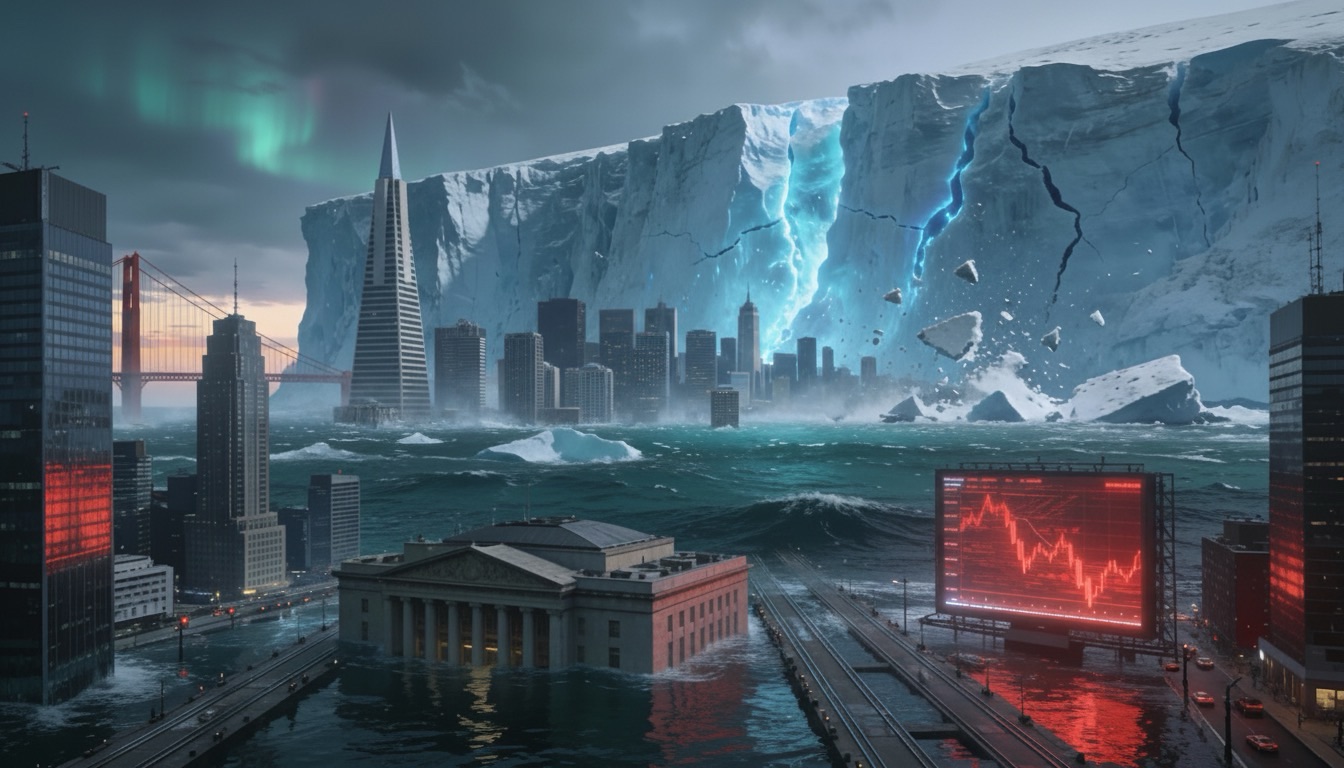
The “Doomsday Glacier” is edging closer to a dangerous tipping point, but the story is less asteroid-strike apocalypse and more slow‑motion bond crisis: the numbers are sobering, the timeline is long, and there is still room for adults in the room to act. Thwaites Glacier’s fractures are racing ahead, its underbelly is being chewed by warm ocean “storms,” and yet scientists stress that while catastrophic collapse is unlikely in the next few decades, the trajectory through this century and the next will be shaped by decisions made in the here and now.
Meet Wall Street’s Worst Iceberg Risk
Thwaites Glacier, the so‑called Doomsday Glacier in West Antarctica, is roughly the size of Britain or Florida and currently accounts for around 4 percent of global sea level rise as it spills billions of tons of ice into the ocean each year. If it were to fully collapse, it holds enough water to raise global sea levels by about 65 centimeters, or a bit over 2 feet on its own, with the potential to unlock a broader West Antarctic ice retreat that could ultimately deliver several meters—10 feet or more—of sea level rise over time.
Scientists have watched its retreat “accelerate considerably over the past 40 years,” a chart any equity analyst would recognize as the kind you don’t want to see without a hedging strategy. The glacier’s position acts like a cork in the neck of the West Antarctic ice sheet, meaning if Thwaites goes, neighboring glaciers may follow, much like a line of highly leveraged funds discovering what “correlated risk” really means.
Cracks in the Ice, Cracks in the Model
A new study from the International Thwaites Glacier Collaboration and University of Manitoba researchers examined two decades of satellite data and found that the network of fractures along a key shear zone has more than doubled in total length since 2002, from about 100 miles to over 200 miles. Interestingly, the average fracture length has shrunk, suggesting a transition from a few large structural weaknesses to a dense field of smaller cracks—less “one big default,” more “systemic stress everywhere you look.”
Underwater, the news is equally bracing: recent work shows warm ocean eddies and tidal “storms” are slipping beneath the ice shelves, melting them from below in patterns that can change over days rather than decades, undermining the buttresses that slow Thwaites’ slide into the sea. Robotic surveys and ocean models indicate that complex melt channels and intrusions of seawater at the grounding line—the point where glacier meets seabed—are accelerating ice loss in ways earlier, smoother models largely missed.
Doom, With a Footnote of Hope
For all the apocalyptic branding, the latest research injects nuance that would make even a dour credit rating agency add an asterisk. Several studies suggest that one feared failure mode—marine ice cliff instability, a domino‑style collapse of tall ice cliffs—may be less likely or at least more constrained than first thought, implying that a truly sudden, Hollywood‑grade disintegration this century is not the base case.
Instead, Thwaites looks set for a prolonged retreat through the 21st and 22nd centuries, with the pace highly sensitive to future greenhouse gas emissions and ocean warming—akin to a long‑duration liability whose final bill depends on whether policymakers choose a discount rate closer to “urgent action” or “pray for miracles.” The latest ITGC synthesis notes that while a full collapse within a few decades is unlikely, continued rapid retreat is expected, meaning coastal risk is not a question of if but how fast and how prepared.
Coastal Real Estate, Meet Climate VaR
For coastal cities, Thwaites is the ultimate long‑term counterparty, promising to pay out in inches and feet of water rather than coupons. Even its standalone potential—roughly 2 feet of sea level contribution, plus the knock‑on risk of several additional meters if West Antarctica’s wider ice system destabilizes—translates into trillions of dollars in exposed infrastructure, from New York and Miami to Kolkata and Shanghai.
Urban planners now speak the language of climate Value‑at‑Risk: higher storm surges on a raised baseline, saltwater intrusion into groundwater, chronic flooding that turns “once in a century” events into line items in annual budgets. Insurance markets are already edging away from some high‑risk coastlines, effectively marking down assets long before the water actually arrives, a reminder that financial markets front‑run physical reality when the models look credible enough.
A Slow‑Motion Margin Call on Carbon
The policy takeaway is refreshingly unsensational: there is no big red button to “save” Thwaites, but cutting emissions sharply and fast can still limit how much and how quickly sea level rises, turning an existential cliff into a steep but navigable slope. Geoengineering ideas—from reflecting sunlight to attempting to influence ocean circulation—have entered the chat, though most scientists warn these are at best speculative backstops, not substitutes for the dull, proven work of decarbonizing energy, transport, and industry.
If Thwaites is the world’s icy, over‑leveraged asset, then the global economy is the risk committee that finally read the footnotes—late, but not yet too late to tighten exposure. The glacier’s message to markets and policymakers is unnervingly clear: the margin call on carbon is coming; whether it arrives as a managed transition or a forced liquidation of coastal comfort is, for the moment, still a choice.
The Sources
[1] Doomsday Glacier Approaching Catastrophic Collapse https://futurism.com/science-energy/doomsday-glacier-approaching-catastrophic-collapse
[2] Antarctica’s ‘doomsday’ glacier is heading for catastrophic collapse https://www.newscientist.com/article/2448793-antarcticas-doomsday-glacier-is-heading-for-catastrophic-collapse/
[3] Underwater ‘storms’ are eating away at the Doomsday Glacier … – CNN https://www.cnn.com/2025/12/10/climate/underwater-storms-melt-doomsday-pine-island-glaciers-antarctica
[4] New research offers hope on sea-level rise, although risks remain https://thwaitesglacier.org/news/research-offers-hope-sea-level-rise-risks-remain
[5] [PDF] Antarctica’s Thwaites Glacier and sea-level rise https://thwaitesglacier.org/findings
[6] Bound for Antarctica: A Trip to Study the Thwaites Glacier Is Underway https://www.nytimes.com/2025/12/27/climate/antarctica-thwaites-glacier.html
[7] Thwaites Glacier Facts https://thwaitesglacier.org/about/facts
[8] Measuring how – and where – Antarctic ice is cracking with new … https://www.psu.edu/news/earth-and-mineral-sciences/story/measuring-how-and-where-antarctic-ice-cracking-new-data-tool
[9] The ‘Doomsday Glacier’ is rapidly melting. Scientists now … – CNN https://www.cnn.com/2024/02/26/climate/doomsday-glacier-antarctic-ice-melt-climate-intl
[10] Scientists Send Robot Under Doomsday Glacier, Alarmed by What It … https://futurism.com/the-byte/scientists-robot-doomsday-glacier-alarmed
[11] New research from Dartmouth shows how underwater ‘storms’ may … https://www.nhpr.org/nh-news/2025-12-26/dartmouth-glacier-research-melting-climate-change
[12] ‘Doomsday’ Antarctic Glacier Melting Faster Than Expected, Fueling … https://news.climate.columbia.edu/2024/10/30/doomsday-antarctic-glacier-melting-faster-than-expected-fueling-calls-for-geoengineering/
[13] ‘Doomsday Glacier’ may be more stable than initially feared https://news.engin.umich.edu/2021/06/doomsday-glacier-may-be-more-stable-than-initially-feared/
[14] The Doomsday Glacier Is Getting Closer and Closer to Irreversible Collapse https://www.wired.com/story/the-doomsday-glacier-is-getting-closer-and-closer-to-irreversible-collapse/
[15] Doomsday Glacier’s Rapid Collapse Exposes Urgent Climate Challenges, Impacting Coastal Communities Worldwide https://www.sustainability-times.com/climate/doomsday-glaciers-rapid-collapse-exposes-urgent-climate-challenges-impacting-coastal-communities-worldwide/
[16] Two Times Journalists Join an Expedition to Antartica https://www.nytimes.com/2025/12/27/climate/thwaites-glacier-expedition-antarctica.html
[17] “The final judgment” – scientists warn after detecting hundreds of earthquakes beneath this glacier that could cause a catastrophe – how it affects us https://unionrayo.com/en/earthquakes-glacier-antarctica/
[18] Doomsday Glacier Approaching Catastrophic Collapse – Yahoo https://nz.news.yahoo.com/doomsday-glacier-approaching-catastrophic-collapse-120000518.html
[19] Scientists Horrified by What They Found Under the Doomsday Glacier https://futurism.com/the-byte/scientists-horrified-doomsday-glacier
[20] Doomsday Glacier Approaching Catastrophic Collapse (Futurism) https://x.com/MarkKepes/status/2005282034734784972