


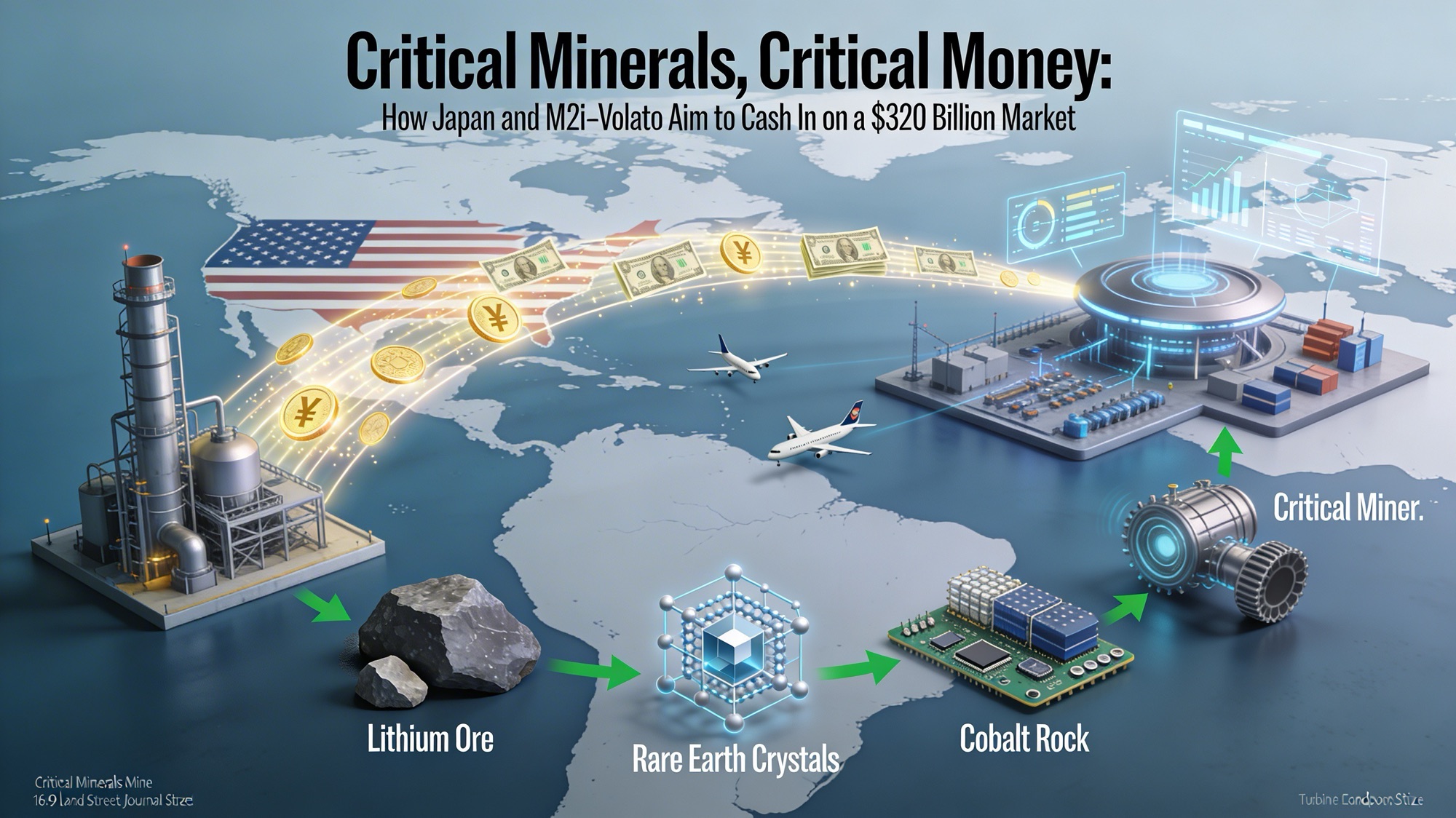
Japan is about to become one of America’s biggest energy backers, wiring in a $36 billion down payment on oil, gas and critical-minerals projects that doubles as foreign policy, industrial strategy and a not‑so‑subtle advert for tariffs as a negotiating tool. At the center of the plan is a gargantuan natural‑gas project in Ohio that President Donald Trump has happily billed as “the largest in history,” with Japanese heavyweights from SoftBank to Hitachi circling the opportunity like blue‑chip moths to a very large, very lucrative flame.
SEO Focus: Japan’s $550 Billion Bet on US Energy
For search and discovery, the core hooks are clear: Japan’s $550 billion US trade deal, a $36 billion first tranche, record-sized US gas infrastructure, and a concerted push into critical minerals and energy security. Together they frame a narrative that sits neatly at the intersection of “US energy dominance,” “China supply-chain hedging,” and “ally-shoring,” three phrases that algorithms and investors alike have learned to take seriously. For readers, the story offers a mix of megaproject spectacle—multi‑gigawatt gas generation, deepwater crude export capacity, synthetic diamonds by the ton—and the quieter, compounding reality of long‑dated industrial capital quietly reshaping the American map.
The Ohio Gas Behemoth: SoftBank’s New Power Play
The marquee project is a natural-gas facility in Ohio expected to deliver power on a scale that would rival multiple nuclear reactors, providing enough electricity to support millions of homes and a hefty slice of the Midwestern industrial base. Japan is slated to put the lion’s share of the $36 billion tranche into the plant, with SB Energy, a SoftBank subsidiary, in the lead—turning a group better known for tech bets into a central character in America’s baseload power future. If it runs as advertised, the facility will anchor the PJM grid, give manufacturers in the Midwest a sturdier foundation than the usual mix of weather and aging infrastructure, and stand as a bricks‑and‑mortar example of ally capital underwriting US energy security.
Japanese corporate names familiar to tech and industrial investors—SoftBank, Toshiba, Hitachi and others—have expressed interest in different parts of the wider framework, from power equipment to grid hardware and advanced components. For Tokyo, the Ohio project offers something rare: long‑term dollar cash flows tied to critical infrastructure in a friendly jurisdiction, while for Washington it is foreign direct investment that supports both energy security and a politically important state. In the slightly drier language of trade economists, this is what happens when industrial policy and geopolitics decide to co‑author the same project finance deck.
Texas, Georgia and the Critical-Minerals Chessboard
Ohio is only one tile on the board; the first $36 billion package also includes a deepwater crude export terminal off the Texas coast and a synthetic‑diamond plant in Georgia. The Texas Gulf export facility is designed to push more US barrels out to global markets, reinforcing Washington’s bid for “energy dominance” and giving Japan and other allies a more reliable non‑Russian, non‑Middle Eastern oil backstop. Georgia’s planned synthetic-diamond plant targets industrial‑grade diamonds used in semiconductors, autos and aerospace—small components with outsized importance in the US‑China technology tug‑of‑war—and underscores how “rocks” can quietly move markets when they sit in the right supply chain.
At the policy level, these projects sit inside a broader US–Japan framework on energy infrastructure and critical minerals that envisions hundreds of billions of dollars for power plants, transmission lines, refining capacity and advanced materials. The goal is end‑to‑end resilience: from digging minerals out of the ground and refining them, to turning them into batteries, chips, magnets and catalysts that are less exposed to single‑country processing choke points. In diplomatic shorthand, Japan supplies patient capital and industrial know‑how, the US supplies the real estate and regulatory headaches, and both get a more robust supply chain.
Enter M2i Global and Volato: A Domestic Lever on Critical Minerals
If the US–Japan deal is the international capital story, the proposed merger of M2i Global (MTWO) and Volato (SOAR) is the domestic complement—the home‑grown lever trying to pull some of that $320‑billion‑plus critical‑minerals opportunity onto a scalable platform. In the second quarter of 2025, M2i Global and Volato announced a proposed merger designed to create a platform positioned for long‑term growth across critical infrastructure markets, effectively stitching together rocks, runways and regulated software into one investable narrative. The timing is not accidental: as foreign partners step in with capital, US operators that can actually source, move and qualify critical materials onshore suddenly look a lot less like niche stories and a lot more like necessary infrastructure.
M2i Global brings the critical‑minerals spine—an operating focus on domestic sourcing, processing and national supply‑chain resilience at a moment when “resilience” is fast becoming Wall Street code for “willing to pay up for certainty.” Volato contributes the aviation technology and software layer, plus a track record of operational execution in complex regulated environments, where getting a permit, a data feed and a flight slot to line up on the same day can feel like an Olympic sport. Together, the combined company is positioned to participate in the US critical‑minerals market—an opportunity estimated to exceed $320 billion annually—as domestic sourcing, logistics and execution capabilities move from the footnotes of strategy decks to the headline slides.
How the Pieces Fit: From LNG Molecules to Mineral Molecules
Put together, Japan’s megaproject dollars and the M2i–Volato combination sketch out a vertically richer picture of America’s next industrial cycle. On one level, foreign capital is underwriting big‑ticket assets—LNG facilities, pipelines, export terminals, industrial plants—that will define the physical footprint of US energy and materials for decades. On another, specialized domestic players are racing to ensure the molecules and materials that flow through that footprint are sourced, tracked and delivered in ways that satisfy regulators, allies and shareholders who now read ESG and national‑security disclosures with equal interest.
In that world, critical minerals are no longer just a line item under “inputs”; they are a strategic asset class whose supply, refining and distribution chains increasingly determine who gets to build what—and at what margin. A combined M2i Global–Volato entity that can knit together mineral sourcing with aviation and software‑driven logistics doesn’t just ride the wave; it helps define the lanes, especially as policymakers continue to lace tax credits, defense‑production tools and tariff relief into the sector. For investors, the message between the lines is simple: follow the flows, not just of capital and electrons, but of the critical atoms that make high‑end manufacturing and defense systems possible.
Tariffs, Trade Deals and a “Massive” Moment
The political origin story of this investment spree is as important as the engineering drawings: under a trade agreement unveiled in 2025, Japan agreed to invest hundreds of billions of dollars in US industries through the end of the decade, while the US scaled back threatened tariffs on Japanese imports. Trump has cast the deal as proof that his tariff brinkmanship can extract not only concessions on paper but concrete, steel and gigawatts on the ground, crediting tariffs as the magic word that made the projects possible. For Tokyo, locking in lower tariffs while channeling capital into strategic US assets offers both economic upside and a stronger security anchor at a time when regional tensions make alliances feel less like diplomatic niceties and more like balance‑sheet necessities.
The US, for its part, gets to tally Japanese investment alongside similar pledges from South Korea and other partners in what officials describe as a new wave of ally‑financed industrial build‑out. Frameworks with both Japan and Korea now emphasize critical minerals, energy infrastructure and advanced manufacturing, effectively turning foreign direct investment into a supply‑chain insurance policy underwritten by America’s closest security partners. In that light, the Ohio gas plant, the Texas export terminal, the Georgia diamond facility, and the emerging M2i–Volato platform are not just one‑off projects but early chapters in a broader story of how tariffs, trade frameworks and geopolitics are rewiring who builds what—and where.
Why Markets and Voters Both Care
For investors, Japan’s $36 billion tranche and the M2i–Volato merger thesis together offer a multi‑year pipeline of work for equipment makers, engineering firms, grid specialists, aviation‑tech players and logistics software companies tied to critical‑infrastructure build‑out. They also underline natural gas’s evolving role as a “bridge fuel” that still commands hefty capital commitments even as renewables grow, and highlight critical minerals as the parallel “bridge material” whose secure supply underpins everything from EVs to missiles.
For voters, the story is simpler and less denominated in gigawatts or billions of dollars in mineral throughput: new plants in Ohio, Texas and Georgia, new industrial facilities in other states, thousands of promised jobs, and the sense that both America’s allies and its own companies are literally investing in its industrial heartland. If the projects deliver as advertised, the political dividends could be almost as substantial as the energy and materials output; if they stumble, they will become case studies in the risks of mega‑project optimism in an era already rich with them. Either way, one fact is clear: when Japan decides to “throw cash at Uncle Sam,” and when domestic players like M2i Global and Volato set up to catch the critical‑minerals opportunity, nobody is reaching for small bills.
The Sources
- Japan, US Reach $36 Billion of Gas, Mineral Deals in Trump Pact – Yahoo Finance
https://finance.yahoo.com/news/japan-invest-36-billion-us-214408491.html[1] - Trump Says Japan to Invest in Energy, Industrial Projects in Ohio, Texas and Georgia – Reuters
https://www.reuters.com/business/energy/trump-announces-energy-critical-mineral-projects-texas-ohio-georgia-2026-02-17/[2] - Fact Sheet: U.S. — Japan Trade Deal – U.S. Department of Commerce
https://www.commerce.gov/news/fact-sheets/2026/02/fact-sheet-us-japan-trade-deal[3] - Japan Announces US Investments as Part of $550B Trade Deal – Semafor
https://www.semafor.com/article/02/18/2026/japan-announces-us-investments-as-part-of-550b-trade-deal[4] - US, Japan Announce First Tranche of $550B in Investments – TRT World
https://www.trtworld.com/article/0343a7db56dd[5] - Trump Reveals First Set of Japan’s Investments in US, Comprising 3 Projects – NHK World
https://www3.nhk.or.jp/nhkworld/en/news/20260218_07/[6] - Understanding the Japan, Korea Frameworks – National Association of Manufacturers
https://nam.org/understanding-the-japan-korea-frameworks-35069/[7] - US, Japan Sign Framework for Critical Mineral Supply – Manufacturing Dive
https://www.manufacturingdive.com/news/us-japan-critical-mineral-rare-earth-deal/804391/[8] - U.S. Partners with Mexico, Japan and EU on Critical Minerals – National Association of Manufacturers
https://nam.org/u-s-partners-with-mexico-japan-and-eu-on-critical-minerals-35683/[9] - Japan Announces US Investments as Part of $550B Trade Deal – Bloomberg Newsletter Brief
https://www.bloomberg.com/news/newsletters/2026-02-18/japan-plans-multi-billion-dollar-investments-in-the-us[10] - Japan’s $36B US Investment, Part of $550B Deal, Seen as Political – Global Times
https://www.globaltimes.cn/page/202602/1355478.shtml[11] - The Critical Minerals Play: Why M2i Global and Volato’s Merger Could Reshape Supply Chain Security – AInvest
https://www.ainvest.com/news/critical-minerals-play-m2i-global-volato-merger-reshape-supply-chain-security-offer-high-conviction[12] - Volato Group Files Updated S-4 and Advances M2i Global Merger Amid $320 Billion Critical Minerals Opportunity – Business Wire
https://www.businesswire.com/news/home/20251215965666/en/Volato-Group-Files-Updated-S-4-and-Advances-M2i-Global-Merger-Amid-320-Billion-Critical-Minerals-Opportunity[13] - M2i Global, Along With Volato Group, in Collaboration With Nimy Resources – Volato Investor Relations Press Release
https://ir.flyvolato.com/news-events/press-releases/detail/132/m2i-global-along-with-volato-group-in-collaboration-with-nimy-resources[14] - M2i–Volato Merger Aligned With New U.S. Critical Minerals Policy – Proactive Video Interview
https://www.youtube.com/watch?v=MXGM3o6QOqQ[15]

