


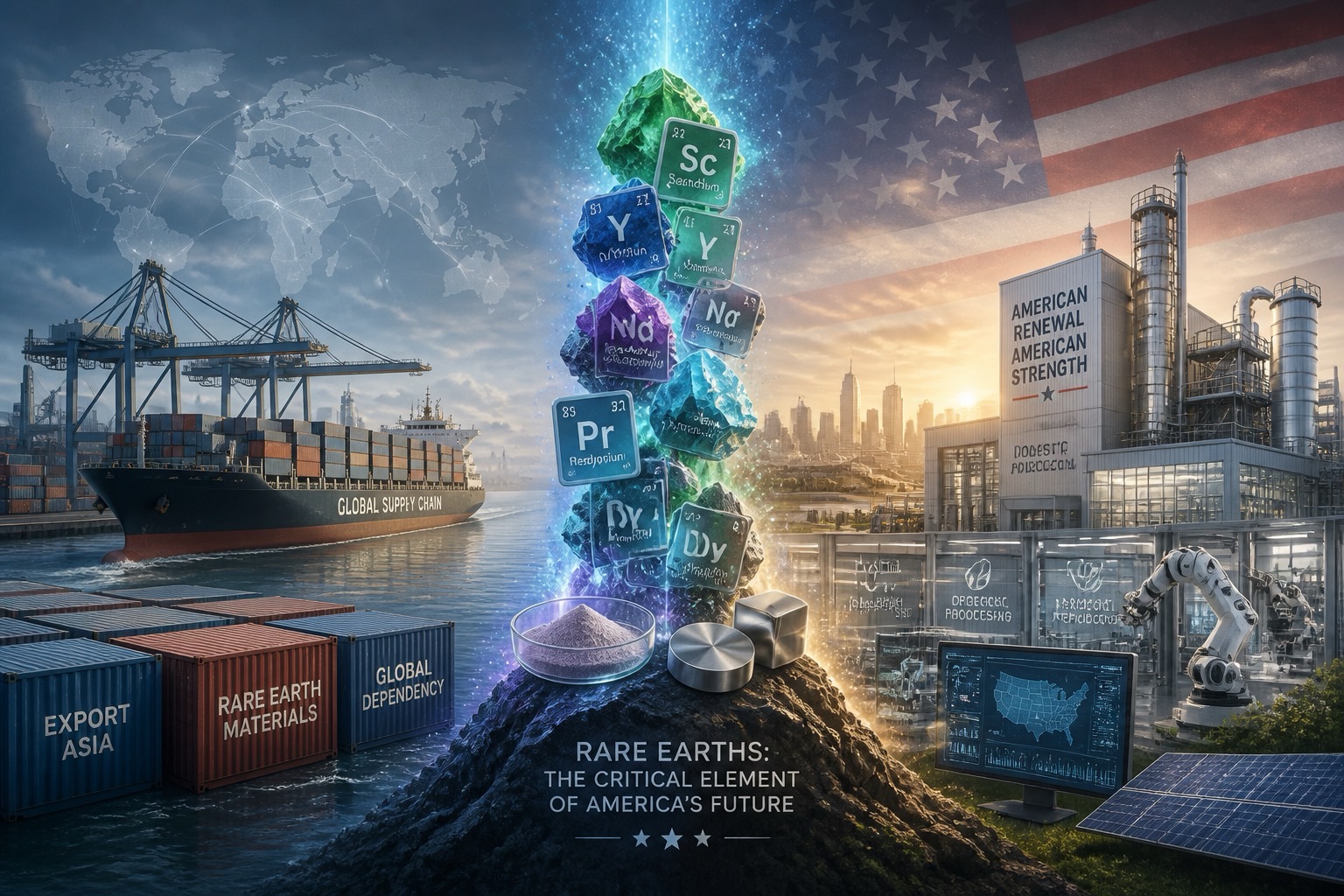
For a nation that prides itself on independence, relying on foreign sources for more than 95% of its rare earth elements is less a strategy and more a vulnerability. These minerals—quietly embedded in everything from electric vehicles to missile guidance systems—have become the unsung protagonists of the modern economy. Yet, until recently, they have largely been someone else’s problem to produce.
That may be changing.
A Strategic Bet on American Innovation
The U.S. Department of Energy (DOE) has stepped forward with a $45.7 million investment across 19 projects aimed at strengthening domestic critical mineral supply chains. The initiative, led by the Office of Critical Minerals and Energy Innovation, is not merely a funding announcement—it is a signal that Washington sees minerals not as commodities, but as strategic assets.
The focus is clear: build pilot-scale facilities capable of processing magnesium and rare earth elements on U.S. soil. In other words, don’t just dig it up—refine it, scale it, and ultimately manufacture with it domestically.
Assistant Secretary of Energy Audrey Robertson put it succinctly: reshoring mineral production is about creating an end-to-end American supply chain. Translation for investors: less geopolitical risk, more control, and a stronger industrial base.
From Ore to Opportunity
Historically, the U.S. has not lacked geological potential. What it has lacked is infrastructure—particularly in processing and refining, where foreign players have long dominated. Mining is only the first chapter; the real value lies in what happens next.
The newly funded projects aim to rewrite that narrative through:
- Advanced separation technologies that improve efficiency and reduce environmental impact
- Modular processing systems that can scale more quickly than traditional facilities
- Recycling and recovery methods that extract rare earths from electronic waste and industrial byproducts
- Alternative feedstocks, including unconventional mineral sources that were previously uneconomical
Consider, for example, a pilot facility that extracts rare earth elements from coal ash—a legacy waste product now being reimagined as a strategic resource. It is the industrial equivalent of turning yesterday’s liabilities into tomorrow’s assets.
National Security Meets Supply Chain Strategy
The urgency behind these efforts extends beyond economics. Rare earth elements are foundational to defense systems, clean energy technologies, and advanced electronics. Dependence on foreign suppliers—particularly in geopolitically sensitive regions—introduces risks that no amount of spreadsheet modeling can fully hedge.
By investing in domestic processing capabilities, the U.S. is effectively buying an insurance policy against supply disruptions. It is also positioning itself to compete more aggressively in global markets where demand for critical minerals is expected to surge alongside electrification and decarbonization trends.
The Private Sector Angle
For investors and industry players, the DOE’s funding acts as both catalyst and validation. Early-stage technologies that might have struggled to secure capital now have a federal tailwind. This could accelerate partnerships between startups, established mining companies, and downstream manufacturers.
Moreover, the development of pilot-scale facilities suggests a near-term pathway to commercialization—a key inflection point for any emerging industrial technology.
A Measured Path Forward
While $45.7 million will not singlehandedly close the gap between U.S. demand and domestic supply, it represents a meaningful step toward diversification. More importantly, it reflects a shift in mindset: from reactive dependence to proactive development.
If successful, these initiatives could transform the U.S. from a price-taker in global mineral markets into a more self-reliant—and potentially influential—player.
And in a world increasingly defined by supply chain resilience, that is a position worth mining for.
Learn More By Watching This
The Sources
- U.S. Department of Energy – DOE’s Office of Critical Minerals and Energy Innovation Announces Over $45 Million to Support Domestic Critical Minerals Processing
https://www.energy.gov/cmei/articles/does-office-critical-minerals-and-energy-innovation-announces-over-45-million-support - Metal Tech News – DOE funding targets U.S. minerals processing
https://www.metaltechnews.com/story/2026/05/20/mining-tech/doe-funding-targets-us-minerals-processing/2766.html - U.S. Department of Energy – Audrey Robertson Biography
https://www.energy.gov/cmei/person/audrey-robertson - US Critical Materials – US Dependence on China for Rare Earth Elements Sparks Security Concerns
https://uscriticalmaterials.com/us-dependence-on-china-for-rare-earth-elements-sparks-security-concerns/ - Econofact – Can the U.S. Reduce Its Reliance on Imported Rare Earth Elements?
https://econofact.org/can-the-u-s-reduce-its-reliance-on-imported-rare-earth-elements - Georgia Tech Research – How the US Can Mine Its Own Critical Minerals — Without Digging New Holes
https://research.gatech.edu/how-us-can-mine-its-own-critical-minerals-without-digging-new-holes-0 - U.S. Department of Energy – Critical Materials Innovation Hub (CMI)
https://www.energy.gov/cmei/ammto/critical-materials-innovation-hub-cmi - U.S. Department of Energy – Developing a Domestic Supply of Critical Minerals and Materials
https://www.energy.gov/hgeo/articles/developing-domestic-supply-critical-minerals-and-materials
Stay Updated with Vista Partners
Subscribe to receive market insights, investing ideas, and the latest updates directly in your inbox.
