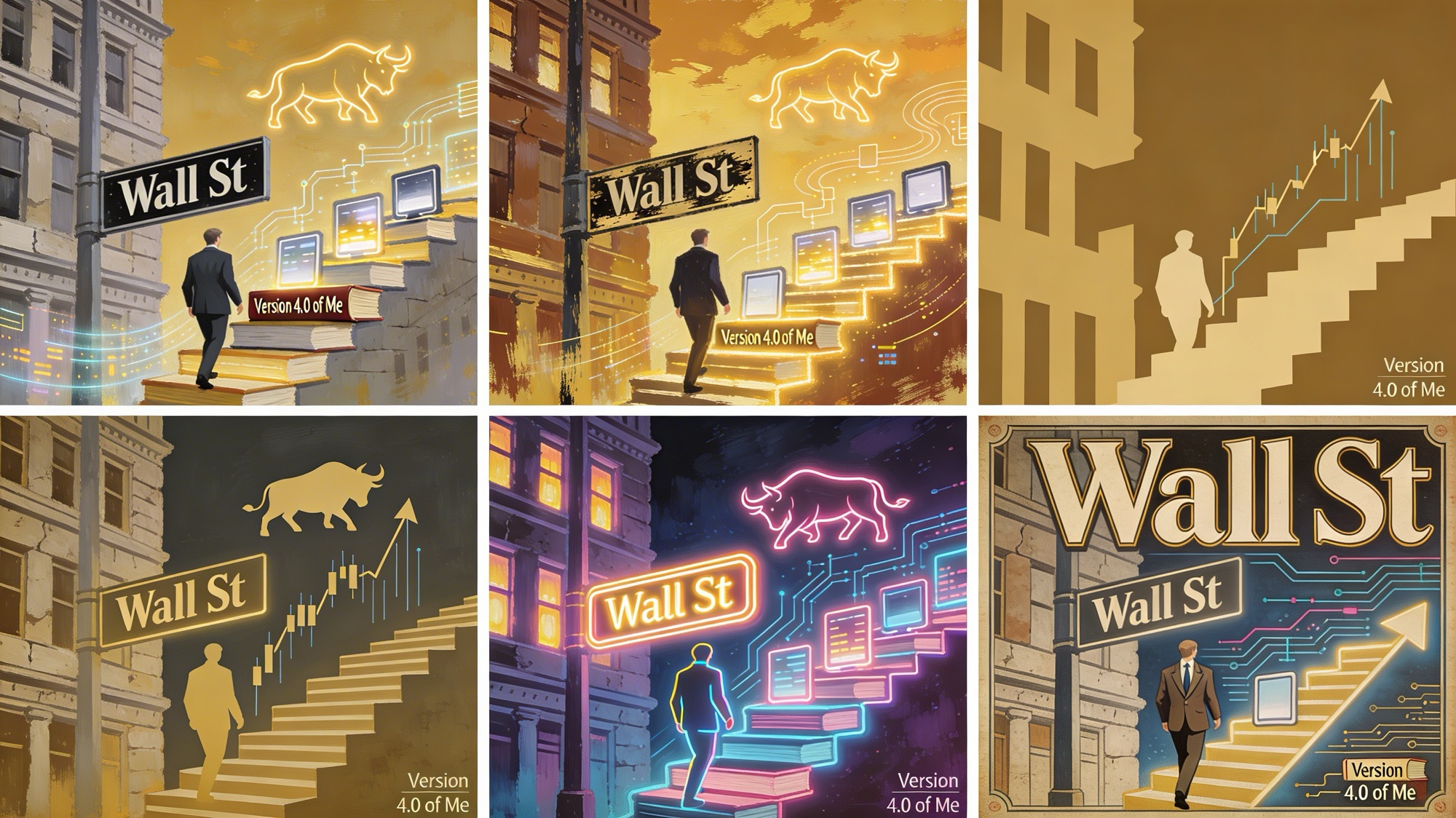
For decades, markets rewarded management teams that could master a strategy, stick to it, and talk about it in perfect bullet points. Today, investors are quietly rerating a different skill: the ability to discard that strategy on demand when the world—and the models—change.
The modern portfolio is built on the same uncomfortable premise. Knowledge is no longer a moat; it is a rental asset with a shrinking half‑life. In an era where artificial intelligence can reframe an industry thesis overnight, the cost of clinging to yesterday’s expertise shows up in underperforming funds, style drift, and awkward quarterly letters.
From Reading the 10‑K to Prompting the Model
The old definition of literacy in markets was straightforward: read the 10‑K, build a model, listen to the call, repeat. That loop is still necessary, but no longer sufficient. The new differentiator is whether investors can continuously learn, unlearn, and relearn as tools, data sets, and competitive landscapes evolve.
AI has turned that from a philosophical stance into an operating requirement. It is reshaping research workflows, compressing information advantages, and bringing institutional‑grade analytics within reach of smaller firms and sophisticated individuals. In this environment, literacy looks less like defending a static DCF and more like interrogating an evolving ecosystem of tools at 6:30 a.m., before futures fully digest the news.
Many market participants still treat AI the way previous generations treated options pricing models: mysterious, useful, and ideally someone else’s problem. They can recite every covenant in a credit agreement, yet feel oddly illiterate when confronted with a prompt window. The irony is that the next edge may lie not in knowing more than everyone else, but in being faster to update what you think you know.
AI Literacy as an Investing Edge
For investors, “AI literacy” is no longer an abstract tech buzzword; it is quickly becoming part of process risk. It shapes how efficiently research is done, how well risks are surfaced, and how agilely portfolios can respond to regime shifts.
Practically, AI literacy in investing means three things. First, understanding what these systems can and cannot do—where they excel at pattern recognition across filings, transcripts, and alternative data, and where they confidently fabricate detail. Second, knowing how to apply them to real decisions, from screening ideas and scenario testing to monitoring factor exposures and sentiment. Third, building the muscle of ongoing learning so each new tool or model release is viewed as incremental infrastructure, not an existential threat to a career.
The real productivity gap is emerging not between funds with AI and funds without it, but between those who embed these capabilities into disciplined investment processes and those who bolt them on as marketing copy. Capital allocators are increasingly probing managers on how they integrate new tools into risk management, research, and execution, rather than accepting a generic “AI strategy” slide.
The Humble Art of Unlearning a Thesis
If learning a new framework is hard, unlearning an old thesis is even harder—and far more relevant to performance. This is where the modern literacy test for investors quietly bites.
The AI era shortens the half‑life of conviction. Competitive advantages erode faster, business models pivot more abruptly, and new data can invalidate neat narratives in a single product announcement or regulatory shift. The investors who once traded on deep, static domain knowledge now differentiate themselves by their willingness to revise that knowledge in public, and to do so quickly.
There is a certain dark humor in watching investment committees debate “agile” decision‑making while still scheduling risk reviews on a quarterly cadence. But beneath the irony sits a serious point: capital pools that reward intellectual flexibility—rather than punishing every change of mind—are better positioned to harness AI as a tailwind instead of treating it as background noise.
Portfolio Construction as a Learning Loop
For investors, the emerging edge lies less in owning a specific sector or style, and more in mastering the cycle of learning itself. The durable skill is not any single factor model, screening framework, or valuation approach; it is the ability to update these as markets evolve.
That means treating every major technological shift, from new AI capabilities to data‑infrastructure upgrades, as a catalyst to re‑examine assumptions about risk, correlation, and return drivers. It means building feedback loops into the investment process—reviewing not only what worked or failed, but how quickly the team recognized the signal and course‑corrected. And for CIOs and portfolio managers, it requires the humility to admit that the market may be repricing adaptability itself.
Markets have always put a price on behavior; now they are increasingly discriminating between strategies that can incorporate new tools and information flows at scale and those that cannot. Investors who remain teachable—willing to learn, unlearn, and relearn—are better equipped to navigate regimes where yesterday’s backtests offer only partial comfort.
The Upside of Being Perpetually “In Draft”
“Lifelong learner” used to sound like something you write on a scholarship application. In the context of investing, it reads more like prudent risk management—and, for the optimist, a compelling upside case. There is real value in being perpetually in draft mode.
The investors best positioned for the next decade will not simply be those with the longest track records, but those with the most adaptive ones. In a sense, market literacy has come full circle: it is still about decoding signals and stories, but the text now scrolls by as real‑time data, AI‑generated insights, and rapidly shifting competitive dynamics.
If the truly “illiterate” investors of this era are the ones who refuse to adapt, then the bull case for the rest is straightforward: stay curious, stay analytical, and treat every new tool and dataset as both a challenge and an invitation—to your process, and to your returns.
The Sources
- U.S. Department of Labor – AI Literacy Framework (official workforce guidance)
https://www.dol.gov/newsroom/releases/eta/eta20260213 - U.S. Department of Labor – Full AI Literacy Framework PDF
https://www.dol.gov/sites/dolgov/files/ETA/advisories/TEN/2025/TEN%2007-25/TEN%2007-25%20(complete%20document).pdf - American Enterprise Institute – “Advancing AI Literacy in the US Workplace”
https://www.aei.org/technology-and-innovation/advancing-ai-literacy-in-the-us-workplace/ - ET-Mag – “AI Literacy: The Newest 21st Century Competency”
https://et-mag.com/ai-literacy-the-newest-21st-century-competency/ - John Jermain – “Bridging the AI Literacy Gap: Education and Equity in a Changing World”
https://www.johnjermain.org/bridging-the-ai-literacy-gap-education-and-equity-in-a-changing-world/ - Research Leap – “Digital Literacy for Workforce Readiness: Bridging the Skills Gap in the 21st Century”
https://researchleap.com/digital-literacy-for-workforce-readiness-bridging-the-skills-gap-in-the-21st-century/ - World Economic Forum – “In the age of AI, human skills are the new advantage”
https://www.weforum.org/stories/2026/01/ai-and-human-skills/ - Wall Street Journal (Opinion) – “AI Means the End of Entry-Level Jobs”
https://www.wsj.com/opinion/ai-means-the-end-of-entry-level-jobs-6b268661 - Wall Street Journal – “CEOs Say AI Is Making Work More Efficient. Employees Tell a Different Story.”
https://www.wsj.com/lifestyle/workplace/ceos-say-ai-is-making-work-more-efficient-employees-tell-a-different-story-6613ce9d - Wall Street Journal Podcast – “AI Is Coming for Entry-Level Jobs” (The Journal.)
https://www.wsj.com/podcasts/the-journal/ai-is-coming-for-entry-level-jobs/e9f9eb31-14ad-498d-94f3-11ce91e9c464