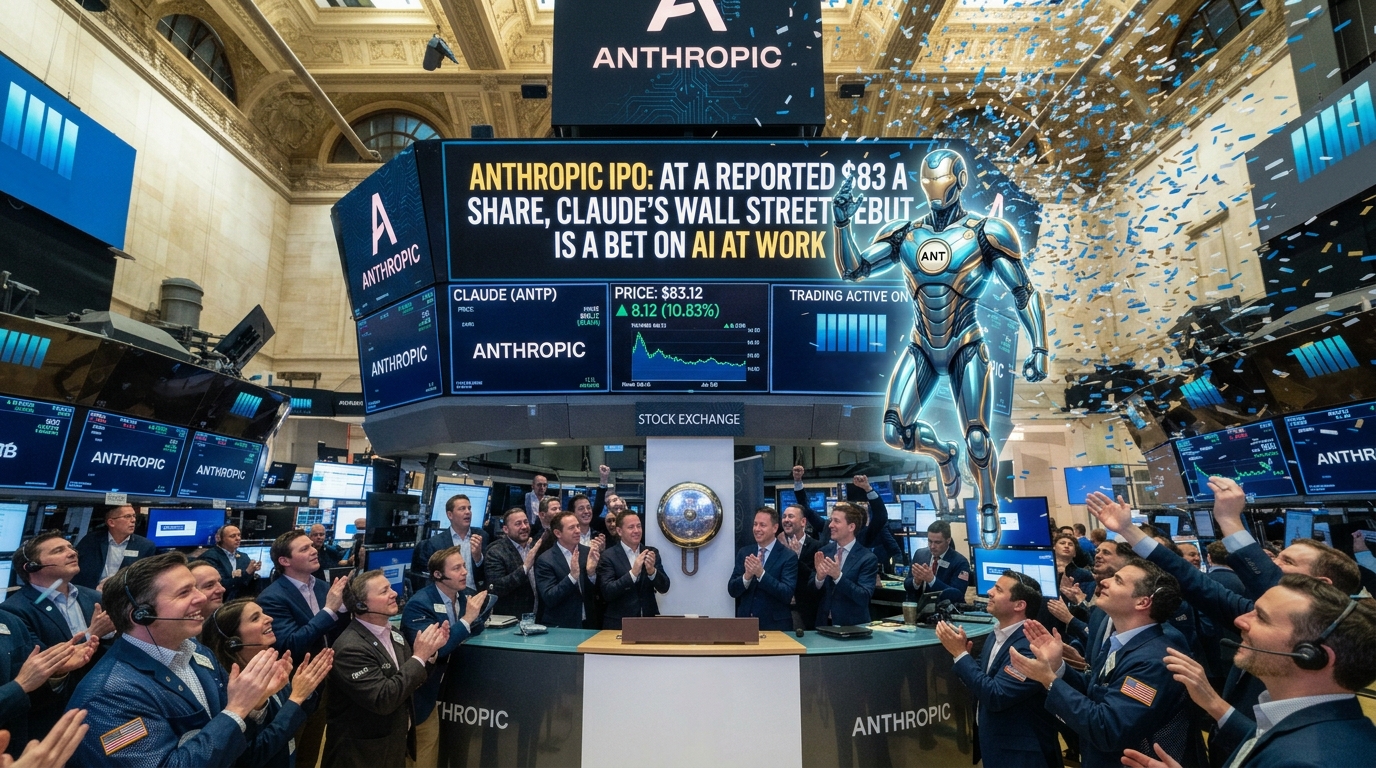
Anthropic PBC, the company behind Claude, reportedly priced its initial public offering at $83 a share, 6.4% above the top of its marketed $70 to $78 range. Bloomberg reported the pricing on Nov. 18, ahead of an expected Nov. 19 debut on the Nasdaq Global Select Market under the ticker ANT. The public offering is expected to total at least $68 billion, with a separate $26 billion private placement bringing the combined transaction above $94 billion. The $83 figure reflects Bloomberg’s reporting, not the price in Anthropic’s Nov. 17 preliminary prospectus. The price is a vote of confidence in Claude. The more interesting bet is that businesses will pay for AI not just when employees have a question, but when they have work to finish. A chatbot can win a demo. A tool that helps get the next software release out the door has a better chance of winning a budget.
Anthropic Versus SpaceX: A Record With an Asterisk That Matters
On the 825 million shares in Anthropic’s preliminary filing, $83 implies roughly $68.5 billion in gross public sales. That is not all money for Anthropic: the filing lists about 801.4 million shares from the company and 23.6 million from existing holders. At the reported price, that split would put roughly $66.5 billion with Anthropic and $2 billion with selling shareholders, before fees and expenses. Bloomberg reported that the offering size increased, so those figures illustrate the economics of the filed share count rather than confirm the final allocation. SpaceX (Nasdaq: SPCX) raised $75 billion in its June base IPO, or $86.2 billion including the underwriters’ option to buy additional shares. Anthropic’s headline figure clears both marks because it includes the private placement. The public sale alone, measured against the preliminary share count, does not. The distinction is worth keeping: the combined deal shows how much capital public and private buyers are willing to commit at the same price, not that the public tranche alone broke the record.
Claude Code Makes the Bull Case Easier to Underwrite
Anthropic reported $33.2 billion in revenue for the first nine months of 2026, more than 13 times the prior-year figure. Meanwhile, sales through cloud providers such as Amazon (Nasdaq: AMZN), Alphabet’s Google (Nasdaq: GOOGL, GOOG) and Microsoft (Nasdaq: MSFT) accounted for 44% of revenue, up from 11% in 2023. That gives Claude a route into companies that already buy cloud services from those providers. It also makes the economics of those relationships worth watching as Anthropic grows, Claude Code offers the clearest picture of what durable demand could look like. Software teams have recurring work, from investigating bugs to reviewing changes, and they can judge the output against a repository and a test suite. If Claude becomes part of that routine rather than an occasional shortcut, Anthropic can grow usage inside existing accounts. The next opportunity is to prove the same economics in other work where customers can measure the results. The early demand for shares suggests many are willing to pay for that possibility. Bloomberg reported multiple orders of $10 billion or more before pricing. Anthropic is also reaching the public market ahead of privately held OpenAI, which Bloomberg reported is not planning an IPO before 2027. That gives Anthropic a financing head start and makes its quarterly disclosures an early benchmark for the frontier AI business. It does not settle which company builds the better model or earns the better margin.
The Next Test Is Whether Revenue Outruns the Compute Bill
Anthropic spent $18.8 billion on computing and infrastructure in the first nine months of 2026, and Bloomberg reported that its spending commitments, primarily for computing power and chips, approach $901 billion through 2045. About $71 billion was due in the year through Sept. 30, 2027. Those are commitments over different periods, not a bill payable all at once. They do, however, show why raising capital before it is needed can be an advantage in a business where capacity has to be secured ahead of demand.For many following ANT, the most telling numbers after the debut will be revenue from actual usage, the cost of serving that demand and cash flow after paying for computing capacity. Anthropic’s $81 billion revenue run rate at the end of October is a sign of momentum, but it annualizes a recent period of usage and subscription fees. It is not $81 billion already earned. The bullish case is that Anthropic can use the capital to secure capacity while Claude becomes harder to dislodge from everyday work. If usage keeps expanding and the cost of delivering each useful result falls, the company can turn impressive revenue growth into a stronger business. The IPO answers what many will pay for a share. The next few quarters will tell them more about what customers will pay for Claude, and what Anthropic gets to keep.
The Sources
- Bloomberg: Anthropic Is Said to Price IPO at $83 Per Share
- SEC.gov: Anthropic PBC, Form S-1/A, Amendment No. 3
- Bloomberg: Anthropic Set for Record After Pricing IPO at $83 Per Share
- Bloomberg: What to Know About the Anthropic IPO
- Bloomberg Law: Anthropic Is Said to Price IPO at $83 Per Share, Above Range
- Bloomberg: Anthropic Said to Guide IPO Price to Top of Range or Above
- SEC.gov: Space Exploration Technologies Corp., Final IPO Prospectus, Form 424B4
- Bloomberg: Anthropic IPO to Cap Year of Record-Breaking Equity Megadeals
- Bloomberg: Anthropic’s IPO by the Numbers
- Bloomberg: Anthropic Nears Final IPO Hurdle After Tech Stocks Churn
- Bloomberg: Anthropic IPO Financial Analysis
- Bloomberg: Anthropic Is Shooting for the IPO Pricing Moon
Stay Updated with Vista Partners
Subscribe to receive market insights, investing ideas, and the latest updates directly in your inbox.