November 18, 2026
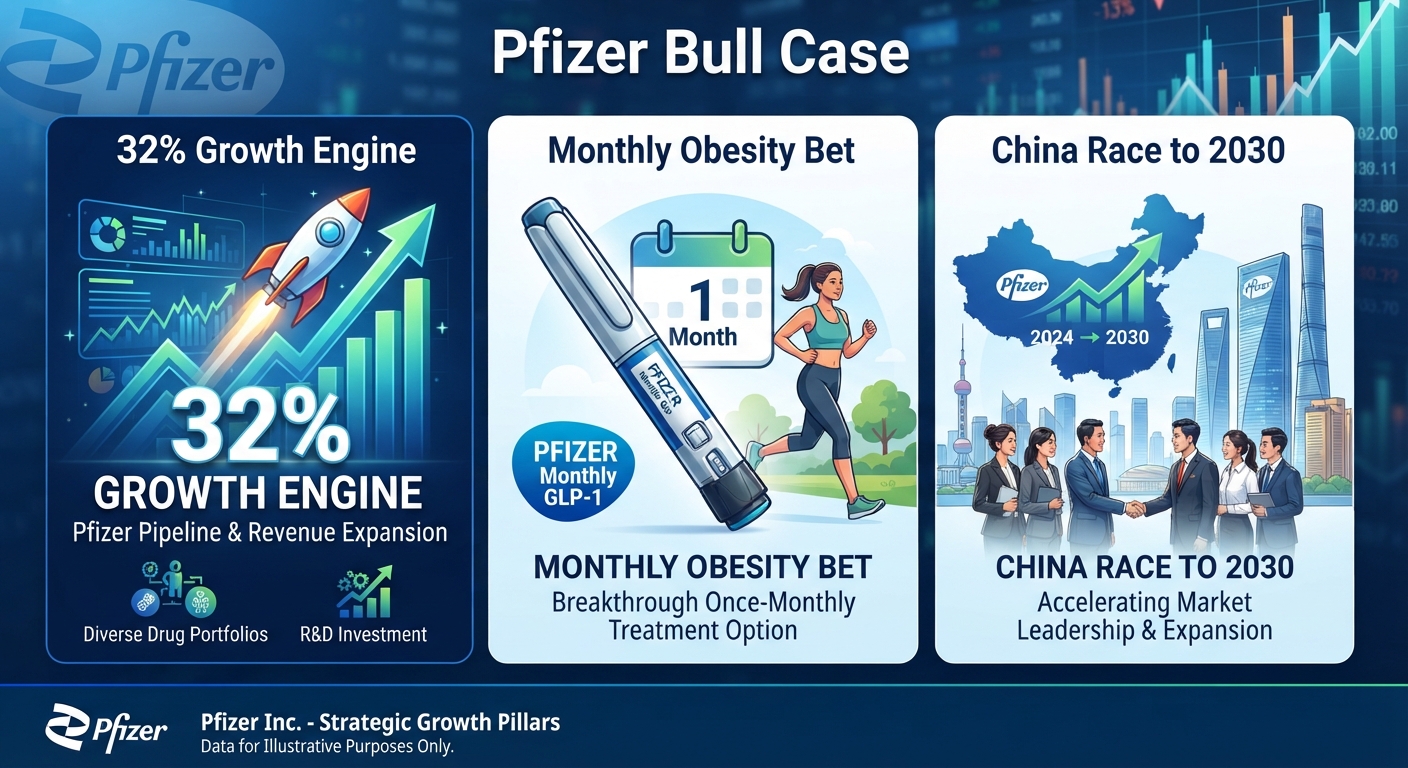
Pfizer Inc. (NYSE: PFE) does not need artificial intelligence to discover its patent cliff. The calendar has that covered. What the drugmaker needs is for newer medicines to grow fast enough to replace sales lost as older drugs face competition. Its latest quarter offered a reason to think that can happen: revenue from a select group of recently launched and acquired products rose 32% year over year, excluding currency effects, to $3.8 billion. That is roughly 23% of Pfizer’s $16.6 billion in quarterly sales. The distinction matters. Pfizer’s total quarterly revenue was roughly flat, so this is not yet a companywide growth story. The bullish case is that Pfizer already has a growing business inside the flat one, and that cancer, obesity and immunology could give it enough room to become the bigger story.
A Flat Quarter With a Better Growth Mix
Pfizer raised its 2026 revenue outlook to $62 billion to $64 billion, up $1.5 billion at the midpoint, and lifted its adjusted diluted earnings outlook to $2.95 to $3.05 a share from $2.80 to $3.00. Sales outside its COVID-19 portfolio grew 7% excluding currency effects. That makes the quarter less a story about waiting for pandemic comparisons to improve and more a story about what is already selling. Padcev, a cancer treatment acquired with Seagen, and Nurtec, a migraine medicine, helped drive the newer portfolio’s growth. Lorbrena, a lung cancer treatment, also contributed. The mix is important: Pfizer is not relying on a single launch to carry the transition. Nor should one quarter’s $3.8 billion be mistaken for a full-year forecast. The number to watch is whether that group keeps adding enough revenue in dollars to offset erosion elsewhere.
Seagen Is Already Selling Drugs. Metsera Still Has to Prove Its Case.
Pfizer paid approximately $43 billion in enterprise value for Seagen (formerly Nasdaq: SGEN) in 2023. The deal brought four marketed oncology medicines, including Padcev, as well as a pipeline of antibody-drug conjugates, which use an antibody to deliver a drug payload to cells bearing a particular target. Pfizer took on substantial debt to finance the transaction. Padcev’s contribution to this quarter’s growth is a tangible return on that bet, though not proof that the entire acquisition has earned its price. Metsera (formerly Nasdaq: MTSR) is a different proposition. Pfizer paid roughly $7 billion in upfront enterprise value, with additional payments tied to milestones, and said at closing that it expected the deal to dilute earnings through 2030. Its lead asset, berobenatide, is an experimental GLP-1 drug being studied for once-monthly maintenance dosing. Pfizer reported encouraging midstage results, and its late-stage program includes both a monthly dosing study and a study of whether people can maintain their weight after switching from approved weekly injections. That switch study gets to the commercial question. Fewer injections are easy to put in a presentation. Showing that people can keep weight off after switching is what could turn convenience into a reason to change prescriptions. Until the late-stage data arrive, monthly dosing is a potential advantage, not a market-share forecast.
China Is Both a Competitor and a Source of New Drugs
At the November 17 Jefferies Global Healthcare Conference in London, Pfizer Chief Executive Albert Bourla said he expects Chinese biotech companies to become his principal competitors by 2030. His benchmark for Pfizer was stark: operate at half the cost and move three to four times as fast. He cited enterprise AI as a way to improve productivity and described $7.2 billion in net savings expected to be realized by year-end, with another $1.5 billion in reductions announced. The speed and cost figures are management’s ambition, not evidence that Pfizer has already achieved those gains. Pfizer is not waiting to match that pace entirely on its own. In 2025, it agreed to pay 3SBio Inc. (HKEX: 01530) $1.25 billion upfront for rights outside mainland China to an experimental cancer antibody, with up to $4.8 billion in potential milestone payments. In 2026, it also secured mainland China commercialization rights to an obesity drug from Sciwind Biosciences. The two deals show different sides of the same strategy: bring a Chinese-developed cancer candidate to markets abroad and sell a Chinese-developed obesity drug in China. The AI plan deserves a similarly practical test. The useful evidence will be shorter development timelines and lower costs alongside credible clinical results. A faster presentation deck, however handsome, is not a clinical milestone.
The Next Test for PFE: Trial Results, Not Trial Starts
Bourla said Pfizer had started about 20 Phase 3 studies this year, nearly twice the prior year’s pace. One of the more revealing tests is a head-to-head study of Pfizer’s experimental trispecific antibody against Dupixent in atopic dermatitis. Dupixent is an established treatment from Sanofi (Nasdaq: SNY; Euronext Paris: SAN) and Regeneron Pharmaceuticals Inc. (Nasdaq: REGN), which in October expanded their alliance to develop additional long-acting antibodies. Pfizer is challenging an incumbent that is still investing in its own next generation. For many watching PFE, three developments would strengthen the case: newer medicines continuing to add sales faster than older brands lose them, late-stage results showing a meaningful advantage in obesity or immunology, and cost savings that leave Pfizer able to fund its best programs. Loss of exclusivity and U.S. drug-pricing pressure can still squeeze the business while those bets mature. Pfizer’s case is not that the patent cliff has disappeared. It is that the company has more to meet it with than a pipeline slide: a $3.8 billion quarterly portfolio of newer products, a marketed oncology franchise contributing to growth, and late-stage studies designed to answer questions that matter commercially. The next leg of the story depends on how much of that promise makes it into reported sales.
Further Afield But Within December’s View

Eupraxia Pharmaceuticals Inc. (NASDAQ: EPRX; TSX: EPRX) is approaching a consequential clinical milestone with something that makes the occasion considerably more interesting: enough financial breathing room to focus on the science. The company’s November 10 third-quarter update put three elements of its bullish case into sharper focus. Enrollment has reached the targeted 120 patients in the blinded, placebo-controlled Phase 2b portion of its RESOLVE trial. Interim results are expected in December 2026. And management expects existing resources to fund operations into the second half of 2028. At September 30, Eupraxia held $75.2 million in cash and cash equivalents and $51.2 million in short-term investments, a combined $126.4 million. For many following EPRX, the attraction is the convergence of a differentiated drug-delivery approach, encouraging early durability findings and a controlled trial positioned to test whether that promise holds up under more demanding conditions. Biotechnology has no shortage of compelling scientific introductions. Eupraxia is moving toward the chapter where the evidence must carry more of the conversation. Eupraxia’s lead gastrointestinal candidate, EP-104GI, is being developed for eosinophilic esophagitis, or EoE, an inflammatory disease that can cause difficulty swallowing, pain and food impaction. Persistent inflammation can also contribute to fibrosis and structural changes in the esophagus. The company is not trying to introduce an entirely unfamiliar anti-inflammatory ingredient. Instead, it is investigating whether a different delivery system can make a familiar corticosteroid work locally for an extended period. EP-104GI contains fluticasone propionate particles coated in a polymer layer. Eupraxia’s proprietary Diffusphere technology is designed to release the drug at a near-constant rate within targeted tissue. The treatment is administered into the esophageal wall during endoscopy, rather than relying on repeated swallowed doses. The commercial hypothesis is straightforward: sustained local treatment could become an attractive option if it delivers durable symptom relief and tissue improvement with acceptable safety. That remains a hypothesis, not an established product advantage. EP-104GI is investigational, and its safety, efficacy and treatment duration still require confirmation. But the delivery strategy gives Eupraxia a distinct proposition to test, rather than merely another seat at the same dosing table. Learn more now!
The Sources
- Pfizer’s third-quarter 2026 earnings release, filed with the SEC, for revenue, product performance and revised guidance.sec
- Pfizer’s third-quarter 2026 results summary, for the $3.8 billion contribution and the composition of its launched and acquired portfolio.pfizer
- Pfizer’s third-quarter 2026 corporate performance materials, including the presentation and prepared remarks.investors.pfizer
- Pfizer’s first-quarter 2026 Form 10-Q, filed with the SEC, for the Sciwind commercialization agreement.sec
- Pfizer’s 2023 Form 10-K, filed with the SEC, for the Seagen acquisition and oncology portfolio.sec
- Pfizer’s SEC-filed Seagen closing announcement, for enterprise value and the acquired commercial medicines.sec
- Pfizer’s SEC-filed 2023 earnings release, for Seagen acquisition financing.sec
- Pfizer’s Metsera acquisition closing announcement, for transaction terms and expected earnings dilution.pfizer
- Pfizer’s VESPER-3 Phase 2b announcement, for initial monthly maintenance data.pfizer
- Pfizer’s June 2026 berobenatide clinical update, for Phase 2b results and Phase 3 plans.pfizer
- Pfizer’s 2026 pipeline catalyst schedule, for the berobenatide switching study.pfizer
- 3SBio’s Hong Kong Stock Exchange filing, for upfront and contingent licensing payments.www1.hkexnews
- Pfizer’s 3SBio licensing completion announcement, for the scope of the oncology rights.pfizer
- Sanofi and Regeneron’s October 2026 SEC-filed announcement, for their expanded antibody alliance.sec
- Sanofi and Regeneron’s April 2026 Dupixent update, for its approved uses, including atopic dermatitis.sanofi
Stay Updated with Vista Partners
Subscribe to receive market insights, investing ideas, and the latest updates directly in your inbox.