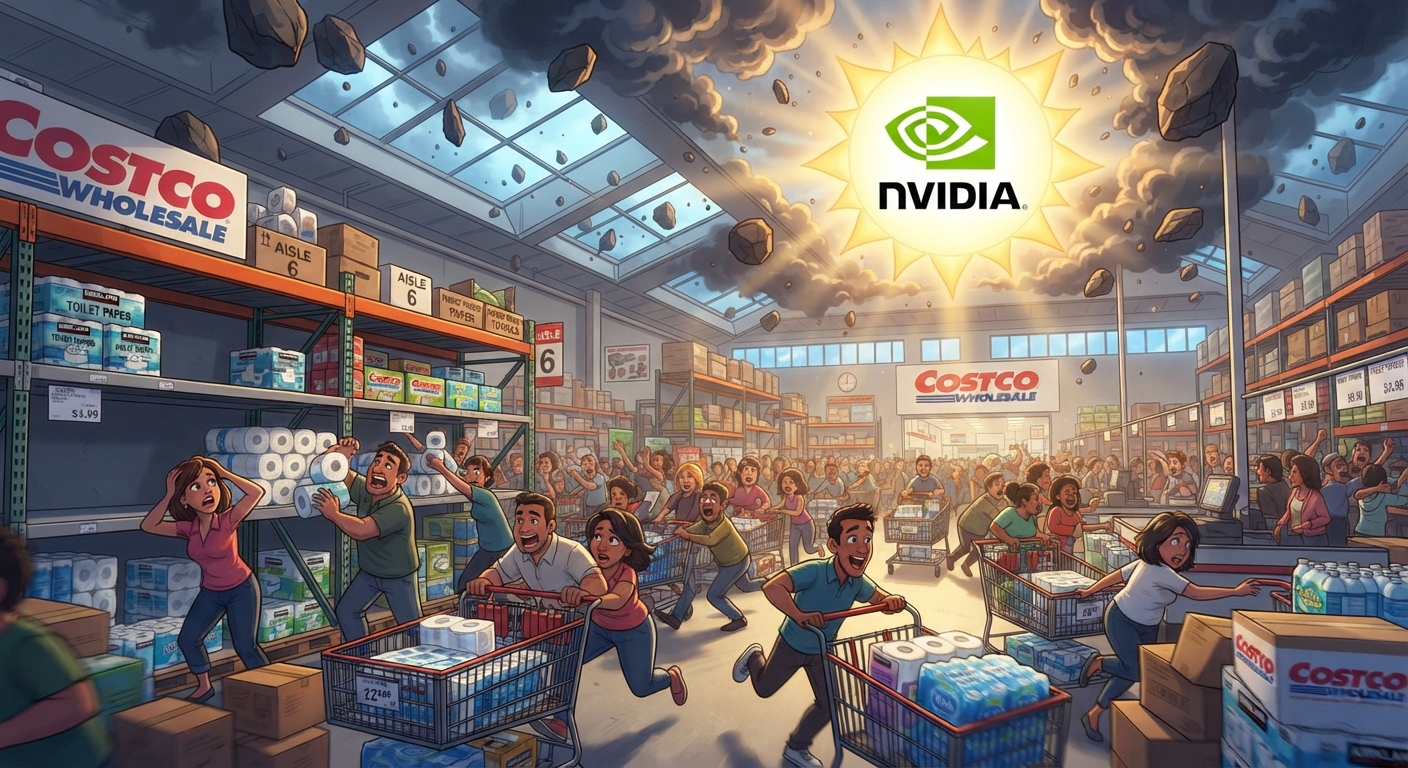
By the time Nvidia (Nasdaq: NVDA) reported earnings Tuesday, the sky had been falling for so long that someone was bound to ask whether Costco sold it in bulk. The S&P 500 had fallen for four straight sessions. Nvidia co-founder Jensen Huang had resigned the previous week, then said Tuesday he would return if the board wanted him back. Bloomberg reported that the board wasn’t considering it. Wall Street hadn’t even finished updating the org chart. Meanwhile, the outages seemed to arrive in installments. Microsoft’s (Nasdaq: MSFT) Outlook stumbled, JPMorgan Chase (NYSE: JPM) had transaction delays, United Airlines (Nasdaq: UAL) delayed departures after a systems outage, and an internal update disrupted services at Apple (Nasdaq: AAPL). There was no indication the incidents were linked, but the internet rarely lets separate explanations spoil a good apocalypse. At Costco Wholesale (Nasdaq: COST), the mood had a familiar 2020 ring to it. Chief Financial Officer Gary Millerchip told Bloomberg the retailer had seen increased buying of paper products, water, canned goods, batteries and generators. Analysts said the pickup began in late October and continued into November. That’s evidence of stockpiling, not of a nationwide toilet-paper shortage or another lockdown. Still, for some shoppers, the lesson of 2020 appeared to be that a 30-roll pack is not a purchase so much as a position. Then Nvidia gave Wall Street a number worth worrying less about: $130 billion. That was the midpoint of its fiscal fourth-quarter revenue forecast, above the $125.3 billion analyst average reported by Bloomberg. Nvidia shares climbed as much as 5% in extended trading, and U.S. stock futures rose Tuesday night. The sky, for the moment, could wait.
Nvidia Earnings: The AI Buildout Is Showing Up in Profits
Nvidia’s fiscal third-quarter 2027 revenue reached $115.8 billion, up 103% from a year earlier and 20% from the preceding quarter. Data Center revenue more than doubled to $107.6 billion, accounting for roughly 93% of total sales. GAAP operating income rose 115% to $77.5 billion, and diluted earnings came in at $2.70 a share, or $2.68 on an adjusted basis. The most encouraging detail was that operating income grew faster than sales. Nvidia didn’t just sell more; it kept more of each sales dollar as operating profit than it did a year earlier. The fourth-quarter forecast gave many a reason to revisit their estimates rather than simply applaud the earnings beat. The midpoint implies roughly 12% growth from the third quarter. Even the low end of Nvidia’s range, $126.1 billion, sits above the analyst average Bloomberg reported. An after-hours rally can be relief. A forecast that clears consensus even at the low end gives the rally something more substantial to work with.
Vera Rubin Moves From Roadmap to Shipments
Nvidia said it had shipped its Vera Rubin NVL72 system, an early milestone for its next generation of AI computing hardware. The distinction matters: announcing a faster chip and delivering a complete system are different jobs. Nvidia also announced new supply-chain commitments to support the AI infrastructure buildout. Securing capacity matters when the ability to turn orders into revenue depends on getting enough components and packaging lined up at the same time. The trade-off is visible in the guidance. Nvidia expects a fourth-quarter GAAP gross margin of about 71.5%, down from 74.8% in the third quarter. That leaves room for sales to rise sharply while Nvidia retains less gross profit on each dollar of revenue. The company’s annual report also identifies export restrictions and reliance on third-party manufacturing and supply partners as risks. The next test is not just how much Nvidia can ship, but how profitably it can ship it.
CoreWeave and Nebius Offer a Second Read on AI Demand
The buildout is showing up in the results of the companies selling access to AI computing power. CoreWeave (Nasdaq: CRWV) reported third-quarter revenue of $3.66 billion, up from $1.37 billion a year earlier, and raised its 2026 revenue outlook to $13.0 billion to $13.3 billion. Nebius Group (Nasdaq: NBIS) reported quarterly revenue of $980.8 million, up 571% from a much smaller base, and discussed capacity expansion and expected customer prepayments in its shareholder letter. Those figures answer a different question from Nvidia’s. The chipmaker’s sales show what cloud providers are buying; the providers’ results show how quickly they’re turning that capacity into revenue. The growth is encouraging, but it doesn’t settle whether the returns will justify the cost of financing and operating those data centers. The cloud, it turns out, still comes with a power bill.
What Would Make the Rally Last?
Nvidia’s SEC filing says the board accepted Huang’s resignation and named longtime finance chief Colette Kress interim CEO while she continues as CFO. The fourth-quarter forecast doesn’t settle who should run Nvidia next, but it does offer evidence that the business kept moving during the transition. That distinction matters for a company whose co-founder had become almost as recognizable as its products.. From here, three developments would give the bullish case more weight: Vera Rubin shipments translating into reported sales, gross margins holding near guidance as production expands, and gains spreading beyond Nvidia when regular trading resumes. Tuesday’s report didn’t fix the outages, resolve the succession or make anything in the Costco cart returnable. It did give Wall Street a better reason to look up than to check whether the ceiling was still there.
The Sources
- Bloomberg: U.S. market coverage ahead of Nvidia’s November 17 earnings[bloomberg]
- SEC.gov: Nvidia Form 8-K on its CEO and board leadership transition[sec]
- Bloomberg: Jensen Huang says he would return as Nvidia CEO if the board agreed[bloomberg]
- Bloomberg: Recent technology outages and the public response[bloomberg]
- Bloomberg: Evening briefing on disruptions at JPMorgan Chase, United Airlines and other systems[bloomberg]
- Bloomberg: Apple’s internal update and the Microsoft service disruptions[bloomberg]
- Bloomberg: Costco shoppers stock up on household and emergency supplies[bloomberg]
- Nvidia: Fiscal third-quarter 2027 earnings release and fourth-quarter guidance[investor.nvidia]
- Bloomberg: Nvidia’s fourth-quarter outlook and Wall Street expectations[bloomberg]
- Bloomberg Opinion: Nvidia’s after-hours share reaction and leadership transition[bloomberg]
- Nvidia: Fiscal third-quarter 2027 earnings webcast and presentation materials[investor.nvidia]
- Nvidia Newsroom: November 17 announcements, including supply-chain commitments[nvidianews.nvidia]
- SEC.gov: Nvidia fiscal 2026 Form 10-K and risk factors[sec]
- SEC.gov: CoreWeave third-quarter 2026 earnings release, Form 8-K exhibit[sec]
- SEC.gov: Nebius Group third-quarter 2026 earnings release, Form 6-K exhibit[sec]
- SEC.gov: Nebius Group third-quarter 2026 shareholder letter, Form 6-K exhibit[sec]
Stay Updated with Vista Partners
Subscribe to receive market insights, investing ideas, and the latest updates directly in your inbox.