


Higher Guidance Puts a Digital Health Turnaround in Focus
Amwell (NYSE: AMWL) is giving many a more compelling reason to revisit its digital healthcare story: a clearer route toward operating cash generation, a higher revenue outlook and a platform strategy built around making an overcrowded healthcare technology landscape less crowded. The company’s third-quarter 2026 results, released November 3, delivered $49 million in revenue, above its previously announced guidance range. Management raised its full-year revenue forecast to $204 million to $206 million and projected fourth-quarter adjusted EBITDA between breakeven and positive $1 million. It also reaffirmed its objective of generating positive operating cash flow in the fourth quarter. That combination makes the emerging turnaround worth watching. Amwell is not yet presenting a finished profitability story. It is presenting something more useful than another distant promise: a near-term financial checkpoint. In digital health, where the future has occasionally arrived with excellent branding and an inconvenient invoice, that counts as progress.
Third-Quarter Results Clear the Revenue Bar
Amwell entered the quarter expecting revenue between $46 million and $48 million. Its $49 million result exceeded the top of that range by approximately $1 million. The company reported $23.9 million in subscription revenue and $23.7 million in Amwell Medical Group visit revenue, alongside approximately 800,000 total platform visits. Gross margin was 53%. The revenue mix illustrates the business Amwell is trying to build. Its software subscriptions provide access to the technology platform, while its affiliated clinical network supplies care when customers need additional capacity. That gives Amwell a role in both the infrastructure and delivery of digital healthcare, rather than limiting it to a single consumer-facing service. The quarter was not uniformly stronger than the preceding period. Net loss increased to approximately $11 million from $9.6 million in the second quarter, while the adjusted EBITDA loss widened to $3.6 million from $1.2 million. Subscription revenue also declined from the second quarter’s $25.7 million. Those figures matter. The bullish case rests on the trajectory toward a more sustainable business, not on pretending every line item has already received a clean bill of health.
Fourth-Quarter Guidance Creates a Measurable Catalyst
The most consequential figures in the release concern the next quarter. Amwell expects fourth-quarter revenue of $48 million to $50 million and adjusted EBITDA of zero to positive $1 million. Separately, management reiterated its objective of positive operating cash flow during the period. These are distinct milestones. Adjusted EBITDA excludes items such as stock-based compensation, depreciation and amortization, and certain transformation costs. Positive operating cash flow measures cash generated by operating activities, but does not by itself establish positive free cash flow after capital investment. Neither measure means the company has achieved GAAP net profitability. Still, the guidance creates a concrete test. Many no longer have to evaluate Amwell solely through broad claims about healthcare’s eventual digital transformation. They can assess whether management delivers the financial transition it has placed immediately ahead. The full-year outlook also moved in the right direction:
- Revenue guidance increased to $204 million to $206 million from $200 million to $205 million.
- The adjusted EBITDA loss forecast narrowed to $7 million to $8 million from $7 million to $9 million.
- Amwell Medical Group visit guidance remained between 1.32 million and 1.37 million.
The changes are measured rather than theatrical. That may be their appeal. A business approaching breakeven benefits more from credible execution than from a forecast requiring its own special-effects department.
Amwell Is Selling the Infrastructure, Not Just the Appointment
Understanding Amwell’s opportunity requires moving beyond the idea that telehealth is simply a physician appearing on a screen. The company describes its platform as infrastructure connecting in-person, virtual and automated care. Its software supports urgent care, behavioral health, chronic condition management, specialty consultations, virtual nursing and other clinical workflows. Customers can deploy services under their own brands and incorporate their own clinicians, Amwell’s clinical network or third-party programs. That positioning addresses a practical problem for health plans and health systems: digital tools become less useful when each requires a separate workflow, identity, data stream and administrative relationship. Amwell’s provider offerings emphasize connecting clinical networks and blending virtual and in-person services. Its broader corporate platform description similarly centers on a single technology-based environment supporting programs from Amwell and its partners. The commercial logic is straightforward. If healthcare organizations want fewer disconnected systems, a platform that organizes multiple services could become more valuable than another standalone application. That is the strategic opportunity, not a guarantee of pricing power or future growth. Amwell still must demonstrate that integration translates into customer retention, additional program adoption and stronger financial results.
An Established Customer Base Gives the Strategy Substance
Amwell’s platform ambitions sit on top of an existing operating footprint. In its 2025 Form 10-K filed with the SEC, the company reported supporting digital care programs for approximately 50 health plans, collectively representing more than 90 million covered lives, and approximately 80 large health systems. It also reported having powered more than 37.6 million virtual care visits since inception, including more than 4.5 million during 2025. Those figures require careful interpretation. Covered lives are not the same as active users, and historical customer scale does not guarantee future revenue. Nevertheless, the footprint gives Amwell an established distribution base from which to pursue broader adoption. Its SEC filings describe an expansion strategy that includes reaching additional populations within existing customers, increasing utilization and adding new clinical use cases. The company’s first- and second-quarter 2026 filings provide the financial reporting context for evaluating that strategy as the business changes. For many, the attraction is that Amwell does not have to introduce itself to the healthcare industry before attempting to sell the next service. The harder task is converting those existing relationships into durable economics.
The AI Opportunity Is About Connected Care, Not Just Clever Software

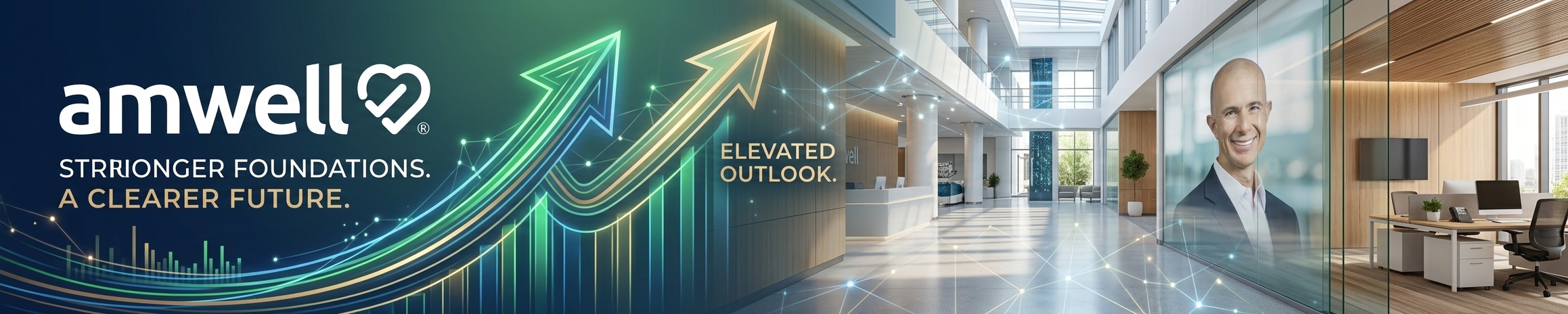
Amwell’s latest earnings statement places artificial intelligence within its platform strategy. Chairman and Chief Executive Ido Schoenberg (pictured above) described a common data structure designed to help customers understand what works, while positioning the company as infrastructure on which AI-powered care could run. That is a more grounded proposition than treating AI as a substitute for a business model. In a September company essay, Amwell described how its own programs and third-party offerings operate within a shared customer experience and data environment. The company also cited external recognition of its approach to evaluating integrated programs across clinical effectiveness, business sustainability, technical scalability and enterprise security. Its cardiovascular care partnership with privately held Hello Heart offers a practical illustration. Amwell describes combining connected-device information, coaching and clinical services within a broader care platform, with the goal of linking signals between visits to coordinated support. The potential advantage is not simply possessing another algorithm. It is helping useful technology reach patients and clinicians inside workflows they already use. Healthcare has no shortage of promising tools. Getting them to cooperate is the less glamorous assignment, which is often where an enterprise software business earns its keep.
Mental Health Results Add Evidence Beyond the Product Pitch
One of Amwell’s more substantive recent developments came from digital mental healthcare. In October, the company published a case study examining the use of SilverCloud by Discovery Health, the South African healthcare administrator within Discovery Limited (JSE: DSY). The program integrated funded digital treatment into existing benefits, clinical referral pathways and the member application According to the company-published findings:
- Approximately 22,000 members activated the benefit in its first 12 months.
- Clinically significant improvement rates ranged from 60% to 78% across specified depression and anxiety severity groups.
- Satisfaction reached 90% among surveyed users.
- Adjusted mental-health-related in-hospital costs were 6% lower in the year after use.
The qualifications are important. These were observational findings using statistical adjustment, not a randomized trial establishing that the program would produce identical results across other populations. The reported cost result concerned mental-health-related inpatient spending, not total healthcare spending. Even with those boundaries, the case study strengthens Amwell’s commercial narrative. Health plans buy technology to solve clinical and financial problems. Evidence of engagement, improvement and an association with lower relevant hospital costs provides a more substantial sales conversation than convenience alone.
Why the Consolidation Theme Could Favor Amwell

Amwell’s leadership has identified consolidation of disconnected healthcare tools, modernization of digital infrastructure and more efficient use of AI as priorities for health plans. These are management’s assessments of customer needs, rather than independent proof of future demand, but they align closely with the platform the company is selling. The distinction matters because the business does not need every digital health application to win. Its strategy is to make selected applications easier to deploy together. A successful platform could let a health plan add a condition-specific program without constructing an entirely new member experience. It could also allow clinicians to move patients between automated support and live care without treating each transition as a separate administrative expedition. Amwell’s product materials and SEC business description outline those capabilities. If customers increasingly value coordination over another isolated feature, Amwell’s breadth could become an advantage. The financial evidence to watch is whether that advantage eventually appears in subscription stability, program expansion and sustained cash generation.
The Bullish Case Still Has to Pass Its Financial Exam
A credible positive thesis has room for unfinished business. Amwell remains loss-making on a GAAP basis. Its third-quarter subscription revenue declined sequentially, and the adjusted EBITDA loss widened from the second quarter. Its SEC filings also identify risks involving customer concentration, competition, privacy and cybersecurity, adoption rates and the continuation of important government relationships. The third-quarter release specifically identifies uncertainty around the continuation of the Defense Health Agency relationship beyond the third quarter of 2026 on comparable financial terms. That makes government-related opportunities something to evaluate carefully, not revenue to assume in advance. The constructive interpretation is therefore conditional: Amwell has raised its outlook, established a near-term adjusted EBITDA target around breakeven and reaffirmed a fourth-quarter operating cash-flow objective, while bringing an established customer footprint and a broad care platform to the effort. For AMWL stock, the next important chapter is less about proving digital healthcare exists than proving Amwell can operate it sustainably. Delivering on that assignment could give many a reason to judge the company by its emerging economics rather than by the sector’s old promises.
The Sources
- Amwell, “Amwell Announces Results for the Third Quarter 2026,” November 3, 2026, company-issued earnings release distributed through GlobeNewswire.globenewswire
- SEC.gov, American Well Corporation, Form 10-K for the year ended December 31, 2025.sec
- SEC.gov, American Well Corporation, Form 10-Q for the quarter ended June 30, 2026.sec
- SEC.gov, American Well Corporation, Form 10-Q for the quarter ended March 31, 2026.sec
- Amwell, “Amwell Announces Results for the Second Quarter 2026,” August 4, 2026.business.amwell
- Amwell, “The Amwell Platform,” product and platform overview.business.amwell
- Amwell, “Digital Care Solutions for Providers.”business.amwell
- Amwell, corporate overview and care delivery platform description.business.amwell
- Amwell, “Twenty Years of Digital Care Taught Us a Surprising Lesson: Innovation Wasn’t the Hard Part,” September 11, 2026.business.amwell
- Amwell, “How AI and Connected Devices Are Transforming Heart Health for Members,” February 11, 2026.business.amwell
- Amwell, “Discovery Health Expanded Access to Mental Healthcare for 22,000 Members in One Year, With Better Outcomes and Lower Hospital Costs,” October 14, 2026, company-issued case study announcement distributed through GlobeNewswire.globenewswire
- Amwell, “What’s Taking Center Stage for Payers in 2026,” December 19, 2025.business.amwell
Stay Updated with Vista Partners
Subscribe to receive market insights, investing ideas, and the latest updates directly in your inbox.

