


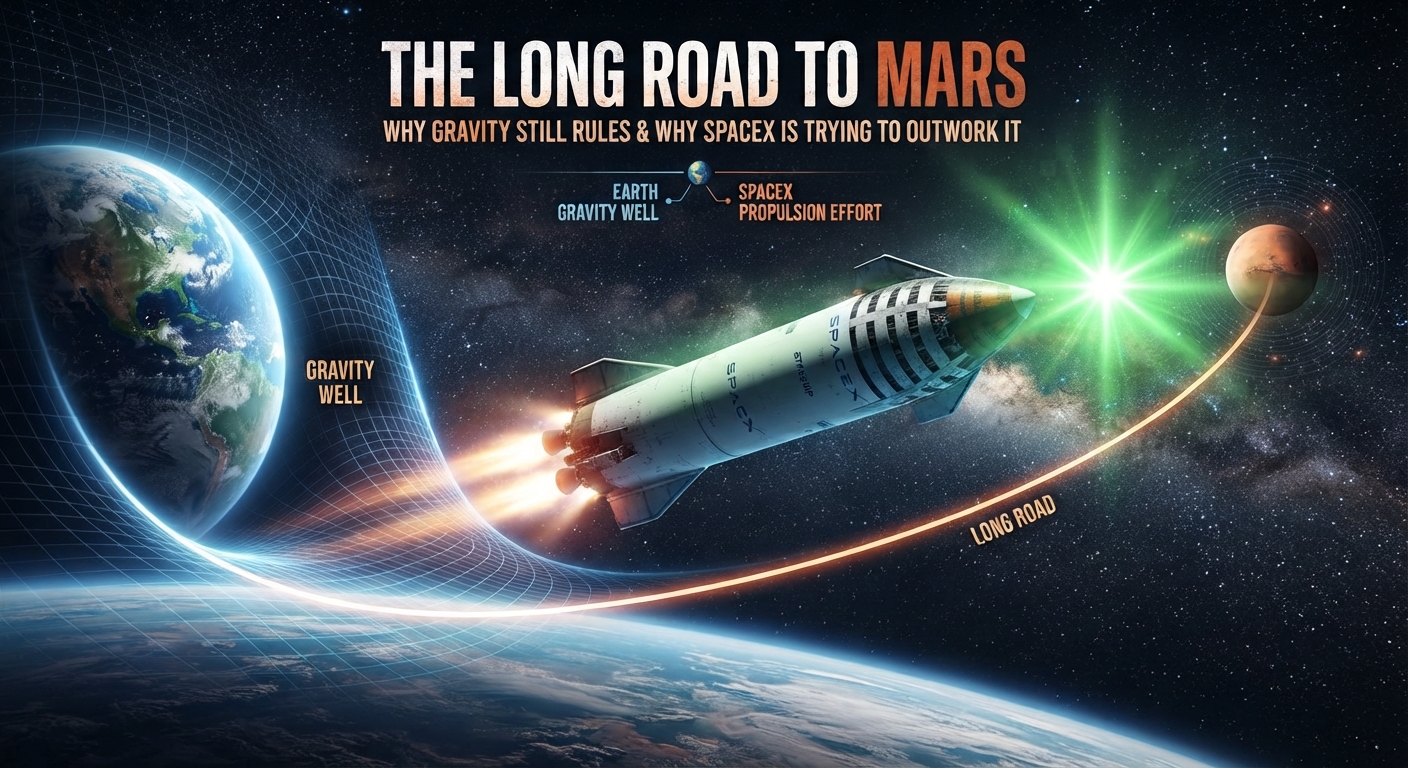
The dream of controlling gravity remains unproven, but the dream of reaching Mars is becoming a serious engineering and industrial project. SpaceX (SPCX), led by Elon Musk, is not waiting for an antigravity breakthrough: it is pursuing reusable rockets, orbital refueling and high-cadence launches to make deep-space travel more practical, and potentially more commercial. That distinction matters. A genuine gravity-control device would rewrite physics and transportation. SpaceX’s approach is more grounded, if hardly modest: accept gravity’s rules, then use reusable hardware, propulsion, fuel logistics and scale to beat the economics that have kept Mars out of reach.
Gravity’s Great Unsolved Challenge
Gravity is the force that holds Earth’s atmosphere, oceans and inhabitants in place, shapes the formation of stars and galaxies, and governs orbital motion. Yet it remains difficult to reconcile fully with quantum physics, and it continues to inspire a steady supply of elegant theories, speculative propulsion concepts and, occasionally, machinery that looks remarkably like a high-end espresso maker with delusions of interplanetary grandeur. The documentary Project Green Glow: Inside BAE’s Secret Race to Control Gravity chronicles the serious-minded but ultimately unverified effort to manipulate gravity. It follows aerospace engineer Ron Evans and BAE Systems’ Project Green Glow, a British research effort that explored whether unconventional physics could produce new forms of propulsion. It also examines NASA’s former Breakthrough Propulsion Physics program, led by Mark Millis, which evaluated advanced, non-rocket concepts and tried to separate experimentally testable ideas from hopeful extrapolation. Neither program produced a verified technology capable of reducing mass, shielding gravity, generating antigravity or propelling a spacecraft without expelling reaction mass. That is not a criticism of the scientists involved. It is the scientific process working as intended: bold hypothesis, careful measurement, attempted replication, and occasionally a rather expensive answer of “not yet.”
The Antigravity Claims That Did Not Hold
Several headline-making concepts featured in the film illustrate why rigorous repetition matters in frontier science.
https://youtu.be/ZuHRlMy2lHA?si=S1KuhsGx8NIxTDoc
Spinning Gyroscopes
Engineer Eric Laithwaite famously suggested that spinning gyroscopes could appear to counteract gravity. In practice, gyroscopes can create unusual and counterintuitive mechanical effects when moved or rotated, but they do not become lighter and do not cancel Earth’s gravitational pull. The apparent changes arise from angular momentum and applied forces, not antigravity.
Superconductors and “Gravity Shielding”
Russian researcher Eugene Podkletnov claimed that rotating superconductors could produce gravity-shielding effects and later short-lived “gravity impulses.” Those reports attracted attention from defense, aerospace and scientific communities because the implications would have been enormous. However, sensitive follow-up attempts described in the documentary did not reproduce the effect. Researchers found no reliable evidence that the experiment altered gravity, displaced remote objects through a gravitational pulse or generated a usable gravitational field.
The EM Drive
The EM Drive proposed a microwave-filled cavity capable of producing thrust without expelling propellant. If real, the device would have been revolutionary: spacecraft could accelerate without hauling an enormous tank of fuel through the solar system. The central problem is conservation of momentum. In a closed system, electromagnetic waves reflecting inside a cavity should produce internal forces that cancel. Reports of tiny measurements have faced serious concerns involving thermal changes, electromagnetic interference, power cables and other experimental artifacts. The documentary itself shows why a small reading is not necessarily a new propulsion system; it may simply be a test stand having a complicated day..
The Scale Problem
Gravity is extraordinarily weak at the human scale when compared with electromagnetism. A modest refrigerator magnet can oppose the gravitational pull of the entire Earth on that magnet, a striking reminder that engineers can readily manipulate electrical and magnetic fields but cannot simply dial gravity up, down or sideways. Gravity becomes dominant when enormous masses are involved: planets, stars, black holes and galaxies. Under Einstein’s general relativity, mass and energy curve spacetime, and that curvature is observed as gravity. Producing a measurable gravitational effect with laboratory equipment would require fantastically large masses or energy densities, or a genuinely new discovery in physics. That is why an antigravity aircraft or a gravity-powered spaceplane remains in the realm of speculation. The universe may hold surprises, but it has so far declined to issue a user manual.
The Real Breakthrough: Measuring Gravity
The most credible technological advance presented in the documentary is not gravity control but quantum gravity sensing. Quantum gravimeters and gradiometers use laser-cooled atoms, atom interferometry and exceptionally sensitive measurements to detect tiny changes in a gravitational field. A nearby person, vehicle, underground tunnel, hidden cavity or changing geological formation can create a measurable local variation in gravity. This technology can support practical applications:
- Underground mapping and detection of tunnels, voids and buried infrastructure.
- Navigation in environments where GPS is unavailable, unreliable or deliberately disrupted.
- Geological surveying, mineral exploration and groundwater monitoring.
- Defense, security and intelligence applications.
- More precise Earth observation and infrastructure assessment.
These tools do not allow an aircraft to hover by “turning off” gravity. They could, however, give governments and industry an unusually sharp new way to see what lies beneath the ground, an outcome less cinematic than a flying car, but arguably more commercial.
SpaceX’s Pragmatic Route to Mars
Elon Musk’s SpaceX is pursuing a more practical, though still audacious, solution to the gravity problem: develop a fully reusable heavy-lift transportation system, refuel it in orbit and use repeated launches to carry cargo and eventually people toward Mars. SpaceX’s Starship and Super Heavy system is designed as a fully reusable launch architecture for crew and cargo missions to Earth orbit, the Moon, Mars and beyond. The company says Starship is intended to carry more than 100 metric tons to orbit in a reusable configuration and, in a crew configuration, may eventually carry up to 100 people on long-duration interplanetary missions. The key is not an antigravity engine. It is logistics. A Mars-bound spacecraft must overcome Earth’s gravity, reach orbit, refuel in space, accelerate toward Mars, decelerate at arrival, land safely and, if humans are involved, support life and provide a means of return. Traditional rockets can accomplish portions of that journey, but their economics become punishing because propellant mass multiplies rapidly. Every additional kilogram of fuel demands more fuel to lift it. SpaceX’s proposed answer includes:
- Full reusability: Reusing booster and spacecraft hardware could lower launch costs and support a faster launch cadence.
- Orbital refueling: Tanker versions of Starship would transfer propellant to a Mars-bound Starship in Earth orbit, allowing it to depart with a fuller tank than it could carry from the ground.
- Large cargo capacity: High payload capacity could allow delivery of equipment, power systems, habitats, food supplies and industrial machinery before human arrival.
- Repeated missions: Mars transfer opportunities occur approximately every 26 months, so a sustainable campaign requires reliable operations across many launch windows rather than one heroic mission.
- In-situ resource use: A long-term Mars strategy would likely require making useful materials—especially oxygen and methane propellant, from Martian resources rather than shipping every return-trip necessity from Earth.
SpaceX says that Starship cargo flights to Mars could begin no earlier than 2028, subject to the development progress of the vehicle and related systems. That is an ambition, not a guarantee, and it depends on successful orbital operations, in-space propellant transfer, reentry performance, life-support development and many other complex milestones.
A Developing Commercial Space Industry
Mars missions capture imaginations, but the nearer-term business case for space is broader: launch services, satellite communications, Earth observation, defense, navigation, in-space manufacturing, lunar logistics and data infrastructure. The global space economy was estimated at about $626 billion in 2025 and is projected by industry forecasters to exceed $1 trillion during the early-to-mid 2030s. Commercial activities account for the majority of current economic activity, with communications satellites and expanding constellations among the important drivers. SpaceX sits at the center of several converging trends:
- Reusable launch systems: Lower launch costs can make satellite deployment and replenishment more economically viable.
- Starlink: Space-based broadband supports consumer, enterprise, aviation, maritime and government connectivity.
- National-security demand: Governments increasingly view resilient satellite systems, launch capability and space-domain awareness as strategic assets.
- Lunar and Mars infrastructure: Long-term exploration requires transport, communications, navigation, power, habitats, robotics and resource extraction.
- Space-enabled data: Earth-observation satellites and communications networks provide data increasingly valuable to agriculture, climate monitoring, logistics, insurance and defense.
Other publicly traded companies participating in the evolving space economy include:
| Company | Ticker | Space-related exposure |
|---|---|---|
| Rocket Lab USA Inc. | NASDAQ: RKLB | Launch services, spacecraft systems, satellite components and space infrastructure |
| Lockheed Martin Corp. | NYSE: LMT | Space systems, defense satellites, deep-space programs and national-security missions |
| Northrop Grumman Corp. | NYSE: NOC | Space payloads, defense systems, launch technologies and national-security space |
| Boeing Co. | NYSE: BA | Spacecraft, satellite systems, NASA partnerships and human-spaceflight programs |
| RTX Corp. | NYSE: RTX | Sensors, propulsion, defense technologies and space-related systems |
| L3Harris Technologies Inc. | NYSE: LHX | Space payloads, communications, sensors and national-security systems |
| AST SpaceMobile Inc. | NASDAQ: ASTS | Space-based cellular broadband network development |
| Intuitive Machines Inc. | NASDAQ: LUNR | Lunar services, spacecraft and Moon-focused infrastructure |
| Redwire Corp. | NYSE: RDW | Space infrastructure, mission systems and in-space manufacturing technologies |
| Planet Labs PBC | NYSE: PL | Earth-observation satellite data and imagery services |
| BlackSky Technology Inc. | NYSE: BKSY | Geospatial intelligence and satellite-imagery services |
SpaceX itself is privately held; references to SpaceX (SPCX) should not be interpreted as an actively traded public common-stock ticker. Investors seeking exposure typically look to public suppliers, satellite companies, aerospace primes and space-focused funds rather than a listed SpaceX share class.
NASA’s Mars Roadmap
NASA is also pursuing a structured, government-led path toward human exploration of Mars through its Moon to Mars Architecture. Rather than treating Mars as a single launch destination, NASA frames it as a long-duration campaign requiring integrated transportation, habitation, surface systems, operations and safe return capabilities. The strategy begins with the Moon. Artemis missions are intended to build experience in deep-space operations, surface exploration, life support, mobility and international coordination before attempting crewed Mars missions. NASA’s current architecture divides the effort into four segments:
- Human lunar return.
- Foundational exploration.
- Sustained lunar evolution.
- Humans to Mars.
That approach acknowledges the obvious but inconvenient reality: a Mars mission is not a slightly longer trip to the International Space Station. It is a multi-year operational challenge with radiation exposure, closed-loop life support, communications delays, power generation, landing precision, medical contingencies and a return trip that cannot be handled by calling a rideshare.
Dark Energy, Antimatter and the Frontier
The documentary also explores dark energy, antimatter and quantum theory as potential clues to gravity’s deepest nature. These subjects represent serious physics, but they should not be confused with an engineering roadmap for antigravity. Dark energy is the name given to the unknown cause associated with the accelerating expansion of the universe. It appears to shape cosmic-scale behavior, but no one knows what it is, how it works in a complete theory or whether it can ever be manipulated. It is not a fuel source waiting for a clever engineer and a sufficiently persuasive PowerPoint presentation. Antimatter is likewise a legitimate scientific frontier. Experiments at CERN study how antimatter behaves under gravity, but there is no validated evidence that antimatter “falls upward” or that it can be used to create a gravity-repulsion device. Even if fundamental physics reveals new gravitational behavior, converting that knowledge into propulsion technology would remain an entirely separate—and much harder—problem.
The Investment and Innovation Case
The commercial space industry does not need antigravity to grow. It needs reliable launch services, falling costs, sustained government demand, scalable satellite economics, stronger communications networks and continued advances in robotics, sensors, materials, AI and manufacturing. The gravity-control quest is valuable because it forces researchers to test the limits of established physics. But the investable and technological story today is more concrete:
- Quantum sensors can measure gravity with increasing precision.
- Reusable rockets can reduce the cost of reaching orbit.
- Satellite networks can provide global communications and real-time data.
- Government and defense budgets can support critical space infrastructure.
- NASA, SpaceX and industry partners are developing the systems that could eventually support human missions beyond the Moon.
- Mars remains a long-term destination, but the infrastructure being built to pursue it can create nearer-term economic value on and around Earth.
Bottom Line
The dream of controlling gravity remains exactly that: a dream supported by compelling questions but not by verified technology. Project Green Glow, Podkletnov’s superconductor experiments and the EM Drive demonstrate how difficult it is to move from an intriguing anomaly to reproducible physics. SpaceX and Elon Musk are taking a different route. Rather than waiting to reverse gravity, they are seeking to make gravity less economically punishing through reusability, scale, orbital refueling and a sustained industrial approach to spaceflight. Starship is designed to serve Earth orbit, the Moon and eventually Mars, but it must still prove its technical and operational readiness through many demanding tests. Mars may not require antigravity. It will require something arguably harder: exceptional engineering, relentless testing, abundant capital, dependable infrastructure and the willingness to keep launching after the first few rockets remind everyone that the laws of physics have very firm opinions.
The Sources
- Project Green Glow: Inside BAE’s Secret Race to Control Gravity Pure Science Docs / YouTube
- SpaceX Official Website
- SpaceX Starship Official Vehicle Overview
- SpaceX Mission to Mars Official Overview
- SpaceX Starship Mars 2026 Update
- NASA Moon to Mars Architecture
- NASA Moon to Mars Architecture Components
- NASA Moon to Mars Strategy and Objectives
- NASA Moon to Mars Architecture Definition Documents
- NASA Technical Reports Server: Moon to Mars Architecture Definition Document
- European Space Agency: Report on the Space Economy 2026
- Orbital Radar: The Space Economy 2026$626 Billion, Heading for $1 Trillion
Stay Updated with Vista Partners
Subscribe to receive market insights, investing ideas, and the latest updates directly in your inbox.

