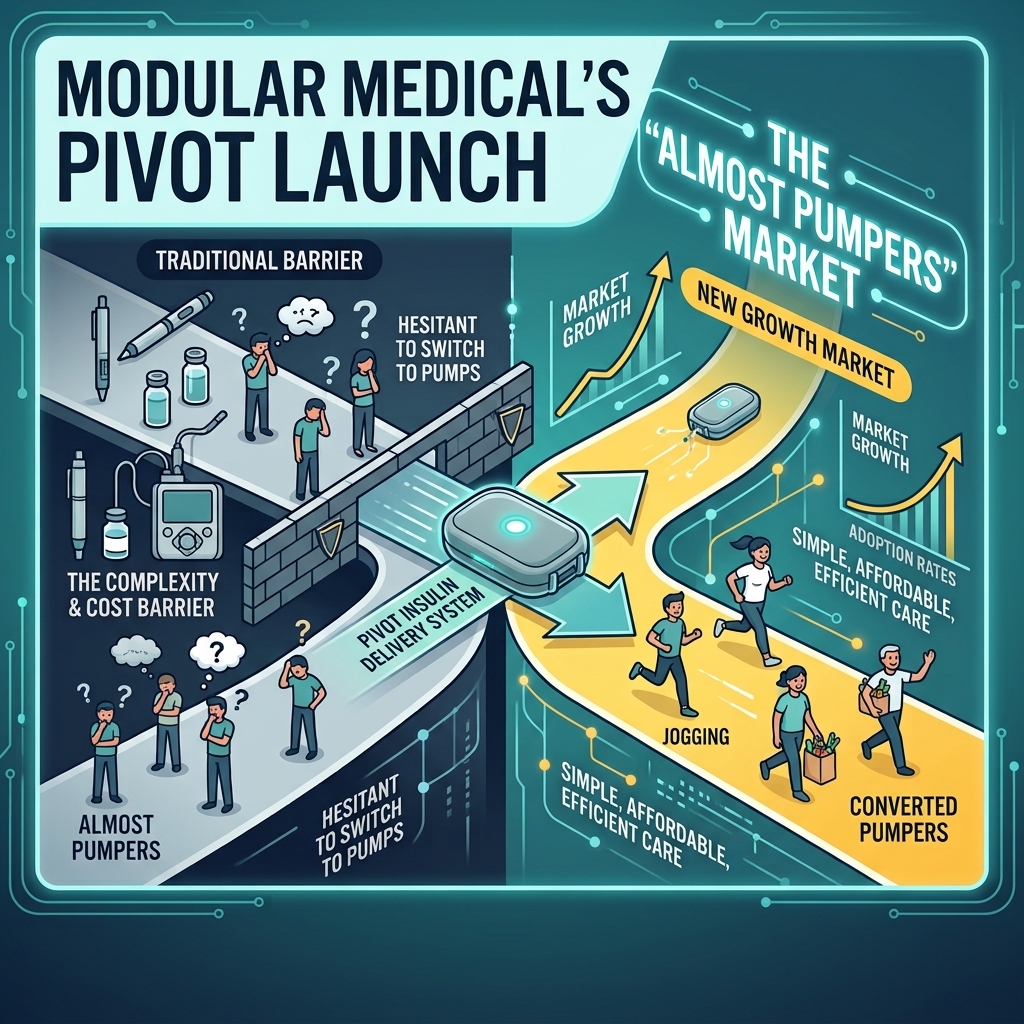
Modular Medical, Inc. (NASDAQ: MODD) is approaching one of the most consequential moments in its corporate history: converting an FDA-cleared insulin patch-pump platform into a recurring-revenue commercial franchise. The company’s early launch plan for Pivot™, including targeted metropolitan markets, a national pharmacy-benefit-manager contract, and recently cleared software upgrades, suggests management is building the commercial rails before attempting to accelerate down them.
The Bull Case: MODD Is Targeting Patients the Industry Has Not Fully Won
Diabetes technology has no shortage of engineering prowess. What it may lack, at least for a large group of insulin users, is a product designed to make pump therapy feel less like an advanced-placement course in software management. Modular Medical’s core proposition is straightforward: Pivot is designed for the “almost pumpers,”people who could potentially benefit from insulin-pump therapy but have remained on multiple daily injections because existing systems can be too complex, too burdensome, too expensive, too dependent on a smartphone, or simply too much apparatus for everyday life. That is not a small clinical backdrop. The CDC estimates that 40.1 million Americans had diabetes in 2023, equivalent to 12.0% of the U.S. population. The addressable opportunity is therefore not confined to a narrow technology niche; it sits inside a vast chronic-care category where ease of use can be commercially meaningful. In the recent Tribe Public CEO webinar titled, “The Road To Revenue: Modular Medical’s Strategy For Launching Pivot,” CEO Jeb Besser framed the opportunity around low adoption of pump therapy among people who could benefit from it. The implication for investors is important: MODD does not necessarily need to displace every sophisticated, highly satisfied user of a feature-rich pump from Tandem Diabetes Care, Inc. (NASDAQ: TNDM), Medtronic plc (NYSE: MDT), or Insulet Corporation (NASDAQ: PODD). It can instead focus on people for whom existing pump choices have not yet crossed the adoption threshold. That is a more practical commercial thesis than trying to persuade every Ferrari owner that a compact electric sedan is inherently better. Some patients want the entire cockpit. Others simply want the drive to be easier.
Pivot’s Design Aims at Friction, Not Just Features
The Pivot system seeks to combine the tubeless convenience that has helped make Insulet’s Omnipod platform a formidable force with a simpler, more flexible design philosophy. MODD describes Pivot as a two-part system: a reusable component intended to last roughly 90 days and a disposable cartridge/infusion component used over three days. Management believes that reusing the more expensive electronics and other core components could create an eventual cost advantage at scale. The company’s stated differentiators include:
- A tubeless patch-pump form factor.
- A physical on-device control, reducing the need to have a smartphone available for basic pump functions.
- A 3 mL insulin capacity, which MODD says broadens potential usability for patients with higher insulin requirements.
- A removable form factor during its wear period.
- Bluetooth and near-field communication capabilities.
- A simplified configuration approach intended to make pump therapy more approachable for patients who may not want, need, or use every advanced feature available in a premium system.
- A pathway for future automated insulin-delivery functionality, subject to product-development and regulatory progress.
The value proposition is not that advanced pumps are deficient. In fact, Tandem’s t:slim X2 and Insulet’s Omnipod systems have demonstrated the commercial appetite for increasingly capable diabetes technology. Insulet reported first-quarter 2026 revenue of $761.7 million, including $758.4 million of Omnipod revenue, while total Omnipod revenue rose 36.9% year over year. Tandem, meanwhile, shipped more than 29,000 pumps worldwide in the first quarter of 2026. Those figures validate the market; they do not close it. For MODD shareholders, the more encouraging interpretation is that a large and growing market can accommodate distinct user experiences. Insulet’s success proves that tubeless delivery resonates. Modular’s wager is that patients who have not adopted pump therapy may respond to a system built around convenience, simplicity, capacity, and affordability rather than an arms race of features.
FDA Clearance and PBM Access Change the Conversation
A medical device can be clinically compelling and still become commercially invisible if it lacks reimbursement access. In diabetes care, the reimbursement pathway is not scenery; it is the road. Modular Medical received FDA 510(k) clearance for Pivot in April 2026, which opened the path to U.S. commercialization. The company later announced commercial availability and initial U.S. shipments in June. On September 3, 2026, the FDA cleared additional Pivot software enhancements, including greater flexibility and customization in bolus dosing, user-interface improvements, and other software upgrades. In particular, management highlighted that users can set the bolus amount per button press within a half-unit-to-five-unit range, in specified increments. That matters because a simplified device still must accommodate individual patient needs; simplicity is useful only when it does not become rigidity wearing a friendly hat. The next day, Modular Medical announced a contract with a national U.S. pharmacy benefit manager, making Pivot available through that PBM. The company did not identify the counterparty in the webinar, but it characterized the agreement as meaningful access to covered lives and positioned it as an important early reimbursement milestone. This is a potentially material development for three reasons:
- Pharmacy-benefit distribution can be more familiar to patients because it resembles recurring prescription fulfillment rather than a traditional durable-medical-equipment transaction.
- The company’s model is designed around recurring prescriptions for three-day disposable components, potentially creating a repeat-revenue cadence after patient onboarding.
- PBM contracting may lower a major adoption hurdle for physicians and patients: confidence that the product is covered and can be obtained without an administrative scavenger hunt.
MODD still needs broader coverage and formulary progress. But investors should recognize the distinction between a product that is merely cleared and a product beginning to enter the reimbursement machinery. One gets applause at a trade show; the other can eventually generate refill revenue.
Five Markets, Five Reps, and a Sensible First Act
Modular Medical is taking a deliberately concentrated approach rather than attempting to market nationally with a thin commercial blanket. Management identified Cincinnati/Lexington, Atlanta, Dallas, Houston, and Tampa as initial launch regions, replacing Philadelphia with Tampa based on available sales talent. The company said these markets represent 14% of high-volume pump prescribers, 15% of new pump starts, and 21% of prescribers with a high affinity for new branded diabetes products. That targeted strategy deserves more credit than it may initially receive. Early-stage medtech launches are often evaluated as if an immediate nationwide revenue surge were the only evidence of progress. Yet commercialization is usually a sequence:
- Recruit appropriately experienced sales talent.
- Establish product availability and reimbursement pathways.
- Educate prescribers.
- Place initial patients on therapy.
- Collect patient, physician, and payer feedback.
- Expand only after the commercial model demonstrates repeatability.
Management has specifically cautioned that initial October and November sales could be modest while the company builds physician familiarity, payer confidence, and its early user base. That is not a bearish statement. It is a commercially literate one. Doctors do not generally change prescribing habits after one handshake, one email, and a branded stress ball. The company has engaged a contract sales organization and said it had hired key representatives in four of its five territories, even as it searches for a new sales leader. The departure of a head of sales is a real execution consideration, but the reported presence of field personnel and an outside sales infrastructure reduces the risk that the launch is entirely dependent on one executive hire.
Why the Recurring-Revenue Model Could Matter
Pivot’s commercial model is designed around recurring purchases of disposable three-day cartridges or pods. Management described a monthly prescription as roughly ten cartridges, with reimbursement economics resembling a pharmacy prescription rather than a one-time capital-equipment sale. For investors, that creates a potentially attractive economic architecture if adoption takes hold:
| Investor question | Potential MODD answer |
|---|---|
| What begins the relationship? | A prescription for Pivot and initial placement of the reusable component |
| What drives repeat sales? | Recurring purchases of three-day disposable cartridges |
| What can increase value per patient? | Persistence, refill frequency, broader reimbursement, and eventual product enhancements |
| What could improve margins over time? | Manufacturing scale, higher production volumes, and reuse of expensive components |
| What makes the model fragile early? | Limited patient counts, launch costs, reimbursement variability, and the need to prove retention |
This is why the first six months of commercialization matter more than a single quarterly sales figure. Investors should watch for evidence of a steadily rising installed base, refill behavior, physician testimonials, expanding coverage, new geographic markets, and confirmation that patients who previously remained on injections will adopt and stay on the system. The financial logic is appealing if MODD can establish those habits. The operational work, naturally, is less glamorous. Recurring revenue is wonderful, right up until the first “recurring” part decides it prefers a competitor.
Competition Validates the Category
The insulin-pump market is not vacant. That is both the challenge and the opportunity. Insulet (NASDAQ: PODD) is the clear benchmark in tubeless delivery. Its Omnipod franchise generated $758.4 million of first-quarter 2026 revenue, and U.S. Omnipod revenue rose 28.3% year over year. Insulet’s momentum underscores strong consumer and clinician interest in tubeless systems. Tandem Diabetes Care (NASDAQ: TNDM) is another major participant, with more than 29,000 worldwide pump shipments in the first quarter of 2026 and a stated view that the global insulin-pump market remains highly underpenetrated. Medtronic (NYSE: MDT), a broad medical-device incumbent, also remains an established presence in diabetes technology, particularly among users who value advanced automated insulin-delivery systems and established clinical infrastructure. But MODD’s thesis does not require it to win the market’s prestige contest. It needs to demonstrate that it can build a defensible lane for patients who want a tubeless alternative that is less intimidating, avoids some limitations of current designs, and has an economically compelling recurring model. That is an achievable strategic posture if the product experience matches the company’s pitch and reimbursement execution continues to improve.
Catalysts Investors Should Watch
The next several quarters could produce a sequence of concrete proof points for Modular Medical:
- Initial market launch performance: Progress in the five initial metropolitan areas, including patient starts and prescriber adoption.
- Additional PBM or payer agreements: Expanded coverage could materially improve access and reduce friction at the point of prescription.
- Refill and persistence data: Early evidence that patients remain on Pivot and continue ordering cartridges would strengthen the recurring-revenue thesis.
- Clinical and real-world outcomes: Case studies, clinician endorsements, and data showing improved treatment engagement for former multiple-daily-injection users could support broader adoption.
- Manufacturing scale: Greater output could help validate MODD’s expected cost advantages from its reusable-plus-disposable architecture.
- European regulatory progress: Management has discussed pursuing CE-mark approval, which could open a second large, less-penetrated insulin-pump market if successfully executed.
- Strategic partnership potential: Management said it has held discussions across the industry and views its platform as compatible with potential partners’ algorithms and interfaces. No transaction is assured, but commercial proof could make the platform more strategically interesting.
Risks Investors Should Respect
The bullish thesis is credible only if the risks remain plainly visible.
- Commercial execution risk: FDA clearance does not guarantee physician adoption, patient uptake, or refill persistence.
- Reimbursement risk: A single national PBM contract is a notable start, but broad commercial traction will likely require continued formulary and payer progress.
- Capital needs and dilution: MODD remains a commercial-stage company investing in launch infrastructure, manufacturing, and market development. Future financing needs could affect shareholders.
- Competitive intensity: Insulet, Tandem, Medtronic, and other diabetes-technology companies have greater commercial resources, established brands, and deep reimbursement relationships.
- Scale economics risk: Management’s anticipated cost advantages depend on meaningful production volumes; early commercialization can be expensive before the manufacturing flywheel begins to turn.
- Clinical-positioning risk: The “almost pumper” segment is compelling, but MODD must prove that it can identify, acquire, and retain these patients efficiently.
A Takeaway
Modular Medical is no longer merely telling investors what Pivot might become. It now has FDA clearance, commercial availability, software upgrades, early manufacturing activity, a focused market-entry strategy, and a national PBM contract supporting access to its insulin-delivery system. The central investment question is no longer whether MODD can build a tubeless patch pump. It has done that. The question is whether the company can prove that millions of insulin-treated patients who have avoided pump therapy are waiting for a more accessible version of it. If the answer is yes, Modular Medical (NASDAQ: MODD) may be entering the market at a particularly interesting point: after category validation, but before its own commercial value is fully tested. Insulet (NASDAQ: PODD) has shown that tubeless insulin delivery can become a blockbuster business. Tandem Diabetes Care (NASDAQ: TNDM) has shown that the broader pump market remains underpenetrated. MODD is trying to demonstrate that the next leg of growth may come from making the technology feel less like a device purchase and more like an obvious daily choice. That is a risky proposition, as early-stage medtech opportunities tend to be. It is also the sort of proposition that can become much more valuable once prescription pads, payer systems, and patient habits begin pointing in the same direction.
The Sources
- Modular Medical Announces FDA Clearance of Pivot Tubeless Insulin Patch Pump Enhancements — September 3, 2026
Access Newswire press release - Modular Medical Announces Contract With National U.S. Pharmacy Benefit Manager — September 4, 2026
Newswire release - Modular Medical Receives FDA 510(k) Clearance for Pivot Tubeless Insulin Delivery System — April 9, 2026
Access Newswire release - Modular Medical Achieves Key Manufacturing Milestone for Pivot Tubeless Insulin Patch Pump — February 4, 2026
BioSpace release - Modular Medical Investor Relations
Modular Medical investor-relations website - Modular Medical Annual Report 2026
Annual report and SEC filing summary - CDC National Diabetes Statistics Report
U.S. diabetes prevalence and statistics - CDC Diabetes Data and Research
CDC diabetes data overview - American Diabetes Association: Diabetes Statistics
ADA diabetes prevalence statistics - Insulet Corporation (NASDAQ: PODD) — First-Quarter 2026 Results
Insulet Q1 2026 earnings release - Insulet Corporation Investor Relations
Insulet investor-relations website - Tandem Diabetes Care, Inc. (NASDAQ: TNDM) — First-Quarter 2026 Financial Results
Tandem Q1 2026 earnings release - Tandem Diabetes Care, Inc. (NASDAQ: TNDM) — 2025 Annual Report / Form 10-K
Tandem Diabetes Care Form 10-K - Modular Medical FY 2026 Financial Results and Loss Summary
FY 2026 results summary
Stay Updated with Vista Partners
Subscribe to receive market insights, investing ideas, and the latest updates directly in your inbox.