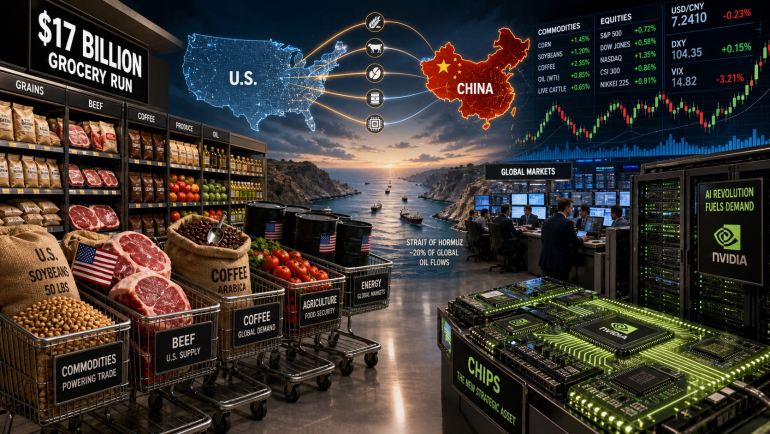
A rare convergence of California production growth, rising global oil prices and Washington’s renewed push for domestic supply is sharpening investor attention on Sable Offshore Corp. (NYSE: SOC). The company’s Santa Ynez Unit restart is no longer merely a regional energy story; in a higher-price, geopolitically strained crude market, it is becoming a potentially consequential U.S. supply-and-cash-flow narrative. Brent crude climbed above $96 per barrel Thursday after Iranian attacks targeting U.S. Gulf allies heightened fears around the Strait of Hormuz, a corridor that had carried roughly 20 million barrels per day of oil and petroleum products before the latest conflict. West Texas Intermediate crude traded near $91.86, while Brent had gained more than 7% for the week.
A California Barrel Has New Strategic Appeal
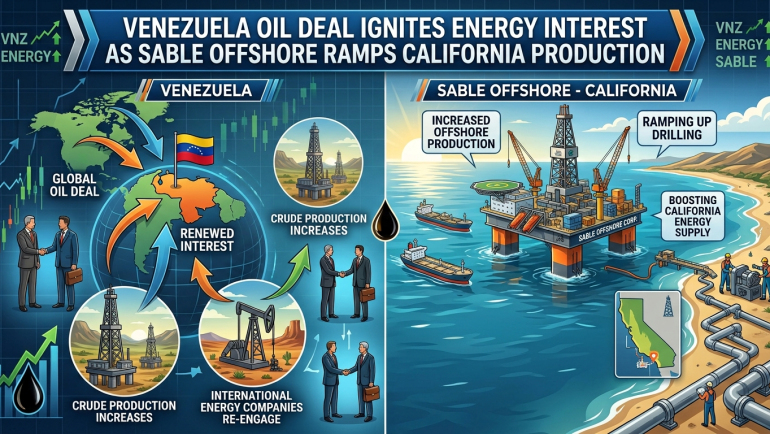
California has long had the energy appetite of a major economy and the refining system to match, even as its own oil output has trended lower over the years. That combination has left the state more dependent on crude shipped from abroad, an arrangement that works smoothly until global supply chains decide to become geopolitical theater. That is what makes the restart of the Santa Ynez Unit notable. Sable Offshore is bringing production back from federal waters off California, providing the prospect of incremental local supply close to a large refining market. The Trump administration has simultaneously intensified its dispute with California officials and the California Coastal Commission over offshore oil development, underscoring a wider federal interest in getting more production flowing from the state. For many, the attraction is straightforward: domestic barrels located near consumption and refining infrastructure can carry strategic value when the international oil market is assigning a premium to reliability. Oil, unlike a fine Bordeaux, does not improve with a longer voyage across a disrupted ocean.
Sable Offshore’s Production Ramp Is Becoming Visible
Sable Offshore reported $137.1 million in second-quarter 2026 revenue and $9.4 million in positive operating cash flow, its first full quarter of revenue generation and positive operating cash flow since inception. Average net oil sales during the quarter were approximately 21,000 barrels per day, but exit sales reached roughly 40,000 net barrels per day, a 149% increase from the quarter’s first day. The operational trend accelerated into the summer:
- July preliminary sales were approximately 38,000 gross barrels per day.
- August sales averaged approximately 42,000 gross barrels per day through August 9.
- Sable expected all 77 production wells at the Harmony and Heritage platforms to be online during the third quarter.
- Platform Hondo was expected to restart in September (It’s September!) , with well-optimization work designed to add incremental barrels.
This is the critical distinction for the NYSE: SOC story: the company is not simply forecasting a turnaround from a conference-room spreadsheet. It has reported an actual ramp in sales volumes, expanded the number of producing wells, and moved from no operating cash flow to positive operating cash flow.
Higher Oil Prices Could Magnify the Cash-Flow Setup
Sable’s 2026 outlook calls for 40,000 to 45,000 net barrels of oil equivalent per day in the second half, with production expected to be almost entirely oil. Its 2027 framework points to approximately 42,500 net barrels per day at the midpoint, again nearly 100% oil-weighted. That oil-heavy profile matters more when global benchmarks rise. At roughly $96 Brent, the market is signaling that supply security has once again become an economic variable rather than a footnote in an energy presentation. Sable has also placed downside protection beneath part of its production. The company initiated costless collars with a $65-per-barrel Brent floor on average volumes of:
- 28,000 barrels per day through the end of 2026.
- 25,000 barrels per day during 2027.
- 21,000 barrels per day during 2028.
Those collars cap some upside, the 2026 sold-call level is $89.39 per barrel, but they also give lenders and investors a clearer view of minimum realized-price protection. In a business famous for price cycles and occasional emotional weather, a defined floor can be a welcome form of adult supervision.
The Margin Story Depends on Marketing Progress
The bullish thesis is not without moving parts. During the second quarter, Sable said California refining constraints and the abrupt arrival of Pacific Outer Continental Shelf crude resulted in $18.5 million of nonrecurring demurrage charges. The company also faced temporary sales-throughput constraints of approximately 40,000 gross barrels per day beginning in July, as refiners adjusted their supply mix. Still, management identified several potential avenues for improvement:
- California refineries were expected to accept additional Santa Ynez barrels and fewer imported cargos beginning in September (It’s Septmber!).
- Platform Hondo’s lower-sulfur oil could improve field-wide crude quality after its planned restart.
- The company is exploring waterborne marketing options through Los Angeles-area marine terminals.
- Chemical treatments intended to lower sulfur content are expected to be tested during the fourth quarter, with potential full implementation in 2027.
Importantly, Sable’s 2027 outlook assumes no benefit from waterborne marketing, chemical treatments or broader California infrastructure improvement. That leaves room for operating upside if marketing conditions normalize more quickly than expected, though none of those improvements should be treated as guaranteed.
Capital Discipline Adds Credibility
Sable reduced the midpoint of its planned second-half 2026 capital expenditure budget by 41% to $85 million, emphasizing cash-flow optimization, debt amortization, asset integrity and high-return well work. The company also refinanced its debt structure during July, including a $675 million senior secured term loan due in December 2028 and $345 million of convertible senior notes due in 2031. The financing extended its maturity runway, but it comes with meaningful obligations: the term loan carries a 15% annual coupon, mandatory amortization, and a quarterly excess-cash-flow sweep. That means SOC is not a carefree oil-price call option. Its balance sheet places a premium on execution, sustained production, marketing improvements and disciplined capital allocation. Yet that same discipline may be precisely what gives the equity its torque if output and crude pricing cooperate.
The Bull Case: A Domestic-Barrel Re-Rating
The constructive investor case for Sable Offshore rests on several reinforcing elements:
- Production has moved sharply higher from the start of the second quarter into July and August.
- The company has crossed into positive operating cash flow.
- Its 2027 outlook is highly oil-weighted, creating meaningful sensitivity to a sustained higher-price environment.
- Hedging provides a degree of downside protection at a $65 Brent floor.
- California market constraints may ease as refiners replace imported barrels with locally produced supply.
- Global instability around the Strait of Hormuz makes secure, U.S.-based crude production more strategically relevant.
Washington’s growing pressure to facilitate more California offshore production further adds an unusual policy tailwind to the company-specific operational story.
Risks Investors Should Respect
The same features that make Sable Offshore Corp. (NYSE: SOC) intriguing also make it speculative. The company remains exposed to California regulatory and legal friction, offshore operating risks, environmental scrutiny, crude-quality and refinery-acceptance issues, commodity-price volatility, and substantial debt-service requirements. Sable itself cautions that actual outcomes may differ materially from its forward-looking projections. Oil prices may also retreat if the Middle East conflict de-escalates or if global supply disruptions prove temporary. A Brent price spike can make every barrel look glamorous; durable equity value still depends on consistently producing, transporting and selling those barrels at attractive netbacks.
Bottom Line
The emerging SOC narrative is bigger than one offshore restart. It is a bet on the value of local supply in a state dependent on crude, a company moving rapidly toward higher volumes, and an oil market newly reminded that logistics can matter as much as geology. For many comfortable with execution risk, regulatory drama and a balance sheet that insists on being taken seriously, Sable Offshore offers a potentially compelling combination: rising production, improving cash generation, hedged downside, and exposure to a world in which dependable American oil barrels may command a larger strategic and financial premium.
Oil Market Trading
The Sources
- Associated Press “Trump administration ratchets up its fight to get more oil flowing from California”
- Yahoo Finance / Sable Offshore Corp. “Sable Offshore Corp. Reports Second Quarter 2026 Financial and Operational Results”
- CNBC “Brent oil price above $96 per barrel after Iran fires missiles at Kuwait”
- U.S. Department of Energy “Secretary Wright Directs Sable Offshore to Restore the Santa Ynez Unit and Pipeline”
- International Energy Agency “Oil Market Report: March 2026”
- Reuters “Sable Restarts Disputed California Pipeline Under Trump Federal Order”
- Reuters “Trump Administration Directs Sable Offshore to Restore Santa Ynez Oil Unit”
- Congressional Research Service “The Strait of Hormuz: Security Developments and Impacts for Global Oil Markets”
- World Bank Data Blog “Strait of Hormuz Disruption Sends Oil Prices Surging”
- Sable Offshore Corp. (NYSE: SOC) “Second Quarter 2026 Financial and Operational Results”
Stay Updated with Vista Partners
Subscribe to receive market insights, investing ideas, and the latest updates directly in your inbox.