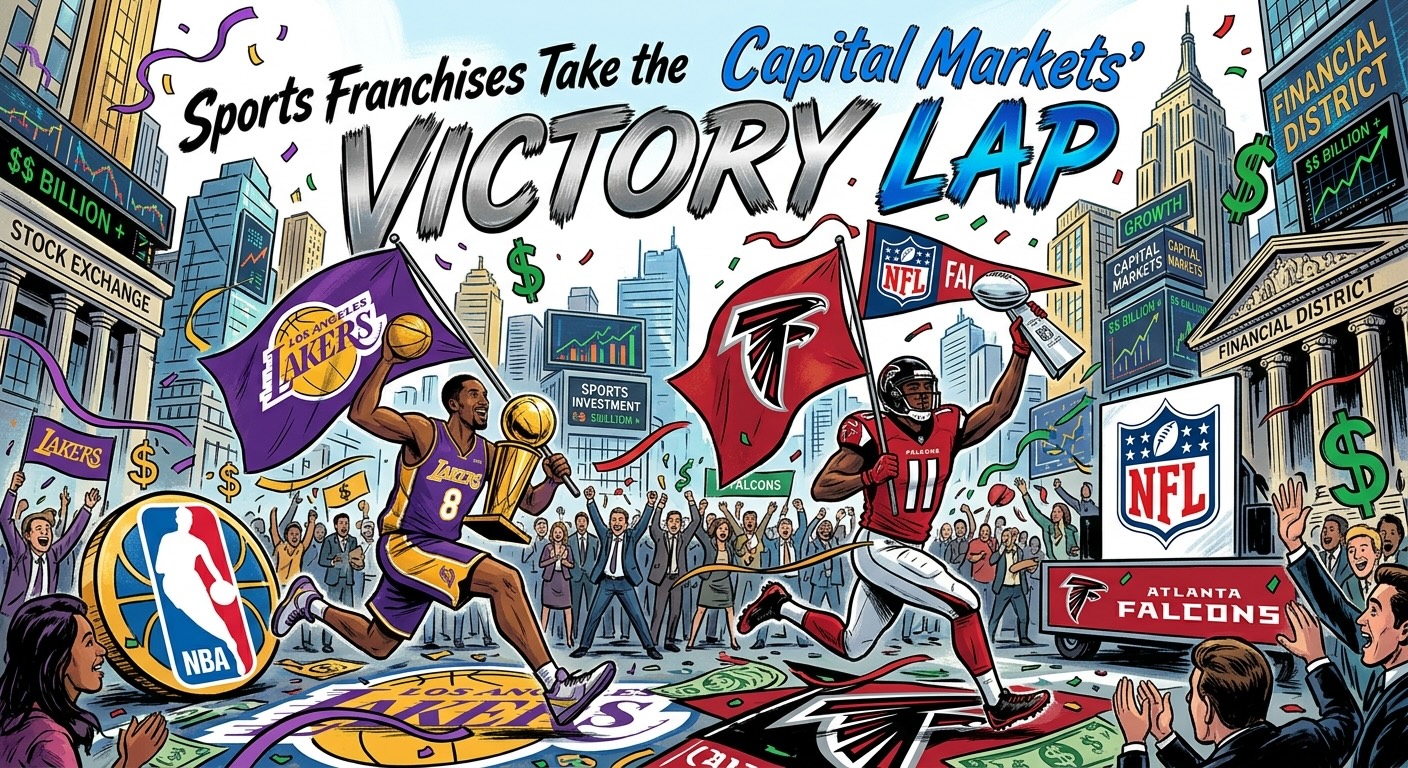
Professional sports ownership is rapidly becoming one of the market’s most compelling scarcity trades. The proposed 10% sale of the Atlanta Falcons to Arctos at a $10.6 billion enterprise valuation—and the developing $12.5 billion Los Angeles Lakers transaction—underscore a clear bullish message: elite franchises are being priced less like local teams and more like durable global media, real-estate and intellectual-property platforms.
The Falcons: A $10.6 Billion Vote of Confidence
Arctos Partners has reportedly agreed to acquire 10% of the Atlanta Falcons over two tranches during the next 18 months, subject to expected NFL approval. The implied $10.6 billion enterprise valuation is notable not merely for the size of the check, but for what it says about investors’ view of the NFL’s long-duration economic engine. Arthur Blank bought the Falcons in 2002 for $545 million. At the reported current valuation, the franchise has appreciated by roughly 19 times—not including the cash flows, civic relevance and stadium-adjacent opportunities accumulated along the way. Home improvement, it turns out, can be a remarkably useful apprenticeship for building a sports empire. The headline is especially constructive because Atlanta’s valuation expansion has occurred despite an eight-season playoff absence. In ordinary equities, the market sometimes prices anticipated improvement. In premium sports assets, the market is increasingly paying for the underlying franchise machine: media rights, sponsorship inventory, premium seating, global relevance and a fixed supply of NFL teams.
The NFL’s Private-Capital Door Opens Wider
If approved, the Falcons would represent Arctos’ fourth NFL investment, following reported stakes in the Los Angeles Chargers, Buffalo Bills and Cleveland Browns. That developing portfolio signals institutional confidence that the NFL’s business model can produce attractive returns even when weekly box scores are less than lyrical. The NFL’s decision to permit qualified institutional investors to take minority positions has created a new capital-allocation framework for franchise owners. The league reportedly caps private-equity ownership at 10% per club and requires a minimum six-year holding period—rules that preserve owner control while giving institutional capital a disciplined way into an exceptionally scarce asset class. The Falcon transaction also follows the pending Seattle Seahawks sale at a reported $9.61 billion valuation. That sequence suggests that the NFL’s valuation floor is moving up, not merely that one bidder has found an unusually expensive set of shoulder pads.
Lakers Prove the Premium Is Global
Across town—and across sports—the Los Angeles Lakers are providing an even louder valuation signal. Josh Kushner and Bob Iger are set to purchase a controlling stake in the Lakers at a reported $12.5 billion valuation, after Mark Walter’s prior majority purchase had valued the franchise at $10 billion. The Buss family’s remaining 17.8% stake is now central to the next chapter. Five Buss siblings said they are united in their intention to sell those shares through a tag-along provision, although Jeanie Buss is contesting the process and asserting that her approval is required under the family’s governance arrangements. The ownership outcome remains unresolved, but the market’s verdict on the Lakers brand is already clear: a globally recognized franchise with a powerful media identity commands a very large premium. For investors, the 25% jump from a $10 billion valuation to $12.5 billion in roughly a year is a reminder that trophy sports assets do not always follow the gentle pace recommended in a traditional finance textbook. They trade on scarcity, brand elasticity and the growing value of live entertainment in a fragmented media landscape.
Why Public-Market Investors Should Care
Neither the Atlanta Falcons nor the Los Angeles Lakers is publicly traded, and Arctos Partners and Thrive Capital are private firms. Still, the transactions reinforce several investable public-market themes:
| Public company | Ticker | Why the sports-valuation wave matters |
|---|---|---|
| The Walt Disney Company | NYSE: DIS | Bob Iger’s involvement with the Lakers keeps attention on the strategic importance of premium sports brands and high-value live content, an arena where Disney remains a major participant. |
| The Home Depot, Inc. | NYSE: HD | Arthur Blank co-founded Home Depot and remains the Falcons’ principal owner, linking one of America’s most recognizable retail success stories to the continued institutionalization of sports ownership. |
| Madison Square Garden Sports Corp. | NYSE: MSGS | As a publicly traded owner of the New York Knicks and New York Rangers, MSGS offers investors one of the more direct listed proxies for rising major-league franchise values. |
| Atlanta Braves Holdings, Inc. | NASDAQ: BATRA / NASDAQ: BATRK | The Braves’ publicly traded structure gives investors another rare way to assess how live sports, regional economics, sponsorship and venue development can interact. |
| TKO Group Holdings, Inc. | NYSE: TKO | TKO provides exposure to premium live sports entertainment and media rights through UFC and WWE—adjacent evidence that must-watch programming retains strategic value. |
The critical distinction is that public companies are not interchangeable with private franchise valuations. Still, the widening gap between the value of live, scarce sports properties and commodity content strengthens the strategic case for businesses with premium rights, brands, venues and fan communities.
The Takeaway
The Atlanta Falcons’ reported $10.6 billion valuation and the Lakers’ reported $12.5 billion transaction are more than trophy-asset headlines. Together, they point to an evolving capital-markets reality: premier sports franchises are becoming institutional-grade assets with global distribution, recurring commercial opportunities and unusually limited supply. The Falcons need not win a Super Bowl for investors to recognize the quality of the underlying business. The Lakers need not settle every ownership question before their brand commands a record-setting valuation. In this market, a championship parade is valuable—but a permanent place in the cultural and media economy may be the more durable prize.
The Sources
- CNBC: Arctos agrees to buy 10% of Atlanta Falcons at $10.6 billion valuation, sources say
- ESPN: Five Buss siblings “united” in decision to sell Lakers shares
- Reuters: Iger, Kushner purchasing Lakers for record $12.5 billion
- CNBC: Bob Iger and Josh Kushner buy the Los Angeles Lakers at a $12.5 billion valuation
- Atlanta Falcons: Falcons induct owner Arthur Blank into team’s Ring of Honor
- ZoomInvestors: Private Equity in Football—Top Firms in 2026
Stay Updated with Vista Partners
Subscribe to receive market insights, investing ideas, and the latest updates directly in your inbox.