


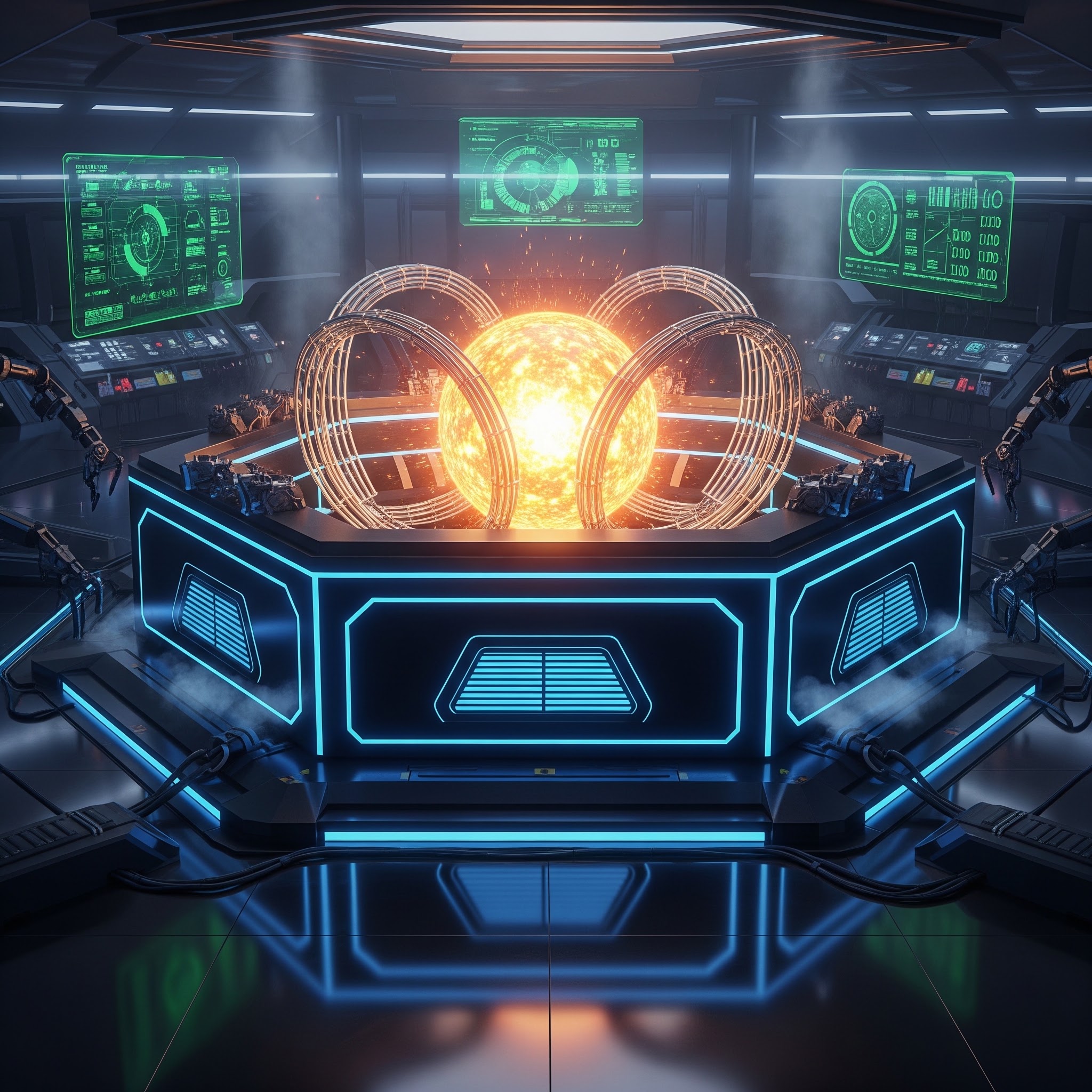
Wall Street has seen its share of big bets, but few are as audacious—or as delightfully bureaucratic—as ITER, the sprawling fusion experiment rising in the south of France. This public‑sector “artificial sun” carries a price tag north of €22 billion, a construction schedule stretched by years of delays, and a governance model that looks suspiciously like the United Nations tried to build a power plant. The pitch is disarmingly simple: if the sun can run on fusion for billions of years, surely humanity can borrow the playbook for a few megawatts. The execution is anything but simple. ITER aims to confine plasma at roughly 150 million degrees Celsius—about ten times hotter than the core of the real sun—while superconducting magnets a few meters away are chilled to just above absolute zero. That’s not a physics experiment so much as an ongoing dare to thermodynamics.
Magnets, Plasma, And A Very Nervous Heat Shield
At the heart of ITER sits a tokamak, a doughnut‑shaped vacuum vessel designed to corral plasma, the “fourth state of matter” that behaves like an unruly hedge fund: everyone’s charged, nobody respects boundaries, and the whole thing must be contained with strong fields before it blows up the model. The containment comes from what is set to become the world’s largest central solenoid magnet—a five‑story structure weighing around 1,000 tons—surrounded by D‑shaped and circular magnets sourced from the U.S., Italy, Japan, Russia, China, and Europe. Each component must align with millimetric precision, because the plasma particles are less forgiving than bond traders on a bad CPI print. The magnets run at cryogenic temperatures, the plasma at “please don’t drop anything, the machine won’t work” levels, separated only by a thin heat shield that already forced engineers to rip out and refabricate about 20 kilometers of piping after leaks were found in testing.
Burning Plasma: The Holy Grail (No Dividend Yet)
The scientific and economic prize is a “burning plasma”—a self‑heated fusion state where the reaction feeds itself, like a well‑chosen compounder in your portfolio. Getting there requires heating a mix of deuterium and tritium, isotopes of hydrogen with one and two neutrons, to fusion conditions inside the tokamak. The reaction produces helium and a swarm of high‑energy neutrons that don’t care about magnets and slam into the reactor walls, demanding materials that can shrug off constant nuclear abuse with the stoicism of a long‑only manager in a bear market. Deuterium is abundant in seawater; tritium is decidedly not. ITER therefore plans to embed lithium‑based materials in special shield blocks inside the tokamak wall, “breeding” tritium in situ as the neutrons fly. If this works at scale, future reactors could manufacture their own fuel, transforming tritium from a supply‑chain headache into an on‑site production line. Think of it as vertical integration, but for neutrons.
Governance: NATO Meets Nuclear Physics
Financial investors are familiar with syndicates and clubs; ITER is the mega‑project version. More than 30 countries participate, with Europe covering roughly 45% of the value and partners such as the U.S., China, Russia, India, Japan, and South Korea contributing about 9% each in the form of components rather than cash. Decision‑making is consensus‑driven, modeled on frameworks used by the Antarctic Treaty, the World Trade Organization, and NATO. The result is a de facto global supply chain for cutting‑edge fusion hardware—and an object lesson in how many cooks can occupy one kitchen before someone suggests ordering takeout. Setbacks, including quality issues that triggered the costly rework of that heat shield piping, have added years to the timeline and roughly €5 billion to the budget. The project’s leaders frame this as normal for first‑of‑its‑kind engineering, a talking point that plays better in technical briefings than in budget hearings.
Open‑Source Energy: ITER As The World’s Fusion GitHub
ITER won’t be plugging directly into the grid; it is deliberately a research tokamak, a bridge between lab‑scale experiments and commercial machines. That makes it less like a utility and more like a global R&D platform whose most valuable output will be data, design lessons, and software. The team is already building predictive models for plasma behavior and releasing them as open‑source tools so that private fusion firms can adopt and adapt them. They are also drafting an ITER Engineering Handbook that explicitly catalogs mistakes and what was learned from them—a corporate culture that would be unthinkable in certain corners of Silicon Valley but is essential when you’re co‑developing an energy technology that needs to work for decades, not quarters. All member countries get access to the scientific results, and non‑members can receive access if the existing members approve. For investors, that means the knowledge base underpinning next‑generation fusion companies is being socialized rather than locked in one corporate vault.
Timelines, Setbacks, And The Investor Narrative
The updated schedule now targets first plasma in 2034, a date that has slid as engineering surprises and quality issues surfaced. In the cynical shorthand of markets, fusion has long been “a decade away” for roughly seven decades. Walking through ITER’s tokamak hall and control room—still under construction but architected for high‑density operations—suggests we may finally be living in the last decade when that joke is still funny. Compare ITER’s world to the rapidly growing ecosystem of private fusion startups, many backed by sophisticated venture and strategic capital and racing to demonstrate net‑energy gains on tighter timelines with smaller devices. ITER’s leaders acknowledge that private players might beat their facility to certain milestones, but they point out that every puzzle ITER solves—materials, magnets, breeding blankets, control software—is one fewer challenge confronting the commercial sector. In macro terms, it looks less like competition and more like a layered call option structure on the future of baseload clean power, with public capital underwriting the deepest technical risk.
Why This Matters For Capital Allocation (Even Without A Ticker)
There is no ITER stock ticker to drop into a portfolio, but the project’s implications bleed into several public‑market themes. The potential for high‑density, dispatchable, zero‑carbon baseload power could reshape long‑term assumptions around utilities, grid infrastructure, electrification, AI data centers, and even commodity demand. Fusion’s promise—millions of times more energy per reaction than fossil fuel combustion and roughly four times more than current fission reactors, without meltdown risk or long‑lived waste—sits at the intersection of climate policy, industrial strategy, and technology investing.
For institutional and sophisticated retail investors, ITER offers a narrative scaffold:
- It legitimizes fusion as a serious cross‑border priority, not a fringe science project.
- It codifies engineering standards and open data that private firms baking commercialization into their pitch decks cannot ignore.
- It provides a real‑world timeline—first plasma in the mid‑2030s—that can anchor scenario analysis around when fusion might begin to show up in grid planning and policy discussions..
In short, while you can’t buy ITER, you can price the world in which ITER succeeds—or at least meaningfully de‑risks fusion—and tilt exposure accordingly.
The Subtle Art Of Patience
As construction crews maneuver giant tokamak slices with bright yellow cranes and engineers refine cryogenic systems that live mere meters from star‑grade heat, ITER is quietly teaching markets an old lesson in a new way: some technologies simply do not care about quarterly earnings. Fusion requires patience, precision, and the kind of global collaboration that tends to produce footnotes, not meme stocks. The project’s leaders like to say ITER reflects “the knowledge of the world,” a phrase that would be unbearably grandiose if it weren’t backed by vacuum chambers, magnets, and a control room being wired for the moment someone finally pushes the “ignite plasma” button. Whether fusion ultimately becomes the backbone of 22nd‑century power grids or a very expensive footnote in the history of energy innovation, investors watching from the sidelines may want to remember: when humanity decides to build its own sun, it’s usually worth paying attention—if only because, this time, the target market is literally everyone.
Learn More Now
The Sources
- ITER – In a Few Lines (official project overview)
https://www.iter.org/few-lines - ITER – Fusion (technical background on fusion and tokamaks)
https://www.iter.org/fusion - ITER Newsline – Ongoing construction and assembly updates
https://www.iter.org/news - ITER Council notes continued progress across construction, commissioning, and licensing (press release)
https://www.iter.org/node/20687/iter-council-notes-continued-progress-across-construction-commissioning-and-licensing - 37th ITER Council Meeting: ITER maintains strong project execution (PDF press release, Baseline 2024 context)
https://www.iter.org/sites/default/files/media/2025-11/ic-37_press_release_final.pdf - ITER – What’s New (digest of recent milestones and media)
https://www.iter.org/whatsnew - ITER – European Commission funding programme page
https://commission.europa.eu/funding-and-tenders/find-funding/eu-funding-programmes/iter_en[commission.europa] - Fusion for Energy – ITER overview (EU partner perspective)
https://fusionforenergy.europa.eu/iter/ - U.S. Department of State – ITER International Fusion Energy Organization Agreement
https://www.state.gov/07-1024 - BBC News – “Iter: World’s largest nuclear fusion project begins assembly”
https://www.bbc.com/news/science-environment-53573294 - World Nuclear News – “Iter fusion project passes construction milestone”
https://www.world-nuclear-news.org/articles/iter-fusion-project-passes-construction-milestone - Nuclear Engineering International – “ITER reports strong project progress”
https://www.neimagazine.com/news/iter-reports-strong-project-progress/ - ESA – ITER fusion reactor project overview
https://sci.esa.int/web/cluster/-/44483-iter-fusion-reactor-project[sci.esa] - ITER – Official sitemap (navigation hub for technical and governance docs)
https://www.iter.org/sitemap
Stay Updated with Vista Partners
Subscribe to receive market insights, investing ideas, and the latest updates directly in your inbox.

