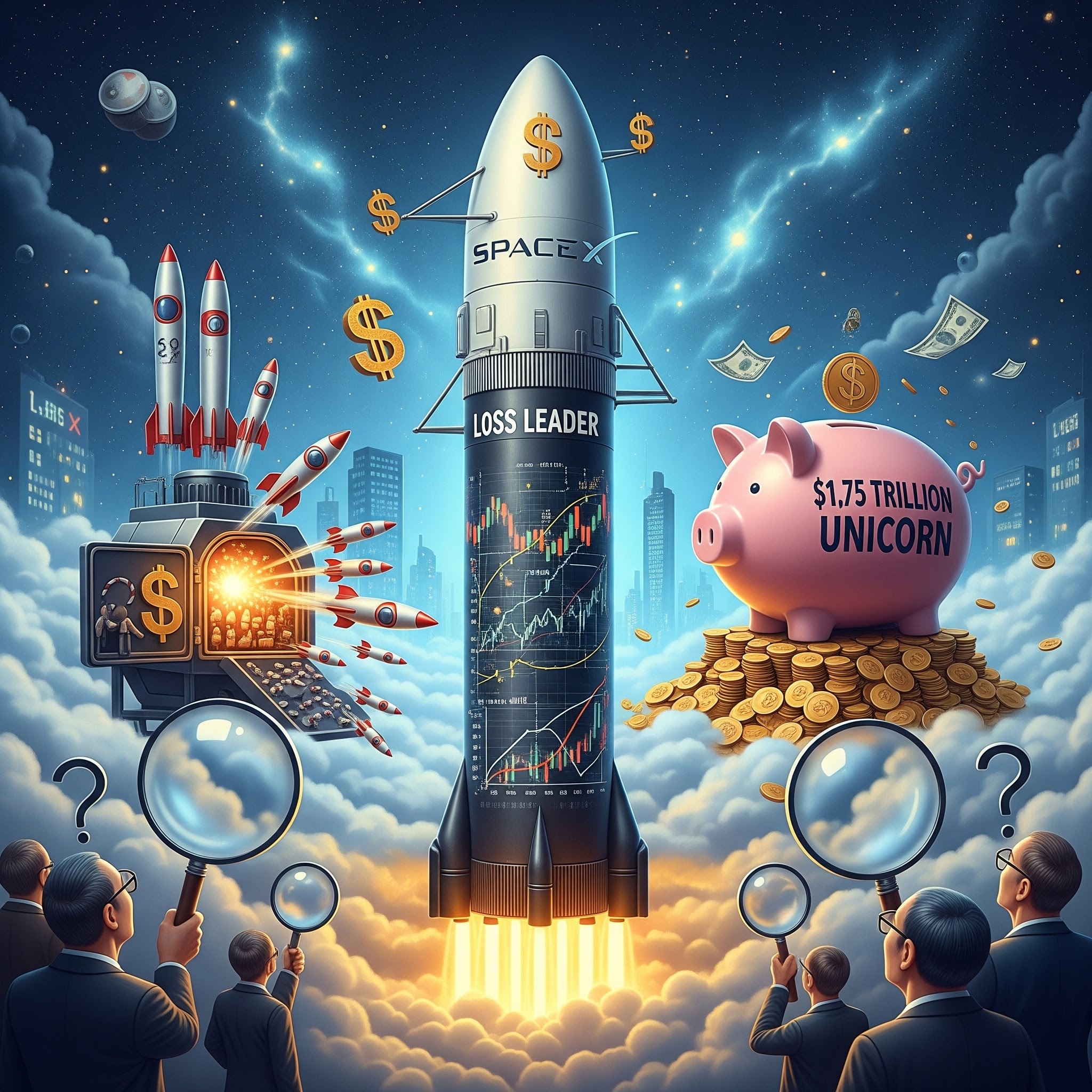
SpaceX’s march toward a record-smashing IPO is quickly turning into Wall Street’s favorite Rorschach test: one camp sees the dawn of a “trillion‑plus” space internet empire, the other sees a very expensive science project with a sky‑high multiple and a low Earth orbit margin of safety.
The $1.75 Trillion Question
SpaceX is reportedly targeting a public valuation around 1.75 trillion dollars, positioning its IPO as the largest in market history and eclipsing even Saudi Aramco’s listing by a wide margin. The company’s filing and related reporting suggest plans to raise tens of billions in fresh capital, effectively turning the public markets into the next launch pad for Musk’s long‑term Mars, Starlink, and AI ambitions.
Morningstar, however, has lobbed a well‑timed bucket of cold water on the frenzy, assigning SpaceX a fair value near 780 billion dollars—less than half the aspirational IPO figure and a reminder that gravity still exists, even in valuation space. In their view, the business is impressive but not invincible, with a limited “moat” rating and an explicit suggestion that patient investors could eventually buy in at more down‑to‑earth prices after the initial hype cycle fades.
Starlink: The Cash Engine in Orbit
Beneath the headline valuation debate sits the operational reality that Starlink now drives the majority of SpaceX’s revenue and, crucially, its profit. The company’s prospectus and subsequent reporting indicate that satellite connectivity generated roughly 60 to 70 percent of overall sales recently and was the only division to post a profit, contributing several billion dollars in earnings while launch and AI initiatives operated in the red.
Starlink’s network of over ten thousand satellites in low Earth orbit has quietly evolved from “science fair on steroids” into a global internet utility, now serving customers across more than 160 countries and all seven continents. This gives SpaceX a recurring‑revenue core with telecom‑like characteristics, but layered with infrastructure risk, regulatory complexity, and capital intensity that remind investors this is not your average SaaS flywheel—it’s a constellation that has to be continuously maintained, upgraded, and occasionally replaced.
Launch Business: 83% of the Mass, Not All of the Profit
On the launch side, SpaceX dominates the payload economy, with analysis showing the company is responsible for launching more than 80 percent of the total mass sent into orbit. That dominance cements SpaceX as the de facto logistics backbone of the modern space industry, from government contracts and defense payloads to commercial satellites and private missions.
Yet the launch segment has recently been a loss maker, absorbing hundreds of millions in operating losses even as volume and cadence hit historic highs. In effect, rockets are the loss‑leader infrastructure that makes Starlink, and potentially future AI‑and‑compute offerings, economically possible—something closer to an ultra‑capital‑intensive “distribution cost” than a pure profit center.
Morningstar vs. Musk: A Tale of Two Universes
Morningstar’s 780 billion dollar valuation rests on a more conservative read of SpaceX’s total addressable market, competitive dynamics, and execution risk. Their discounted cash flow work effectively applies a haircut to some of the bolder assumptions baked into the company’s own pitch, particularly around Starlink’s long‑term margins and the monetization of adjacent AI and compute businesses.
By contrast, bullish analysts and aligned investors point to SpaceX’s 28.5 trillion dollar total addressable market estimate—approaching the size of the entire U.S. economy—as justification for a multi‑trillion‑dollar runway if execution stays on track. In that framing, 1.75 trillion is not a bubble so much as a down payment on a vertically integrated internet‑and‑space infrastructure giant that could sit at the intersection of communications, AI, defense, and even off‑planet industry.
Tesla’s European Rebound: The Sidecar Story
While SpaceX captures the IPO spotlight, Tesla (TSLA) is quietly scripting a subplot in Europe that matters for the broader Musk complex narrative. Recent data show new registrations of Tesla vehicles jumping sharply in several European markets in May, continuing a recovery in the company’s regional sales after a period of pressure from competition, pricing dynamics, and policy uncertainty.
In countries such as France and Norway, year‑over‑year registration growth has surged, in some cases several‑fold, signaling that the Tesla brand still has the ability to reaccelerate when pricing, supply, and incentives align. For investors, the combination of a resurgent Tesla and a Starlink‑powered SpaceX reinforces the broader theme that Musk‑aligned platforms continue to wield meaningful operating leverage once cyclical and execution headwinds ease.
The Investor’s Dilemma: Narratives vs. Numbers
From an investor’s perspective, SpaceX’s IPO is shaping up as a case study in narrative finance: a company with dominant share in launch, a structurally advantaged satellite internet business, and a charismatic founder, all wrapped in the largest offering ever attempted. The bull narrative leans heavily on scarcity value—space infrastructure and global satellite internet at this scale simply do not exist elsewhere in public markets—and on the optionality embedded in AI, defense, and future Mars‑adjacent businesses.
The bear—or at least the sober—narrative centers on valuation discipline, governance risk from dual‑class control structures, and the possibility that early public investors will be asked to underwrite not just Starlink’s growth but a long list of capital‑hungry science projects. In that lens, SpaceX could prove to be a phenomenal business that is merely an average stock at 1.75 trillion dollars, particularly if Starlink’s profitability proves more cyclical, regulated, or contested than current projections assume.
Where This Leaves the Long‑Only Crowd
For long‑only and crossover funds, the practical question is less “Is space cool?” and more “What margin of safety exists at a price that bakes in Mars, militarized LEO infrastructure, and global broadband saturation?” One camp will choose to sit out the opening salvo, letting lockups expire and multiples normalize before initiating positions, effectively treating the IPO as a multi‑year process rather than a single event.
Another camp—especially those benchmarked against indices likely to add SpaceX quickly—may feel compelled to participate early, betting that the combination of index inclusion, liquidity constraints, and retail enthusiasm will support the stock even if traditional valuation frameworks flash yellow. Either way, the SpaceX listing is poised to become a defining test of just how much future—and how much altitude—public markets are willing to price into a single story stock in the age of AI, reusable rockets, and subscription‑based constellations.
The Sources
- SpaceX IPO valuation target (~1.75 trillion dollars, largest IPO plans) – Yahoo Finance article on SpaceX targeting a 1.75 trillion dollar valuation and tens of billions in IPO proceeds:
https://finance.yahoo.com/markets/stocks/articles/exclusive-spacex-targets-1-75-161439113.html - Morningstar valuation of SpaceX at 780 billion dollars – Yahoo Finance coverage of Morningstar’s fair value estimate, moat rating, and skepticism versus the IPO target:
https://finance.yahoo.com/markets/article/spacex-valued-at-just-780-billion-by-morningstar-less-than-half-its-ipo-target-174617034.html - Starlink now drives majority of SpaceX revenue and profit – Yahoo Finance / Yahoo Singapore piece detailing Starlink’s share of revenue and profitability within SpaceX:
https://sg.finance.yahoo.com/news/starlink-now-drives-majority-spacexs-180000267.html - Additional analysis of SpaceX’s 1.75 trillion dollar IPO valuation and market implications – Yahoo Finance and related coverage of the S‑1 and valuation debates:
https://finance.yahoo.com/markets/stocks/articles/spacex-files-ipo-tens-trillions-133205673.html - Tesla May registrations jump in several European markets – Reuters report on Tesla’s European recovery, with May registration data across multiple countries:
https://www.reuters.com/business/tesla-may-registrations-jump-several-european-markets-recovery-continues-2026-06-01/ - Supplemental valuation and academic take on SpaceX’s 1.75 trillion dollar target – SSRN paper discussing whether the 1.75 trillion dollar valuation can be justified:
https://papers.ssrn.com/sol3/Delivery.cfm/6640738.pdf?abstractid=6640738
Stay Updated with Vista Partners
Subscribe to receive market insights, investing ideas, and the latest updates directly in your inbox.